Home

28. August 2018 19:08
by Rene Pallesen
0 Comments

Outdoor Artnude photography workshop

28. August 2018 19:08 by Rene Pallesen | 0 Comments

all
I did an art nude photoshoot over on the other side or Botany bat at Kurnell with a group of photographers and a Elen who was the model and organiser.


26. August 2018 16:08
by Rene Pallesen
0 Comments

Camping - Wombeyan Caves

26. August 2018 16:08 by Rene Pallesen | 0 Comments

We made another camping trip. This time to Wombeyan caves with one of Kims colleagues.It was just be
We made another camping trip. This time to Wombeyan caves with one of Kims colleagues.

It was just before winter set in, so the nights were cold and it was nice sitting around the fire at night.


There are a lot of limestone caves in the area that are worth visiting. We did this one which was self guided.


I tried to teach the boys how to shoot with a bow - kept them busy for a while.


We also rigged up a badminton net for both adults and kids to play.


But mostly it was the fire that the boys had fun with.


We also did a really long 8km walk - almost lost the track at one point.


26. August 2018 15:08
by Rene Pallesen
0 Comments

Thailand - Ayutthaya Train

26. August 2018 15:08 by Rene Pallesen | 0 Comments

We took the train back to Bangkok after visiting Ayutthaya on 2nd class tickets.There is not much di
We took the train back to Bangkok after visiting Ayutthaya on 2nd class tickets.

There is not much difference between the classes except extra bolstering on the seats. We however found a more open carriage where the kids could better play, draw and read books during the ride.


There was also a bit more life here. I went for a couple of walks through the train and found a lot of interesting sights.

The carriages were open between the carriages, so people used these areas to sit sown and get some fresh air or a smoke.


There was also a section that was reserved for monks, where I got permission to take this shot.


The mail/cargo carriage was more open with this man sitting keeping an eye on things.


As we approached Bangkok the man from the little kitchen chased people away from a part of our carriage as this was his place to sleep.


26. August 2018 15:08
by Rene Pallesen
0 Comments

My dad's 75th birthday

26. August 2018 15:08 by Rene Pallesen | 0 Comments

This year it was my dad's 75 birthday. I traveled back for the party.The party was at a little hotel
This year it was my dad's 75 birthday. I traveled back for the party.


The party was at a little hotel (in danish called a 'Kro') at Soroe.


While there I also got to see the new house they are living in.


26. August 2018 15:08
by Rene Pallesen
0 Comments

Blue Mountains

26. August 2018 15:08 by Rene Pallesen | 0 Comments

This winter we went to the Blue mountains with a group of friends. We hired a house at Leura and spe
This winter we went to the Blue mountains with a group of friends. We hired a house at Leura and spend the days going for walks.


This is from the Grans Canyon walk.


And some from the other walks.


26. August 2018 15:08
by Rene Pallesen
0 Comments

Thailand - Ayutthaya

26. August 2018 15:08 by Rene Pallesen | 0 Comments

Ayutthaya is the old capital of Thailand. It is a couple of hour north of Bangkok, and the easiest w
Ayutthaya is the old capital of Thailand. It is a couple of hour north of Bangkok, and the easiest way to get there (by far) is by Train (we learned this the hard way).

The capital was only moved 250 years ago after it was ransacked by the Burmese, but now most of what used to be some extraordinary buildings are now mostly rubble.


It is a large area with lots of temples, so it is worthwhile having plenty of time and not rush it. We just visited three of the main sites, and that was plenty with the kids around.


Some of the highlights are the big lying down Buddha.


People still use this as a place of worship.


And apparently it is good luck if you can make a coin stick on the buddhas feed (without resorting to chewing gum).


At one of the temples there is also the head of Buddha stuck in the roots of the tree.


And as usual it is worthwhile keeping a look out for other moments involving people.


26. August 2018 14:08
by Rene Pallesen
0 Comments

Bangkok

26. August 2018 14:08 by Rene Pallesen | 0 Comments

After Laos we went back to Bangkok.Bangkok is much the same, however it feels a lot cleaner with reg
After Laos we went back to Bangkok.

Bangkok is much the same, however it feels a lot cleaner with regards to smoke from all the bikes, but the traffic itself is horrendous.


The tuk-tuks are still there, but they try to charge exorbitant prices, so it was far cheaper and more convenient to get a taxi.


As usual there are still lots of interesting choices for food, such as braised pigs head.


Or Scorpions (which are mostly sold to tourists)


When it comes to shopping, Kim was in shoe shop heaven.


The boys however was in their own upside down ice cream heaven.


The nightlife is also much the same, with the more relaxes and romantic atmosphere along the river.


As opposed to the more thrashy massage parlour atmosphere just around the corner from our hotel.


While we were there it was childrens week, much to the joy of the boys.


This also gave me some unique photo opportunities such as the Thai version of Wonder woman.


Evening were spend having nice dinners with friends, Kim's colleagues and by ourselves.


This photo was my all I packed for the entire trip (only thing missing is my camera and the two lenses I brought along). Everything fitted into a small carry-on backpack.


26. August 2018 14:08
by Rene Pallesen
0 Comments

Thailand - Floating market

26. August 2018 14:08 by Rene Pallesen | 0 Comments

The floating market is 2 hours drive south of Bangkok. We made a bargain with a taxi driver to drive
The floating market is 2 hours drive south of Bangkok. We made a bargain with a taxi driver to drive us all there in a minivan. In the process he tried to take us to the wrong place 5 kilometers from the market and tried to rip us off by saying we should pay an exorbitant amount to take a boat from there - Kim and I had been there before and remembered that it was possible to drive there. With the assistance from Kim's colleague, the driver was put in his place and took us to the right location, so we still came out ahead and it turned out to be a nice day trip.


The market is very much for tourists these days, but they still have the original boats selling food, although the market itself is all souvernirs.


It is however interesting to observe the other tourists and I managed to capture a couple of good moments.


11. March 2018 22:03
by Rene Pallesen
0 Comments

Monks - Laos

11. March 2018 22:03 by Rene Pallesen | 0 Comments

Religion is an integral part of Laos society where the majority are Budhists.


The monks dressed in orange and red ropes are still visible everywhere and it is largely seen as becoming a novice (junior monk) is seen as an opportunity to get an education and support your family if you come from a poor rural area.


The high influx of tourists, especially to Luang Prabang is therefore a bit of a win-win situation for everyone. The tourists support the temples in the area by paying their admission fees to visit and on both my trips I have found that the monks are keen to have a conversation as it is a way of practicing their language skills.

In Luang Prabang the monks walk in procession every morning to collect rice from worshipper along the roads. Before sunrise there are hundreds of monks walking the streets in every direction. There is an equal horde of tourists trying to take photos of these monks and equally tourists handing out (sometimes dubious) rice to them.


There are posters around the city encouraging being there and seeing the monks as well as providing some guidelines such as keeping a certain distance, not using flash photography and if you hand out rice then where to get it from. Most of it common sense really, so it was sad to see how some would be blocking the paths and sticking their camera phones with flashes into the monks faces.
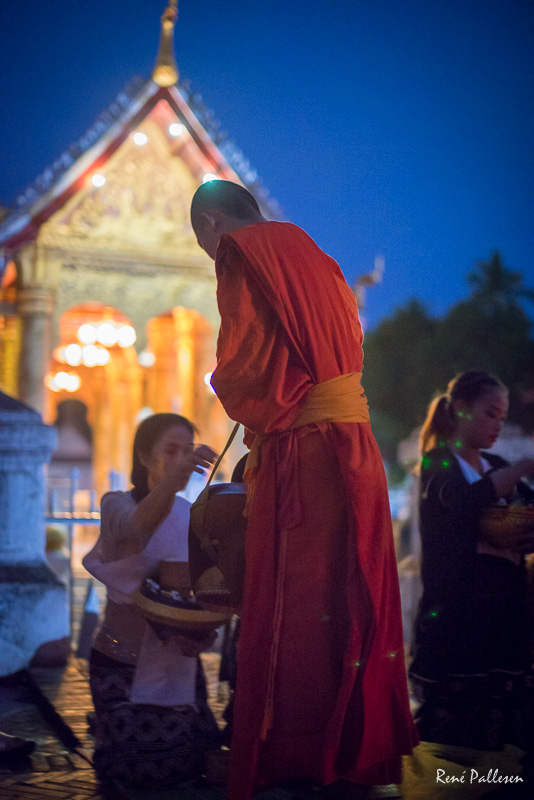


Sacha and I went there a couple of mornings, but because of the time of the year everything was dark and because the monks move quite fast through the streets it was a challenge getting good shots.


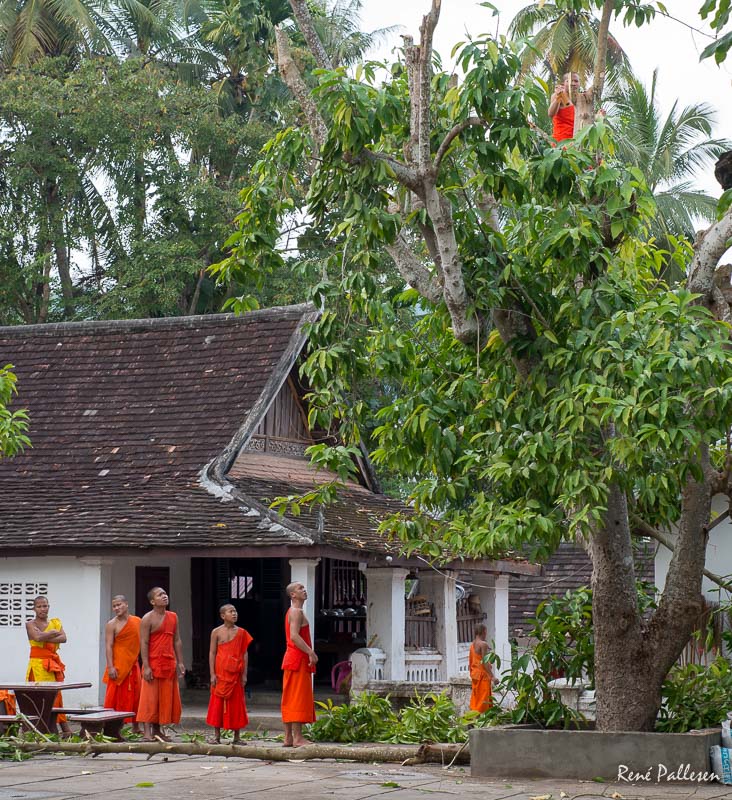
One afternoon we walked past a temple and a group of monks were in progress of cutting down a large tree and afterwards trimming off the branches. They were going to use some of the tree trunk for traditional drums and the rest for ornamental purposes inside the temple.


In the late afternoons you would hear them chanting in the small rooms of meditations, chanting and prayer. These are often smaller places of worship and not part of the main temples which are used for more ceremonial purposes.
One evening I heard such chanting and went to investigate and found these monks. Definitely one of my favourite moments in Luang Prabang.


A common assumption and misconception is that the monks live by an ancient code with a simple life, so it is quite interesting to see that even they have adopted modern technology with smart phones and cameras.


11. February 2018 22:03
by Rene Pallesen
0 Comments

Locals transport - Laos

11. February 2018 22:03 by Rene Pallesen | 0 Comments

The locals are still relying on motorbikes to get around. They are far cheaper and more convenient i
The locals are still relying on motorbikes to get around. They are far cheaper and more convenient in the towns. It is even possible to fit an entire family onto a single motorbike.


Younger kids and high schoolers ride their push bikes for transport.


Although Aiden and the other kids definitely preferred the motor bikes.


Nothing too flash for weddings - a normal new car will suffice. If you notice the sign on the door, then I am not sure if the bride was expecting to come home to 'Meat & Sausage'.


There are also some vintage cars around which have survived since colonial times - like this 1952 Citroen.

Perfect Moments Photography | A Rene Pallesen Journal

Home

24. April 2026 16:04
by Rene Pallesen
0 Comments

China 2026 Guangzhou

24. April 2026 16:04 by Rene Pallesen | 0 Comments

First Shamian Island in GuangzhouThen sight seeingDinner with one of Kims friends at exclusive priva
Guangzhou was our gateway into China — just the four of us: Rene, Kim, Aiden and Lucas.

Arriving into Guangzhou, the sheer size hits you first. This isn’t just a big city — it’s a sprawling megacity built on more than 2,000 years of history, now layered with relentless modern growth. Yet it is super clean everywhere and despite all the traffic it is super quiet due to everyone driving electric bikes and cars.

First stop in the morning was Shamian Island. Walking onto Shamian Island feels like stepping into Europe. Tree-lined streets, colonial mansions, quiet cafés — it couldn’t be more different from the rest of the city.

But this place carries a complicated history. After the Opium Wars in the 19th century, this small island was carved out and divided between British and French control, becoming a foreign enclave in China.

What remains today is a fascinating blend of cultures — European architecture, Chinese life, and a sense of calm that feels almost surreal in a city like this.

For us, it was one of those rare travel moments where everything slows down. The boys could wander, Kim could soak in the atmosphere, and I found myself drawn to the history that I have read about in numerous books.


It’s easy to be distracted by Guangzhou’s scale — the towers, the traffic, the constant movement — but the real character of the city reveals itself when you step off the main roads and into the narrow alleyways.

These laneways are where life compresses.

The streets tighten, the noise softens into something more human, and suddenly you’re walking through someone’s everyday world. Open doorways reveal small kitchens in full swing, laundry hangs overhead like a patchwork sky, and scooters squeeze past with barely enough room to spare.

This is where Guangzhou slows down.

We wandered without much of a plan, turning corners simply because they looked interesting. The boys quickly realised this was a different kind of exploring — not landmarks, but observation. Small moments. A nod from a local, a curious glance, someone going about their day completely unfazed by four outsiders passing through.

For me, this was where the camera came alive. Not because of anything grand, but because of the texture — worn walls, layered history, faces that told stories without words.


Not far from the bustle of the city, we found ourselves wandering into the area around the Guangdong Cantonese Opera Museum — and it turned out to be one of the most unexpectedly fascinating parts of Guangzhou.

The museum itself is beautifully designed, built in the style of traditional Lingnan architecture, with ornate roofs, carved woodwork, and peaceful courtyards. But what really drew us in wasn’t just the building — it was what was happening around it.

Locals were gathering, dressed in elaborate Cantonese opera costumes — vibrant silks, intricate embroidery, and dramatic makeup. Some were performers, others simply enthusiasts, but all of them carried a quiet pride in what they were part of.

What made it so compelling was how natural it all felt.

People were chatting, adjusting costumes, helping each other prepare, and taking photos — not for tourists, but for themselves. It wasn’t staged or curated. It was a living tradition, still very much part of everyday culture.

Cantonese opera has deep roots in southern China, blending music, storytelling, martial arts, and symbolism into a highly stylised art form that dates back hundreds of years. And here, in this small pocket of Guangzhou, it wasn’t something preserved behind glass — it was still alive.


Beyond the main roads, the city unfolds through a rhythm of small shops and daily rituals. Narrow storefronts spill out onto the pavement — fruit stacked in careful pyramids, hardware stores packed floor to ceiling, tiny eateries with a handful of stools and a constant flow of regulars. There’s no clear boundary between business and street; everything blends together into one continuous, living space.


And then, almost quietly, you start to notice them — the bronze statues.

They’re scattered throughout the city, often without fanfare. A fisherman hauling in a net. A street vendor mid-sale. Children playing. Scenes from another time, frozen in metal but placed right in the middle of modern Guangzhou.

They’re easy to walk past if you’re not paying attention.

But once you notice them, they change the way you see the city.

These aren’t grand monuments to emperors or victories — they’re tributes to everyday life. They reflect the trading roots of Guangzhou, once one of China’s most important ports and the starting point of the Maritime Silk Road. For centuries, this was a city defined by commerce, movement, and connection to the outside world.

And those stories are still here — just told in quieter ways.


One evening in Guangzhou took a different turn.

Kim had arranged to meet an old colleague, and instead of the street-side eateries and small local restaurants we’d been exploring, we were taken somewhere altogether more elaborate.

From the outside, it didn’t immediately give much away. But once inside, the scale revealed itself.

The restaurant unfolded like a maze — long corridors branching into more corridors, each lined with private dining rooms hidden behind heavy doors. It felt less like a restaurant and more like a series of discreet, self-contained worlds. Every group tucked away in their own space, out of sight, out of earshot.

You couldn’t help but wonder what kinds of conversations these rooms had hosted over time. Business deals, family negotiations, celebrations, quiet discussions — the kind of interactions that are never meant to spill into the public space.

There’s a long tradition of private dining in China, especially in cities like Guangzhou where relationships — guanxi — are central to both business and social life. Meals aren’t just about food; they’re about trust, hierarchy, and connection. And spaces like this are designed for exactly that.

For us, it felt like stepping briefly into that world.

The food itself was exceptional — beautifully presented, carefully paced, and clearly designed to impress. But interestingly, it wasn’t the local Cantonese street-style cuisine we’d been expecting. This was something more refined, more international in influence, almost curated to suit a different kind of audience.

For the boys, the novelty was in the setting — their own private room, the formality of it all. For Kim, it was a chance to reconnect. And for me, it was the atmosphere that lingered — the sense that behind every closed door, a different story was unfolding.

It was a completely different side of Guangzhou.

Not the chaotic, open, street-level city we’d come to know — but something quieter, more controlled, and in its own way, just as revealing.


After dinner, we stepped back out into the night and made our way down to the river, drawn by the glow of the Canton Tower rising in the distance.

If the restaurant had felt enclosed and hidden, this was the complete opposite.

The Pearl River opens everything up. Wide promenades, open air, and a steady flow of people out enjoying the evening — families, couples, groups of friends, all moving at a slower, more relaxed pace than the daytime rush.

And then there’s the tower.

Up close, the Canton Tower doesn’t just dominate the skyline — it feels almost unreal. Its twisting structure is lit in shifting colours, constantly changing, reflecting off the river below. Boats drift past, their own lights adding to the scene, and the whole area takes on a slightly surreal, almost cinematic feel.

The boys were immediately drawn to the energy of it — the lights, the movement, the scale. For them, this was Guangzhou at its most exciting.

The Pearl River has been the lifeblood of Guangzhou for centuries — the reason the city became one of China’s most important trading ports, connecting it to the outside world long before the skyscrapers arrived.

Now, instead of trading ships, it’s light shows and river cruises.


Somewhere in the middle of Guangzhou’s busy streets, we stumbled across something completely unexpected — and for Lucas, it may well have been the highlight of the entire city.

A shop where everything looked like it belonged in a museum… but was made entirely of chocolate.

Not just small displays or decorative pieces, but full-scale creations. Life-sized animals stood frozen mid-step — elephants, giraffes, creatures you’d expect to find on the African savannah, not in a shop in southern China. Alongside them were intricate replicas of local architecture, temples and buildings recreated in astonishing detail, all in chocolate.

At first, it didn’t quite register. The level of craftsmanship made it hard to believe it wasn’t carved wood or painted resin. But the closer you looked, the more surreal it became — every surface, every texture, every tiny detail… chocolate.

Lucas was completely in his element.

You could see the internal conflict playing out — admiration versus appetite. Was this something to photograph, or something to eat? (The answer, unfortunately, was mostly the former.)


5. February 2026 16:02
by Rene Pallesen
0 Comments

Cook Islands - Snorkeling

5. February 2026 16:02 by Rene Pallesen | 0 Comments

We went snorkeling in the lagoon


5. February 2026 16:02
by Rene Pallesen
0 Comments

Cook Islands - Long Boat

5. February 2026 16:02 by Rene Pallesen | 0 Comments

On a rainy afternoon we went in a longboat. The idiot at the back almost got all of us killed by hav
On a rainy afternoon we went in a longboat. The idiot at the back almost got all of us killed by having no idea how to steer (that was his one job) and landed us on the outer reef.


5. February 2026 16:02
by Rene Pallesen
0 Comments

Cook Island - Turtles

5. February 2026 16:02 by Rene Pallesen | 0 Comments

One day we went snorkeling with the turtles in the lagoon.


5. February 2026 16:02
by Rene Pallesen
0 Comments

Cook Islands - Boys at Black Rock Beach

5. February 2026 16:02 by Rene Pallesen | 0 Comments

I also took some photos of the boys at Black Rock Beach.


5. February 2026 15:02
by Rene Pallesen
0 Comments

Cook Islands 2026

5. February 2026 15:02 by Rene Pallesen | 0 Comments

This year we decided to travel to Rarotonga in Cook Islands. Some of the immediate family booked at

This year we decided to travel to Rarotonga in Cook Islands. Some of the immediate family booked at the same time so that we 
had some days together.


5. February 2026 15:02
by Rene Pallesen
0 Comments

Cook Islands - dogs and other animals

5. February 2026 15:02 by Rene Pallesen | 0 Comments

The islands have a lot of very friendly dogs. A lot of them are unique that they are large dogs with
The islands have a lot of very friendly dogs. A lot of them are unique that they are large dogs with very short legs.

They are also able to feed themselves by catching and eating fish in the lagoon. There are also a lot of chicken (especially roosters) on the island.


5. February 2026 15:02
by Rene Pallesen
0 Comments

Cook Islands - Games

5. February 2026 15:02 by Rene Pallesen | 0 Comments

Other times were spent playing games - Dark, Snooker Fuzball, building cairns and chasing crabs.