Home

14. November 2004 11:03
by Rene Pallesen
0 Comments

Egypt - Pallesen Family Holiday 2004

14. November 2004 11:03 by Rene Pallesen | 0 Comments

egypt pallesen family holiday 2004
Egypt - Pallesen Family Holiday 2004

~ Travel Journal ~

Read about our journey with links to an amazing photo gallery


~ Photo Gallery ~

What We are All in Egypt for

The Sphinx
~ Half Man Half Lion
~
Saqqara's Step Pyramid
Valley of the Kings
Pyramids of Giza
Kheop's Pyramid
~ the Largest Pyramid ~
Khefren's Pyramid
Aswan Dam
Memphis
~ Capital of Ancient Egypt ~
The Unfinished Obelisk


Temples

Karnak
~ 120-metre Columns ~

Hatshepsut in a Cliff
Horus
~ Greek "Egyptian" Temple ~
Philae - the Island Temple
Kom Ombo
Crocodile Mummies
Luxor


The People Way of Life

Streets of Luxor
Khan Al-Khalili
~ an Egyptian Bazaar ~
Horses


The Pallesen Family

Bedstemor's Fest
Egyptian "Italian" Dinner
Coffee-shop

On the Roof-top

In Cairo


The Nile

On the Boat
Felucca on the Nile
Tomb of Nobles


Egyptian Sunset


Things to Buy

Papyrus
Perfumery
Alabaster


Other Places We Saw


The Citadel in Cairo

Lunch on the Nile


Created: 8 Jan 2005Last Updated: 24-Jan-2005

14. November 2004 11:02
by Rene Pallesen
0 Comments

Bedstemor's 85th Birthday ( 13 - 20 Nov 2004 )

14. November 2004 11:02 by Rene Pallesen | 0 Comments

bedstemor s 85th birthday 13 20 nov 2004
Bedstemor's 85th Birthday ( 13 - 20 Nov 2004 )


Ancient Egyptian stories and legends have long made their mark through movies such as "Cleopatra", "The Mummy" and wowed us women with Omar Sharif's performance in "Lawrence of Arabia" and "Doctor Zhivago" and more recently in cartoons such as "The Prince of Egypt". There is a certain mystic about middle east portrayed to us from a very young age when we hear bedtime tales like "Ali Baba the 40 Thieves" or "Sinbad the Sailor" - most of us have a dream of seeing the pyramids.

I was very lucky to have the opportunity 20 years ago to come to Egypt with my parents and at 10 years old, there's only so much a child can remember. But this year, the Pallesen Family once again get together for the Matriach's 85th birthday. It is tradition for the family to come together and travel to an exotic country - in the past Tunisia, Morocco, Gambia and for Grandmother's last wish, to see the pyramids of Egypt, that her husband saw 45 years earlier.

The Matriach's three children, six grandchildren (Nikolai could not make it), four greatgrandchildren and respective spouses all came together for a week in magical Egypt. It is autumn with warm days and cool nights - a contrast to the approaching winter in Denmark.


Saturday 13 November 2004
Departure for Egypt

Our family had to leave Falster at 2:30am to catch a 6:30 flight, 4½hr later we arrived at Cairo Airport. I have dim memories of a very warm airport in complete chaos, with people pushing to get their luggage through, shouting over a mad din. Instead we found a rather clean and uncrowded airport. We were met by the AB Travel Agency representative, taken to a Hotel Pyramisa, left in a closed piano barPallesen familie venter på værelser and promptly forgotten until one of us had the bright idea to ask for our keys.

Our family shared a two-bedroom hotel room with a large living area. Our first afternoon was spent walking around the streets of Cairo trying to find a place for the family to have dinner. Our hotel was located across the river from downtown Cairo, so there was not a lot to see, combined with the fact that many shops were closed during the day over Ramadan, the Islamic period of fasting from dawn to dusk. Sunday heralded the last day of Ramadan, so many were preparing for the final feast.

In the end, the whole family had dinner in the hotel's "Oriental" restaurant of Egyptian style. We figured we would get some decent Egyptian food but were disappointed to find most of our food luke-warm. The rice was very dry, little meat on the lamb and rather bland food. To our surprise, after our comment about this, we were presented with a complimentary platter of fruits native to Egypt such as fresh dates and guava. To our amusement, no matter what kind of Egyptian wine we ordered, they all tasted the same. There was plenty of Egyptian beer and of course the danes lived up to their drinking prowess and Bedstemor ("grandmother") treated us all dinner.


Sunday 14. november 2004

On the first night we didn't sleep very well - sleeping in a different bed combined with quranic prayers coming from a nearby mosque didn't exactly leave us with a peaceful sleep. However we were all up early to get together in Bedstemor's room for a "surprise" get-together - to sing the danish birthday song amongst a flutter of red white flags, and present her with a small gift. This family "surprises" the birthdayee and all sing in unison this rather cute birthday song.

The Citadel Muhammad Ali Mosque

Udsigten fra CitadelletOur first destination was the Citadel. It is the city's fortress that once housed the royal family and although most of the complex is open to visitors, the military still have a foothold and some areas are out of bounds. It takes a half day to explore all areas of the Citadel but we didn't have the opportunity to do so, and instead spent most of our time in the Muhammad Ali Mosque.

<== There is a magnificent view of the city from the Western Terraces - magnificent had most of Cairo not been filled with the same shade of mud-bricked buildings. What was most notable about Cairo was its lack of colour or rather its ability to blend into the desert.

Mohammed Ali MosqueOur guide Adam/Mohammed provided little insight to the function or history of the Citadel, and instead sat the group in one corner of the Muhammad Ali Mosque like a bunch of school children, and gave a lecture on Islamic laws and behaviour.

When René ventured to ask more about the Citadel, he was scolded for interrupting and told to listen. We never got the opportunity to find the number 7 Napoleon's troops had painted above one doorway to avoid using the unfamiliar Arabic names or the twin half-round towers because our guide simply didn't know where they were.

Ind i Mohammed Ali Mosque


During this time, I had the opportunity to wander off and walk the beautiful alabaster-lined arcades of the mosque. the soaring central prayer hall was a glimmer of hundreds of lights hanging in concentric circles. Arabic inscriptions in gold were painted on the ceiling. Women had to be suitably attired and could not wear sleeveless tops or short skirts or shorts. In one corner lay the sarcophagus of Muhammad Ali - the builder of the mosque and an albanian mercenary who was the founder of the dynasty that ruled till the revolution in 1952.

Cairo Egyptian Museum

I have memories of wandering around this museum, peering into smudged glass cases, staring into the shrivelled faces of some once well-known pharaoh like Ramses II and wondering if the ancient Egyptians were giants in their large coffins.
20 years later, it was almost impossible to push through the crowds of tourists - only useful because their guides provided more information than ours. With only two hours, there was no way that we could view the whole museum or see the royal mummies.
The museum was celebrating its centenary and there was a special exhibition dedicated to TutAnkhAmun - the most famous archaeological find. With travel guide in hand, we oohed and ahhed over the gold treasures found in his tomb - a gold throne featuring the famous scene of TutAnkhAmun's queen anointing him, chests made out of ebony ivory, cheetah-skinned hunting shields, bows, arrows, alabaster canopic jars holding King Tut's mummified organs, gold sarcophagus - if Howard Carter had found such treasures for a little known boy-king, imagine what the tomb of a pharaoh like Ramses II would have been like? King Tut's inner coffin of solid gold and the famous mask of gold that everyone wants to see and is portrayed in many egyptian images.
The museum has become another money-making expedition for the Egyptians with an exhorbitant price to view the royal mummies. We had to content ourselves with the animal mummies - cats, dogs, birds, goats, Nile perch (yes, fish as well!) and most amazing was a 7-metre crocodile mummy.
The exhibitions were arranged by themes on the upper floor and chronological on the lower floor, going clockwise from the Old Kingdom, to the Middle and finally to the New and later kingdoms. There were rooms full of giant sarcophagi that would've weighed a tonne each, a room full of miniatures showing the egyptians' daily lives, a room full of ancient papyrus long faded and rooms full of bits and pieces from ruins, statues, palace floors - a place where one needs a days to spend with a decent travel guide.


Khan Al-Khalili

På gaderne af Ægypts største bazar, Khan Al KhaliliAfter a stop at an egyptian perfumery and some lunch, we headed to Khan Al-Khalili - the oldest bazaar in Egypt that has lasted since the 1300s. Ancient buyers visited the khan for goods brought in on merchant caravans. No longer do we find slaves, silk, jewels or diamonds, but wooden guitars, brightly patched pouffe covers, clothes, t-shirts, crappy papyrus paintings, bongs/water pipes, bright bolts of cloth, the aroma of spices is very much present and stalls are heaped with bright red, gold and blue powders and sacks of seeds pods. Coppersmiths hammer out platters, tureens, coffeepots and enormous crescent-shaped tops for minarets. It is a ritual of the bazaar to expect to bargain - locals or foreign visitors - usually a 10th of the offer price - if you have paid a third, you have paid too much. We had only an hour to spare but many of the shops were closed for a siesta after lunch. Ulla I pointed to bags of multicoloured spices. He wanted £50 (AUD$10, 50DK.Kr) and after I said "da ketir awi" (it costs too much) and walked away, the shopkeeper doggedly followed us for a kilometre reducing the price from £40 to £30, £25, £20 and after we shouted £10 in jest, he offered £15, £10 and finally £5 before finally giving up on us. After much haggling, we managed to bargain for two ornate glass perfume bottles for £20 (AUD$2.50; 20DK.Kr)


Bedstemor's Birthday Feast

Bedstemors festIrene Ole had organised a private room for Bedstemor's birthday party. A single long table in a room of egyptian style. Small silver pots lined in two rows in the middle of the table kept the food warm.

We feasted on cumin-flavoured fried fish, chicken fillets egyptian-style, cinammon-flavoured ravioli, rice, mashed potatoes and beef steaks in pepper sauce, sang and toasted with bottles of egyptian wine and beer to Bedstemor.

Whilst the children played in one corner, there was much chatter througout the table and the evening finished off with chocolate and fruit cakes topped with "Happy Pirthday" (note, it's not an error) and we laughed in amusement in a plethora of egyptian sweets - baklawa, semolina tarts, rose-water flavoured tarts, and tarts that tasted like liquid honey... Ulla almost wanted to take the rest of the desserts with her (except for the rose-water flavoured ones - it was funny to watch her expression - rosewater almost smells like cosmetics). The waiters were extremely attentive, coming by every two minutes to serve us.

Best of all, Bedstemor turned 2 years old, as she blew out each candle on the cakes. As the danes would say, "det var meget hyggeligt!" (it was cozy)


Monday 15. november 2004 (7:30am start)

From the brown buildings and streets of Cairo, we travelled 24km southeast of the city to Saqqara, changing from a uniform brown to lush green fields of large cabbages and hundreds of date palms. It was like an oasis, a gentle mist gave a surreal sense of the fertile plains of ancient Egypt. Women in full-length black abeeyas squatted in the fields, the odd man walking around - such a contrast to the intense crowds of central Cairo.

Saqqara's Step Pyramid

Founded as a necropolis (burial city) for the Old Kingdom and is one of the richest archaeological sites in Egypt.

The Step Pyramid is less that ½ the height of the largest pyramids at Giza, but this monument served as a predecessor of the smooth pyramids. Previously tombs were made of mud brick, rectangular slablike structure covering a burial pit. But the architect Imhotep had the bright idea to construct in stone and Zosers trinpyramide i Sakkarabuild the slablike structure 5 times one on top of the other, creating the first pyramid.

We entered through the Great South Court - the size of a soccer field, down a corridor of 40 pillars inspired by bundles of tied reeds. Whilst Adam was making another one of his speeches, I was tempted by a turbaned egyptian in a dress who took me to the top where I managed to get one shot of the magnificent pillars up top, before being scolded by Adam and being asked for baksheesh (tip). I was gratefully rescued by a couple of Italians when the egyptian would not let me go without a baksheesh. However, once I surfaced from the building, I was blinded by white sands and the immense pyramid sitting solitary amongst a few ruined stones, with a much smaller triangular heap of stones in the background. Although the morning had been cool, the sun soon warmed us up as we wandered round to the north.


Memphis

Ramses II ligger på Memphis' lille museetOnce the capital of ancient Egypt, it remains unexcavated due to villages built on top of it and a high water table as a result of the Aswan Dam. There is a small garden with small finds - bits and pieces but the most exciting thing to see is a colossus of Ramses II lying on his back as the lower legs are missing. The colossus would've been 5 stories high had it been standing. Nearby lies the largest alabaster statue ever found - 80 tons of sphinx - imagine what treasures that could've been found if Memphis could've been excavated, especially as this ancient city lay halfway between Upper and Lower Egypt.


Our final stop before lunch was a papyrus museum - another place of commission for Adam. Bedstemor purchased a papyrus of egyptian alphabets. Some of the paintings cost a massive £3,500 (AUD$900, 3,500DK.Kr). For lunch, we had a splendid egyptian meal in the middle of nowhere that served excellent mezza (egyptian tapas) of baba ghanoush (roasted eggplant dip), tzatziki (cucumber dip), hummus (chickpea dip), fuul (beans) served with freshly made pita bread, warm vine-leaf rolls, lamb kofta and freshly roasted chicken in thyme. It was feast fit for a king and the most egyptian meal we had on the whole trip.


De store fantastiske pyramider i Giza. Her ses vi den største pyramid - Cheops/Khufus pyramidPyramids of Giza

From air the desert pyramids were right on the edge of the city, 16km from Cairo.

I remember vaguely, as a child, hunched over, walking up a surprisingly warm shaft lit by a single light bulbs and emerging into a very chilly dark room that held a single stone sarcophagus, the room empty except for occasional square holes in the wall where food was left for the afterlife.

I had entered the Queen's chamber in the largest pyramid and 20 years later, only the first 300 can enter these pyramids - for an exhorbitant fee.


René står næste pyramiden
The largest of the three, Cheops' pyramid was the largest, standing at 146metres at one point, took 920 metres to walk around it and contained 2.3 million blocks! Each block was at least one metre high, so you can imagine how massive these pyramids were.


Den anden største pyramid - Chephrens pyramid


The 2nd largest, Khefren's (Cheop's son) pyramid still had some of the smooth shiny limestone casing that once used to cover all these pyramids.==>

The massive solar boat that once carried the pharaoh's body from Memphis to Giza and the three smaller Queens' pyramids stood at one corner of the massive Cheop pyramid. We didn't have the opportunity this time to enter the tombs, but I feel priveleged that I did and that I still have some memories of the event.


The Sphinx

SfinxenThe pyramids loomed in the background as it sat silently on the hot sand under the glaring sunlight for 4,000 years. Napoleon's troops once used it for target practice, so its nose and pharaohs beard and long fallen off and lies in a British museum. The Greeks called it "the Sphinx" as it was based on a mystical creature with the head of a man and body of a lion, which would stop any traveller along the way with a riddle - if the riddle wasn't answered, it became the sphinx's dinner. Throngs of crowds surrounded the sphinx and we could only enter in single file. Over time, it seemed that tourists could view it from further and further away. 45 years ago, Bedstefar's (grandfather) could touch the Sphinx and even climb to the top of the pyramid; 20 years ago, it was simply surrounded by a small wire fence but I could stand close up to it; now it lay in a very large pit where visitors could only view it up close if they zoomed in on their cameras. 4 millenia later, it still manages to awe all of us.


Tuesday 16. november 2004 (2:30am start)

Yes, you did read that right - we were all waiting in the lobby at 2:30AM. Last night, Bedstemor's grandchildren treated the family to a Spanish-Egyptian Italian dinner, which was followed by a Familien i en cacophany of tambourines, oboes and drums played for an Egyptian engagement couple in the lobby.

This morning we were flying to Aswan, to board a 3-day cruise up the Nile, sailing up to Luxor. When we arrived, we were taken for a short felucca ride along the Nile with a fantastic view of the Tomb of Nobles. When we returned we were given our rooms onboard a four-storey cruise ship that had an indoor games room, a pool and sundeck at the top. Even from our rooms right at the bottom, we had a magnificent view of a small white mosque-like structure on top of huge sandy mountains dotted with small caves.

In the evening we had the opportunity to visit a small souq (local bazaar) selling t-shirts, papyrus paintings, mounds of saffron and dry scented lotus flowers, brown, red, yellow indigo mounds of fragrant spices - all of which some of us bargained for - the most expensive £25 papyrus painting (AUD$5, 25DK.Kr) to cheapest £15 embroidered t-shirts with hieroglyphics (AUD$3, 15DK.Kr). To top the evening off, we took a £5 horse carriage ride back to the ship.

Den anden papyrus har jeg købt fra bazaren


Wednesday 17. november 2004 (7:30am start)

It seemed some of the family had succumbed to a tummy bug. The rest of us steered clear of unwashed fruit, fresh salads, raw vegetables and drinks made with local water. However, this didn't stop us from going out to see a few sights.

The Unfinished Obelisk


Had this obelisk been completed, it would've been the largest and heaviest ever made standing at 142 metres. It sat in a granite quarry, perfectly complete on three sides but abandoned when a flaw was found in the stone. It is almost impossible to imagine how the ancient egyptians could've moved even a single rock made from this quarry as it stood a great many miles from any of the monuments ever made. Unfortunately for Egypt, most of its obelisks have been spirited to other countries - to Italy, Britain, France and even Argentina by foreign archaeologists in the last centuries. Most of us didn't have the chance to view the complete obelisk before Adam rang a bell that he carried (to annoy us I suppose)

Den ufuldendte ObeliskDe meste familier kom ikke så langt til her


High Dam

For centuries the Nile controlled the Egyptians' lives - either flooding or insufficient water levels were disastrous for the people who relied on this huge water source for their livelihood. When the Aswan Dam was built, some of the villages in the south lost their water supply.

30 years ago, a new High Dam was built which resulted in the man-made Lake Nasser to the south being created ==>

This meant many people had to be moved as villages were buried, as well as some of the ancient egyptian monuments such as the Temple of Philae.


Aswan dæmningAt its highest point, the High Dam stands at 111m high, 3.8km long and 980m wide at the base.

Three times the number of stones used for Cheops' Pyramid was used.

Videoing isn't allowed as it is a high-security military area - should there be an attack on this Dam, then much of Egypt would be submerged under water and would be a disaster for the country.


Given only 10min, Adam "rang" us back to the bus.


Temple of Philae

Vi sejler til Philae templetAfter Aswan Dam, the Temple of Philae was submerged for six months a year and tourists had to view it through the murky waters of Lake Philae. When the High Dam was built, it threatened to submerge the Temple permanently, so was moved stone by stone to a new island similarly landscaped. Philae is special in that it's only accessible by boat and the sunset forms a spectactular backdrop. A temple dedicated to Isis (goddess of women, sex purity), it was one of the last outposes for paganism and due to the popularity of Isis, was also used by the early Christians. The Temple walls and many pillars were filled from top to bottom with hieroglyphs and images of Isis - many defaced by the early Christians who considered ancient Egypt's gods to be "pagan". I had a fantastic afternoon walking in and out of all the nook and crannies - visiting the Birth House, Nilometer, the "Pharaoh's Bedstead" and much to the amusement of the family, I was the last to emerge.


Kom Ombo templet i aftenKom Ombo

The ship set sail from Aswan at 3:45pm after an afternoon spent sunbaking and drinking beer (typically danish to make the most of sunshine and beer). We were sailing 48km north of Aswan to Kom Ombo - the site of an ancient city devoted to the worship of a crocodile god, Sobek. The ancient city is long gone and crocodiles existing on nearby sandbanks have been hunted to extinction.

At sunset, we visited the Temple of Kom Ombo, dedicated to both Sobek the Crocodile god and Horus, the falcon-headed sky god Isis' son. Although we didn't have the opportunity to explore this 2 crocodil mumie på Kom Ombo templetemple, it was both spectacular and eerie at sunset, with large light illuminating it. There existed a pit filled with water, with a platform halfway down, where crocodiles were lured in from the Nile with human flesh, and the largest crocodile was caught and mummified as a tribute to Sobek. At the Chapel of Hathor (Horus' wife), an American shouted "Geez, I thought I was supposed to see crocodile statues!" *laugh* It contained two of the mummified crocodiles found at the Temple.

We returned to a small cocktail party before dinner, provided by the ship to introduce all the staff responsible for making our trip enjoyable.


Thursday 18. november 2004 (7am start)

We sailed overnight past Kom Ombo to Edfu, a small regional center for the sugarcane trade, visited the Temple of Horus and sailed on to the Lock-crossing at Esna.

Temple of Horus

Den smukke Horus temple i EdfuThis is the most complete of its kind, a Greco-Roman temple that conforms exactly to ancient egyptian principles of architecture ie visit Edfu to see what almost every other temple in Egypt would've looked like in its original form. We were awed by the massive walls of the pylons at the entrance, distince reliefs showing mirror images of Horus and the pharaoh grasping the hair of his enemies. It was built by Cleopatra's father around 50yr BC. Standing in the forecourt of this well-preserved temple we can see mud-brick houses lined up at the top of the compound walls because this temple was once buried right up to the ceiling with a village built on top of it. Many of the temple relifes capture the cataclysmic battle of Horus with his brother Seth. We entered a small Nilometer - a dark, dank tunnel that smelled of pee and was once used to measure the level of the Nile. Again I was the last to emerge (a couple of minutes late only) to the loud applause of everyone (and a huge glare from Adam).


Fra vort skib på NilenReturning to the ship in time for the 9am sail, we set off for Esna, 48km south of Luxor. Whilst the family tanned on the sundeck, I sat in the sun at the front of the boat, enjoying sense of peace and tranquility. It was truly beautiful to sit on a boat not too big or small, to watch the changing scenery on both sides, passed fields of giant palms and lush green fields, a smoking metal, the ship moving at a leisurely 16km/hr and passing some incredibe mountains of sand and cliffs. Ole joined me for a chat - he Irene are moving to Greenland on Tuesday. Later in the morning, I joined René and Ulla by the pool, gossiping about Bedstefar and family resemblances, watching Vinnie's kids and Sebastian splash about the pool, Lonnie, Sarah Birit stripped down to the minimum to get a bit of colour.


En ægyptisk mand ryger vand pibeWe reached Esna and used the few hours to get off the ship and stretch our legs after a morning of lazing around the pool. I was itching to walk around Esna, away from tourists and see how the locals lived. René and I headed for the quieter streets avoiding the busy streets around a souq. We were followed by a few children clad in long grey or white robes, who guided and annoyed us. Most of the narrow streets were unpaved, some very muddy and smelling of manure. Skinny, skeletal donkeys balanced again flat wagons, many shy girls waving from the darkness of their doorways or 2nd-level windows, whilst little boys came out to say hello and mill around us. Most houses were simple of mud bricks, with tiny wooden shuttered windows to keep the intense summer heat out. Some had extremely ornate wooden doors, reminiscent of colonial days. Occasional peek in doorways revealed empty mud-lined rooms as most people lived in the upper floors. Eventually René shouted imshee! (go away) as the kids got noisier, more aggressive, pulling on our arms and throwing pebbles at us. When I stumbled over a whimpering black and white disease-ridden puppy in brown paper, it was kicked aside - making me almost reach out for it if René hadn't stopped me.it was wise not to even make contact witht the children, who were dust-covered and clad in the long egyptian grey robes. It was such a relief when they finally left us even though we knew they were hiding in in alleyways watching us wind through the streets. There were goldsmiths glittering with ornate rings, earrings and necklaces; tailors still sewing by hand on the steps of their shop; coffee houses filled with solitary men smoking their water-pipes - their eyes following us down the street. We had spent so much time just sitting around that it was good to get away.

Crossing of the Lo Perfect Moments Photography | A Rene Pallesen Journal

Home

14. November 1999 10:34
by Rene Pallesen
0 Comments

My Grandmother's Birthday ( Morrocco 1999 )

14. November 1999 10:34 by Rene Pallesen | 0 Comments

my grandmother s birthday morrocco 1999


Mon Grandmere

My whole family was in Morocco to celebrate my grandmother's 80th birthday.

This is my grandmother. Even as an 80-year-old woman, I find her pretty cool (you should see some of the pictures I’ve got of her with dark Blues Brothers sunglasses).

(No need to say that the flags are Danish.)

It was a family reunion. We do not all live in the same place, but all of us make this journey as it is one of the few times that we all get together. Unfortunately, there were a few of us who could not make it.

It was important for me to be there it was hard to tell whether the whole family will ever come together again as a large group, as my grandparents are no longer living there.


My brother


My brother, Claus!

Another person I find pretty cool is my brother.

He has not been well in the last few years, but I love him anyway
( Definitely can't do without my big brother )
My


Mum's pretty cool too! She will probably hate me for putting this photo on my homepage. But it is a really nice photo of Mum with a big smile.

She hates the idea of me climbing mountains, but at the same time she bought me a climbing helmet as a Christmas present. She thought it will keep me safer when I am so far off the ground.

Thanks Mum for supporting me.

I also find my dad pretty cool. He’s a bit of a nerd just like me which means that we probably understand each other better than anyone else in the family.

My Dad's brother & his wife


This is my dads brother and his wife. The resemblance is unequalled. My dad and his brother looks very much like each other. They have the same bad habits (just like my grandfather) and both their wives are smoking like chimneys.
Me stuffing myself!


Finally, a picture of me...

I do belong to the family even though most of them have probably forgotten about it by now!

I am sitting outside one of the food places on the local market. We each got a serve of excellent calamari, shrimp and fish. I think this was the best meal I had while I was in Morocco.

Most tourists would avoid a place like this just because of the hygiene, but I have never had diarrhoea because I had been eating local food.

Perhaps all this travelling I do has made me immune to germs and bugs! Or maybe I just pick good food!


Do you want to see my family on a Donkey Day out?
Click Here!


Created: Jan 2000 Last Updated: 16 Sept 2001

15. March 1999 11:00
by Rene Pallesen
0 Comments

Laos

15. March 1999 11:00 by Rene Pallesen | 0 Comments

laos 1999


Laos is not a place one can forget.

One day I would like to go back there again in my travels.

It is a beautiful place with friendly people who welcomed me with open hearts.

It is also a place of sorrow because of war and loss.
Yet the people try to go on with their lives despite the war.
They live in hope and their beliefs keep them going.

There are tribes there who seem unaffected by western influence and change and keep to their tradition after all this time.

I met many children there, some happy, some sad.

I also spent time with a special family and also managed to enjoy the local food.



War . . .


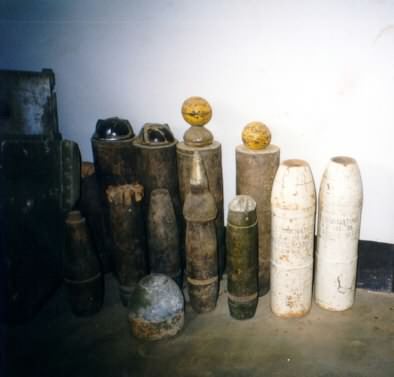
Various types of bombsMore bombs

All the eastern parts of Laos was heavily bombed during the Vietnam War. More bombs were dropped in this area than the number of bombs dropped during the entire Second World War (approximately 10,000 bombs for every citizen of Laos). Laos has the sad reputation of being the most heavily bombed country in the world ...

Ever.

The Ho Chi Min trail went through Laos, and the Americans tried to destroy it with every means. They tried everything from carpet bombing, dropping cases of Budweiser Beer (hoping that the Vietnamese soldiers would get drunk) to dropping washing detergent during the wet season (hoping the trail would get slippery). It is estimated that the Americans only succeeded in stopping 10 percent of the traffic on the trail.


In Vietnam, the Americans were not allowed to bomb within 500 meters from temples and hospitals. Their rules of engagement furthermore said that they were not allowed to return to their home base with a bomb load. The result was that they flew across the border to Laos and dropped all their bombs there. In Laos, there were no rules of engagement. They could bomb whereever they wanted to bomb.
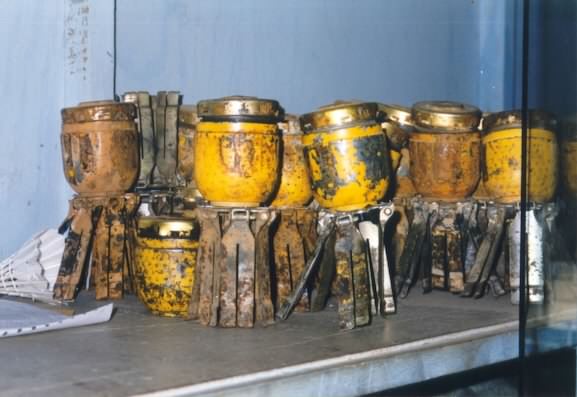
Cluster bombs


This also means that there is quite a large amount of UXO (Unexploded ordnance) in the country. Land mines and unexploded cluster bombs (shown on left) are some of the biggest problems.

In Laos, there are still approximately 4 accidents per day resulting from UXO.

Bombs outside a house


Sad as this may seem, people have been pretty creative about using some of the leftover bombs. In this case they have used a couple of 2000-pound bombs as decoration outside the house.
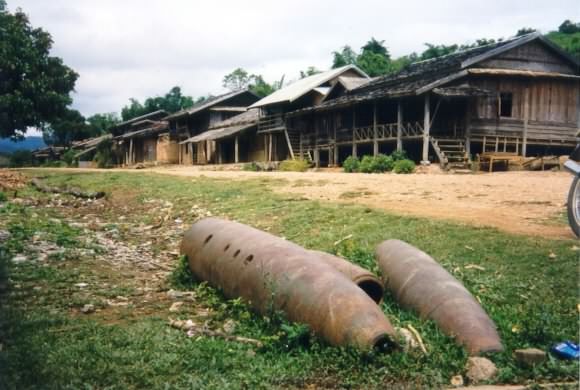
Bombs everywhere


No matter where you go you are reminded of the war.

In all the local villages there are unexploded bombs and shells from the cluster bombs.

Bombs used as scrap metal


A lot of the remains from the war are sold as scrap metal. In this pile there are shells from cluster bombs, wheels from tanks etc. >>>
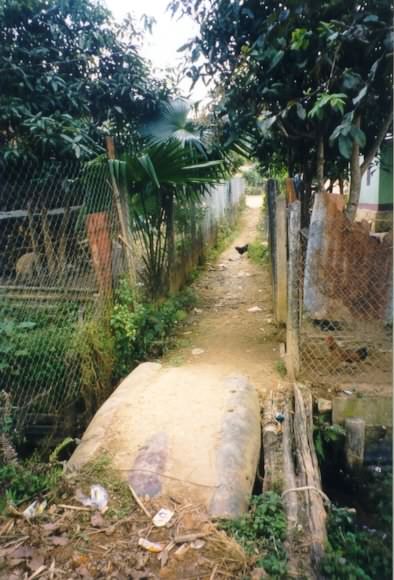

Bridge made from bombs


<<< Shells from the cluster bombs have been used to make this bridge.


Fences made from bombs


Here as fence posts outside a house. >>>
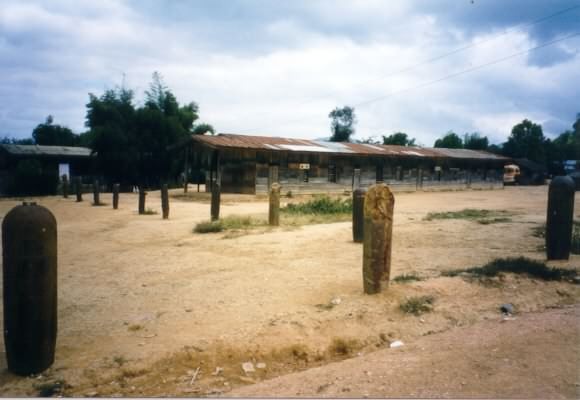
School with bombs


Outside a school, the schoolyard was surrounded by the shells from the American cluster bombs.


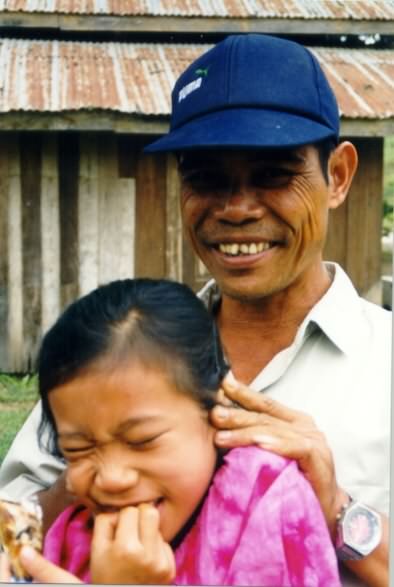
Grandfather  his orphan granddaughterSorrow . . .


This girl's parents were both killed by Hmong guerillas in 1997.

There are still areas where there are lots of problems with guerilla warfare. This is especially the case on Route 7, along the eastern border towards Vietnam and in the western part of Laos west of Vientiane, in the area between the Mekong River and Thailand.

The government is trying to control these problems, but it is difficult with such wast areas of jungle.

Unfortunately such incidents have affected a lot of people. This girl is not the only person in Laos who has lost her family.

Remember that the area has virtually been a permanent warzone since the Vietnam war, until the mid 90’s.

The person behind the girl is her grandfather.
He is now looking after her to make sure that she gets an education

He is after all, her only family left.
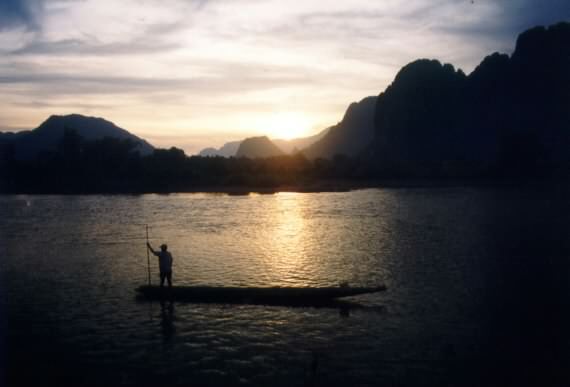


Beautiful SunsetHope . . .


Looking at this beautiful photo, it seems really serene and calm.

You couldn't really tell that things are pretty bad in some parts of the country.

The northern part of Laos is especially poor. The mountainous terrain limits what can be grown. Outdated farming methods using “slash-and-burn” of whole mountainsides are not very appropriate for feeding a growing population. A lot of the western countries are represented in Laos with health care workers. What Laos really needs at the moment is help using more environmentally-friendly farming methods, which at the same time improve the growing of crops. The slash-and-burn method basically means they burn a whole mountainside to grow rice. There is nothing left to hold back the nutrients in the soil, and fertiliser is not added. After a few years there are no more nutrients on this mountainside and they move on to the next mountainside. They need to learn how to grow crops in terraces and add fertiliser from their animals to the soil.
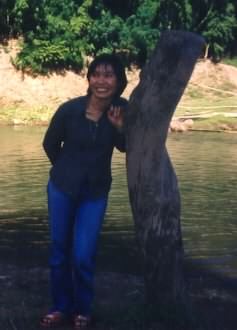

Vinchu - a Red Cross worker

One of the problems with growing rice is that the men are unempleyed most of the year while they are waiting for the rice to grow.

Vinchu is working for the Swiss Red Cross. She intends to buy a piece of land in the 32-kilometre village of Muang Xai, and convert it into a fish farm. This would keep some of the men occupied for most of the year. The profit from the fish farm could be used to take care of the village’s basic needs such as education of the children and buying medicine.

Vinchu is one of the few catholics in the country. She is fluent in English and has had a primary healthcare education. This has enabled her to get a job for one of the foreign representatives in the country, which means she is getting a salary that is considerably higher than what her peers get. Also she gets paid in US dollars instead of kip, the local currency.

On average, the government employed in Laos receives 100.000 kip a month (approx US$30). This is not enough to survive on, so most people have either two jobs or let the wife work as well. Lots of people have small vegetable gardens. This allows them to grow a few things to sell at the markets.
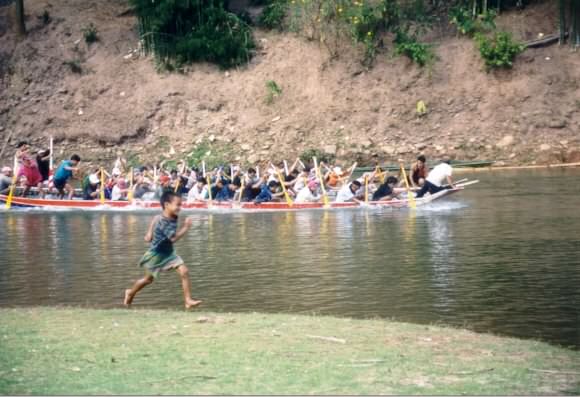

Dragon Boat Race


The employees from the hospital in Muang Xai have not received any money from the government for more than 6 months. The government declared that they should participate in the annual dragon boat race.

Vinchu paid for transportation of the employees to the local river, and other expenses, from her own paycheque.

Most of the people in the boat are doctors and people from the hospital.
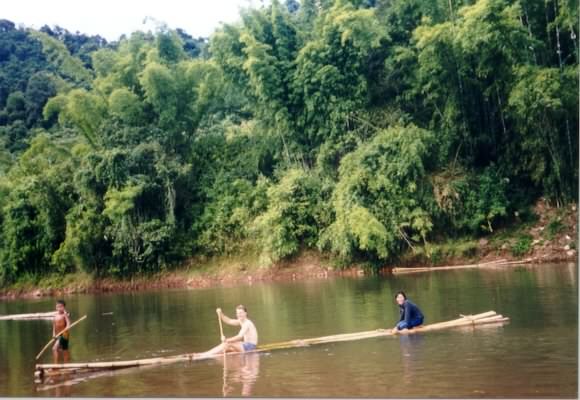


Me in a sailing raft


Vinchu and I in a sailing raft!


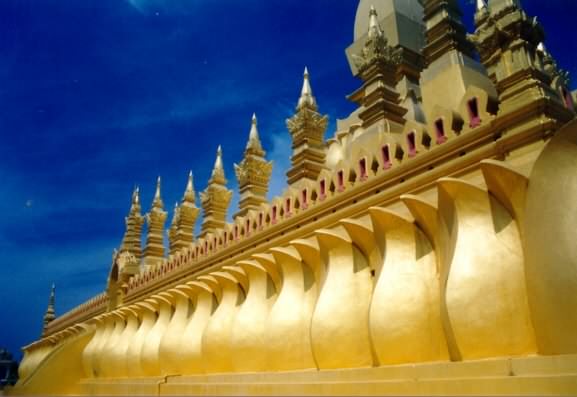
Great Stupa at Vientiene
Religion . . .


Buddhism is a big part of Laos.

The holiest place in Laos is the stupa in Vientiane. There are practically no temples in the eastern part of Laos due to heavy bombardment during the Vietnam War. The only great temples around is the one in Vientiane and Luang Prabang.
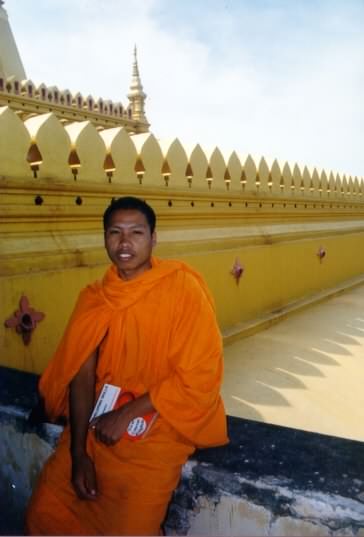

Monk at Great Stupa


The Buddhists in Laos are a bit less extremist than in Thailand. People do not have small alters in their homes, and it is not compulsory for the males to become monks.

In Laos, becoming a monk is voluntary. It is mainly people from the poorer parts of the country that become monks, because it is a good and cheap way to get an education. Some of them are studying English and are therefore very eager to practice their English on the tourists.
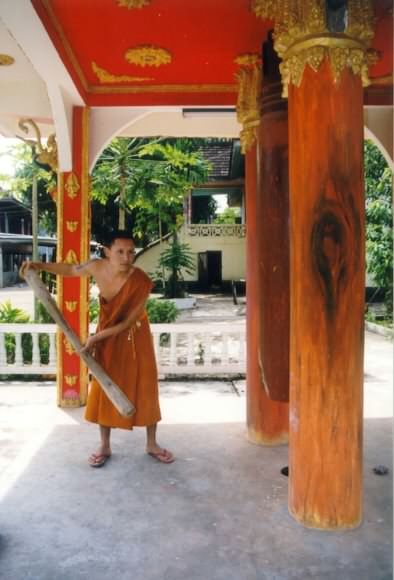
Monk calling for prayer


When they call the monks in for prayer, they either beat a big drum or the use a wooden ram to chime the bell.


Tribes . . .

3 Hmong girls in traditional garb

There are three main tribes in Laos. One of these tribes is called Lao Tsung (or HMong).

They live mainly in the northern part of the country.
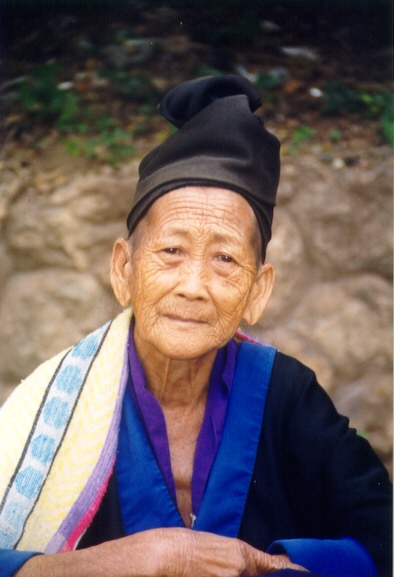
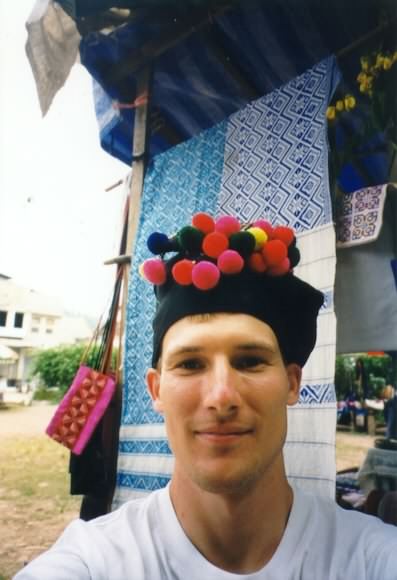
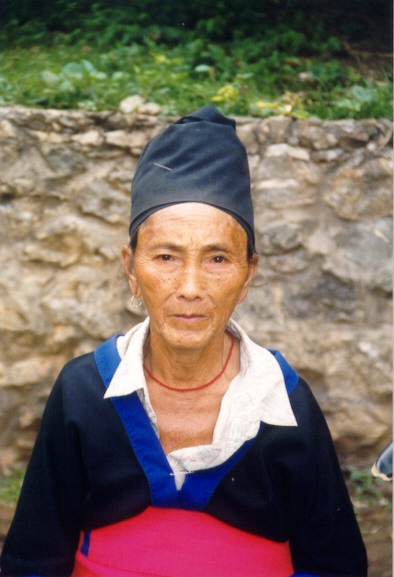
Old Hmong WomanMe wearing a Hmong hatOld Hmong Woman 2

The women still wear traditional clothing. I am wearing a traditional Hmong hat.

A Hmong Woman and I

The Hmong have a dialect that is different from the other tribes. They keep to themselves and are very isolated from the rest of the society.
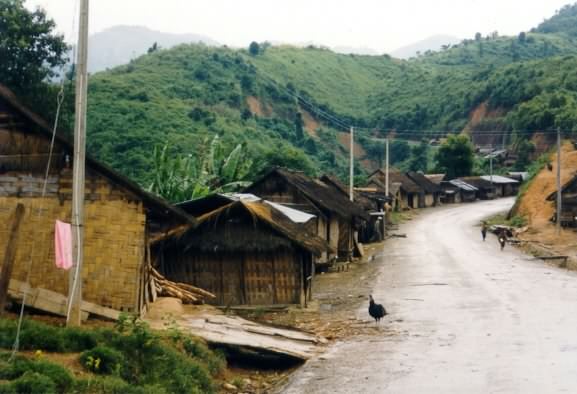
Hmong Village

The difference between the Hmong village and the other villages is that the Hmong build their houses on the ground instead of on stilts.

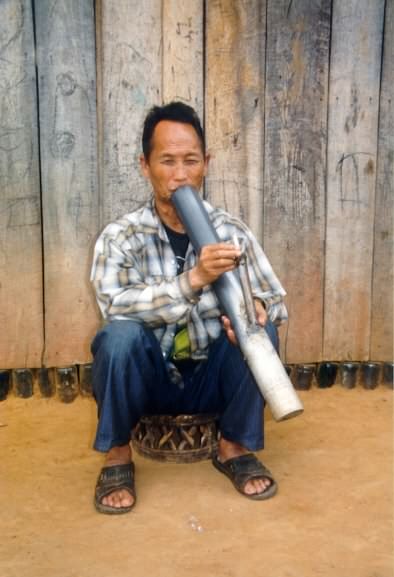
An Opium PortraitMan smoking opium

The Hmong is responsible for most of the opium growing and trading in Laos. The government is trying to stop this trade, but it is difficult as the Hmong live in areas that are not easily accessible.

The Hmong are also responsible for most of the problems in the area around Route 7.


The Children of Laos . . .

The kids in Laos are wonderful. There are always kids around you no matter where you go and they are always very joyful and curious to find out who you are.
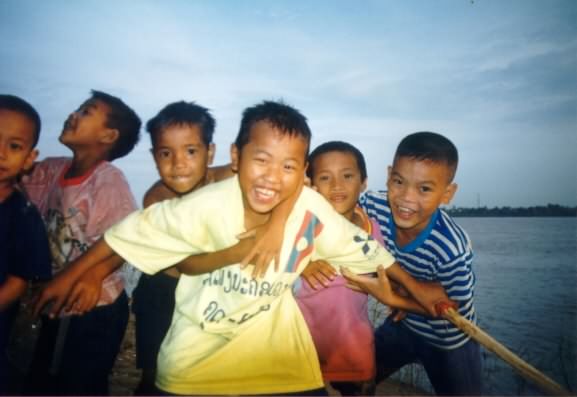
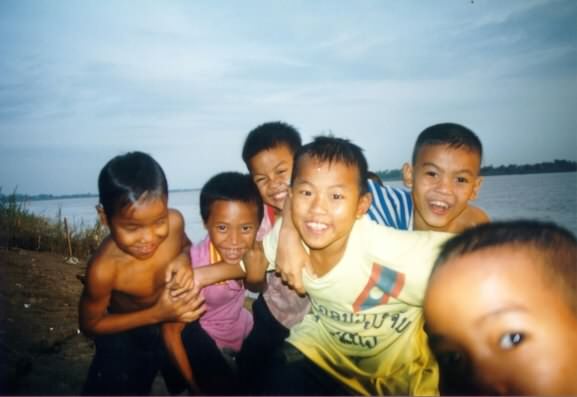
Kids playing by a riverKids playing by a river

You see a lot more kids playing with each other in Laos than in the western world. I guess it also somehow encourages them to grow up being socially responsible. This could be the simple reason why people are so friendly and welcoming in this country.

Lots of people say that it is because of the religion but I believe that it is something more fundamental than that. People in the western world have just forgotten how to be responsible towards each other. Why? Maybe they do not spend enough time in one another's company.
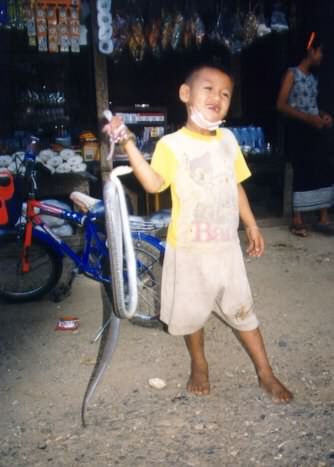
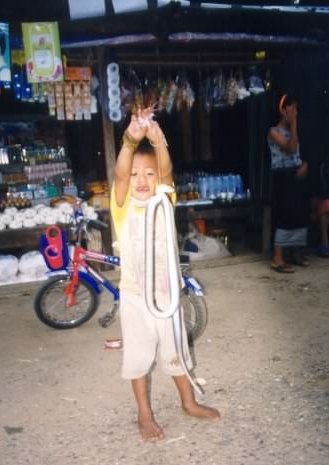
Kid playing snakeKid playing snake

In Vang Vieng, I saw a kid playing around with a snake. It did not seem to bother him or his parents that it might be poisonous.
I don't know if the pad on his chin was caused by the snake. I doubt it though since he had been very sick.

He was pretty proud of his snake.
I am not sure what kind of snake it was. I did see a few other snakes around, especially at the temples.
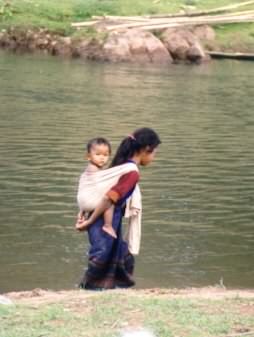
Girl carrying child


It tends to be the elder children’s task to look after their younger brothers and sisters while the parents are busy. The system seems to work fairly well since the whole group of children play together, no matter what their age group. It is therefore not such a big burden as some might think.

The photo was taken approx 40 kilometres north of Muang Xai (where Vinchu was).
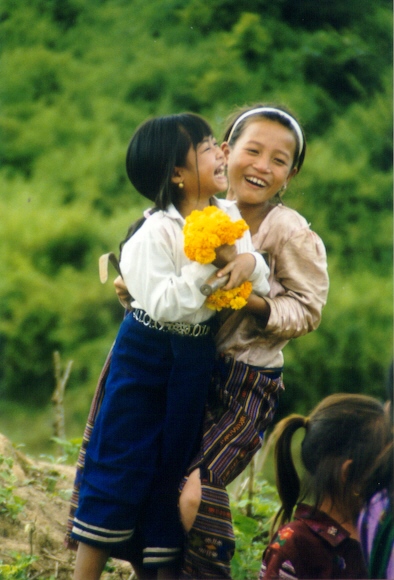
Beautiful flower girls


This photo on the right is one of my favourites.

It was taken in the northern part of Laos, at the 32-kilometer village outside Muang Xai.

The girls were collecting flowers outside one of the local schools.
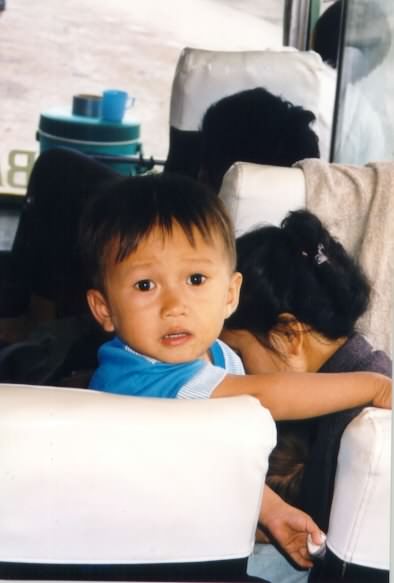
Beautiful flower girls


The younger kids tend to be afraid of Europeans. Most of them have never seen a white face before.

This little fellow here was a bit worried about my presence...
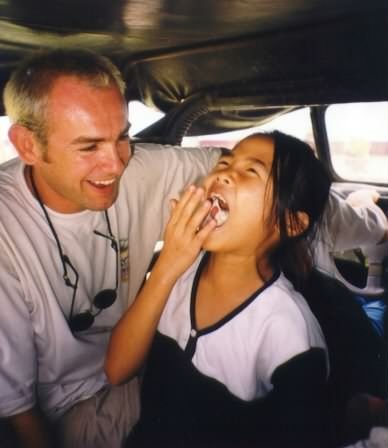
Girl eating chewing gum


This is the girl’s first piece of chewing gum... Pretty interesting to watch! *smile*


In the cities kids love to have their picture taken.
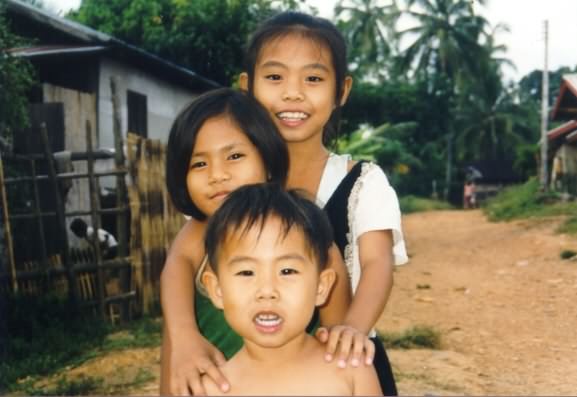
3 kids


Tanoy's mother and friend


The Tanoy Family . . .

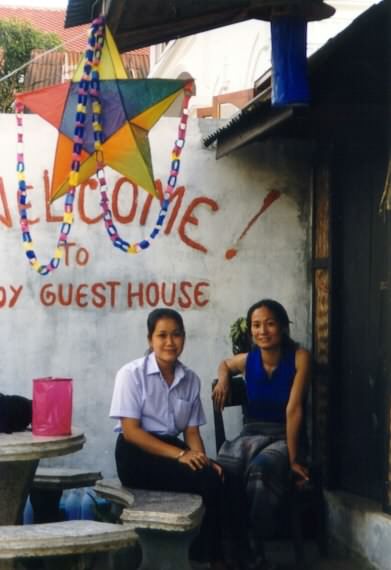
I stayed a few days with a family running the Tanoy Guest house.

The eldest daughter of the place was called Tanoy.

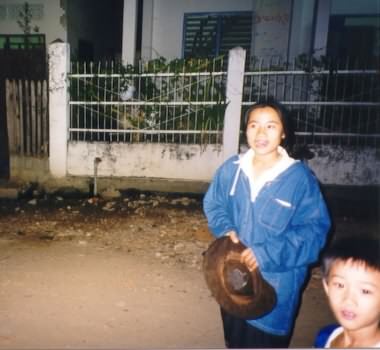
The girl on the left of this photo is one of Tanoy’s friends from school.
The woman on the right is Tanoy's mum. Tanoy’s mum is 40 years old and has had 6 kids. She does not look that old and still looks absolutely stunning.


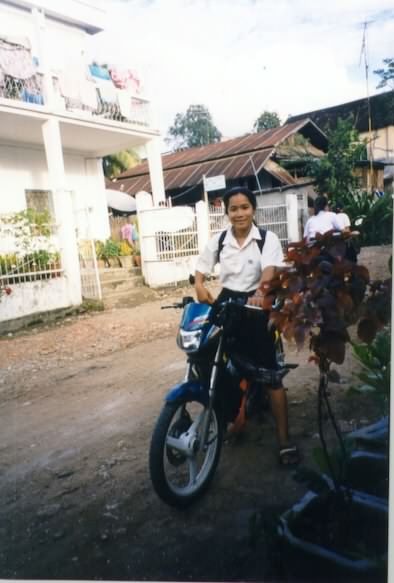
Below are a series of shots of Tanoy herself.

I guess she will one day take over the guest house.


Tanoy herselfTanoyTanoy on scooter

Whilst I was staying at the Tanoy Guest House, I saw the preparations for the annual Water Festival.

Every year when the monsoon ends and Water Festival coincides with the full moon, The festival included Dragon Boat racing.
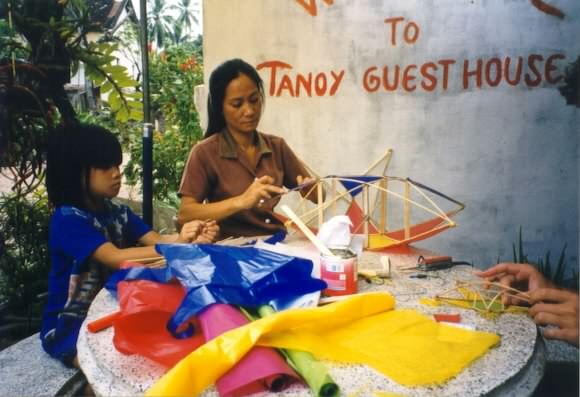
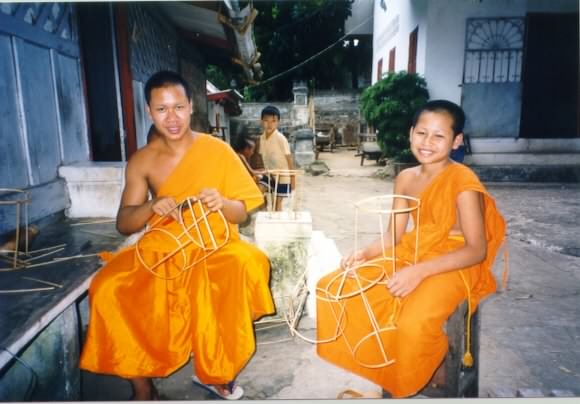
Tanoy's mother making lanterns for the Water FestivalMonks making lanterns for the Water Festival

Everyone was taking part by making lanterns for this festival, including the monks!

All the monks were making lanterns to decorate the temples.

Man drinking already!Party starts!Girl on my shoulders

The festival lasts for three days.

During the festival, they celebrate with all their friends and families. They also drink a lot of “Lao Lao” (or Laos Whisky), which is a kind of rice wine.

Everyone walks down to the river during the day to watch the boat races.

Later in the evening, everyone parties some more and drinks more beer. It does not matter that it is pouring down. The whole village is at the party and everyone is happy.
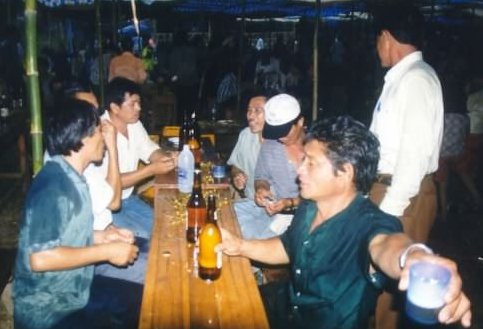
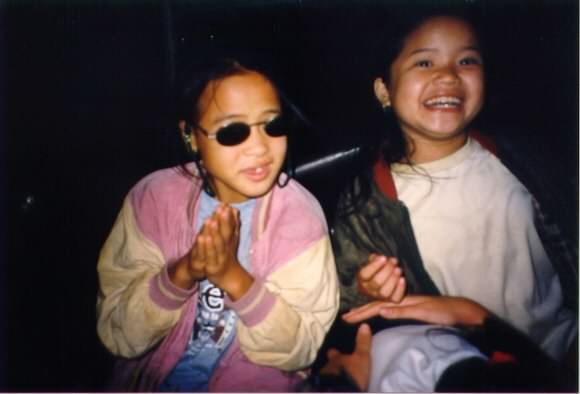
Drinks galore!The kids are also having a good time!

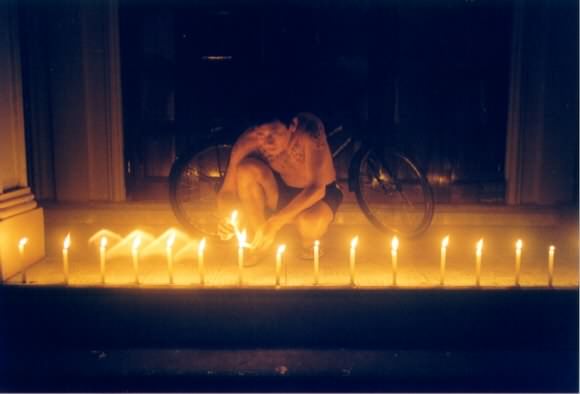
On the night of the festival, people light candles. They also float the candles in the rivers. House lit with candlesMan lighting candles

Unfortunately it was raining a lot that night, so people had difficulties keeping the candles lit.
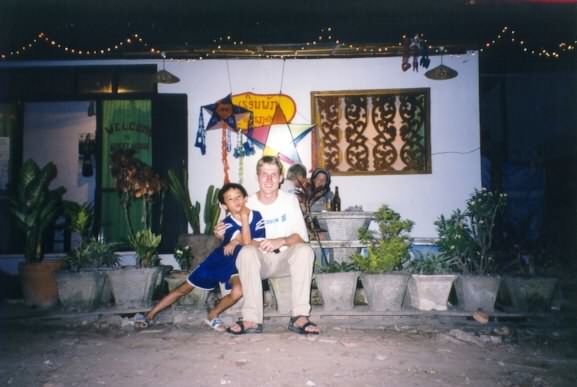
Outside the Tanoy House

At the end of the day, I managed to get a photo of me sitting outside the Tanoy Guest House!


Food . . .
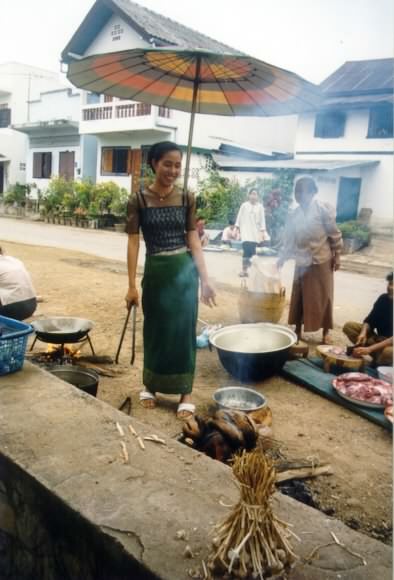
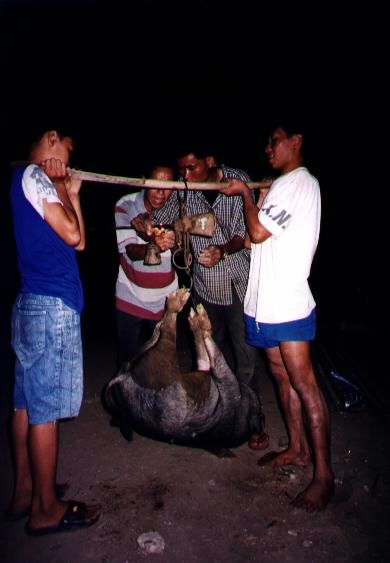
Young woman cookingPig being weighedWater buffalo

The food is excellent in Laos.
It takes some time to get used to eating noodle soup for breakfast, but once you get used to it, it is excellent.

There are pigs and turkeys all over the place. Above is a pig being weighed.

An essential part of farming is the water buffalo - it is important for pulling the heavy plough and there feet are designed to walk in water-logged gxround.

Old woman carrying heavy basketsGirl throwing rice

All ingredients used are very fresh. People are walking around selling vegetables on the streets.

It is hard work getting the rice ready for eating. First the rice is to be pounded to break the husks. Then thrown up in the air to remove the husks from the rice itself.


Created: Jan 2000 Last Updated: 16 Sept 2001

15. March 1999 10:32
by Rene Pallesen
0 Comments

Thailand

15. March 1999 10:32 by Rene Pallesen | 0 Comments

thailand
Statue at Grand Palace
Thailand ( 1999 ) . . .

On my way back from Laos, I stayed in Bangkok for a few days, visiting a friend whom I have known for a long time.

On the right, I am standing in front of a huge statue at the Grand Palace in Bangkok. There are many statues like this, very ornate and detailed. They are brightly coloured and some of them can look scary! As you can see in the background, the architecture and design of the roof is also very detailed and many of these were built a very long time ago by very gifted artists.

Nui


Here is Nui on the left.

She was the girlfriend of one of my friends at University in Denmark. She used to be a lecturer at the University of Bangkok and specialised in software design.

I stayed at her family's house for a few days in the outskirts of Bangkok. It was very nice to get away from all the pollution, noise and chaos of inner city.

You will now be happy to know that Nui has finally married Søren after all these years!

Me on a canal cruise


I am on a canal cruise!

Much of the water near the cities are very polluted, but it is very interesting to see the floating markets in Bangkok - yes, you will see people selling vegetables and meat from little boats...


Created: Jan 2000 Last Updated: 16 Sept 2001

15. March 1999 10:31
by Rene Pallesen
0 Comments

Working in Australia . . .

15. March 1999 10:31 by Rene Pallesen | 0 Comments

work


Dilbert

I can apply a lot of Dilbert's Principles to my work, that is why I always go to the Dilbert website to see what else Dilbert has come up with. More importantly, I thought Dilbert an accurate description of what I do, hence the first think you see on this page is... Dilbert!

The group I worked with at Cochlear

I had the privilege of working as a contractor in the world's leading company in bionic implants, Cochlear. I worked there for 1½ years as the head designer/developer of the software programming the bionic implants. I worked with some of the best developers, and had a lot of fun whilst I was at it.

On the Bridge ClimbOn the Bridge Climb

I had the chance to go on the Harbour Bridge climb, organised by the company. It is quite an expensive trip up over thte top of the bridge and normally would not pay to do it, but had the opportunity to do this with my colleagues. It is very windy up there and the view spectacular. There is quite a lot of people on the bridge climb - average about 10-15 per group, with about 3-5 groups on the bridge at a time. The whole walk from the bottom, to the top and back the other side takes about 2 hours. Many tourists take the opportunity to try out the climb, and I am told that the trip at sunset is spectacular.

Staff at PMP

I took this trip on a Douglas DC-3 (from the 1930-40's) with PMP Software. PMP Software was the company I worked for during the years I was waiting to get my permanent residency in Australia. I had the chance to see this state from an aerial view. There were quite a few Danes working for PMP, and at present, Kenneth is also working for them.


15. June 1998 10:33
by Rene Pallesen
0 Comments

New Zealand South Island 1998

15. June 1998 10:33 by Rene Pallesen | 0 Comments

new zealand south island 1998
Map of New Zealand
New Zealand ( June 1998 ) . . .


My first trip to New Zealand took place in June 1998. I travelled with the Lenehans - friends I have known since my arrival in Australia. This was one of many trips I took with Lance and Anne. We rented a campervan and decided to explore the south island of NZ.

I have since been to New Zealand again - NZ has some of the most beautiful mountains and I had the chance to go there again in January 2001 to do a technical ice-climbing course.

I took so many photos and would have loved to place all of them on this webpage.

Instead, I have selected a few to show some of the places I managed to go to, such as Milford Sound, Nelson, Arthurs Pass and Mt Cook.

There were many glaciers in NZ and lots of seals to go with them!

NZ is a beautiful country with many unusual natural formations. It is a photographer's haven. We ended our trip with a farewell dinner in Christchurch.


Seals . . .

The Lenehans and I decided to spend 2 weeks in New Zealand in the winter of 1998. We flew to Christchurch from Sydney, and drove north to Nelson.

On the way to Nelson, on the east coast of the southern island, there are hundreds of seals. It was a spectacular sight and I managed to get quite close to them to take photos.

SealTired sealWet seal

They did not seem to mind me taking a few photos. Some of the seals look tired - I guess even seals, like humans become tired. Who wouldn't like to pet a seal? They look different when they are wet though.

Anne sitting on stone

This was taken near where the seals were. I like the blend of colours and the harmony of the picture.

A lot of friends have commented on this photo! Most of them really like the photo, and feel there is something calm about it.


Nelson . . .

Nelson is located at the northern most part of the southern island.

We explored the area around Lake Rotoiti.


On the ridgeOn the ridge

These were taken from the ridge itself.

There is a lake at the end of the mountain ridge. From here, it is all downhill. We camped just below the lake at 1,500 metres altitude.

It was snowing the next morning and all water was frozen. We estimated the temperature to be around -7 degrees celcius.


Side of ridgeLenehans  I

The side of the ridge was one big stonefall.

It was very cold and the wind was strong that day so it was necessary to wear gloves hat.

We managed to get a group shot from the top of the ridge. The mountains in the background are knows as the McAngus ridge at Lake Rotoiti. Mountains at Lake Rotoiti

Here are the mountains at Lake Rotoiti.


Morning MistMorning Frost

The mornings are incredibly beautiful at Lake Rotoiti. Here you can see the morning mist floating gently on the water.

It is also very cold here - that is why there is ice on the bridge in the foreground.
Lance  Anne crossing bridge

The photo on the right shows the Lenehans crossing one of the suspension bridges at Lake Rotoiti.

At this point we had walked 15 kilometres, with a 1,000 metre descent. We had yet another 7 to 8 kilometres to go that day!

The Renet

This is what happens when you do not use a tripod. The effect is quiet interesting and makes the photo look like a painting by Monet.

This photo has has been dubbed "The Renet" among my friends.


Ladder at Goat Pass trackArthurs Pass . . .


We drove to Arthurs Pass, on the way from Nelson to Queenstown further south.

There is a place called Goat Pass, and there is only one way in - on foot.

Here, you can see Anne climbing up ladders on the Goat Pass track.

Inside our 'hut'

It was raining so much that we were not able to get down through the canyon on the other side of the Pass. We therefore decided to go back the way we came.

Further down the track, we had passed a bivouak and decided to stay ther during the night. It was very dirty and Anne would rather sleep outside in the rain.

Everything was wet so she changed her mind and came back in. *laugh*

Anne trying to cross a river

She wore plastic bags on her feet, in her boots are so that she could wear her boots without getting cold feet! Aussies will never get used to the cold.

Here is Anne crossing one of the rivers.

Every time she crossed a river, she would sit and massage her feet for 10 minutes until they warm again.

I guess Aussies will never get used to the cold. Neither will Danes for that matter! An Australian winter is like a Danish summer - so you can imagine how cold Denmark is! Still, Danes cannot get used to it - just ask Kenneth or Soeren!

Who's this?

Sleeping ???

Aussies will never learn to live with the cold!

I must admit I hate the cold. I loved it when I lived in Kenya - so hot and humid!

Even living in Denmark for all those year did not make me like cold weather any more than I used to. That is why I love Australia - warm summers and mild winters. Sometimes winter in Australia is a bit too cold for me! But I do not usually wear more than a T-shirt or a thin jumper in winter. My girlfriend was complaining about me having the heater on full-blast in the car during spring!

Okay, so I love the heat!

Lance  Anne in the campervan


Inside the campervan.

Temperature was down to -10 degrees Celcius during the night and there was no heating in the van.


This explains why Anne was wearing a thick blanket. There was only enough water for a two minute shower. That is why Anne is wearing a hat indoors.


See the expression on her face? She knows I will write a stupid description for this photo.

Black  white photo of me


In the campervan I had the top bunk.

This is one of my girlfriend's favourite photos!


On the way to Milford Sound, we saw some unusual formations - The Pancake Rocks. The Pancake Rocks are located near Hokitika, between Kumara and Ross.

Pancake RockPancake Rock

They do not taste as good as real pancakes - you get sand in your teeth...

The Remarkables near QueenstownThe Remarkables at sunset

At Queenstown, we had the most glorious view of "The Remarkables". The Remarkables are the mountains in the background - don't ask me why they call The Remarkables, I don't know. But the photo on the left shows Queenstown with these mountains in the background.

The photo on the right shows the a sunset at The Remarkables (with snow on top!) Pretty 'remarkable', huh?


Putting chains on campervanMilford Sound . . .


Milford Sound is located near the southern-most tip of the south island of NZ. It is the series of 'islands' that you can see on the western tip of NZ on the map.

To get to Milford Sound, we had to take a huge detour from Queenstown. To come back from Milford Sound, we had to take the same detour before heading east from Queenstown.

Driving down to Milford Sound, we had to put chains on the tyres of the campervan.

In the pass, there was at least 10 centimetres of snow on the road, and it was illegal to continue on without chains. Chains help create friction on the roads and makes it easier for the vehicle to drive on in icy conditions.

We managed to rent a set of chains in Te Anau because we had heard rumours about chains being mandatory.

If you go to New Zealand during the winter, then make sure you have a set of chains for the car.

Milford


How many postcards have you seen from Milford Sound, where there was snow on top of the mountains?

It is beautiful, but nothing compared to the Mount Cook area.

Milford


The sun rising in the Milford Sound area.


Glaciers . . .

The Tasman Glacier

Most of the glaciers we went to were located on the main range.

We had to drive inland when we were heading south on the west coast because the Westland was too rough and wild to drive through.

Here on the right is the Tasman glacier near Mt Cook village. It is 35 km long - a hundred years ago it was 85km long. The ice is 600m thick and used to be 1,300m thick.

Where the glacier ends at the water on the photo, the ice is more than 200m thick.

The Fox Glacier


Both the Fox and Franz Josef glaciers are located on the west coast.

On the left is The Fox Glacier.

It is so huge that if you built a house at the end where the ice begins (or ends since it is a glacier), you would not be able to see it on this picture.

Me at the Franz Josef glacier


The pile of ice behind me are 3 to 4 times bigger than the size of a house.

I am standing about half a kilometre from the glacier.


Keas on the campervanA Kea

At the Franz Josef glacier, people have been feeding the keas. The kea is the only alpine parrot in the world.

This means the keas associate every man-made thing with something edible.

They are therefore making the attempt to eat the cars. You can see the keas on the roof of our campervan.

It is a very weird bird. They can survive in extreme conditions with freezing temperatures and snow.


Mt CookMount Cook . . .


On the way back to Christchurch, we went to Mt Cook.

Here is Mt Cook as seen from the west coast.

I achieved my goal to climb it in January 2001! You can see the photos from this trip.


View of Mt Cook from Linde PassAnother view of Mt Cook from Linde Pass

Take a look at the colours. The photos were taken at Lindes Pass, just north of Mount Cook.

There was no sound up there. You could not hear the wind or any birds. The only sound you could hear was yourself breathing.

Lance taking a photo


Lance praying towards Mecca???

No just Lance in a weird posture taking a video of Mt Cook.

My favourite photo of Mt Cook


One of my favorite photos.
"The man and his mountain". Kerenyaga.

Here is Mt Cook in the background (almost 4,000 meters). I am so glad that I had the opportunity to go back to NZ and actually climb on Mt Cook!


Sunrise on the East Coast of New Zealand!Farewell Dinner . . .


From Milford Sound, back to Queenstown, we then drove back to Christchurch via the east coast. We saw some pretty spectacular sunrises along the way.

During our last night in New Zealand, we went to a restaurant called "The Sign of the Takahe". We had our farewell dinner at Christchurch before returning to Sydney.

It is an old castle/house built in the same style as the old English castles. The atmosphere and food is excellent.

This is the place to bring a date.

Someone was playing quiet piano music in the hall.

The photo is taken with a long exposure because I wanted to capture the atmosphere with the woman playing the piano in these old surroundings.

Atmosphere in the restaurantGroup shot at the restaurant


Created: Jan 2000 Last Updated: 19 Sept 2001

15. March 1998 11:09
by Rene Pallesen
0 Comments

Cockatoos . . .

15. March 1998 11:09 by Rene Pallesen | 0 Comments

cockatoos
Cockatoos on my balconyCockatoo up close

I have the most spectacular view from my home in Narrabeen.

It is an apartment on the beach, only 10 metres away from the sand. As you can see from the picture on the left, this was taken from my balcony, with the beach in the background.

Almost every morning, these beautiful white birds, come in abundance to visit me. I usually hand-feed them sunflower seeds, but you have to be extremely careful because sometimes they mistake your fingers for food!

Cockatoos are approximately the same size as a duck. They are very intelligent and not afraid of humans. However, along with the cockatoos, I also get the pesky pigeons - I wish I could get rid of them!!!

Cockatoos on my balconyCockatoos on my balconyCockatoos on my balcony


Created: 12 Aug 2001 Last Updated: 25 Oct 2002

15. March 1998 10:54
by Rene Pallesen
0 Comments

Port Macquarie ( 1998 ) . . .

15. March 1998 10:54 by Rene Pallesen | 0 Comments

port macquarie 1998
Graham -


During my first year in Australia, after coming from Denmark, I was contracted out to work at Port Macquarie - a quiet, but beautiful and peaceful seaside town a few hours north of Sydney. The first pictures were taken in Port Macquarie during Easter 1998.

Lance, Anne and Graham, some good friends of mine, decided to do some exploring around the area...

Graham here, on the right, The Admiral himself... (also called "Wobber") "Is that a chicky-babe in the water ?"

The photo is taken on "Kermit" (Note, the green seats...) in the river at Port Macquarie.

Lance - sleeping


Lance seasick ???? No, just a little tired !

This is one of many photos I have of Lance sleeping - he has a knack for taking a nap just about anywhere - just ask Anne! *smile*

It's a great day to sail on "Kermit".

Rene up front onboard!


Whereas, who do we have here?


Me! I love sailing, and as usual, like to be a'head' of things...

"Clear water ahead Navigator?"

"Aye-Aye Admiral!"
Graham picking on Anne!


"The Admiral" is giving Anne a good whacking.

Poor Anne...


Lighthouse at Port Macquarie


Lance and The Admiral in front of the lighthouse at Port Macquarie


Hundreds of crabs!

In the mangrove at Port Macquarie, there are millions of these small blue crabs (Taste like shit). It's pretty amazing though - crabs do not exist only on a beach. They live wherever there is enough water and they can burrow quickly and easily away from danger.

The photo above is taken on a sandbar in the river at Port Macquarie.

There are also a lot of pelicans in Port Macquarie. I managed to get a picture of one flying. And one yawning!

Flying pelican

More pelicans

There are quite a few pelicans here in Narrabeen, on Pittwater Rd - a main street near where I live. Narrabeen lakes draws its salt water from the sea, and at one point on Pittwater Rd, there is a bridge. This is where I see most of the pelicans - perched on top of the flat heads of street lights! It's quite funny to see them there, and have never managed to get a photo of this yet, as I usually see them when I am driving over the bridge.

Rockpool

We went bushwalking in the mountains and forests at Port Macquarie and found this beautiful rockpool. We used the opportunity to go for a swim.

Me!


Off the beaten track in the forests around Port Macquarie!


Me!


Moi!

One of the few pictures of me (as you will notice in this whole website). I tend to prefer taking pictures of other people and places - but my girlfriend is trying to remedy that! (she's still trying not get blurry pictures...)


Me 
eating lunch


As you can see, this place is really good for getting comfortable, enjoying my lunch, no worries, good place to get a bit of sleep...


Me under the bushes...

Like my new haircut?

I wanted to do something radical. I needed a change, I wanted people to look at me when I was walking down the street. So decided to change my hairstyle. By the way, you like it green? I can't be a dumb blond forever...

Lance & I


A picture of Lance and I with the beaches at Port Macquarie and one of the Brothers in the background !


The hugest waves!

There was a storm in Newcastle. These were the biggest waves I had ever seen - some were 7-8 meters high. The waves were washing all the way up to where I am standing taking the picture.

The kids in the photo were waiting for a big wave to hit them and wash them into the rock pool. You know the big wave coming towards them? They were still a couple of hundred meters away from it...


Dinner with the Lenehans, Henrik & wife


Henrik, Lance and I made a bet with Anne about whether or not we would be able not to use a computer in our sparetime for two weeks while we were up in Newcastle. We accepted the bet and won it simply because it was impossible for us to lose since we didn't have access to any computers!

That meant that Anne had to cook us a dinner... Australian Style!


Who looks Aussie now?


Aussie?

We had to dress "Australian style" for the dinner (at least to start with). Reckon it is Aussie with a billabong hat? (Need some flies for the corks to chase away). But it is DEFINITELY Aussie with that holey surfie t-shirt and a Fosters (disgusting) in hand!


Henrik


Can't see, can't hear and can't talk, who am I?


No actually he was trying to wear his wife's earrings but didn't want it on a photo!

I have often said that Port Macquarie was a beautiful place, but it is much too quiet for me in the long run. Working there during 1998 was good, but I was also glad to be back in Sydney!


15. February 1998 10:54
by Rene Pallesen
0 Comments

Anne's Birthday ( 15th Feb 1998 ) . . .

15. February 1998 10:54 by Rene Pallesen | 0 Comments

anne s birthday 15th feb 1998


Anne


We celebrated Anne's birthday at a restaurant called Pete's Bite. The only access to the restaurant is by seaplane or boat. It is located 2 hours north of where I live.

The food is marvelous and bloody expensive. It is definetely worth trying (once)!

Me feeling hot


It was 40-45 degrees that day and no wind so everybody moved out on the lawn in the shade of palms!

Me definitely feeling hot


So this is what a heat stroke looks like !

15. March 1997 11:14
by Rene Pallesen
0 Comments

Narrabeen Beach . . .

15. March 1997 11:14 by Rene Pallesen | 0 Comments

narrabeen beach
Huge waves at Narrabeen

Narrabeen Beach . . .

My apartment is situated right on Narrabeen beach - one of the nicer and quieter northern beaches.

Now that I've said this, you're probably wondering about that surfer in the middle of that photo... and is the wave real?

You betcha!

I even have a photo of this surfer being 'chased' by this HUGE wave, on the wall in my apartment.

Narrabeen beach

Narrabeen is renowned for its great surf and dangerous rips. Many famous lifesavers come to surf at this beach. However, usually after a big storm, the beach is closed as the waves can get pretty rough and dangerous rips pull you out to sea.

These photos were taken outside my apartment during the annual National Surf and Lifesaving competition.

Narrabeen BeachNarrabeen beach