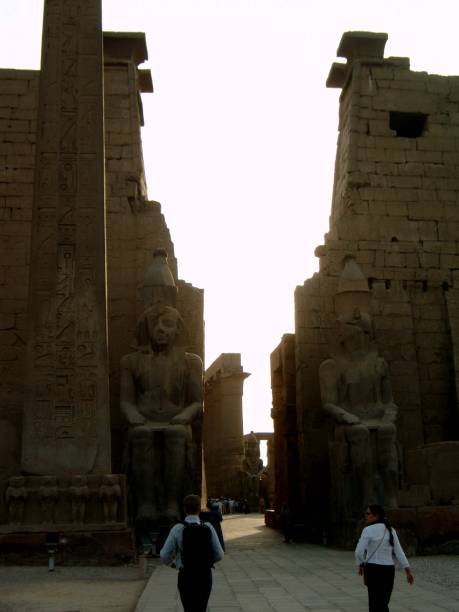
højste obelisk i Ægypt - Hatshepsuts Oberlisk i Karnak tempel" height="372" width="279" hspace="10">
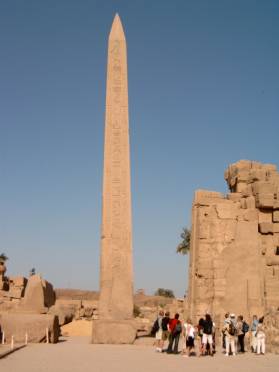
Forbi de kæmpe søjler stod den højeste eksisterende
obelisk I Ægypten, næsten 30 meter høj. Selvom den
er lavet af et stykke granit, ser Hatsheosuts obelisk ud, som om den
er lavet af to forskellige sten, da den nederste del i mange år
var dækket til af Tuthmosis III i hans vrede over stedmoderens
tilranelse af tronen. Der var engang 17 obeliske, men disse er nu spredt
over hele verden.
Jo længere vi kommer ind i tempelområdet,
jo ældre er templet og ligger i ruiner, så da vi når
den anden ende, ligger alt i ruiner.
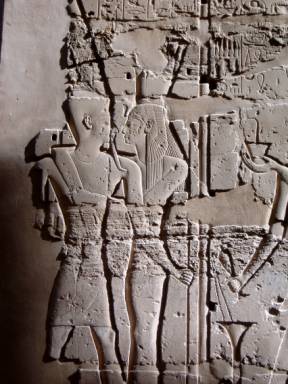
Det mest skønne syn for mig I templet var billedet af dronningen,
der omfavner sin Farao.
Det blev betragtet som tabu at vise billeder
med en sådan affekt, så billedet var i mange år dækket
af en guldplade.
Tæt ved den hellige sø - et bassin beregnet til præsternes
renselse - stor en kæmpe skarabel. Adam fortalte, at vi skulle
gå syv gange rundt om den, mod uret, og vi ville få vort
ønske opfyldt. Det ville have været ret komisk at se en
stor skare af folk vandre omkring skarabellen.
Efter 1½ time måtte vi videre…
til endnu en kommisionsbutik - en bomuldsbutik med t-shirts med fabrikstryk,
der kostede fem så meget, som jeg havde købt broderede
t-shirts for.
Til sidst på vores tur: Luxor templet==>
Der var en avenue af Sphinxer, som engang
forbandt Karnak templet med Luxor templet med 2½ km.
Engang i Faraoernes tid lå Luxor
templet i hjertet af den gamle hovedstad Thebes og var velbevaret fordi
den engang var begravet under landsbyen Luxor og endog i det 13. årh.
havde en moske opført indenfor dens mure - hvilket indbyggerne
kræver bevaret under restaureringen af templet.
Templet synes ikke oversvømmet med
turister og i det forsvindende lys fra solnedgangen lægger templet
et spøgelsesagtigt men flot skygge over byen.
Efter
turen tog resten af familien på hestevognstur tilbage til skibet,
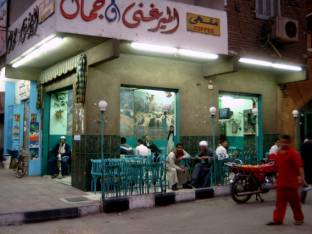
mens vores lille familie besluttede at gå gennem byen - en kort
tur langs Nilen. Som i Esra var vi interesserede i at gå gennem
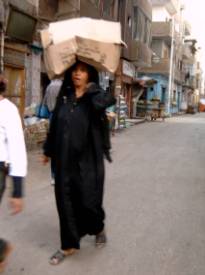
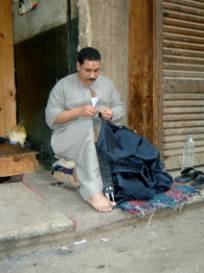
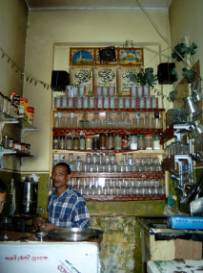
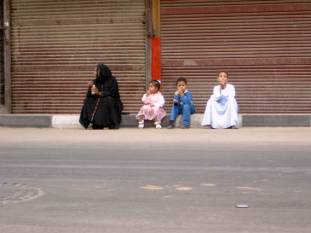
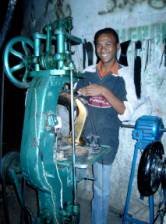
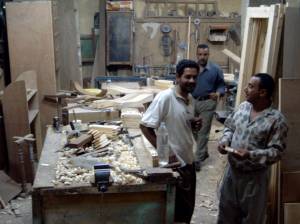
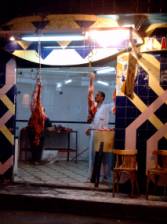
gaderne, tage video og fotos og se, hvordan folk levede - gamle mænd
ryger vandpibe, skrædere syer dragter, en mand vasker kopper i
en kaffeshop, en åben slagter med kroppe hængende ved fortovet,
små børn hviner for at blive fotograferet, kvinder klædt
fra top til tå i sort, børn glad vinkende fra alle hjørner
- disse mennesker smilede mere og syntes venligere - og ingen spurgte
efter bakshees (drikkepenge), og en skarp kontrast til Esna. Vi stoppede
for at få en sodavand på tagterrassen af en hotel og betragtede
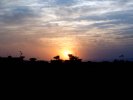
endnu en fantastisk solnedgang over Luxor.
Efter
vores sidste middag blev vi underholdt af en ung kedelig mavedanserinde
og, hvad jeg har ventet på at se, en "Hvirvlende Dervish"
- en fremvisning af Sufi dans.
Sufism, en halv-mystisk gren af Islam,
med en uortodoks vej til bøn, det vil sige at danse og opnå
en trancelignende forening med Gud.
Tilskyndet af takten fra trommer, strenge
og fløjter, spinner danseren rundt i et slør of flerfarvet
skørt - rød, gul og blå - indtil han lignede en
snurretop.
De fleste af familien nød krydstogtet
og stederne de så. De var ikke særlig glade ved planlægningen
af turen med latterlige tidlige morgenstarter, nogle dage sammenpressede
og andre med næsten intet. Men mest af alt var mange af familien
utilfredse med Adam - vi klagede på vore spørgeskemaer
og Ulla gav AB-Travel repræsentanten en opsang om, hvor ubehagelig
Adam havde været, hvor intetsigende hans høj-accenterede
sprog havde været, han kørte på nogle af os, stirrede
på børnene for at sludre bag i bussen, han undgik spørgsmål
og skældte på alle, der afbrød ham med et spørgsmål.
Værst var alle de unødvendige "kommissions baserede"
stop, som tog tid fra vores seværdigheds besøg. Han var
en typisk Ægypter, som kunne have gjort vores tur meget mere lykkelig.
Fra en tidelig flyvetur til Cairo, en galehus
med vores bagage, en tretimers ventetid I en kaffeshop på et hotel
tæt ved, til en 4½ timers flyvetur tilbage til København,
var klokken 17, da vi fik vores bagage og tog en sidste afsked med alle
medlemmer af familien. På trods af en start kl. 4.45 tog det os
en hel dag at komme hjem.
Der er en vis portion tristhed at det måske
er sidste gang familien er samlet, da Bedstemor jo bliver ældre.
René har været med på måske ti samlinger, planlagt
af Bedstemors børn, men betalt af Bedsteforældrene - som
en arv til familien. Jeg har været heldig og privilegeret at blive
inviteret med på en af disse familiesamlinger - fire generationer
i alt. Det gav mig lov til at besøge en anden eksotisk del af
verden og at lære at kende denne meget specielle Matriark.
Ancient Egyptian stories and legends have
long made their mark through movies such as "Cleopatra", "The
Mummy" and wowed us women with Omar Sharif's performance in "Lawrence
of Arabia" and "Doctor Zhivago" and more recently in
cartoons such as "The Prince of Egypt". There is a certain
mystic about middle east portrayed to us from a very young age when
we hear bedtime tales like "Ali Baba the 40 Thieves"
or "Sinbad the Sailor" - most of us have a dream of seeing
the pyramids.
I was very lucky to have the opportunity
20 years ago to come to Egypt with my parents and at 10 years old, there's
only so much a child can remember. But this year, the Pallesen Family
once again get together for the Matriach's 85th birthday. It is tradition
for the family to come together and travel to an exotic country - in
the past Tunisia, Morocco, Gambia and for Grandmother's last wish, to
see the pyramids of Egypt, that her husband saw 45 years earlier.
The Matriach's three children, six grandchildren
(Nikolai could not make it), four greatgrandchildren and respective
spouses all came together for a week in magical Egypt. It is autumn
with warm days and cool nights - a contrast to the approaching winter
in Denmark.
Saturday 13 November 2004 Departure for Egypt
Our family had to leave Falster at 2:30am
to catch a 6:30 flight, 4½hr later we arrived at Cairo Airport.
I have dim memories of a very warm airport in complete chaos, with people
pushing to get their luggage through, shouting over a mad din. Instead
we found a rather clean and uncrowded airport. We were met by the AB
Travel Agency representative, taken to a Hotel Pyramisa, left in a closed
piano bar
and promptly forgotten until one of us had the bright idea to ask for
our keys.
Our family shared a two-bedroom hotel room
with a large living area. Our first afternoon was spent walking around
the streets of Cairo trying to find a place for the family to have dinner.
Our hotel was located across the river from downtown
Cairo, so there was not a lot to see, combined with the fact that
many shops were closed during the day over Ramadan, the Islamic period
of fasting from dawn to dusk. Sunday heralded the last day of Ramadan,
so many were preparing for the final feast.
In the end, the whole family had dinner
in the hotel's "Oriental" restaurant of Egyptian style. We
figured we would get some decent Egyptian food but were disappointed
to find most of our food luke-warm. The rice was very dry, little meat
on the lamb and rather bland food. To our surprise, after our comment
about this, we were presented with a complimentary platter of fruits
native to Egypt such as fresh dates and guava. To our amusement, no
matter what kind of Egyptian wine we ordered, they all tasted the same.
There was plenty of Egyptian beer and of course the danes lived up to
their drinking prowess and Bedstemor ("grandmother") treated
us all dinner.
Sunday 14. november 2004
On the first night we didn't sleep very
well - sleeping in a different bed combined with quranic prayers coming
from a nearby mosque didn't exactly leave us with a peaceful sleep.
However we were all up early to get together in Bedstemor's room for
a "surprise" get-together - to sing the danish birthday song
amongst a flutter of red white flags, and present her with a small
gift. This family "surprises" the birthdayee and all sing
in unison this rather cute birthday song.
The Citadel Muhammad Ali Mosque
Our
first destination was the Citadel. It is the
city's fortress that once housed the royal family and although most
of the complex is open to visitors, the military still have a foothold
and some areas are out of bounds. It takes a half day to explore all
areas of the Citadel but we didn't have the opportunity to do so, and
instead spent most of our time in the Muhammad
Ali Mosque.
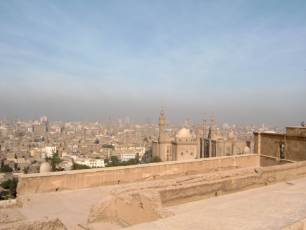
<== There is a magnificent view of the
city from the Western Terraces - magnificent had most of Cairo not been
filled with the same shade of mud-bricked buildings. What
was most notable about Cairo was its lack of colour or rather its ability
to blend into the desert.
Our
guide Adam/Mohammed provided little insight to the function or history
of the Citadel, and instead sat the group in one corner of the Muhammad
Ali Mosque like a bunch of school children, and gave a lecture on Islamic
laws and behaviour.
When René ventured to ask more about
the Citadel, he was scolded for interrupting and told to listen. We
never got the opportunity to find the number 7 Napoleon's troops had
painted above one doorway to avoid using the unfamiliar Arabic names
or the twin half-round towers because our guide simply didn't know where
they were.
During this time, I had the opportunity
to wander off and walk the beautiful alabaster-lined arcades of the
mosque. the soaring central prayer hall was a glimmer of hundreds of
lights hanging in concentric circles. Arabic inscriptions in gold were
painted on the ceiling. Women had to be suitably attired and could not
wear sleeveless tops or short skirts or shorts. In one corner lay the
sarcophagus of Muhammad Ali - the builder of the mosque and an albanian
mercenary who was the founder of the dynasty that ruled till the revolution
in 1952.
Cairo Egyptian Museum
I
have memories of wandering around this museum, peering into smudged
glass cases, staring into the shrivelled faces of some once well-known
pharaoh like Ramses II and wondering if the ancient Egyptians were giants
in their large coffins. 20
years later, it was almost impossible to push through the crowds of
tourists - only useful because their guides provided more information
than ours. With only two hours, there was no way that we could view
the whole museum or see the royal mummies.
The museum
was celebrating its centenary and there was a special exhibition dedicated
to TutAnkhAmun - the most famous archaeological find. With travel guide
in hand, we oohed and ahhed over the gold treasures found in his tomb
- a gold throne featuring the famous scene of TutAnkhAmun's queen anointing
him, chests made out of ebony ivory, cheetah-skinned hunting shields,
bows, arrows, alabaster canopic jars holding King Tut's mummified organs,
gold sarcophagus - if Howard Carter had found such treasures for a little
known boy-king, imagine what the tomb of a pharaoh like Ramses II would
have been like? King Tut's inner coffin of solid gold and the famous
mask of gold that everyone wants to see and is portrayed in many egyptian
images.
The museum
has become another money-making expedition for the Egyptians with an
exhorbitant price to view the royal mummies. We had to content ourselves
with the animal mummies - cats, dogs, birds, goats, Nile perch (yes,
fish as well!) and most amazing was a 7-metre crocodile mummy.
The exhibitions
were arranged by themes on the upper floor and chronological on the
lower floor, going clockwise from the Old Kingdom, to the Middle and
finally to the New and later kingdoms. There were rooms full of giant
sarcophagi that would've weighed a tonne each, a room full of miniatures
showing the egyptians' daily lives, a room full of ancient papyrus long
faded and rooms full of bits and pieces from ruins, statues, palace
floors - a place where one needs a days to spend with a decent travel
guide.
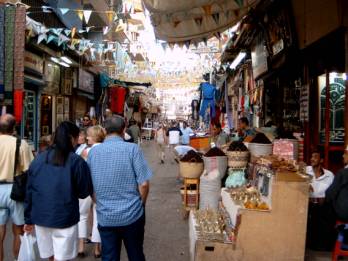
Khan Al-Khalili
After
a stop at an egyptian perfumery and some lunch,
we headed to Khan Al-Khalili - the oldest
bazaar in Egypt that has lasted since the 1300s. Ancient buyers visited
the khan for goods brought in on merchant caravans. No longer do we
find slaves, silk, jewels or diamonds, but wooden guitars, brightly
patched pouffe covers, clothes, t-shirts, crappy papyrus paintings,
bongs/water pipes, bright bolts of cloth, the aroma of spices is very
much present and stalls are heaped with bright red, gold and blue powders
and sacks of seeds pods. Coppersmiths hammer out platters, tureens,
coffeepots and enormous crescent-shaped tops for minarets. It is a ritual
of the bazaar to expect to bargain - locals or foreign visitors - usually
a 10th of the offer price - if you have paid a third, you have paid
too much. We had only an hour to spare but many of the shops were closed
for a siesta after lunch. Ulla I pointed to bags of multicoloured
spices. He wanted £50 (AUD$10, 50DK.Kr) and after I said "da
ketir awi" (it costs too much) and walked away, the shopkeeper
doggedly followed us for a kilometre reducing the price from £40
to £30, £25, £20 and after we shouted £10 in
jest, he offered £15, £10 and finally £5 before finally
giving up on us. After much haggling, we managed to bargain for two
ornate glass perfume bottles for £20 (AUD$2.50; 20DK.Kr)
Bedstemor's Birthday Feast
Irene
Ole had organised a private room for Bedstemor's
birthday party. A single long table in a room of egyptian style.
Small silver pots lined in two rows in the middle of the table kept
the food warm.
We feasted on cumin-flavoured fried fish,
chicken fillets egyptian-style, cinammon-flavoured ravioli, rice, mashed
potatoes and beef steaks in pepper sauce, sang and toasted with bottles
of egyptian wine and beer to Bedstemor.
Whilst the children played in one corner,
there was much chatter througout the table and the evening finished
off with chocolate and fruit cakes topped with "Happy Pirthday"
(note, it's not an error) and we laughed in amusement in a plethora
of egyptian sweets - baklawa, semolina tarts, rose-water flavoured tarts,
and tarts that tasted like liquid honey... Ulla almost wanted to take
the rest of the desserts with her (except for the rose-water flavoured
ones - it was funny to watch her expression - rosewater almost smells
like cosmetics). The waiters were extremely attentive, coming by every
two minutes to serve us.
Best of all, Bedstemor turned 2 years old,
as she blew out each candle on the cakes. As the danes would say, "det
var meget hyggeligt!" (it was cozy)
Monday 15. november 2004 (7:30am start)
From the brown buildings and streets of
Cairo, we travelled 24km southeast of the city to Saqqara, changing
from a uniform brown to lush green fields of large cabbages and hundreds
of date palms. It was like an oasis, a gentle mist gave a surreal sense
of the fertile plains of ancient Egypt. Women in full-length black abeeyas
squatted in the fields, the odd man walking around - such a contrast
to the intense crowds of central Cairo.
Saqqara's Step Pyramid
Founded as a necropolis (burial city) for
the Old Kingdom and is one of the richest archaeological sites in Egypt.
The Step Pyramid
is less that ½ the height of the largest pyramids at Giza, but
this monument served as a predecessor of the smooth pyramids. Previously
tombs were made of mud brick, rectangular slablike structure covering
a burial pit. But the architect Imhotep had the bright idea to construct
in stone and build
the slablike structure 5 times one on top of the other, creating the
first pyramid.
We entered through the Great South Court
- the size of a soccer field, down a corridor of 40 pillars inspired
by bundles of tied reeds. Whilst Adam was making another one of his
speeches, I was tempted by a turbaned egyptian in a dress who took me
to the top where I managed to get one shot of the magnificent pillars
up top, before being scolded by Adam and being asked for baksheesh (tip).
I was gratefully rescued by a couple of Italians when the egyptian would
not let me go without a baksheesh. However, once I surfaced from the
building, I was blinded by white sands and the immense pyramid sitting
solitary amongst a few ruined stones, with a much smaller triangular
heap of stones in the background. Although the morning had been cool,
the sun soon warmed us up as we wandered round to the north.
Memphis
Once
the capital of ancient Egypt, it remains unexcavated
due to villages built on top of it and a high water table as a result
of the Aswan Dam. There is a small garden with small finds - bits and
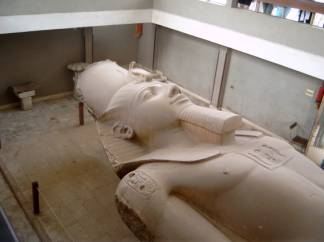
pieces but the most exciting thing to see is a colossus of Ramses II
lying on his back as the lower legs are missing. The colossus would've
been 5 stories high had it been standing. Nearby lies the largest alabaster
statue ever found - 80 tons of sphinx - imagine what treasures that
could've been found if Memphis could've been excavated, especially as
this ancient city lay halfway between Upper and Lower Egypt.
Our final stop before lunch was a papyrus
museum - another place of commission for Adam. Bedstemor purchased a
papyrus of egyptian alphabets. Some of the paintings cost a massive
£3,500 (AUD$900, 3,500DK.Kr). For lunch, we had a splendid egyptian
meal in the middle of nowhere that served excellent mezza (egyptian
tapas) of baba ghanoush (roasted eggplant dip), tzatziki (cucumber dip),
hummus (chickpea dip), fuul (beans) served with freshly made pita bread,
warm vine-leaf rolls, lamb kofta and freshly roasted chicken in thyme.
It was feast fit for a king and the most egyptian meal we had on the
whole trip.
Pyramids
of Giza
From air the desert pyramids were
right on the edge of the city, 16km from Cairo.
I remember vaguely, as a child, hunched
over, walking up a surprisingly warm shaft lit by a single light bulbs
and emerging into a very chilly dark room that held a single stone sarcophagus,
the room empty except for occasional square holes in the wall where
food was left for the afterlife.
I had entered the Queen's chamber in the
largest pyramid and 20 years later, only the first 300 can enter these
pyramids - for an exhorbitant fee.
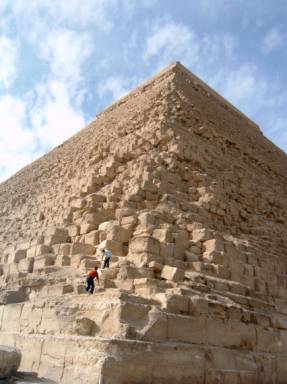
The largest of the three, Cheops' pyramid was
the largest, standing at 146metres at one point, took 920 metres to
walk around it and contained 2.3 million blocks! Each block was at least
one metre high, so you can imagine how massive these pyramids were.
The 2nd largest, Khefren's (Cheop's son) pyramid
still had some of the smooth shiny limestone casing that once used to
cover all these pyramids.==>
The massive solar boat that once carried
the pharaoh's body from Memphis to Giza and the
three smaller Queens' pyramids stood at one corner of the massive Cheop
pyramid. We didn't have the opportunity this time to enter the tombs,
but I feel priveleged that I did and that I still have some memories
of the event.
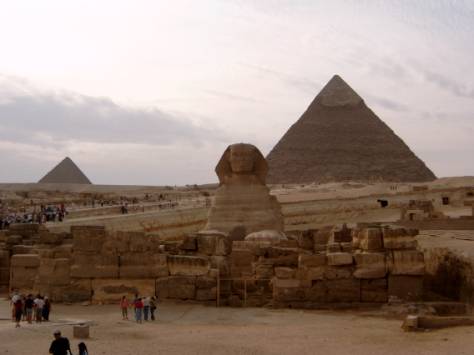
The Sphinx
The
pyramids loomed in the background as it sat silently on the hot sand
under the glaring sunlight for 4,000 years. Napoleon's troops once used
it for target practice, so its nose and pharaohs beard and long fallen
off and lies in a British museum. The Greeks called it "the
Sphinx" as it was based on a mystical creature with the head
of a man and body of a lion, which would stop any traveller along the
way with a riddle - if the riddle wasn't answered, it became the sphinx's
dinner. Throngs of crowds surrounded the sphinx and we could only enter
in single file. Over time, it seemed that tourists could view it from
further and further away. 45 years ago, Bedstefar's (grandfather) could
touch the Sphinx and even climb to the top of the pyramid; 20 years
ago, it was simply surrounded by a small wire fence but I could stand
close up to it; now it lay in a very large pit where visitors could
only view it up close if they zoomed in on their cameras. 4 millenia
later, it still manages to awe all of us.
Tuesday 16. november 2004 (2:30am start)
Yes, you did read that right - we were
all waiting in the lobby at 2:30AM. Last night, Bedstemor's grandchildren
treated the family to a Spanish-Egyptian Italian
dinner, which was followed by a cacophany
of tambourines, oboes and drums played for an Egyptian engagement couple
in the lobby.
This morning we were flying to Aswan, to
board a 3-day cruise up the Nile, sailing up to Luxor. When we arrived,
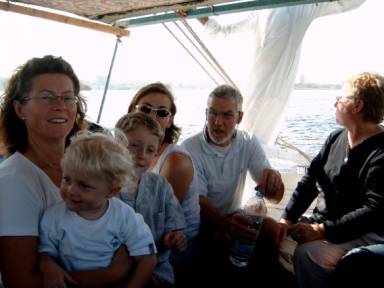
we were taken for a short felucca ride along
the Nile with a fantastic view of the Tomb of Nobles.
When we returned we were given our rooms onboard a four-storey cruise
ship that had an indoor games room, a pool and sundeck at the top.
Even from our rooms right at the bottom, we had a magnificent view of
a small white mosque-like structure on top of huge sandy mountains dotted
with small caves.
In the evening we had the opportunity to
visit a small souq (local bazaar) selling t-shirts, papyrus paintings,
mounds of saffron and dry scented lotus flowers, brown, red, yellow
indigo mounds of fragrant spices - all of which some of us bargained
for - the most expensive £25 papyrus painting (AUD$5, 25DK.Kr)
to cheapest £15 embroidered t-shirts with hieroglyphics (AUD$3,
15DK.Kr). To top the evening off, we took a £5 horse carriage
ride back to the ship.
Wednesday 17. november 2004 (7:30am
start)
It seemed some of the family had succumbed
to a tummy bug. The rest of us steered clear of unwashed fruit, fresh
salads, raw vegetables and drinks made with local water. However, this
didn't stop us from going out to see a few sights.
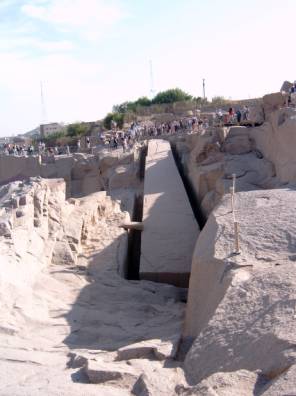
The Unfinished Obelisk
Had this obelisk
been completed, it would've been the largest and heaviest ever made
standing at 142 metres. It sat in a granite quarry, perfectly complete
on three sides but abandoned when a flaw was found in the stone. It
is almost impossible to imagine how the ancient egyptians could've moved
even a single rock made from this quarry as it stood a great many miles
from any of the monuments ever made. Unfortunately for Egypt, most of
its obelisks have been spirited to other countries - to Italy, Britain,
France and even Argentina by foreign archaeologists in the last centuries.
Most of us didn't have the chance to view the complete obelisk before
Adam rang a bell that he carried (to annoy us I suppose)
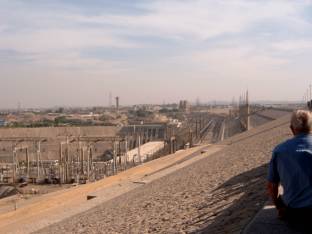
High Dam
For
centuries the Nile controlled the Egyptians' lives - either flooding
or insufficient water levels were disastrous for the people who relied
on this huge water source for their livelihood. When the Aswan
Dam was built, some of the villages in the south lost their water
supply.
30 years ago, a new High Dam was built
which resulted in the man-made Lake Nasser to the south being created
==>
This meant many people had to be moved
as villages were buried, as well as some of the ancient egyptian monuments
such as the Temple of Philae.
At
its highest point, the High Dam stands at 111m high, 3.8km long and
980m wide at the base.
Three times the number of stones used for
Cheops' Pyramid was used.
Videoing isn't allowed as it is a high-security
military area - should there be an attack on this Dam, then much of
Egypt would be submerged under water and would be a disaster for the
country.
Given only 10min, Adam "rang"
us back to the bus.
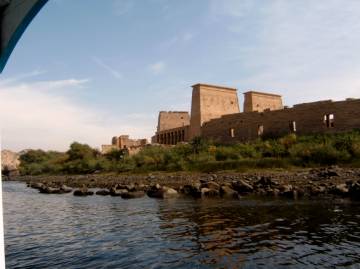
Temple of Philae
After
Aswan Dam, the Temple of Philae was submerged
for six months a year and tourists had to view it through the murky
waters of Lake Philae. When the High Dam was built, it threatened to
submerge the Temple permanently, so was moved stone by stone to a new
island similarly landscaped. Philae is special in that it's only accessible
by boat and the sunset forms a spectactular backdrop. A temple dedicated
to Isis (goddess of women, sex purity), it was one of the last
outposes for paganism and due to the popularity of Isis, was also used
by the early Christians. The Temple walls and many pillars were filled
from top to bottom with hieroglyphs and images of Isis - many defaced
by the early Christians who considered ancient Egypt's gods to be "pagan".
I had a fantastic afternoon walking in and out of all the nook and crannies
- visiting the Birth House, Nilometer, the "Pharaoh's Bedstead"
and much to the amusement of the family, I was the last to emerge.
Kom
Ombo
The ship set sail from Aswan at 3:45pm
after an afternoon spent sunbaking and drinking beer (typically danish
to make the most of sunshine and beer). We were sailing 48km north of
Aswan to Kom Ombo - the site of an ancient
city devoted to the worship of a crocodile god, Sobek. The ancient city
is long gone and crocodiles existing on nearby sandbanks have been hunted
to extinction.
At sunset, we visited the Temple of Kom
Ombo, dedicated to both Sobek the Crocodile god and Horus, the falcon-headed
sky god Isis' son. Although we didn't have the opportunity to
explore this temple,
it was both spectacular and eerie at sunset, with large light illuminating
it. There existed a pit filled with water, with a platform halfway down,
where crocodiles were lured in from the Nile with human flesh, and the
largest crocodile was caught and mummified as a tribute to Sobek. At
the Chapel of Hathor (Horus' wife), an American shouted "Geez,
I thought I was supposed to see crocodile statues!" *laugh* It
contained two of the mummified crocodiles found at the Temple.
We returned to a small cocktail party before
dinner, provided by the ship to introduce all the staff responsible
for making our trip enjoyable.
Thursday 18. november 2004 (7am start)
We sailed overnight past Kom Ombo to Edfu,
a small regional center for the sugarcane trade, visited the Temple
of Horus and sailed on to the Lock-crossing at Esna.
Temple of Horus
This
is the most complete of its kind, a Greco-Roman
temple that conforms exactly to ancient egyptian principles of architecture
ie visit Edfu to see what almost every other temple in Egypt would've
looked like in its original form. We were awed by the massive walls
of the pylons at the entrance, distince reliefs showing mirror images
of Horus and the pharaoh grasping the hair of his enemies. It was built
by Cleopatra's father around 50yr BC. Standing in the forecourt of this
well-preserved temple we can see mud-brick houses lined up at the top
of the compound walls because this temple was once buried right up to
the ceiling with a village built on top of it. Many of the temple relifes
capture the cataclysmic battle of Horus with his brother Seth. We entered
a small Nilometer - a dark, dank tunnel that smelled of pee and was
once used to measure the level of the Nile. Again I was the last to
emerge (a couple of minutes late only) to the loud applause of everyone
(and a huge glare from Adam).
Returning
to the ship in time for the 9am sail, we set off for Esna, 48km south
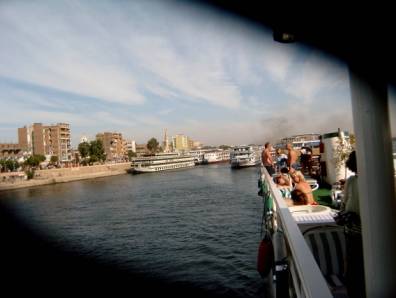
of Luxor. Whilst the family tanned on the sundeck,
I sat in the sun at the front of the boat, enjoying sense of peace and
tranquility. It was truly beautiful to sit on a boat not too big or
small, to watch the changing scenery on both sides, passed fields of
giant palms and lush green fields, a smoking metal, the ship moving
at a leisurely 16km/hr and passing some incredibe mountains of sand
and cliffs. Ole joined me for a chat - he Irene are moving to
Greenland on Tuesday. Later in the morning, I joined René and
Ulla by the pool, gossiping about Bedstefar and family resemblances,
watching Vinnie's kids and Sebastian splash about the pool, Lonnie,
Sarah Birit stripped down to the minimum to get a bit of colour.
We
reached Esna and used the few hours to get off the ship and stretch
our legs after a morning of lazing around the pool. I was itching to
walk around Esna, away from tourists and see how the locals lived. René
and I headed for the quieter streets avoiding the busy streets
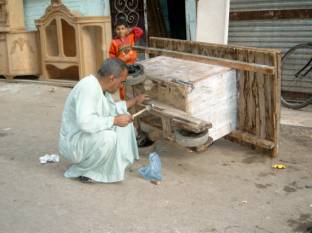
around a souq. We were followed by a few children clad in long grey
or white robes, who guided and annoyed us. Most of the narrow streets
were unpaved, some very muddy and smelling of manure. Skinny, skeletal
donkeys balanced again flat wagons, many shy girls waving from the darkness
of their doorways or 2nd-level windows, whilst little boys came out
to say hello and mill around us. Most houses were simple of mud bricks,
with tiny wooden shuttered windows to keep the intense summer heat out.
Some had extremely ornate wooden doors, reminiscent of colonial days.
Occasional peek in doorways revealed empty mud-lined rooms as most people
lived in the upper floors. Eventually René shouted imshee! (go
away) as the kids got noisier, more aggressive, pulling on our arms
and throwing pebbles at us. When I stumbled over a whimpering black
and white disease-ridden puppy in brown paper, it was kicked aside -
making me almost reach out for it if René hadn't stopped me.it
was wise not to even make contact witht the children, who were dust-covered
and clad in the long egyptian grey robes. It was such a relief when
they finally left us even though we knew they were hiding in in alleyways
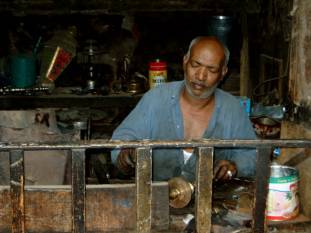
watching us wind through the streets. There were goldsmiths glittering
with ornate rings, earrings and necklaces; tailors still sewing by hand
on the steps of their shop; coffee houses filled with solitary men smoking
their water-pipes - their eyes following us down the street. We had
spent so much time just sitting around that it was good to get away.
Crossing of the Lock
We
set sail at 3pm and many ships like ours got together near two bridges
just north of Esna. For one hour of the day, a bridge opened up for
the ships and cars were ferried across the Nile instead. In the meanwhile,
the ship had organised a special Egyptian "Oriental" dinner
where guests could dress up in egyptian attire. It was a traditional
egyptian feast of flat bread, baba ghanoush, warm stuffed zucchini and
capsicum, warm cabbage rolls, chickpeas, lentils, fish, and traditional
dish of okra, and a dressed up rice-stuffed whole lamb with a foil-covered
head, small skinny eggplants for ears sitting upright on a silver platter.
To finish it off was a plethora of egyptian dessert - semolina tarts,
almond-milk agar (jelly) and the tartlets that tasted of liquid honey.
Between 10-11pm we all gathered together for the lock-crossing.
Canal lock-crossing
involves ships moving from a one water-level to another, usually where
a dam is involved. Two cruise ships moved into a channel that is closed
off and the water in the channel gradually reduced - in our case approx
10 metres. Once we reached the new water-level on the other side of
the lock, the door in front of the ship opened and we sailed out. The
lock-crossing took approx one hour, although all the waiting took a
few hours. It was well-worth staying up even though we had an early
start the next day. What was most amazing was the way the ship travelled
with such expertise through such a narrow channel with barely enough
space on each side.
Friday 19 November 2004 (7am start)
Overnight we had sailed from Esna to Luxor
arriving at approx 2am - the last port for us. We were awoken by efficient
wake-up calls and we could hear phones ringing in all the rooms going
on early tours. We had a long day ahead, cramming four different sights.
Valley of the Kings
Builders of the great pyramids realised
that hidden entrances and false shafts were not going to protect their
dead pharaohs or the riches buried with them from tomb-robbers, so from
the 18th dynasty, the ancient egyptians started digging underground.
Rolling hills and valleys of sand, rubble and solid limestone - it is
amazing to think that the ancient egyptians managed to bury something
like possibly over 300 pharaohs of which only 62 have been found (last
was TutAnkhAmun).
The mountain under which many of the tombs were found
has a pyramid-shaped peak.
Our tickets allowed us to visit three tombs only and only a handful
were opened on the day with long queues at each.
We visited the tombs of Ramseses III, IX
and V/VI - all of them relatively small tombs, some partly excavated,
others quite madly damaged by humidity from all the tourists and from
oily fingers.
There
was a variety of hieroglyphs and images, of the pharaohs, how they treated
their subjects, even the ceilings were beautifully adorned with dark
blue skies, thousands of stars and the sky goddess Nut, stretched above.
Tomb of Ramses III was like a picture book of "Better Homes
Gardens" with images of hundreds of pots, furniture and food preparation.
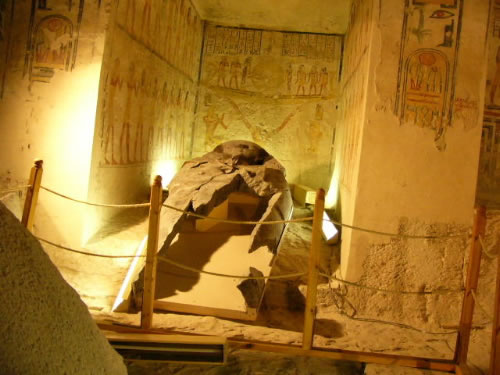
In the tomb of Ramses V/VI was a large shattered giant pharaoh-shaped
sarcophagus eerily illuminated by silver light - Ramses VI unusually
sharing a tomb with his predecessor brother. It is truly amazing
that such images have lasted thousands of years, hidden away in dark
low-humidity tombs that are quickly disintegrating since they have been
excavated.
Colossi of Memnon
Just
past the Valley of the Kings, we stopped to view the Colossi of Memnon
- twin 18-metre figures of Amenhotep III that once stood in front of
what was believed to be Egypt's greatest temples, even larger than the
existing Temple of Karnak. Each carved from single pieces of stone,
once famous for bell-like tone emitted each sunrise. The Greeks believed
these sounds were made by the immortal Memnon greeting his mother. After
an Roman emperor made restorations in 170AD, the sounds ceased.
To our amusement, Adam made another one
of his commission-based stops at an alabaster
factory. He couldn't understand why we broke into laughter. Instead
of boycotting the trip, we all went rushing in for free cups of coffee.
René led a race with Sebastian and Vinnie's boys sliding across
the smooth alabaster marble floor. At the other end was Ulla being approached
with a small £10,000 alabaster hippo, to which she jokingly said
yes and the shop-assistant went away to put it aside.
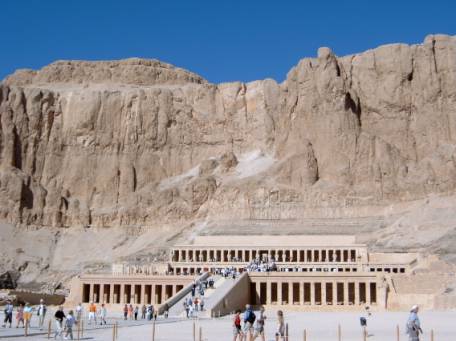
Temple of Hatshepsut
Lying
next to the Valley of the Kings is this temple of the only female
pharaoh who ever ruled in Egypt. Due to a botched job by an Egyptian-Polish
archaeological team, the ruined temple was recreated to resemble a bus
depot, with much of the original artwork covered over or destroyed.
The sucessor to Hatshepsut's brother/husband was stepson Tuthmose III
who had to wait 20 year to get his throne, hence when she died, she
was not mummified and her temple destroyed as punishment. The temple
was at the site of a Coptic monastery and fantastic limestone cliffs.
There may not be much of the temple to look at but the view, from up
close, far away or even from the sky is definitely worth the trip.
Then we had lunch and a brief rest. I was
surprised to find that a humorous member of housekeeping had set up
towels, blanket lettuce leaves to resember a man and his snake.
I thought René had played a joke on me until I found out something
similar other family members' rooms!
Much of it is in ruins but is possibly
the largest temple complex ever built anywhere and created over 1,500
years by successive generations of pharaohs.
It was the residence of pharaohs, place
of worship, wealthy treasury, centre of administration and employed
thousands.
Karnak is most famous for its giant columns
- 134, each 15m high, centre 12 columns were 21 metres tall. It takes
six adults to stretch their arms out around a column's girth.
Between the columns there once stood statues
of pharaohs and the whole effect would've been intimidating, as though
passing through a hall of giant gods.
<== Ramses II was responsible for a
lot of the restoration of the temple and his signature is etched deeply
in certain area so no other pharaoh could take credit.
Past the giant columns stood the tallest obelisk existing in Egypt at
almost 30m high. Although made out of one piece of granite, the Obelisk
of Hatshepsut looks like it's made of two different stones as the lower
half was covered up for many years by Tuthmosis III in his resentment
towards his stepmother's usurpment of the throne. There once existed
17 obelisks but these now lie in various parts of the world.
The further we walked into the temple,
the older the temple and the more ruined it became so when we reached
the other side, it was a mass of ruins.
The most beautiful aspect of the temple to me were the images of a queen
embracing her pharaoh.
It was considered taboo for such displays
of close affection that for many years it was covered up with a gold
plate.
Near the Sacred Lake - a body of water used for priests' ablutions -
stood a giant scarab beetle. Adam told us to walk around it seven time
and our wishes would be granted. It would've been very comical to see
a large group of people all walking around this large beetle.
After 1½hmoments.photography/post/Family-Photo-Shoot" title="Google Buzz" data-button-style="small-count">
This weekend we finally got around to taking some nice outdoor family photos.
We made out way to Centennial park in the afternoon for a coffee, walk and photoshoot. When we got there they had closed most of the roads for a bicycle race so we had to park outside the park.
After the coffee we walked over to one of the closer located lakes and set up for a couple of photos and these are the results.
Aiden was very well behaved although having a few problems with locating the direction of the camera and being confused with the new exciting surroundings. He is now 11 weeks young.
(strobist: SB80DX @ 1/2 power with 1/2 CTO camera left triggered by CTR301P, Nikon 80-200mm f2.8, 3200s, D50)
Every year my work provides with a Volunteer day where we don't have to work and can do volunteer work for any organisation of our choice.
This Friday some of the guys at work organised a day of work at the Celebral Palsy centre (spastic) so I chose to help out (beats sitting behind a desk on a sunny day). The location was at one of their houses in Frenchs Forest and we were to do some maintenance of their garden and some painting of the interior.
There was seven of us so we split up into two teams where I was on the team doing painting. The gardening team definitely had the easier job.
It was a really good day and here are some of the photos from our day out.
Last year Kim and I won 5 days worth of accommodation at Smiggings Hole at Perisher. Because we had Aiden it was difficult for us to go (for some reason the place would not allow children that young).
We therefore decided to let KC and Chong have three of the days with their kids and then I would go with someone else for a weekend. We were lucky that the place would allow all of us to go on the same weekend during the peak season at Perisher.
Soeren and I left Friday afternoon to do the 500km drive to Perisher. We stopped at Cooma to pick up car chains and ski gear and arrived at the lodge just before 7pm...just in time for dinner with the rest of the family.
In the morning we woke up to a glorious day and we hit the fields immediately heading straight to the Blue Cow area after doing a few warm up runs. In the past I have only been skiing in the front of the valley and Mt Perisher itself so it was nice to have some new unexplored territory and it was also nice to get away from the crowds.
In the evening we again had dinner with the family...4 courses at the lodge. I think everyone was pretty tired from a whole day outside so it was a fairly early bedtime.
On the second day the weather closed in and there was a blizzard. On the tops there was a fresh load of snow. My highlight was that I managed to have a good run of Kamikaze which is the only double black diamond in the area and I felt really good on it because of the great conditions. The photo above was taken on top of Bluecow shortly earlier.
Later in the morning Soeren and I met up with chong and we did a couple of runs at Perisher Mountain. Again, because of the blizzard there was no crowds and off the sides of the slopes the snow was soft and deep (for Australian standards). I had really good fun on the unprepared runs in the loose snow and felt solid getting down the terrain (you don't gain much experience from running on prepared slopes all the time).
In the early afternoon we headed back down, packed up and made our way back to Sydney (in just under 6 hours).
So how is daddy coping with fatherhood. Fatherhood is great...So far it has been a lot easier than I thought it would be. So far I would by lying if I didn't say that I enjoy every minute of it.
Everyone around me told me that it is sooo hard having kids, especially the first few months are a nightmare. Not sure what they are talking about...yeah Aiden wakes up at weird times wanting a feed, but besides from that he is doing what babies are expected to be doing. He is sleeping, pooping, crying and eating...easy!
...That is when I'm around. For example this weekend when I was in the snow he was crying all the time. It seems that he somehow senses when I'm not around and then starts being difficult. Maybe he is turning into a daddy's boy ;-)
When we were expecting I promised myself that I would just relax and enjoy the new company. There is no point stressing and swimming against the current...so if he wants to cry then he can cry, and if he wants to eat then he can eat. While we were planng kids I was worried if I was parent material and how
good a dad I would be. I had never really been around newborns...let
alone picked up one. I am getting a lot more confident now.
During the week Kim does the night feeds as I have to go to work in the Morning, but during the weekends I generally give him the bottle at night. Sometimes I have to then catch up on some sleep later in the day (otherwise Kim will have to deal with two babies) but that is ok.
Aiden turned two months old a couple of days ago and is a good little boy. He has started smiling and laughing once in a while when he is in a good mood. He is very curious and looks around to study and understand his surroundings all the time which I take as a good thing.
I think his favourite time is when we take a shower together. Kim and I discovered that it is a lot easier to just take him in the shower with me rather than having to fill up bath tubs etc. We also think that his least favourite time is go leave the shower.
This morning I had an early start (for a Sunday) taking the bus into the city to participate in the city to surf race. This is a race that starts from Hyde park in the centre of Sydney and ends at Bondi beach which is one of the most famous beaches in Australia (but not the best).In this years race there were over 80,000 participants.
I met up with a couple of work colleagues at Martin place in the city. We all also participate in the Global Corporate Challenge and this was a good way to increase our stepcount. We were starting at the back of thepack...which pretty much meant that we were planning to walk the 14.1 kilometers to Bondi.
There are so many variations that we cannot get at home and they don't add all that sugar.
Lucas was a bit tired after a morning at the beach at this one.
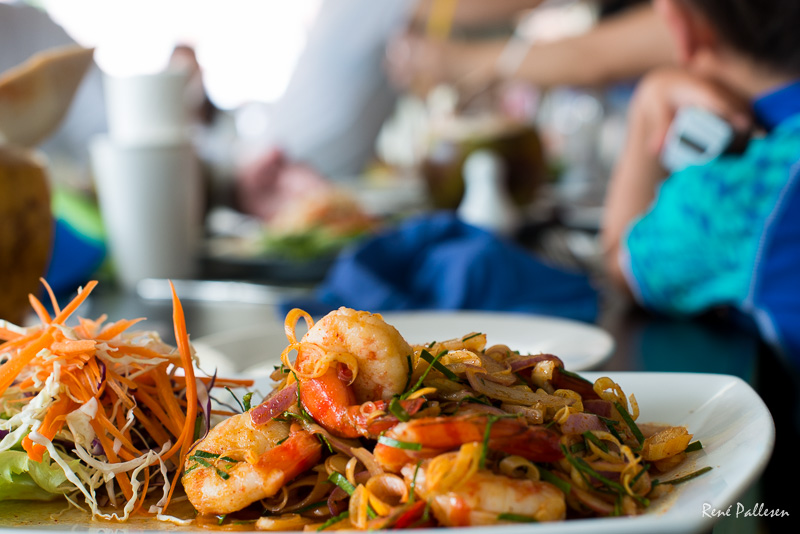
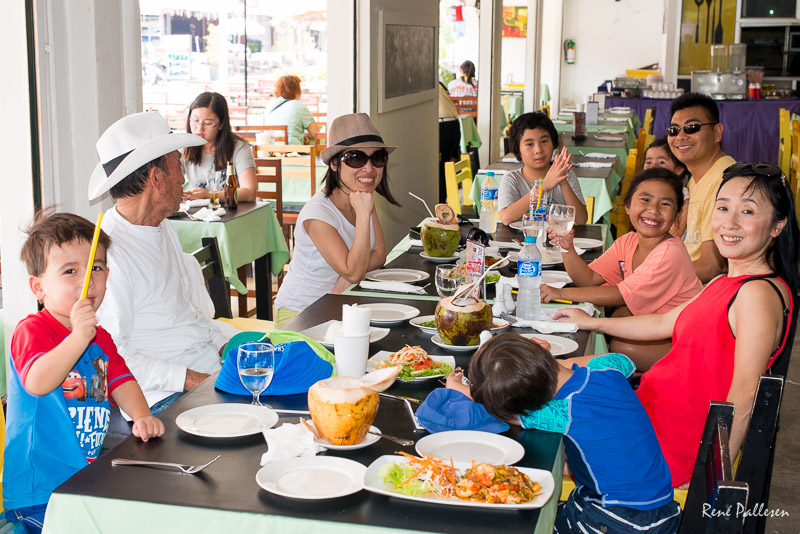
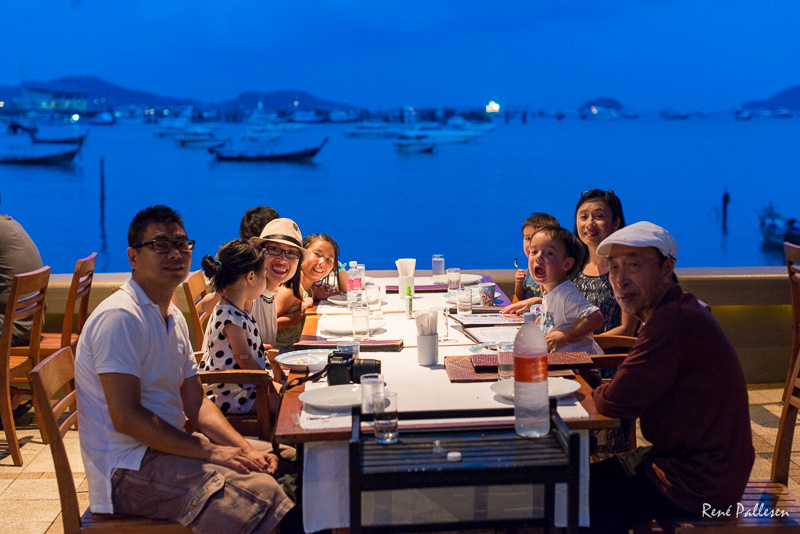
On KC's birthday we went to an ocean front seafood place.
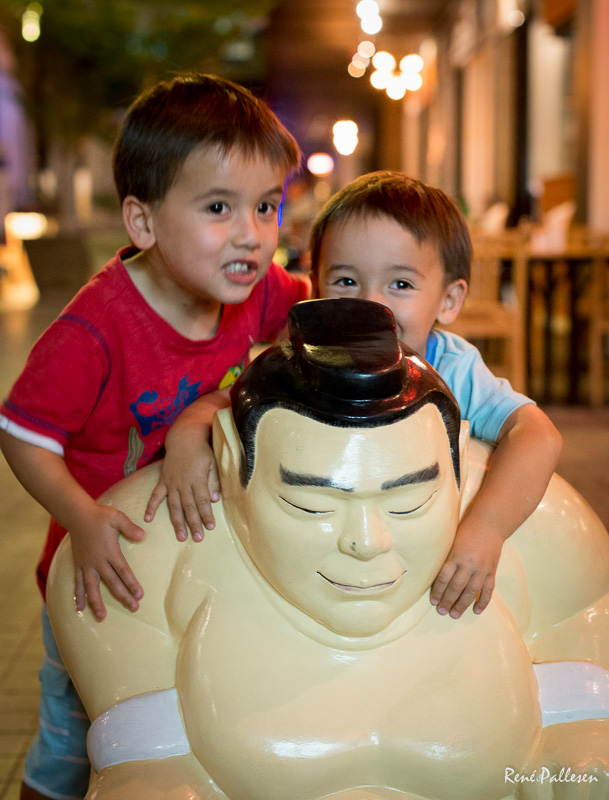
I don't think the family liked the food in Thailand much though, because they wanted to eat japanese and wanted air conditioned restaurants even though the evenings generally were a bit cooler.
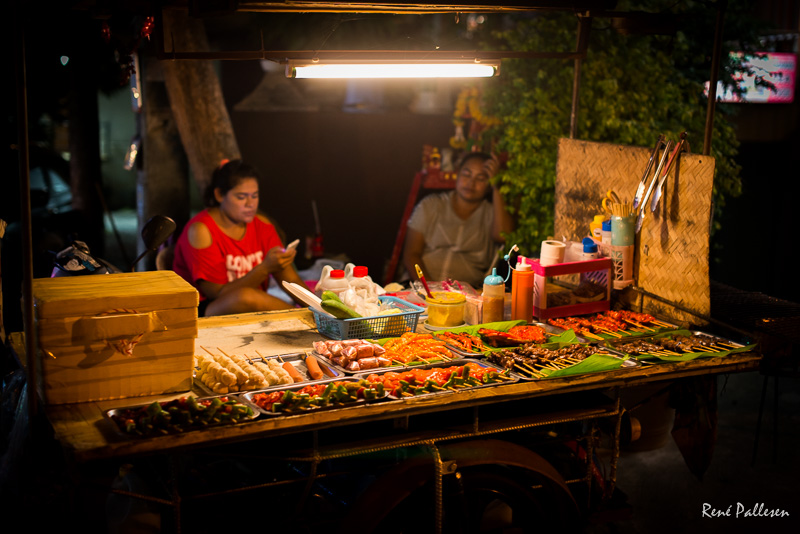
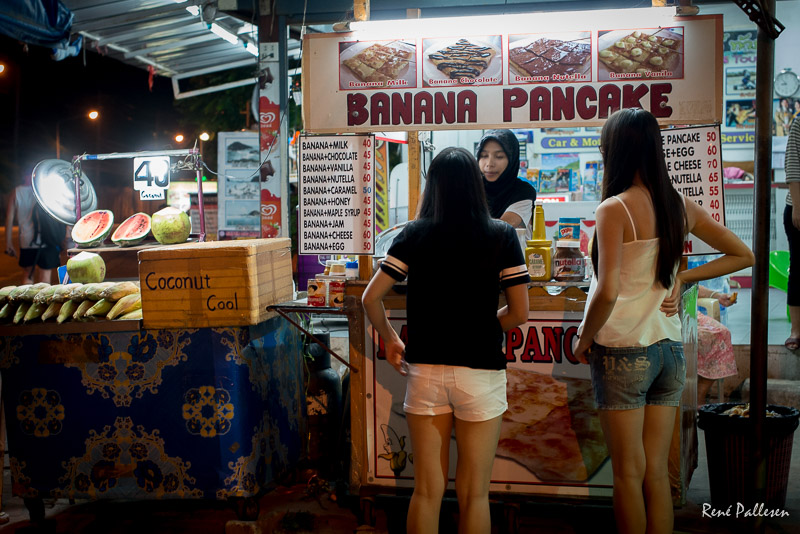
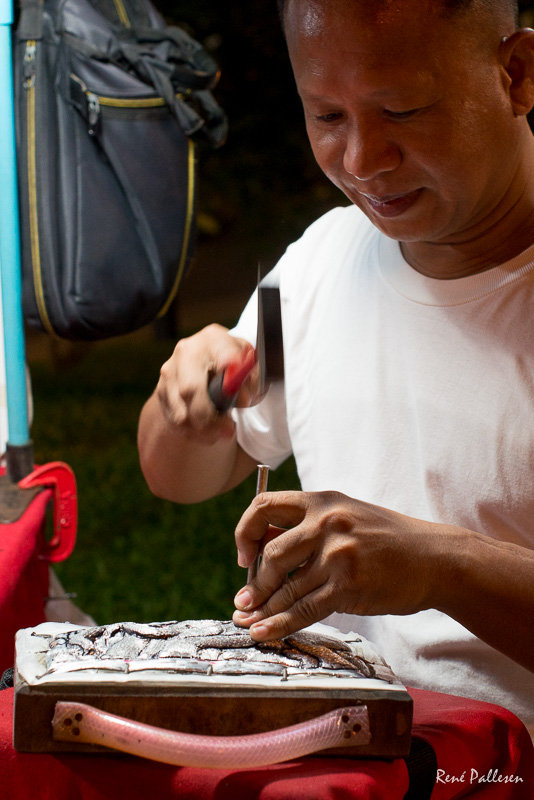
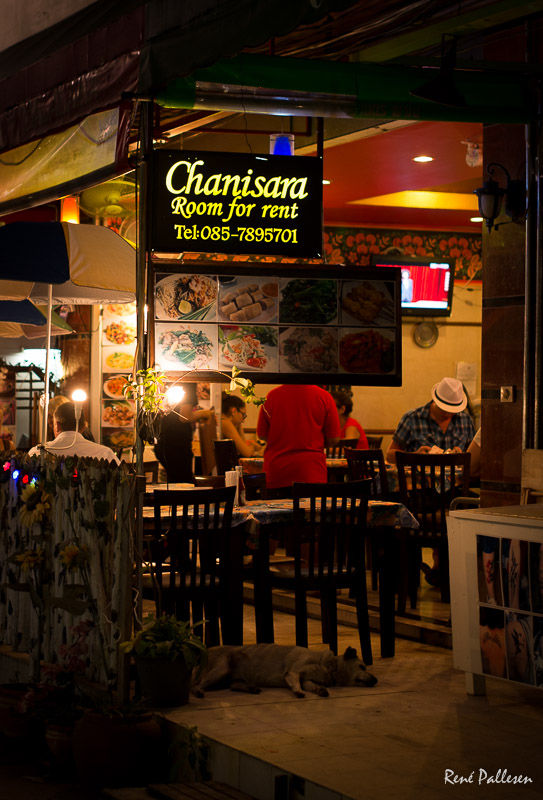
The street life in Thailand is as it always have been with lots of food stalls and other shops.
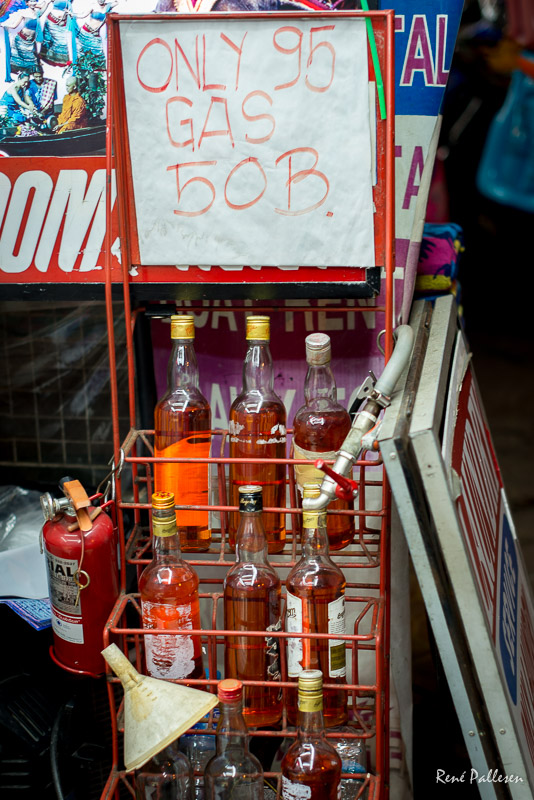
Petrol for all the bikes is bought in these small shops as well.
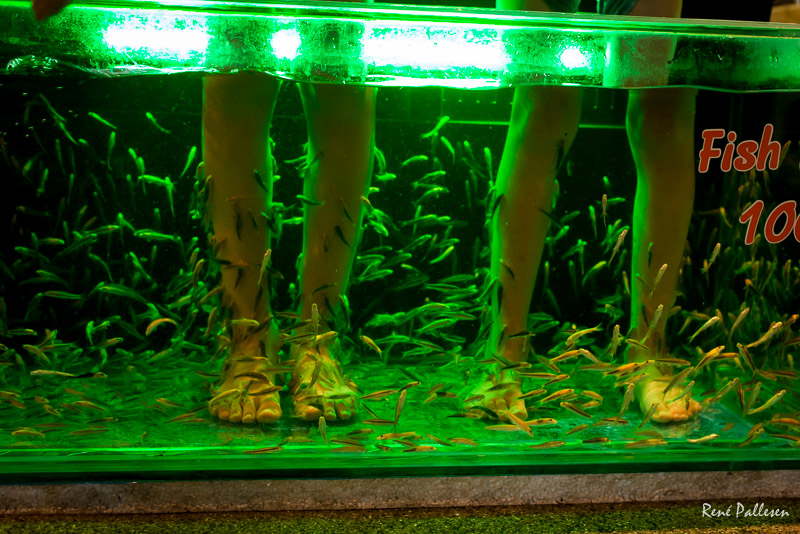
You can even get your feet cleaned by fish.
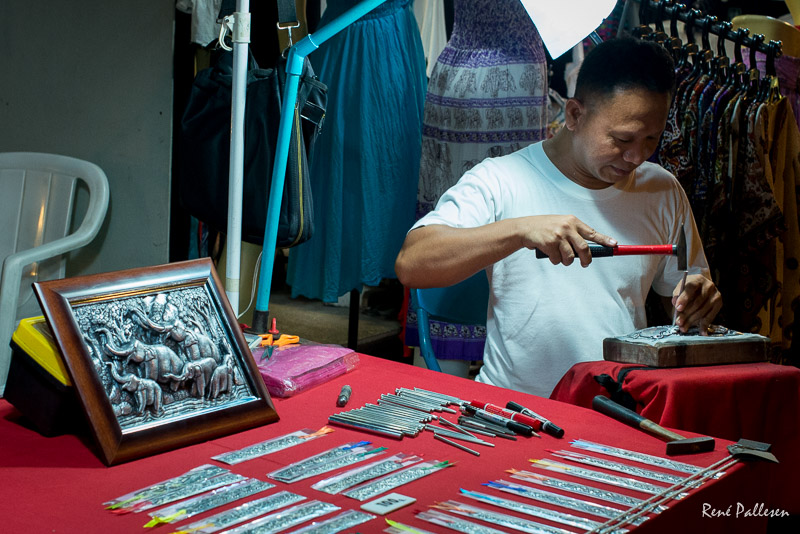
And handicraft is created there as well (The large elephant piece took him 2 weeks to create).
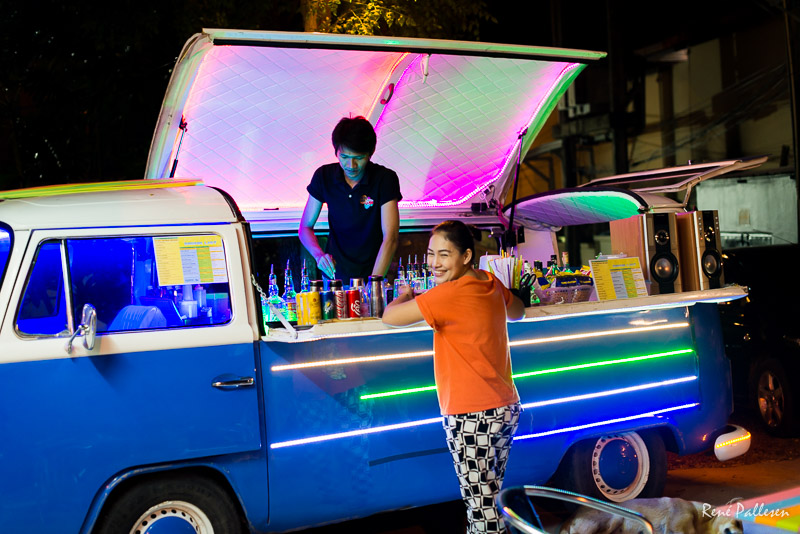
A new addition is the popup cocktail bars.
It reminds me of the good old days of backpacking where nothing was arranged beforehand. I would just organise accommodation when I arrived to a new place. There is still plenty of accommodation options everywhere if you look for it.



 Efter
vores sidste middag blev vi underholdt af en ung kedelig mavedanserinde
og, hvad jeg har ventet på at se, en "Hvirvlende Dervish"
- en fremvisning af Sufi dans.
Efter
vores sidste middag blev vi underholdt af en ung kedelig mavedanserinde
og, hvad jeg har ventet på at se, en "Hvirvlende Dervish"
- en fremvisning af Sufi dans.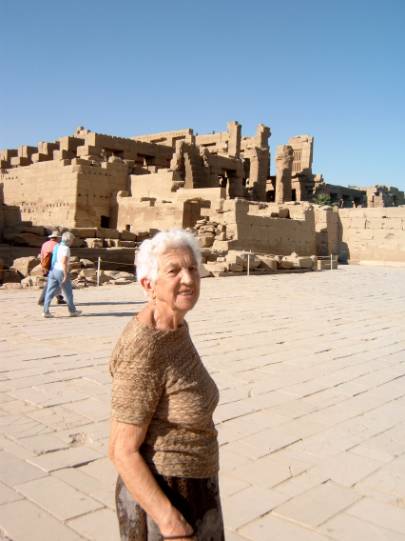












 Our
first destination was the
Our
first destination was the 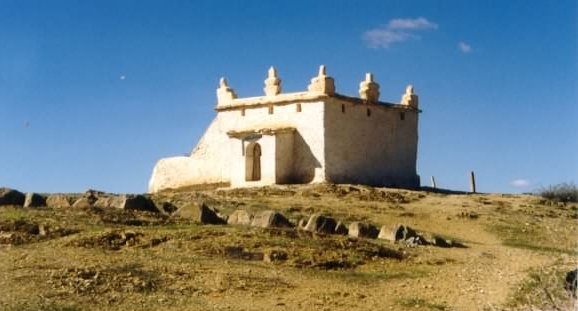 Our
guide Adam/Mohammed provided little insight to the function or history
of the Citadel, and instead sat the group in one corner of the Muhammad
Ali Mosque like a bunch of school children, and gave a lecture on Islamic
laws and behaviour.
Our
guide Adam/Mohammed provided little insight to the function or history
of the Citadel, and instead sat the group in one corner of the Muhammad
Ali Mosque like a bunch of school children, and gave a lecture on Islamic
laws and behaviour.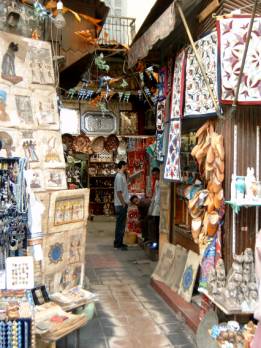 After
a stop at an egyptian
After
a stop at an egyptian 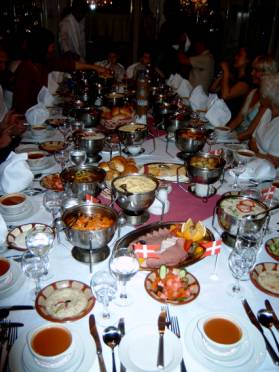 Irene
Ole had organised a private room for
Irene
Ole had organised a private room for 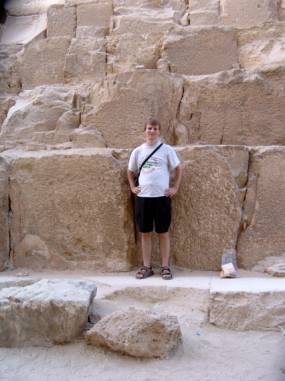
 The
pyramids loomed in the background as it sat silently on the hot sand
under the glaring sunlight for 4,000 years. Napoleon's troops once used
it for target practice, so its nose and pharaohs beard and long fallen
off and lies in a British museum. The Greeks called it "
The
pyramids loomed in the background as it sat silently on the hot sand
under the glaring sunlight for 4,000 years. Napoleon's troops once used
it for target practice, so its nose and pharaohs beard and long fallen
off and lies in a British museum. The Greeks called it "
 At
its highest point, the High Dam stands at 111m high, 3.8km long and
980m wide at the base.
At
its highest point, the High Dam stands at 111m high, 3.8km long and
980m wide at the base.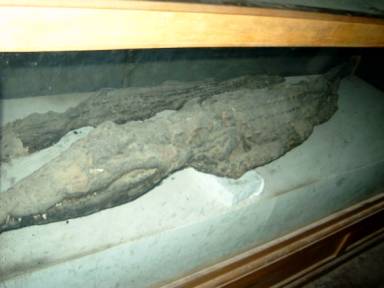 temple,
it was both spectacular and eerie at sunset, with large light illuminating
it. There existed a pit filled with water, with a platform halfway down,
where crocodiles were lured in from the Nile with human flesh, and the
largest crocodile was caught and mummified as a tribute to Sobek. At
the Chapel of Hathor (Horus' wife), an American shouted "Geez,
I thought I was supposed to see crocodile statues!" *laugh* It
contained two of the mummified crocodiles found at the Temple.
temple,
it was both spectacular and eerie at sunset, with large light illuminating
it. There existed a pit filled with water, with a platform halfway down,
where crocodiles were lured in from the Nile with human flesh, and the
largest crocodile was caught and mummified as a tribute to Sobek. At
the Chapel of Hathor (Horus' wife), an American shouted "Geez,
I thought I was supposed to see crocodile statues!" *laugh* It
contained two of the mummified crocodiles found at the Temple.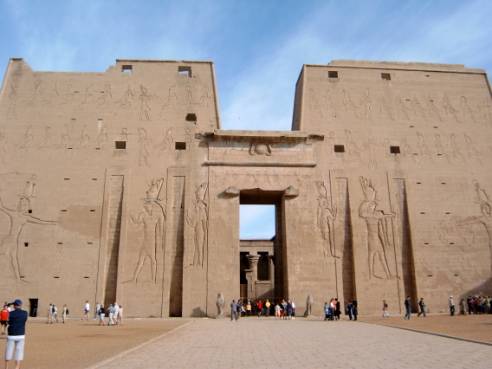 This
is the most complete of its kind, a
This
is the most complete of its kind, a 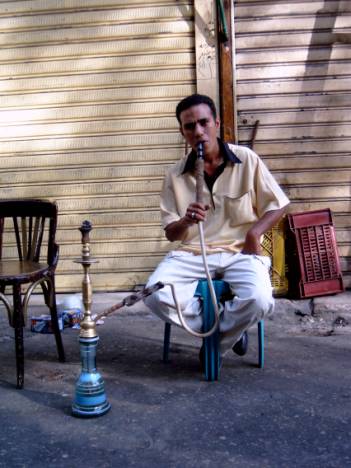 We
reached Esna and used the few hours to get off the ship and stretch
our legs after a morning of lazing around the pool. I was itching to
walk around Esna, away from tourists and see how the locals lived. René
and I headed for the quieter streets avoiding the busy streets
around a souq. We were followed by a few children clad in long grey
or white robes, who guided and annoyed us. Most of the narrow streets
were unpaved, some very muddy and smelling of manure. Skinny, skeletal
donkeys balanced again flat wagons, many shy girls waving from the darkness
of their doorways or 2nd-level windows, whilst little boys came out
to say hello and mill around us. Most houses were simple of mud bricks,
with tiny wooden shuttered windows to keep the intense summer heat out.
Some had extremely ornate wooden doors, reminiscent of colonial days.
Occasional peek in doorways revealed empty mud-lined rooms as most people
lived in the upper floors. Eventually René shouted imshee! (go
away) as the kids got noisier, more aggressive, pulling on our arms
and throwing pebbles at us. When I stumbled over a whimpering black
and white disease-ridden puppy in brown paper, it was kicked aside -
making me almost reach out for it if René hadn't stopped me.it
was wise not to even make contact witht the children, who were dust-covered
and clad in the long egyptian grey robes. It was such a relief when
they finally left us even though we knew they were hiding in in alleyways
watching us wind through the streets. There were goldsmiths glittering
with ornate rings, earrings and necklaces; tailors still sewing by hand
on the steps of their shop; coffee houses filled with solitary men smoking
their water-pipes - their eyes following us down the street. We had
spent so much time just sitting around that it was good to get away.
We
reached Esna and used the few hours to get off the ship and stretch
our legs after a morning of lazing around the pool. I was itching to
walk around Esna, away from tourists and see how the locals lived. René
and I headed for the quieter streets avoiding the busy streets
around a souq. We were followed by a few children clad in long grey
or white robes, who guided and annoyed us. Most of the narrow streets
were unpaved, some very muddy and smelling of manure. Skinny, skeletal
donkeys balanced again flat wagons, many shy girls waving from the darkness
of their doorways or 2nd-level windows, whilst little boys came out
to say hello and mill around us. Most houses were simple of mud bricks,
with tiny wooden shuttered windows to keep the intense summer heat out.
Some had extremely ornate wooden doors, reminiscent of colonial days.
Occasional peek in doorways revealed empty mud-lined rooms as most people
lived in the upper floors. Eventually René shouted imshee! (go
away) as the kids got noisier, more aggressive, pulling on our arms
and throwing pebbles at us. When I stumbled over a whimpering black
and white disease-ridden puppy in brown paper, it was kicked aside -
making me almost reach out for it if René hadn't stopped me.it
was wise not to even make contact witht the children, who were dust-covered
and clad in the long egyptian grey robes. It was such a relief when
they finally left us even though we knew they were hiding in in alleyways
watching us wind through the streets. There were goldsmiths glittering
with ornate rings, earrings and necklaces; tailors still sewing by hand
on the steps of their shop; coffee houses filled with solitary men smoking
their water-pipes - their eyes following us down the street. We had
spent so much time just sitting around that it was good to get away.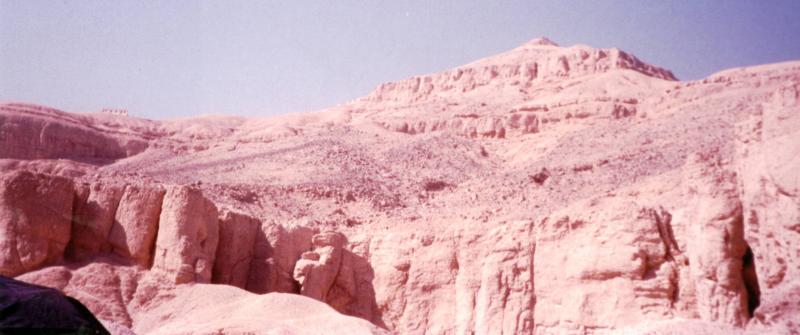
 There
was a variety of hieroglyphs and images, of the pharaohs, how they treated
their subjects, even the ceilings were beautifully adorned with dark
blue skies, thousands of stars and the sky goddess Nut, stretched above.
Tomb of Ramses III was like a picture book of "Better Homes
Gardens" with images of hundreds of pots, furniture and food preparation.
In the tomb of Ramses V/VI was a large shattered giant pharaoh-shaped
sarcophagus eerily illuminated by silver light - Ramses VI unusually
sharing a tomb with his predecessor brother. It is truly amazing
that such images have lasted thousands of years, hidden away in dark
low-humidity tombs that are quickly disintegrating since they have been
excavated.
There
was a variety of hieroglyphs and images, of the pharaohs, how they treated
their subjects, even the ceilings were beautifully adorned with dark
blue skies, thousands of stars and the sky goddess Nut, stretched above.
Tomb of Ramses III was like a picture book of "Better Homes
Gardens" with images of hundreds of pots, furniture and food preparation.
In the tomb of Ramses V/VI was a large shattered giant pharaoh-shaped
sarcophagus eerily illuminated by silver light - Ramses VI unusually
sharing a tomb with his predecessor brother. It is truly amazing
that such images have lasted thousands of years, hidden away in dark
low-humidity tombs that are quickly disintegrating since they have been
excavated. 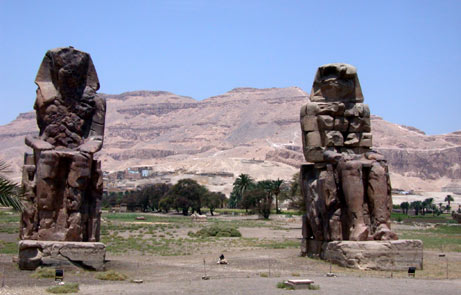 Just
past the Valley of the Kings, we stopped to view the Colossi of Memnon
- twin 18-metre figures of Amenhotep III that once stood in front of
what was believed to be Egypt's greatest temples, even larger than the
existing Temple of Karnak. Each carved from single pieces of stone,
once famous for bell-like tone emitted each sunrise. The Greeks believed
these sounds were made by the immortal Memnon greeting his mother. After
an Roman emperor made restorations in 170AD, the sounds ceased.
Just
past the Valley of the Kings, we stopped to view the Colossi of Memnon
- twin 18-metre figures of Amenhotep III that once stood in front of
what was believed to be Egypt's greatest temples, even larger than the
existing Temple of Karnak. Each carved from single pieces of stone,
once famous for bell-like tone emitted each sunrise. The Greeks believed
these sounds were made by the immortal Memnon greeting his mother. After
an Roman emperor made restorations in 170AD, the sounds ceased. Temples
of Karnak Luxor
Temples
of Karnak Luxor