2. April 2019 13:10
by Rene Pallesen
0 Comments
While in Japan we had to try a traditional Japanese bathhouse. We found a small one in the suburbs of Osaka that had good reviews and was also suited for the boys.
As most of the bath houses men and women are in different sections, so I took the boys with me which was a fun experience for them.
The bath house had a section that was full of yellow rubber ducks, and the boys spent a fair amount of time playing with them.
It also had a lot of other pools that varied from really hot to freezing cold pools as well a various mineral baths with water pumped up from deep underground.
It is difficult to describe the feeling, but both Kim and I felt amazing afterwards. No photos allowed inside, so the outside and the poster at the local trans station will have to do.
2. April 2019 13:10
by Rene Pallesen
0 Comments
In Osaka we went to the Universal Studios theme park. It was just before Halloween, so everywhere in the park people were dressed up in 'scary' costumes.
After dark the park put on the most amazing zombie show with hundreds of actors and dancers dressed up as zombies - No One celebrates Halloween like the Japanese - amazing!!!!
1. April 2019 20:10
by Rene Pallesen
0 Comments
Nara is an area a couple of hours outside Kyoto that is full of temples and deer roaming the streets.
It has a massive temple with one of the pillars with a hole in it. Apparently if you can squeeze through then you are enlightened.
The deers are good fun although Kim and and boys took a while to get used to them.
1. April 2019 18:10
by Rene Pallesen
0 Comments
This castle is close to the centre of the city. It is quite big and lit up at night. Out hotel was just around the corner so we passed it almost every day.
We didn't go inside it as there were too many other things to see.
1. April 2019 18:10
by Rene Pallesen
0 Comments
There are lots of temples in Kyoto. This is mainly because the city wasn't bombed during the second world war.
For historical reasons they are mostly outside the city centre in the hills - apparently they were banned from the city centre long time ago due to the monks growing influence.
1. April 2019 13:10
by Rene Pallesen
0 Comments
The golden pavillion in Kyoto is one of the most iconic sights in Kyoto. It is a small zen temple surrounded by a beautifully manicured landscape.
It is however very touristy with large tour buses and large crowds, but still worth the visit.
1. April 2019 09:10
by Rene Pallesen
0 Comments
Asiyama is on the outskirts of Kyoto and this is where people go to see the Bamboo forest but there is also lots of other things to see in the area such as monkeys and more traditional sights such as temples.
The bamboo forest itself is very crowded and the foot paths are fenced in and to be honest there are so many bamboo forests in Japan in the land districts that it is hard to see why this particular forest is so special.
It is lovely to see people in traditional kimono's being transported in rickshaws.
From the place where there are monkeys, there is also a view of all of Kyoto.
15. August 2000 10:41
by Rene Pallesen
0 Comments
Ecochallenge ( Sabah 2000 )The Competitors . . .The competitors did not rest... three of the teams were half way through the 600 kilometre course after only three days... pretty amazing!
Two of the teams were Australian. 18 teams were out of the race. At least 10 of these were due to medical problems.
Hardly any people around here get enough sleep... the place is active 24 hours per day because there are always competitors coming in!
I was keen to find out how the Danish team would turn out. At the beginning of the race, they were not very sociable. But by the end of the race, I think the tension of the race had gone, and I managed to have a chat with them. By the third day, the Danes are doing pretty well... they had a 22nd place!
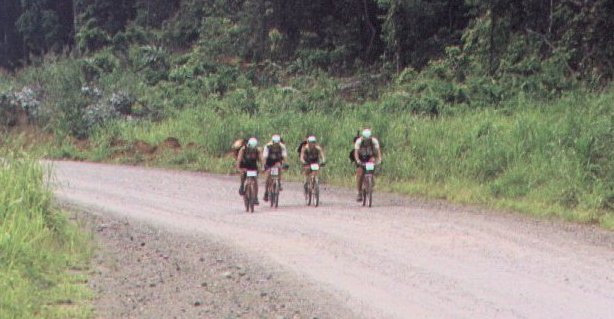
 This was the mountain-bike leg of the race.
The guy you see being transported to hospital in the helicopter (photos below), was doing this part of the race. He was rounding a corner on his bike and rode straight into a large branch.
This was the mountain-bike leg of the race.
The guy you see being transported to hospital in the helicopter (photos below), was doing this part of the race. He was rounding a corner on his bike and rode straight into a large branch.
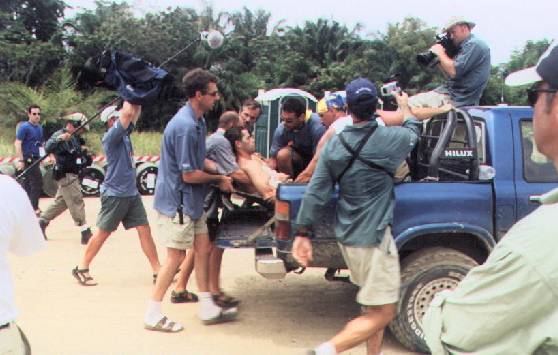
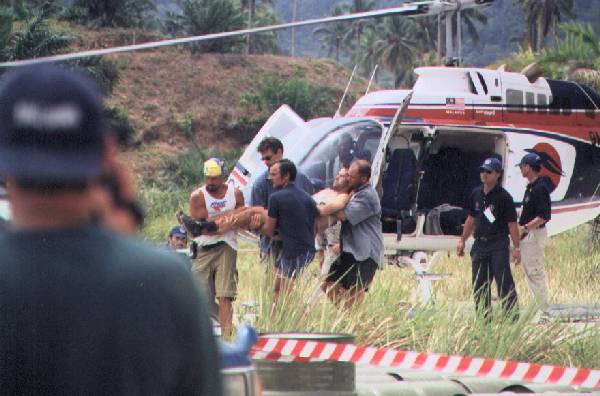 We had a lot of medical urgencies... we almost lost a guy with a punctured lung !
I got some great photos and helped getting the guy into the mobile hospital. There was a lot publicity on the website and through the media about it.
Fortunately, he was only 15 minutes away from HQ, so it was possible for us to get him to the helicopter very quickly, and to the nearest hospital.
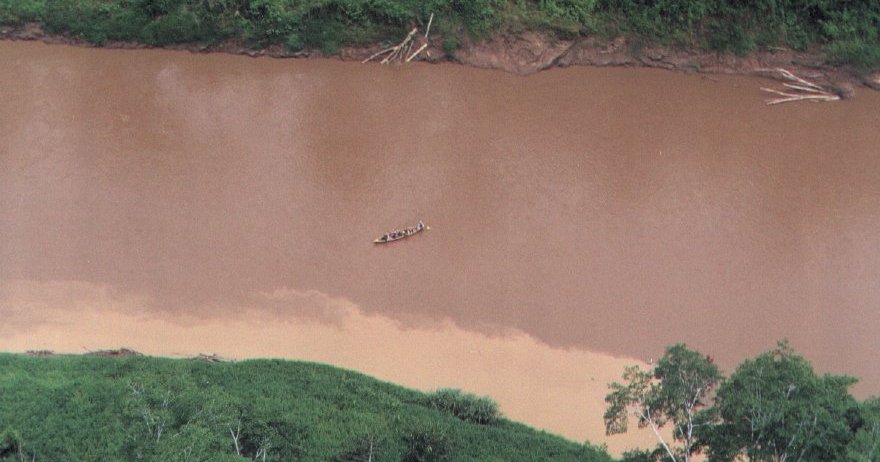 Another leg of the race involved rowing in these “sampans”, a Malay term for “boat”. At some point, the teams in the race had to also split up - some of them swimming, some of them rowing, to complete the water leg of the race.
Below, the competitors had to use a flying fox to cross the canyons. I managed to have a go at it - compared to rock-climbing... well, I found it pretty boring *smile*. I imagine most people would find it quite fun though.
Another leg of the race involved rowing in these “sampans”, a Malay term for “boat”. At some point, the teams in the race had to also split up - some of them swimming, some of them rowing, to complete the water leg of the race.
Below, the competitors had to use a flying fox to cross the canyons. I managed to have a go at it - compared to rock-climbing... well, I found it pretty boring *smile*. I imagine most people would find it quite fun though.

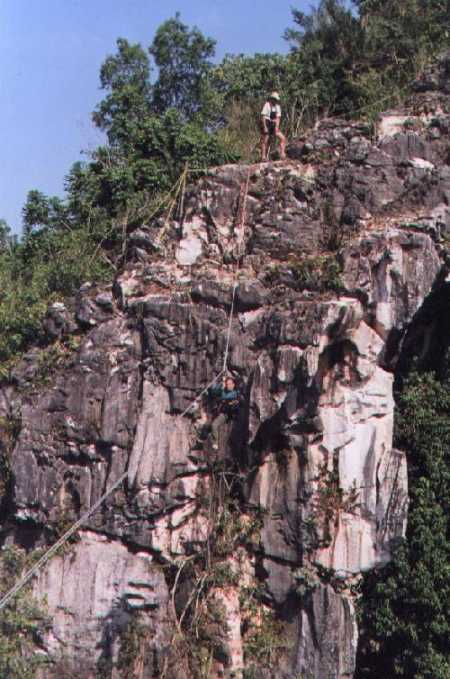 There are no places to climb here.
I had hoped to take one of the helicopters to Madai Caves to check out the 200 metre abseil. The road to the Madai Caves lead directly through the tiny village of Gua Madai - a small cluster of homes, their wood bleached grey.
The town’s main sources of income are tourism and birds’ nests. The nests are found high up the walls of the cave, tucked away in cracks and crevasses, and can command thousands of dollars. They are harvested about three times a year.
My girlfriend mentioned trying "bird's nest soup" whilst I was there. She said normally the bird's nest they use belong to the swallow. It is a delicacy to many Asians, and similar to shark's fin soup - that is if you have tried it. Normally the nests are made out of the birds' saliva.
There are no places to climb here.
I had hoped to take one of the helicopters to Madai Caves to check out the 200 metre abseil. The road to the Madai Caves lead directly through the tiny village of Gua Madai - a small cluster of homes, their wood bleached grey.
The town’s main sources of income are tourism and birds’ nests. The nests are found high up the walls of the cave, tucked away in cracks and crevasses, and can command thousands of dollars. They are harvested about three times a year.
My girlfriend mentioned trying "bird's nest soup" whilst I was there. She said normally the bird's nest they use belong to the swallow. It is a delicacy to many Asians, and similar to shark's fin soup - that is if you have tried it. Normally the nests are made out of the birds' saliva.
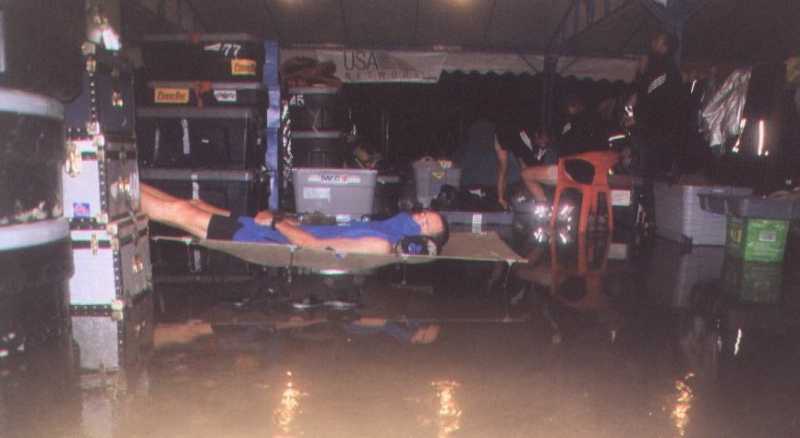
There was so much rain at Silam that HQ was often flooded.
Many of the competitors took the opportunity to get some sleep and the slept on whatever they could find.
Back to TopReturn to Borneo Homepage
Created: 7 Dec 2001
15. August 2000 10:40
by Rene Pallesen
0 Comments
Ecochallenge ( Sabah 2000 )Silam and Jungle Ops . . .It is so bloody hot in Silam! It must have been at least 40 degrees and 100% humidity!
Silam was the overall headquarters, and Danum Valley Field Centre (DVFC) was referred to as Jungle Ops. Jungle Ops controlled all radio communications and conducted the race through the the jungle.
From Kota Kinabalu, we flew to Lahad Datu and drove the rest of the way to Silam. Silam was the site of one of the repeater stations. We had to set up a HQ a few kilometres from this station... heaps of opportunities for a few walks in the jungle.
The operation at Silam was huge!... I had never seen such a busy place before. The place was crawling with energy. It was bigger than any military operation I had ever seen! You would be amazed to see the logistics involved in this project ! At the time I did not have the time to take a lot of photos.
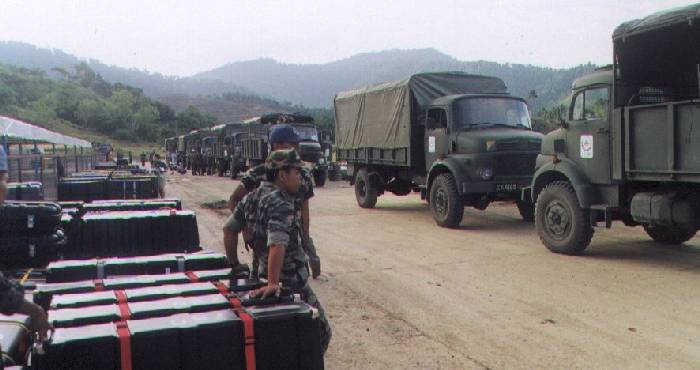
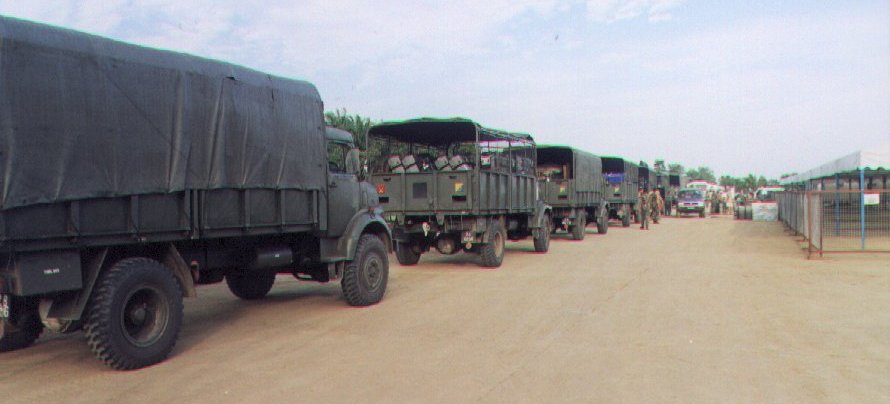
We had many army trucks transporting the competitors' equipment - very good cooperation from the military. They helped out with the preparation and set-up of HQ, and with the transportation of fuel.
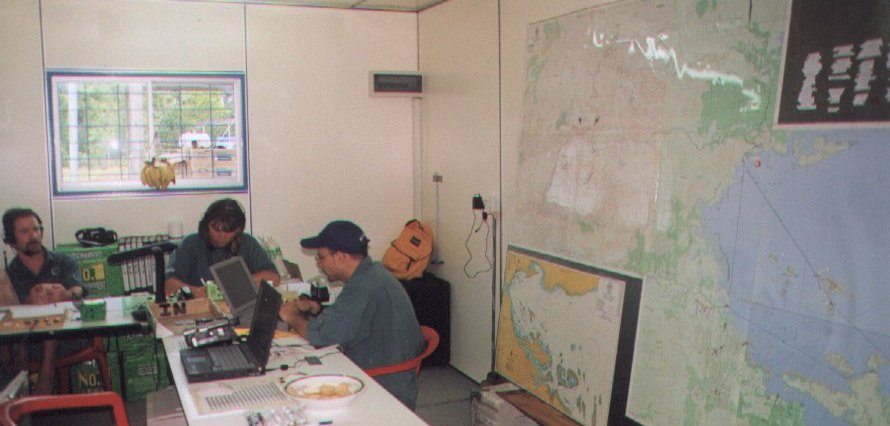 This is the headquarters on the left.
The whole Ecochallenge race is governed from this office.
The map in the background contains the position of all the checkpoints at which the competitors have to go through.
This is the headquarters on the left.
The whole Ecochallenge race is governed from this office.
The map in the background contains the position of all the checkpoints at which the competitors have to go through.
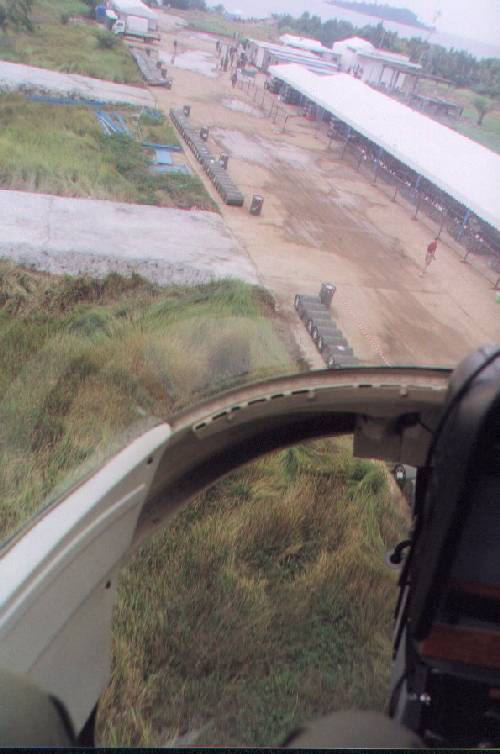

Both of the above photos are aerial shots of HQ and were taken from a helicopter.
I managed to get a nice aerial shot of Silam HQ. The big white patch in the middle is where the competitors stored all their equipment. Just to the left are the containers from where the race is controlled. The 4 'finger-like' white pads on the right are the heli-pads. The long rectangle to the left is the eating area, and just above it is the hospital.

Approaching DVFC in helicopter.
This is actually a research centre in the middle of the jungle - commonly known as DVFC (Danum Valley Field Centre).
DVFC is not normally accessible the tourists and the general public, only to researchers.
DVFC is concerned about contamination into the jungle.
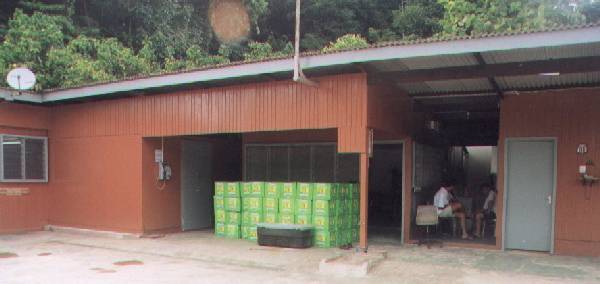 Outside Jungle Ops HQ.
The green boxes contain bottled drinking water.
By the time the race was over, most of this had been consumed - quite amazing really, considering there were really only 10 people at Jungle Ops.
During the competitors were not allowed any help from us, and that included the provision of drinking water.
Outside Jungle Ops HQ.
The green boxes contain bottled drinking water.
By the time the race was over, most of this had been consumed - quite amazing really, considering there were really only 10 people at Jungle Ops.
During the competitors were not allowed any help from us, and that included the provision of drinking water.
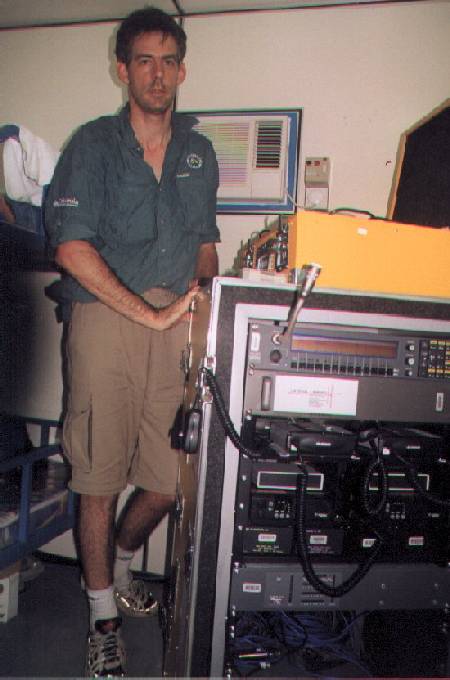
Paul with some of the radio equipment at Silam.
He is standing next to the HQ matrix, which contained all the communications equipment for headquarters.
Paul is also standing next to the only 2 beds in the HQ building. These were used by the radio operators to nap in between shifts.
Below, you see me sitting in the catering tent at Silam.
I think it must have been a good day, to have been sitting there, smiling... I am just guessing here, because obviously I did not take the photo, and I cannot re
Perfect Moments Photography | A Rene Pallesen Journal