Sunday 14. november 2004
On the first night we didn't sleep very
well - sleeping in a different bed combined with quranic prayers coming
from a nearby mosque didn't exactly leave us with a peaceful sleep.
However we were all up early to get together in Bedstemor's room for
a "surprise" get-together - to sing the danish birthday song
amongst a flutter of red white flags, and present her with a small
gift. This family "surprises" the birthdayee and all sing
in unison this rather cute birthday song.
The Citadel Muhammad Ali Mosque
 Our
first destination was the Citadel. It is the
city's fortress that once housed the royal family and although most
of the complex is open to visitors, the military still have a foothold
and some areas are out of bounds. It takes a half day to explore all
areas of the Citadel but we didn't have the opportunity to do so, and
instead spent most of our time in the Muhammad
Ali Mosque. Our
first destination was the Citadel. It is the
city's fortress that once housed the royal family and although most
of the complex is open to visitors, the military still have a foothold
and some areas are out of bounds. It takes a half day to explore all
areas of the Citadel but we didn't have the opportunity to do so, and
instead spent most of our time in the Muhammad
Ali Mosque.
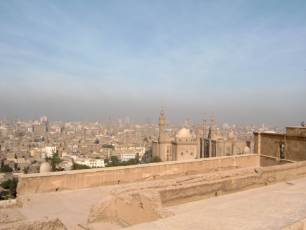
<== There is a magnificent view of the
city from the Western Terraces - magnificent had most of Cairo not been
filled with the same shade of mud-bricked buildings. What
was most notable about Cairo was its lack of colour or rather its ability
to blend into the desert.
 Our
guide Adam/Mohammed provided little insight to the function or history
of the Citadel, and instead sat the group in one corner of the Muhammad
Ali Mosque like a bunch of school children, and gave a lecture on Islamic
laws and behaviour. Our
guide Adam/Mohammed provided little insight to the function or history
of the Citadel, and instead sat the group in one corner of the Muhammad
Ali Mosque like a bunch of school children, and gave a lecture on Islamic
laws and behaviour.
When René ventured to ask more about
the Citadel, he was scolded for interrupting and told to listen. We
never got the opportunity to find the number 7 Napoleon's troops had
painted above one doorway to avoid using the unfamiliar Arabic names
or the twin half-round towers because our guide simply didn't know where
they were.

During this time, I had the opportunity
to wander off and walk the beautiful alabaster-lined arcades of the
mosque. the soaring central prayer hall was a glimmer of hundreds of
lights hanging in concentric circles. Arabic inscriptions in gold were
painted on the ceiling. Women had to be suitably attired and could not
wear sleeveless tops or short skirts or shorts. In one corner lay the
sarcophagus of Muhammad Ali - the builder of the mosque and an albanian
mercenary who was the founder of the dynasty that ruled till the revolution
in 1952.
Cairo Egyptian Museum
I
have memories of wandering around this museum, peering into smudged
glass cases, staring into the shrivelled faces of some once well-known
pharaoh like Ramses II and wondering if the ancient Egyptians were giants
in their large coffins.
20
years later, it was almost impossible to push through the crowds of
tourists - only useful because their guides provided more information
than ours. With only two hours, there was no way that we could view
the whole museum or see the royal mummies.
The museum
was celebrating its centenary and there was a special exhibition dedicated
to TutAnkhAmun - the most famous archaeological find. With travel guide
in hand, we oohed and ahhed over the gold treasures found in his tomb
- a gold throne featuring the famous scene of TutAnkhAmun's queen anointing
him, chests made out of ebony ivory, cheetah-skinned hunting shields,
bows, arrows, alabaster canopic jars holding King Tut's mummified organs,
gold sarcophagus - if Howard Carter had found such treasures for a little
known boy-king, imagine what the tomb of a pharaoh like Ramses II would
have been like? King Tut's inner coffin of solid gold and the famous
mask of gold that everyone wants to see and is portrayed in many egyptian
images.
The museum
has become another money-making expedition for the Egyptians with an
exhorbitant price to view the royal mummies. We had to content ourselves
with the animal mummies - cats, dogs, birds, goats, Nile perch (yes,
fish as well!) and most amazing was a 7-metre crocodile mummy.
The exhibitions
were arranged by themes on the upper floor and chronological on the
lower floor, going clockwise from the Old Kingdom, to the Middle and
finally to the New and later kingdoms. There were rooms full of giant
sarcophagi that would've weighed a tonne each, a room full of miniatures
showing the egyptians' daily li
Perfect Moments Photography | A Rene Pallesen Journal
|