Bedstemor's 85th Birthday ( 13
- 20 Nov 2004 ) |
|
|
Ancient Egyptian stories and legends have
long made their mark through movies such as "Cleopatra", "The
Mummy" and wowed us women with Omar Sharif's performance in "Lawrence
of Arabia" and "Doctor Zhivago" and more recently in
cartoons such as "The Prince of Egypt". There is a certain
mystic about middle east portrayed to us from a very young age when
we hear bedtime tales like "Ali Baba the 40 Thieves"
or "Sinbad the Sailor" - most of us have a dream of seeing
the pyramids.
I was very lucky to have the opportunity
20 years ago to come to Egypt with my parents and at 10 years old, there's
only so much a child can remember. But this year, the Pallesen Family
once again get together for the Matriach's 85th birthday. It is tradition
for the family to come together and travel to an exotic country - in
the past Tunisia, Morocco, Gambia and for Grandmother's last wish, to
see the pyramids of Egypt, that her husband saw 45 years earlier.
The Matriach's three children, six grandchildren
(Nikolai could not make it), four greatgrandchildren and respective
spouses all came together for a week in magical Egypt. It is autumn
with warm days and cool nights - a contrast to the approaching winter
in Denmark.
|
Saturday 13 November 2004
Departure for Egypt
Our family had to leave Falster at 2:30am
to catch a 6:30 flight, 4½hr later we arrived at Cairo Airport.
I have dim memories of a very warm airport in complete chaos, with people
pushing to get their luggage through, shouting over a mad din. Instead
we found a rather clean and uncrowded airport. We were met by the AB
Travel Agency representative, taken to a Hotel Pyramisa, left in a closed
piano bar and promptly forgotten until one of us had the bright idea to ask for
our keys.
and promptly forgotten until one of us had the bright idea to ask for
our keys.
Our family shared a two-bedroom hotel room
with a large living area. Our first afternoon was spent walking around
the streets of Cairo trying to find a place for the family to have dinner.
Our hotel was located across the river from downtown
Cairo, so there was not a lot to see, combined with the fact that
many shops were closed during the day over Ramadan, the Islamic period
of fasting from dawn to dusk. Sunday heralded the last day of Ramadan,
so many were preparing for the final feast.
In the end, the whole family had dinner
in the hotel's "Oriental" restaurant of Egyptian style. We
figured we would get some decent Egyptian food but were disappointed
to find most of our food luke-warm. The rice was very dry, little meat
on the lamb and rather bland food. To our surprise, after our comment
about this, we were presented with a complimentary platter of fruits
native to Egypt such as fresh dates and guava. To our amusement, no
matter what kind of Egyptian wine we ordered, they all tasted the same.
There was plenty of Egyptian beer and of course the danes lived up to
their drinking prowess and Bedstemor ("grandmother") treated
us all dinner.
|
Sunday 14. november 2004
On the first night we didn't sleep very
well - sleeping in a different bed combined with quranic prayers coming
from a nearby mosque didn't exactly leave us with a peaceful sleep.
However we were all up early to get together in Bedstemor's room for
a "surprise" get-together - to sing the danish birthday song
amongst a flutter of red white flags, and present her with a small
gift. This family "surprises" the birthdayee and all sing
in unison this rather cute birthday song.
The Citadel Muhammad Ali Mosque
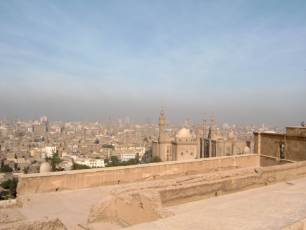 Our
first destination was the Citadel. It is the
city's fortress that once housed the royal family and although most
of the complex is open to visitors, the military still have a foothold
and some areas are out of bounds. It takes a half day to explore all
areas of the Citadel but we didn't have the opportunity to do so, and
instead spent most of our time in the Muhammad
Ali Mosque. Our
first destination was the Citadel. It is the
city's fortress that once housed the royal family and although most
of the complex is open to visitors, the military still have a foothold
and some areas are out of bounds. It takes a half day to explore all
areas of the Citadel but we didn't have the opportunity to do so, and
instead spent most of our time in the Muhammad
Ali Mosque.
<== There is a magnificent view of the
city from the Western Terraces - magnificent had most of Cairo not been
filled with the same shade of mud-bricked buildings. What
was most notable about Cairo was its lack of colour or rather its ability
to blend into the desert.
 Our
guide Adam/Mohammed provided little insight to the function or history
of the Citadel, and instead sat the group in one corner of the Muhammad
Ali Mosque like a bunch of school children, and gave a lecture on Islamic
laws and behaviour. Our
guide Adam/Mohammed provided little insight to the function or history
of the Citadel, and instead sat the group in one corner of the Muhammad
Ali Mosque like a bunch of school children, and gave a lecture on Islamic
laws and behaviour.
When René ventured to ask more about
the Citadel, he was scolded for interrupting and told to listen. We
never got the opportunity to find the number 7 Napoleon's troops had
painted above one doorway to avoid using the unfamiliar Arabic names
or the twin half-round towers because our guide simply didn't know where
they were.

During this time, I had the opportunity
to wander off and walk the beautiful alabaster-lined arcades of the
mosque. the soaring central prayer hall was a glimmer of hundreds of
lights hanging in concentric circles. Arabic inscriptions in gold were
painted on the ceiling. Women had to be suitably attired and could not
wear sleeveless tops or short skirts or shorts. In one corner lay the
sarcophagus of Muhammad Ali - the builder of the mosque and an albanian
mercenary who was the founder of the dynasty that ruled till the revolution
in 1952.
Cairo Egyptian Museum
I
have memories of wandering around this museum, peering into smudged
glass cases, staring into the shrivelled faces of some once well-known
pharaoh like Ramses II and wondering if the ancient Egyptians were giants
in their large coffins.
20
years later, it was almost impossible to push through the crowds of
tourists - only useful because their guides provided more information
than ours. With only two hours, there was no way that we could view
the whole museum or see the royal mummies.
The museum
was celebrating its centenary and there was a special exhibition dedicated
to TutAnkhAmun - the most famous archaeological find. With travel guide
in hand, we oohed and ahhed over the gold treasures found in his tomb
- a gold throne featuring the famous scene of TutAnkhAmun's queen anointing
him, chests made out of ebony ivory, cheetah-skinned hunting shields,
bows, arrows, alabaster canopic jars holding King Tut's mummified organs,
gold sarcophagus - if Howard Carter had found such treasures for a little
known boy-king, imagine what the tomb of a pharaoh like Ramses II would
have been like? King Tut's inner coffin of solid gold and the famous
mask of gold that everyone wants to see and is portrayed in many egyptian
images.
The museum
has become another money-making expedition for the Egyptians with an
exhorbitant price to view the royal mummies. We had to content ourselves
with the animal mummies - cats, dogs, birds, goats, Nile perch (yes,
fish as well!) and most amazing was a 7-metre crocodile mummy.
The exhibitions
were arranged by themes on the upper floor and chronological on the
lower floor, going clockwise from the Old Kingdom, to the Middle and
finally to the New and later kingdoms. There were rooms full of giant
sarcophagi that would've weighed a tonne each, a room full of miniatures
showing the egyptians' daily lives, a room full of ancient papyrus long
faded and rooms full of bits and pieces from ruins, statues, palace
floors - a place where one needs a days to spend with a decent travel
guide.
|
Khan Al-Khalili
 After
a stop at an egyptian perfumery and some lunch,
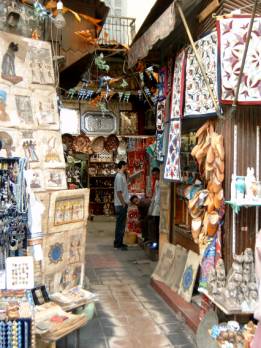
we headed to Khan Al-Khalili - the oldest
bazaar in Egypt that has lasted since the 1300s. Ancient buyers visited
the khan for goods brought in on merchant caravans. No longer do we
find slaves, silk, jewels or diamonds, but wooden guitars, brightly
patched pouffe covers, clothes, t-shirts, crappy papyrus paintings,
bongs/water pipes, bright bolts of cloth, the aroma of spices is very
much present and stalls are heaped with bright red, gold and blue powders
and sacks of seeds pods. Coppersmiths hammer out platters, tureens,
coffeepots and enormous crescent-shaped tops for minarets. It is a ritual
of the bazaar to expect to bargain - locals or foreign visitors - usually
a 10th of the offer price - if you have paid a third, you have paid
too much. We had only an hour to spare but many of the shops were closed
for a siesta after lunch. Ulla I pointed to bags of multicoloured
spices. He wanted £50 (AUD$10, 50DK.Kr) and after I said "da
ketir awi" (it costs too much) and walked away, the shopkeeper
doggedly followed us for a kilometre reducing the price from £40
to £30, £25, £20 and after we shouted £10 in
jest, he offered £15, £10 and finally £5 before finally
giving up on us. After much haggling, we managed to bargain for two
ornate glass perfume bottles for £20 (AUD$2.50; 20DK.Kr) After
a stop at an egyptian perfumery and some lunch,
we headed to Khan Al-Khalili - the oldest
bazaar in Egypt that has lasted since the 1300s. Ancient buyers visited
the khan for goods brought in on merchant caravans. No longer do we
find slaves, silk, jewels or diamonds, but wooden guitars, brightly
patched pouffe covers, clothes, t-shirts, crappy papyrus paintings,
bongs/water pipes, bright bolts of cloth, the aroma of spices is very
much present and stalls are heaped with bright red, gold and blue powders
and sacks of seeds pods. Coppersmiths hammer out platters, tureens,
coffeepots and enormous crescent-shaped tops for minarets. It is a ritual
of the bazaar to expect to bargain - locals or foreign visitors - usually
a 10th of the offer price - if you have paid a third, you have paid
too much. We had only an hour to spare but many of the shops were closed
for a siesta after lunch. Ulla I pointed to bags of multicoloured
spices. He wanted £50 (AUD$10, 50DK.Kr) and after I said "da
ketir awi" (it costs too much) and walked away, the shopkeeper
doggedly followed us for a kilometre reducing the price from £40
to £30, £25, £20 and after we shouted £10 in
jest, he offered £15, £10 and finally £5 before finally
giving up on us. After much haggling, we managed to bargain for two
ornate glass perfume bottles for £20 (AUD$2.50; 20DK.Kr)
|
Bedstemor's Birthday Feast
 Irene
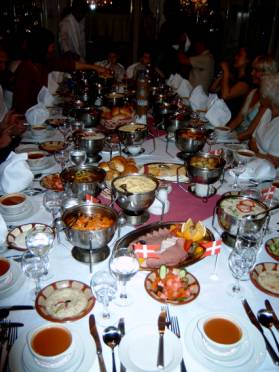
Ole had organised a private room for Bedstemor's
birthday party. A single long table in a room of egyptian style.
Small silver pots lined in two rows in the middle of the table kept
the food warm. Irene
Ole had organised a private room for Bedstemor's
birthday party. A single long table in a room of egyptian style.
Small silver pots lined in two rows in the middle of the table kept
the food warm.
We feasted on cumin-flavoured fried fish,
chicken fillets egyptian-style, cinammon-flavoured ravioli, rice, mashed
potatoes and beef steaks in pepper sauce, sang and toasted with bottles
of egyptian wine and beer to Bedstemor.
Whilst the children played in one corner,
there was much chatter througout the table and the evening finished
off with chocolate and fruit cakes topped with "Happy Pirthday"
(note, it's not an error) and we laughed in amusement in a plethora
of egyptian sweets - baklawa, semolina tarts, rose-water flavoured tarts,
and tarts that tasted like liquid honey... Ulla almost wanted to take
the rest of the desserts with her (except for the rose-water flavoured
ones - it was funny to watch her expression - rosewater almost smells
like cosmetics). The waiters were extremely attentive, coming by every
two minutes to serve us.
Best of all, Bedstemor turned 2 years old,
as she blew out each candle on the cakes. As the danes would say, "det
var meget hyggeligt!" (it was cozy)
|
Monday 15. november 2004 (7:30am start)
From the brown buildings and streets of
Cairo, we travelled 24km southeast of the city to Saqqara, changing
from a uniform brown to lush green fields of large cabbages and hundreds
of date palms. It was like an oasis, a gentle mist gave a surreal sense
of the fertile plains of ancient Egypt. Women in full-length black abeeyas
squatted in the fields, the odd man walking around - such a contrast
to the intense crowds of central Cairo.
Saqqara's Step Pyramid
Founded as a necropolis (burial city) for
the Old Kingdom and is one of the richest archaeological sites in Egypt.
The Step Pyramid
is less that ½ the height of the largest pyramids at Giza, but
this monument served as a predecessor of the smooth pyramids. Previously
tombs were made of mud brick, rectangular slablike structure covering
a burial pit. But the architect Imhotep had the bright idea to construct
in stone and  build
the slablike structure 5 times one on top of the other, creating the
first pyramid. build
the slablike structure 5 times one on top of the other, creating the
first pyramid.
We entered through the Great South Court
- the size of a soccer field, down a corridor of 40 pillars inspired
by bundles of tied reeds. Whilst Adam was making another one of his
speeches, I was tempted by a turbaned egyptian in a dress who took me
to the top where I managed to get one shot of the magnificent pillars
up top, before being scolded by Adam and being asked for baksheesh (tip).
I was gratefully rescued by a couple of Italians when the egyptian would
not let me go without a baksheesh. However, once I surfaced from the
building, I was blinded by white sands and the immense pyramid sitting
solitary amongst a few ruined stones, with a much smaller triangular
heap of stones in the background. Although the morning had been cool,
the sun soon warmed us up as we wandered round to the north.
|
Memphis
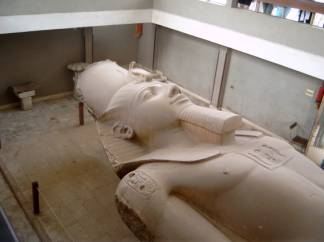 Once
the capital of ancient Egypt, it remains unexcavated
due to villages built on top of it and a high water table as a result
of the Aswan Dam. There is a small garden with small finds - bits and
pieces but the most exciting thing to see is a colossus of Ramses II
lying on his back as the lower legs are missing. The colossus would've
been 5 stories high had it been standing. Nearby lies the largest alabaster
statue ever found - 80 tons of sphinx - imagine what treasures that
could've been found if Memphis could've been excavated, especially as
this ancient city lay halfway between Upper and Lower Egypt. Once
the capital of ancient Egypt, it remains unexcavated
due to villages built on top of it and a high water table as a result
of the Aswan Dam. There is a small garden with small finds - bits and
pieces but the most exciting thing to see is a colossus of Ramses II
lying on his back as the lower legs are missing. The colossus would've
been 5 stories high had it been standing. Nearby lies the largest alabaster
statue ever found - 80 tons of sphinx - imagine what treasures that
could've been found if Memphis could've been excavated, especially as
this ancient city lay halfway between Upper and Lower Egypt.
Our final stop before lunch was a papyrus
museum - another place of commission for Adam. Bedstemor purchased a
papyrus of egyptian alphabets. Some of the paintings cost a massive
£3,500 (AUD$900, 3,500DK.Kr). For lunch, we had a splendid egyptian
meal in the middle of nowhere that served excellent mezza (egyptian
tapas) of baba ghanoush (roasted eggplant dip), tzatziki (cucumber dip),
hummus (chickpea dip), fuul (beans) served with freshly made pita bread,
warm vine-leaf rolls, lamb kofta and freshly roasted chicken in thyme.
It was feast fit for a king and the most egyptian meal we had on the
whole trip.
|
 Pyramids
of Giza Pyramids
of Giza
From air the desert pyramids were
right on the edge of the city, 16km from Cairo.
I remember vaguely, as a child, hunched
over, walking up a surprisingly warm shaft lit by a single light bulbs
and emerging into a very chilly dark room that held a single stone sarcophagus,
the room empty except for occasional square holes in the wall where
food was left for the afterlife.
I had entered the Queen's chamber in the
largest pyramid and 20 years later, only the first 300 can enter these
pyramids - for an exhorbitant fee. |
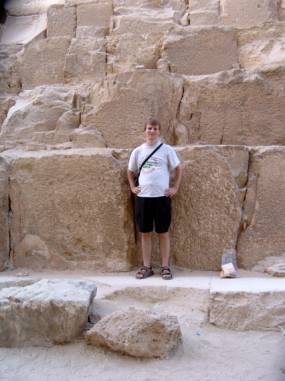
The largest of the three, Cheops' pyramid was
the largest, standing at 146metres at one point, took 920 metres to
walk around it and contained 2.3 million blocks! Each block was at least
one metre high, so you can imagine how massive these pyramids were.
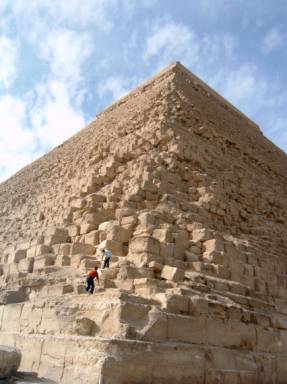
The 2nd largest, Khefren's (Cheop's son) pyramid
still had some of the smooth shiny limestone casing that once used to
cover all these pyramids.==>
The massive solar boat that once carried
the pharaoh's body from Memphis to Giza and the
three smaller Queens' pyramids stood at one corner of the massive Cheop
pyramid. We didn't have the opportunity this time to enter the tombs,
but I feel priveleged that I did and that I still have some memories
of the event.
|
The Sphinx
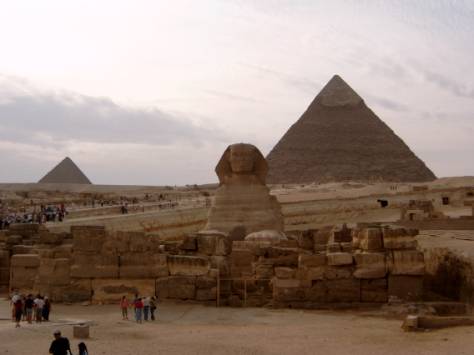 The
pyramids loomed in the background as it sat silently on the hot sand
under the glaring sunlight for 4,000 years. Napoleon's troops once used
it for target practice, so its nose and pharaohs beard and long fallen
off and lies in a British museum. The Greeks called it "the
Sphinx" as it was based on a mystical creature with the head
of a man and body of a lion, which would stop any traveller along the
way with a riddle - if the riddle wasn't answered, it became the sphinx's
dinner. Throngs of crowds surrounded the sphinx and we could only enter
in single file. Over time, it seemed that tourists could view it from
further and further away. 45 years ago, Bedstefar's (grandfather) could
touch the Sphinx and even climb to the top of the pyramid; 20 years
ago, it was simply surrounded by a small wire fence but I could stand
close up to it; now it lay in a very large pit where visitors could
only view it up close if they zoomed in on their cameras. 4 millenia
later, it still manages to awe all of us. The
pyramids loomed in the background as it sat silently on the hot sand
under the glaring sunlight for 4,000 years. Napoleon's troops once used
it for target practice, so its nose and pharaohs beard and long fallen
off and lies in a British museum. The Greeks called it "the
Sphinx" as it was based on a mystical creature with the head
of a man and body of a lion, which would stop any traveller along the
way with a riddle - if the riddle wasn't answered, it became the sphinx's
dinner. Throngs of crowds surrounded the sphinx and we could only enter
in single file. Over time, it seemed that tourists could view it from
further and further away. 45 years ago, Bedstefar's (grandfather) could
touch the Sphinx and even climb to the top of the pyramid; 20 years
ago, it was simply surrounded by a small wire fence but I could stand
close up to it; now it lay in a very large pit where visitors could
only view it up close if they zoomed in on their cameras. 4 millenia
later, it still manages to awe all of us.
|
Tuesday 16. november 2004 (2:30am start)
Yes, you did read that right - we were
all waiting in the lobby at 2:30AM. Last night, Bedstemor's grandchildren
treated the family to a Spanish-Egyptian Italian
dinner, which was followed by a 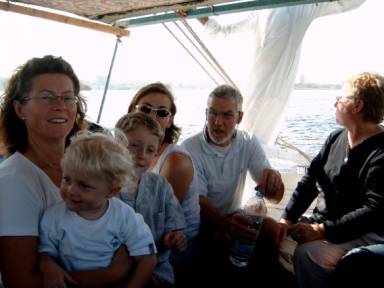 cacophany
of tambourines, oboes and drums played for an Egyptian engagement couple
in the lobby. cacophany
of tambourines, oboes and drums played for an Egyptian engagement couple
in the lobby.
This morning we were flying to Aswan, to
board a 3-day cruise up the Nile, sailing up to Luxor. When we arrived,
we were taken for a short felucca ride along
the Nile with a fantastic view of the Tomb of Nobles.
When we returned we were given our rooms onboard a four-storey cruise
ship that had an indoor games room, a pool and sundeck at the top.
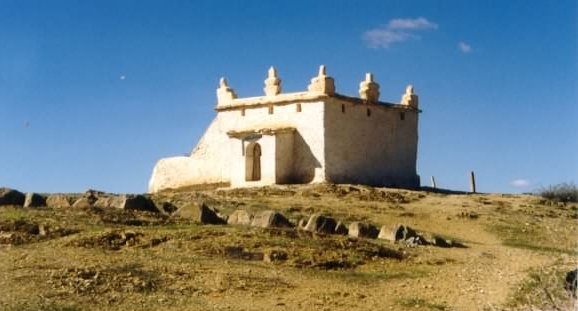
Even from our rooms right at the bottom, we had a magnificent view of
a small white mosque-like structure on top of huge sandy mountains dotted
with small caves.
In the evening we had the opportunity to
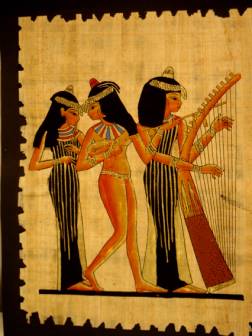
visit a small souq (local bazaar) selling t-shirts, papyrus paintings,
mounds of saffron and dry scented lotus flowers, brown, red, yellow
indigo mounds of fragrant spices - all of which some of us bargained
for - the most expensive £25 papyrus painting (AUD$5, 25DK.Kr)
to cheapest £15 embroidered t-shirts with hieroglyphics (AUD$3,
15DK.Kr). To top the evening off, we took a £5 horse carriage
ride back to the ship. |
|
Wednesday 17. november 2004 (7:30am
start)
It seemed some of the family had succumbed
to a tummy bug. The rest of us steered clear of unwashed fruit, fresh
salads, raw vegetables and drinks made with local water. However, this
didn't stop us from going out to see a few sights.
The Unfinished Obelisk
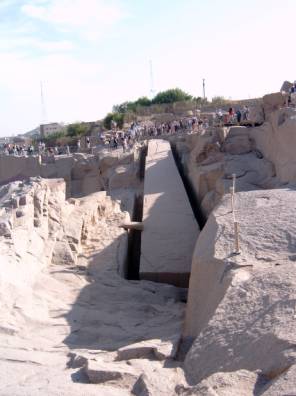
Had this obelisk
been completed, it would've been the largest and heaviest ever made
standing at 142 metres. It sat in a granite quarry, perfectly complete
on three sides but abandoned when a flaw was found in the stone. It
is almost impossible to imagine how the ancient egyptians could've moved
even a single rock made from this quarry as it stood a great many miles
from any of the monuments ever made. Unfortunately for Egypt, most of
its obelisks have been spirited to other countries - to Italy, Britain,
France and even Argentina by foreign archaeologists in the last centuries.
Most of us didn't have the chance to view the complete obelisk before
Adam rang a bell that he carried (to annoy us I suppose) |
|
High Dam
 For
centuries the Nile controlled the Egyptians' lives - either flooding
or insufficient water levels were disastrous for the people who relied
on this huge water source for their livelihood. When the Aswan
Dam was built, some of the villages in the south lost their water
supply. For
centuries the Nile controlled the Egyptians' lives - either flooding
or insufficient water levels were disastrous for the people who relied
on this huge water source for their livelihood. When the Aswan
Dam was built, some of the villages in the south lost their water
supply.
30 years ago, a new High Dam was built
which resulted in the man-made Lake Nasser to the south being created
==>
This meant many people had to be moved
as villages were buried, as well as some of the ancient egyptian monuments
such as the Temple of Philae. |
 At
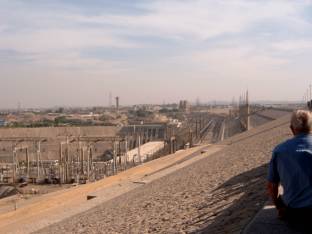
its highest point, the High Dam stands at 111m high, 3.8km long and
980m wide at the base. At
its highest point, the High Dam stands at 111m high, 3.8km long and
980m wide at the base.
Three times the number of stones used for
Cheops' Pyramid was used.
Videoing isn't allowed as it is a high-security
military area - should there be an attack on this Dam, then much of
Egypt would be submerged under water and would be a disaster for the
country.
Given only 10min, Adam "rang"
us back to the bus. |
Temple of Philae
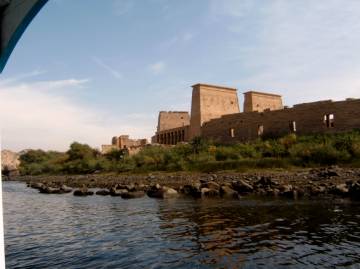 After
Aswan Dam, the Temple of Philae was submerged
for six months a year and tourists had to view it through the murky
waters of Lake Philae. When the High Dam was built, it threatened to
submerge the Temple permanently, so was moved stone by stone to a new
island similarly landscaped. Philae is special in that it's only accessible
by boat and the sunset forms a spectactular backdrop. A temple dedicated
to Isis (goddess of women, sex purity), it was one of the last
outposes for paganism and due to the popularity of Isis, was also used
by the early Christians. The Temple walls and many pillars were filled
from top to bottom with hieroglyphs and images of Isis - many defaced
by the early Christians who considered ancient Egypt's gods to be "pagan".
I had a fantastic afternoon walking in and out of all the nook and crannies
- visiting the Birth House, Nilometer, the "Pharaoh's Bedstead"
and much to the amusement of the family, I was the last to emerge. After
Aswan Dam, the Temple of Philae was submerged
for six months a year and tourists had to view it through the murky
waters of Lake Philae. When the High Dam was built, it threatened to
submerge the Temple permanently, so was moved stone by stone to a new
island similarly landscaped. Philae is special in that it's only accessible
by boat and the sunset forms a spectactular backdrop. A temple dedicated
to Isis (goddess of women, sex purity), it was one of the last
outposes for paganism and due to the popularity of Isis, was also used
by the early Christians. The Temple walls and many pillars were filled
from top to bottom with hieroglyphs and images of Isis - many defaced
by the early Christians who considered ancient Egypt's gods to be "pagan".
I had a fantastic afternoon walking in and out of all the nook and crannies
- visiting the Birth House, Nilometer, the "Pharaoh's Bedstead"
and much to the amusement of the family, I was the last to emerge.
|
 Kom
Ombo Kom
Ombo
The ship set sail from Aswan at 3:45pm
after an afternoon spent sunbaking and drinking beer (typically danish
to make the most of sunshine and beer). We were sailing 48km north of
Aswan to Kom Ombo - the site of an ancient
city devoted to the worship of a crocodile god, Sobek. The ancient city
is long gone and crocodiles existing on nearby sandbanks have been hunted
to extinction.
At sunset, we visited the Temple of Kom
Ombo, dedicated to both Sobek the Crocodile god and Horus, the falcon-headed
sky god Isis' son. Although we didn't have the opportunity to
explore this 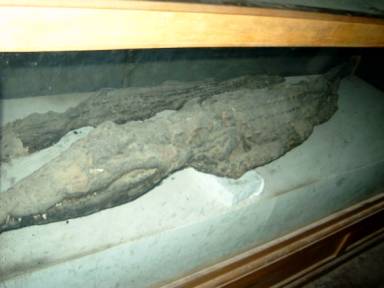 temple,
it was both spectacular and eerie at sunset, with large light illuminating
it. There existed a pit filled with water, with a platform halfway down,
where crocodiles were lured in from the Nile with human flesh, and the
largest crocodile was caught and mummified as a tribute to Sobek. At
the Chapel of Hathor (Horus' wife), an American shouted "Geez,
I thought I was supposed to see crocodile statues!" *laugh* It
contained two of the mummified crocodiles found at the Temple. temple,
it was both spectacular and eerie at sunset, with large light illuminating
it. There existed a pit filled with water, with a platform halfway down,
where crocodiles were lured in from the Nile with human flesh, and the
largest crocodile was caught and mummified as a tribute to Sobek. At
the Chapel of Hathor (Horus' wife), an American shouted "Geez,
I thought I was supposed to see crocodile statues!" *laugh* It
contained two of the mummified crocodiles found at the Temple.
We returned to a small cocktail party before
dinner, provided by the ship to introduce all the staff responsible
for making our trip enjoyable.
|
Thursday 18. november 2004 (7am start)
We sailed overnight past Kom Ombo to Edfu,
a small regional center for the sugarcane trade, visited the Temple
of Horus and sailed on to the Lock-crossing at Esna.
Temple of Horus
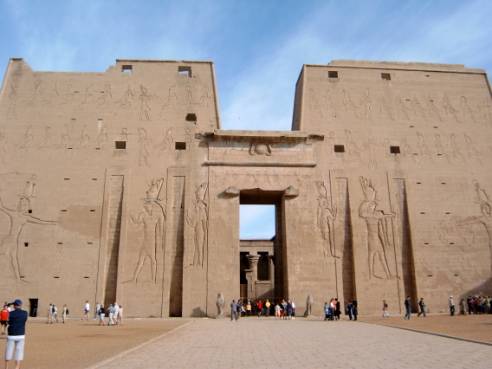 This
is the most complete of its kind, a Greco-Roman
temple that conforms exactly to ancient egyptian principles of architecture
ie visit Edfu to see what almost every other temple in Egypt would've
looked like in its original form. We were awed by the massive walls
of the pylons at the entrance, distince reliefs showing mirror images
of Horus and the pharaoh grasping the hair of his enemies. It was built
by Cleopatra's father around 50yr BC. Standing in the forecourt of this
well-preserved temple we can see mud-brick houses lined up at the top
of the compound walls because this temple was once buried right up to
the ceiling with a village built on top of it. Many of the temple relifes
capture the cataclysmic battle of Horus with his brother Seth. We entered
a small Nilometer - a dark, dank tunnel that smelled of pee and was
once used to measure the level of the Nile. Again I was the last to
emerge (a couple of minutes late only) to the loud applause of everyone
(and a huge glare from Adam). This
is the most complete of its kind, a Greco-Roman
temple that conforms exactly to ancient egyptian principles of architecture
ie visit Edfu to see what almost every other temple in Egypt would've
looked like in its original form. We were awed by the massive walls
of the pylons at the entrance, distince reliefs showing mirror images
of Horus and the pharaoh grasping the hair of his enemies. It was built
by Cleopatra's father around 50yr BC. Standing in the forecourt of this
well-preserved temple we can see mud-brick houses lined up at the top
of the compound walls because this temple was once buried right up to
the ceiling with a village built on top of it. Many of the temple relifes
capture the cataclysmic battle of Horus with his brother Seth. We entered
a small Nilometer - a dark, dank tunnel that smelled of pee and was
once used to measure the level of the Nile. Again I was the last to
emerge (a couple of minutes late only) to the loud applause of everyone
(and a huge glare from Adam).
|
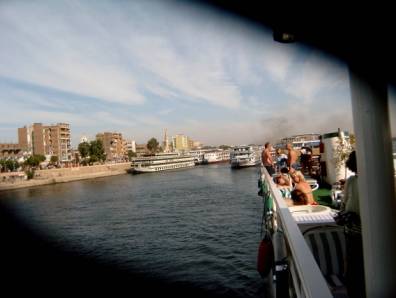 Returning
to the ship in time for the 9am sail, we set off for Esna, 48km south
of Luxor. Whilst the family tanned on the sundeck,
I sat in the sun at the front of the boat, enjoying sense of peace and
tranquility. It was truly beautiful to sit on a boat not too big or
small, to watch the changing scenery on both sides, passed fields of
giant palms and lush green fields, a smoking metal, the ship moving
at a leisurely 16km/hr and passing some incredibe mountains of sand
and cliffs. Ole joined me for a chat - he Irene are moving to
Greenland on Tuesday. Later in the morning, I joined René and
Ulla by the pool, gossiping about Bedstefar and family resemblances,
watching Vinnie's kids and Sebastian splash about the pool, Lonnie,
Sarah Birit stripped down to the minimum to get a bit of colour. Returning
to the ship in time for the 9am sail, we set off for Esna, 48km south
of Luxor. Whilst the family tanned on the sundeck,
I sat in the sun at the front of the boat, enjoying sense of peace and
tranquility. It was truly beautiful to sit on a boat not too big or
small, to watch the changing scenery on both sides, passed fields of
giant palms and lush green fields, a smoking metal, the ship moving
at a leisurely 16km/hr and passing some incredibe mountains of sand
and cliffs. Ole joined me for a chat - he Irene are moving to
Greenland on Tuesday. Later in the morning, I joined René and
Ulla by the pool, gossiping about Bedstefar and family resemblances,
watching Vinnie's kids and Sebastian splash about the pool, Lonnie,
Sarah Birit stripped down to the minimum to get a bit of colour.
|
 We
reached Esna and used the few hours to get off the ship and stretch
our legs after a morning of lazing around the pool. I was itching to
walk around Esna, away from tourists and see how the locals lived. René
and I headed for the quieter streets avoiding the busy streets
around a souq. We were followed by a few children clad in long grey
or white robes, who guided and annoyed us. Most of the narrow streets
were unpaved, some very muddy and smelling of manure. Skinny, skeletal
donkeys balanced again flat wagons, many shy girls waving from the darkness
of their doorways or 2nd-level windows, whilst little boys came out
to say hello and mill around us. Most houses were simple of mud bricks,
with tiny wooden shuttered windows to keep the intense summer heat out.
Some had extremely ornate wooden doors, reminiscent of colonial days.
Occasional peek in doorways revealed empty mud-lined rooms as most people
lived in the upper floors. Eventually René shouted imshee! (go
away) as the kids got noisier, more aggressive, pulling on our arms
and throwing pebbles at us. When I stumbled over a whimpering black
and white disease-ridden puppy in brown paper, it was kicked aside -
making me almost reach out for it if René hadn't stopped me.it
was wise not to even make contact witht the children, who were dust-covered
and clad in the long egyptian grey robes. It was such a relief when
they finally left us even though we knew they were hiding in in alleyways
watching us wind through the streets. There were goldsmiths glittering
with ornate rings, earrings and necklaces; tailors still sewing by hand
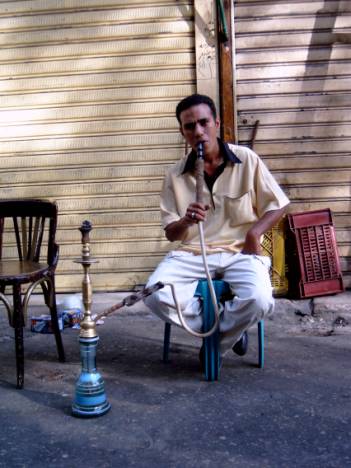
on the steps of their shop; coffee houses filled with solitary men smoking
their water-pipes - their eyes following us down the street. We had
spent so much time just sitting around that it was good to get away. We
reached Esna and used the few hours to get off the ship and stretch
our legs after a morning of lazing around the pool. I was itching to
walk around Esna, away from tourists and see how the locals lived. René
and I headed for the quieter streets avoiding the busy streets
around a souq. We were followed by a few children clad in long grey
or white robes, who guided and annoyed us. Most of the narrow streets
were unpaved, some very muddy and smelling of manure. Skinny, skeletal
donkeys balanced again flat wagons, many shy girls waving from the darkness
of their doorways or 2nd-level windows, whilst little boys came out
to say hello and mill around us. Most houses were simple of mud bricks,
with tiny wooden shuttered windows to keep the intense summer heat out.
Some had extremely ornate wooden doors, reminiscent of colonial days.
Occasional peek in doorways revealed empty mud-lined rooms as most people
lived in the upper floors. Eventually René shouted imshee! (go
away) as the kids got noisier, more aggressive, pulling on our arms
and throwing pebbles at us. When I stumbled over a whimpering black
and white disease-ridden puppy in brown paper, it was kicked aside -
making me almost reach out for it if René hadn't stopped me.it
was wise not to even make contact witht the children, who were dust-covered
and clad in the long egyptian grey robes. It was such a relief when
they finally left us even though we knew they were hiding in in alleyways
watching us wind through the streets. There were goldsmiths glittering
with ornate rings, earrings and necklaces; tailors still sewing by hand
on the steps of their shop; coffee houses filled with solitary men smoking
their water-pipes - their eyes following us down the street. We had
spent so much time just sitting around that it was good to get away.
Crossing of the Lock
We
set sail at 3pm and many ships like ours got together near two bridges
just north of Esna. For one hour of the day, a bridge opened up for
the ships and cars were ferried across the Nile instead. In the meanwhile,
the ship had organised a special Egyptian "Oriental" dinner
where guests could dress up in egyptian attire. It was a traditional
egyptian feast of flat bread, baba ghanoush, warm stuffed zucchini and
capsicum, warm cabbage rolls, chickpeas, lentils, fish, and traditional
dish of okra, and a dressed up rice-stuffed whole lamb with a foil-covered
head, small skinny eggplants for ears sitting upright on a silver platter.
To finish it off was a plethora of egyptian dessert - semolina tarts,
almond-milk agar (jelly) and the tartlets that tasted of liquid honey.
Between 10-11pm we all gathered together for the lock-crossing.
Canal lock-crossing
involves ships moving from a one water-level to another, usually where
a dam is involved. Two cruise ships moved into a channel that is closed
off and the water in the channel gradually reduced - in our case approx
10 metres. Once we reached the new water-level on the other side of
the lock, the door in front of the ship opened and we sailed out. The
lock-crossing took approx one hour, although all the waiting took a
few hours. It was well-worth staying up even though we had an early
start the next day. What was most amazing was the way the ship travelled
with such expertise through such a narrow channel with barely enough
space on each side.
|
Friday 19 November 2004 (7am start)
Overnight we had sailed from Esna to Luxor
arriving at approx 2am - the last port for us. We were awoken by efficient
wake-up calls and we could hear phones ringing in all the rooms going
on early tours. We had a long day ahead, cramming four different sights.
Valley of the Kings
Builders of the great pyramids realised
that hidden entrances and false shafts were not going to protect their
dead pharaohs or the riches buried with them from tomb-robbers, so from
the 18th dynasty, the ancient egyptians started digging underground.
Rolling hills and valleys of sand, rubble and solid limestone - it is
amazing to think that the ancient egyptians managed to bury something
like possibly over 300 pharaohs of which only 62 have been found (last
was TutAnkhAmun). |
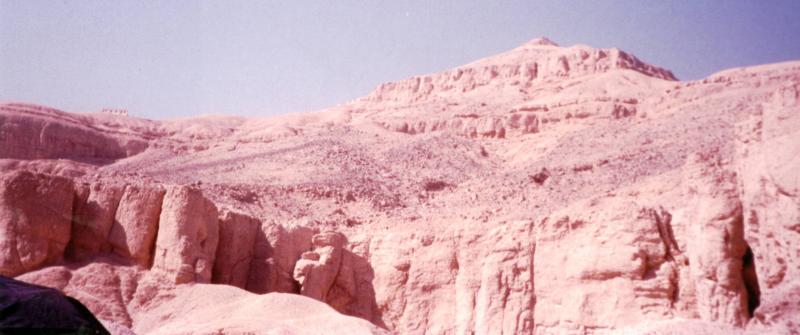 The mountain under which many of the tombs were found
has a pyramid-shaped peak. |
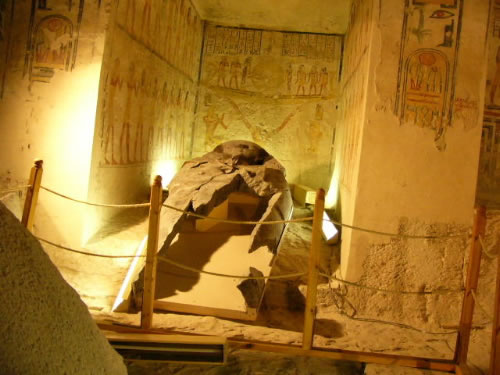
Our tickets allowed us to visit three tombs only and only a handful
were opened on the day with long queues at each.
We visited the tombs of Ramseses III, IX
and V/VI - all of them relatively small tombs, some partly excavated,
others quite madly damaged by humidity from all the tourists and from
oily fingers.
|
 There
was a variety of hieroglyphs and images, of the pharaohs, how they treated
their subjects, even the ceilings were beautifully adorned with dark
blue skies, thousands of stars and the sky goddess Nut, stretched above.
Tomb of Ramses III was like a picture book of "Better Homes
Gardens" with images of hundreds of pots, furniture and food preparation.
In the tomb of Ramses V/VI was a large shattered giant pharaoh-shaped
sarcophagus eerily illuminated by silver light - Ramses VI unusually
sharing a tomb with his predecessor brother. It is truly amazing
that such images have lasted thousands of years, hidden away in dark
low-humidity tombs that are quickly disintegrating since they have been
excavated. There
was a variety of hieroglyphs and images, of the pharaohs, how they treated
their subjects, even the ceilings were beautifully adorned with dark
blue skies, thousands of stars and the sky goddess Nut, stretched above.
Tomb of Ramses III was like a picture book of "Better Homes
Gardens" with images of hundreds of pots, furniture and food preparation.
In the tomb of Ramses V/VI was a large shattered giant pharaoh-shaped
sarcophagus eerily illuminated by silver light - Ramses VI unusually
sharing a tomb with his predecessor brother. It is truly amazing
that such images have lasted thousands of years, hidden away in dark
low-humidity tombs that are quickly disintegrating since they have been
excavated.
|
Colossi of Memnon
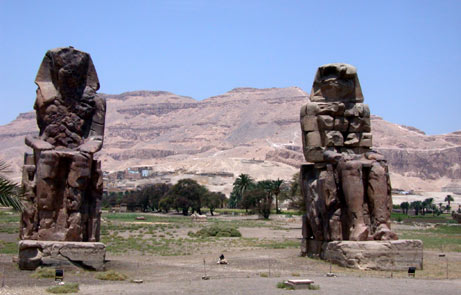 Just
past the Valley of the Kings, we stopped to view the Colossi of Memnon
- twin 18-metre figures of Amenhotep III that once stood in front of
what was believed to be Egypt's greatest temples, even larger than the
existing Temple of Karnak. Each carved from single pieces of stone,
once famous for bell-like tone emitted each sunrise. The Greeks believed
these sounds were made by the immortal Memnon greeting his mother. After
an Roman emperor made restorations in 170AD, the sounds ceased. Just
past the Valley of the Kings, we stopped to view the Colossi of Memnon
- twin 18-metre figures of Amenhotep III that once stood in front of
what was believed to be Egypt's greatest temples, even larger than the
existing Temple of Karnak. Each carved from single pieces of stone,
once famous for bell-like tone emitted each sunrise. The Greeks believed
these sounds were made by the immortal Memnon greeting his mother. After
an Roman emperor made restorations in 170AD, the sounds ceased.
To our amusement, Adam made another one
of his commission-based stops at an alabaster
factory. He couldn't understand why we broke into laughter. Instead
of boycotting the trip, we all went rushing in for free cups of coffee.
René led a race with Sebastian and Vinnie's boys sliding across
the smooth alabaster marble floor. At the other end was Ulla being approached
with a small £10,000 alabaster hippo, to which she jokingly said
yes and the shop-assistant went away to put it aside.
|
Temple of Hatshepsut
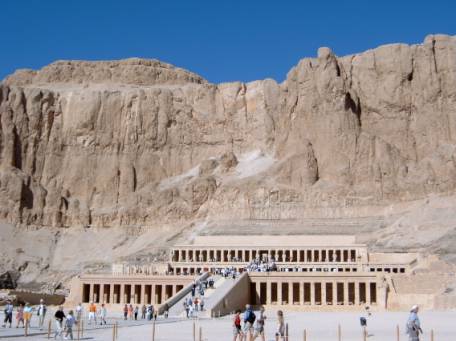 Lying
next to the Valley of the Kings is this temple of the only female
pharaoh who ever ruled in Egypt. Due to a botched job by an Egyptian-Polish
archaeological team, the ruined temple was recreated to resemble a bus
depot, with much of the original artwork covered over or destroyed.
The sucessor to Hatshepsut's brother/husband was stepson Tuthmose III
who had to wait 20 year to get his throne, hence when she died, she
was not mummified and her temple destroyed as punishment. The temple
was at the site of a Coptic monastery and fantastic limestone cliffs.
There may not be much of the temple to look at but the view, from up
close, far away or even from the sky is definitely worth the trip. Lying
next to the Valley of the Kings is this temple of the only female
pharaoh who ever ruled in Egypt. Due to a botched job by an Egyptian-Polish
archaeological team, the ruined temple was recreated to resemble a bus
depot, with much of the original artwork covered over or destroyed.
The sucessor to Hatshepsut's brother/husband was stepson Tuthmose III
who had to wait 20 year to get his throne, hence when she died, she
was not mummified and her temple destroyed as punishment. The temple
was at the site of a Coptic monastery and fantastic limestone cliffs.
There may not be much of the temple to look at but the view, from up
close, far away or even from the sky is definitely worth the trip.
Then we had lunch and a brief rest. I was
surprised to find that a humorous member of housekeeping had set up
towels, blanket lettuce leaves to resember a man and his snake.
I thought René had played a joke on me until I found out something
similar other family members' rooms!
|
 Temples
of Karnak Luxor Temples
of Karnak Luxor
Karnak was known
as "Ipet-Isut" - The Most Perfect of Places.
Much of it is in ruins but is possibly
the largest temple complex ever built anywhere and created over 1,500
years by successive generations of pharaohs.
It was the residence of pharaohs, place
of worship, wealthy treasury, centre of administration and employed
thousands.
Karnak is most famous for its giant columns
- 134, each 15m high, centre 12 columns were 21 metres tall. It takes
six adults to stretch their arms out around a column's girth.
Between the columns there once stood statues
of pharaohs and the whole effect would've been intimidating, as though
passing through a hall of giant gods. |

<== Ramses II was responsible for a
lot of the restoration of the temple and his signature is etched deeply
in certain area so no other pharaoh could take credit.
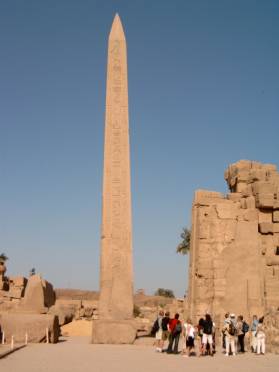
Past the giant columns stood the tallest obelisk existing in Egypt at
almost 30m high. Although made out of one piece of granite, the Obelisk
of Hatshepsut looks like it's made of two different stones as the lower
half was covered up for many years by Tuthmosis III in his resentment
towards his stepmother's usurpment of the throne. There once existed
17 obelisks but these now lie in various parts of the world.
The further we walked into the temple,
the older the temple and the more ruined it became so when we reached
the other side, it was a mass of ruins. |
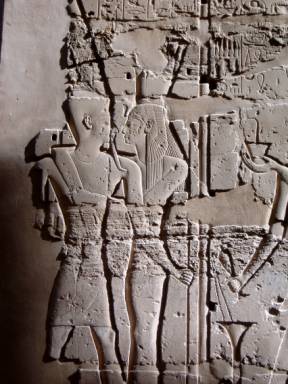
The most beautiful aspect of the temple to me were the images of a queen
embracing her pharaoh.
It was considered taboo for such displays
of close affection that for many years it was covered up with a gold
plate.
Near the Sacred Lake - a body of water used for priests' ablutions -
stood a giant scarab beetle. Adam told us to walk around it seven time
and our wishes would be granted. It would've been vessing to here. We have however booked a tour into the mines tomorrow afternoon which should be exciting and I´d like to see the Mint museum.

We are also considering what to do next before going to Brazil on the 17th...so far looks like we will go to Sucre (3 hours from here) day after tomorrow and then fly to La Paz from there (maybe even re-shedule flight to go to Rio a day or two earlier).
Click here to see more photos from Bolivia
10. March 2008 08:29
by Rene Pallesen
0 Comments
The bus ride to La Paz was interesting. It was a local bus so full of locals heading into La Paz 4 hours away. After about one hours drive through the high plains (4300 meters altitude) we suddenly arrived to a strait. I hadn´t studies the map properly and hadn´t realised that Copacabana was on a peninsular with no Bolivian direct access to mainland Bolivia (you would have to pass back into Peru to drive directly)...so at the strait we got offloaded from the bus and then had to get onto a smaller boat for the passengers while the bus was ferried across on a big wooden pram.

Also at this strait is the only division of Bolivias Navy (I think they still hope to eventually get access to the ocean through Chile (They lost 350 kilometers of coastline in a war with Chile back in time). On the other side Kim missed using the toilet so when we stopped at a petrol station a couple of hours later we took the oppertunity...when the bus took off she wasn´t back yet...and she would have been standing there alone if I hadn´t told the bus driver that we were missing a passenger. Unfortunately it was cloudy so we could only see the bottom bits of the Huyana Potosi and Illimani (6500 meters). The drive into La Paz is stunning...they outer suburbs is totally disorganised with mud houses and mud roads...but suddenly you drive over the escarpment and see all of La Paz in a big crater below.
Once we got out of the bus we were however less impressed. La Paz is a town like any other...it is full of traffic, pollution and there has been no city planning whatso ever. Once you get over the escarpment wow factor it is really an ugly city full of social problems, beggers, street kids, pollution, crime etc. Even the backpacker area is totally uninteresting and has been totally spoiled by young kids going for white water rafting, mountain biking without any interest whatsoever in the local culture. Our plan was to spend a day here and then continue down to Potosi and we decided we would spend the next day before heading south looking around and see if the city would reveal its more beautiful side. In the morning I went to the bus station to organise bus tickets and I hope I´ve got the promised ticket (sleeper bus, with toilet onboard and sitting in the front of the bus away from the toilets...but Bolivia is full of surprises...but that is part of the adventure). Afterwards wewent for a walk around the city and found a couple of nice spots but not enough to convince us that this is a city worthwhile spending a lot of time in.
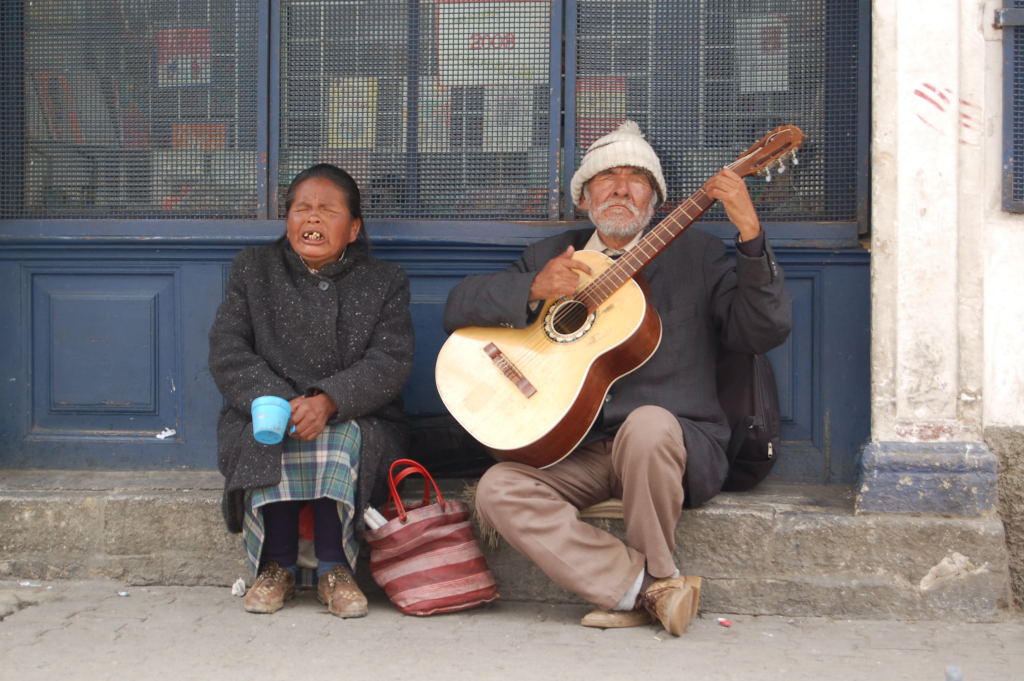 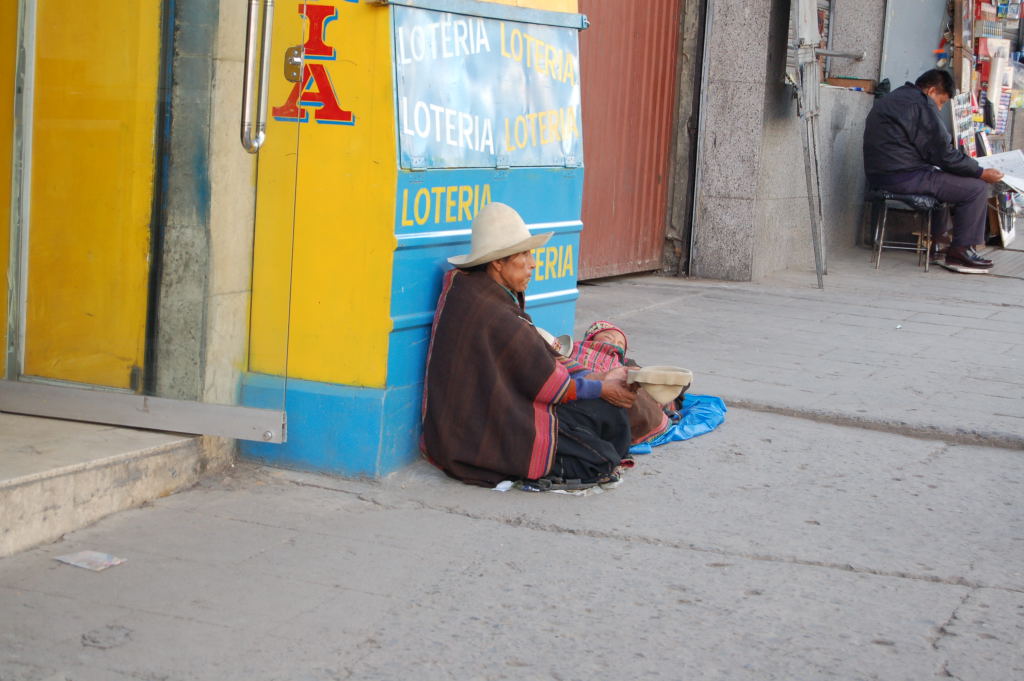
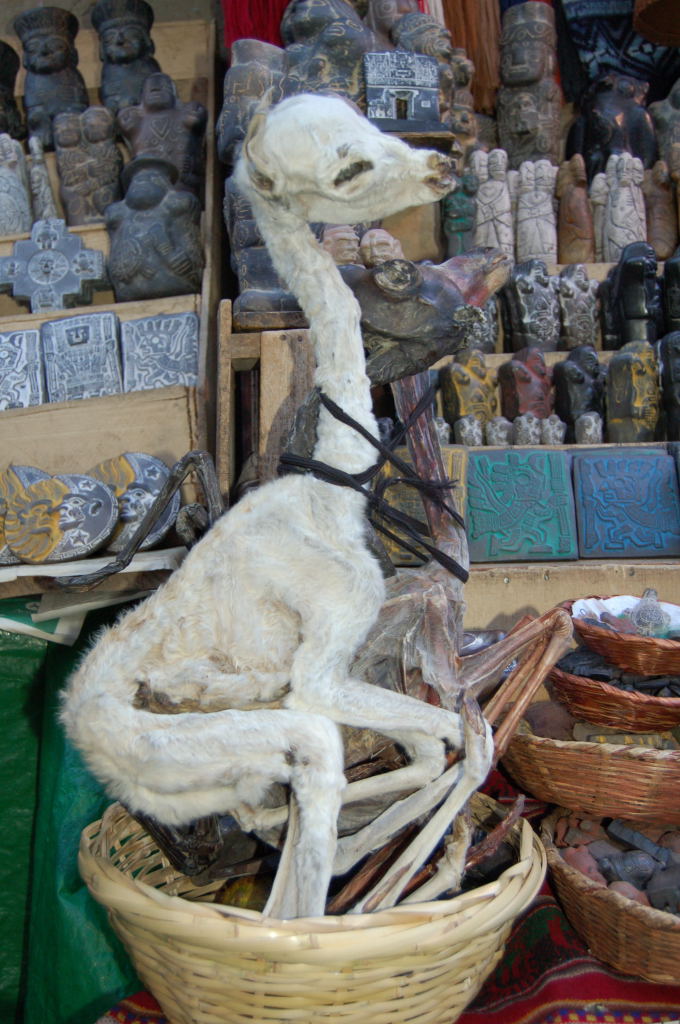
The witches market if full of souvernirs that are no-where near as good quality as what we saw in Copacabana, The museums were all closed on Sundays (except the music instrument museum which was interesting), and we are unable to find any decent local food in La Paz (only pizza, pasta etc.).
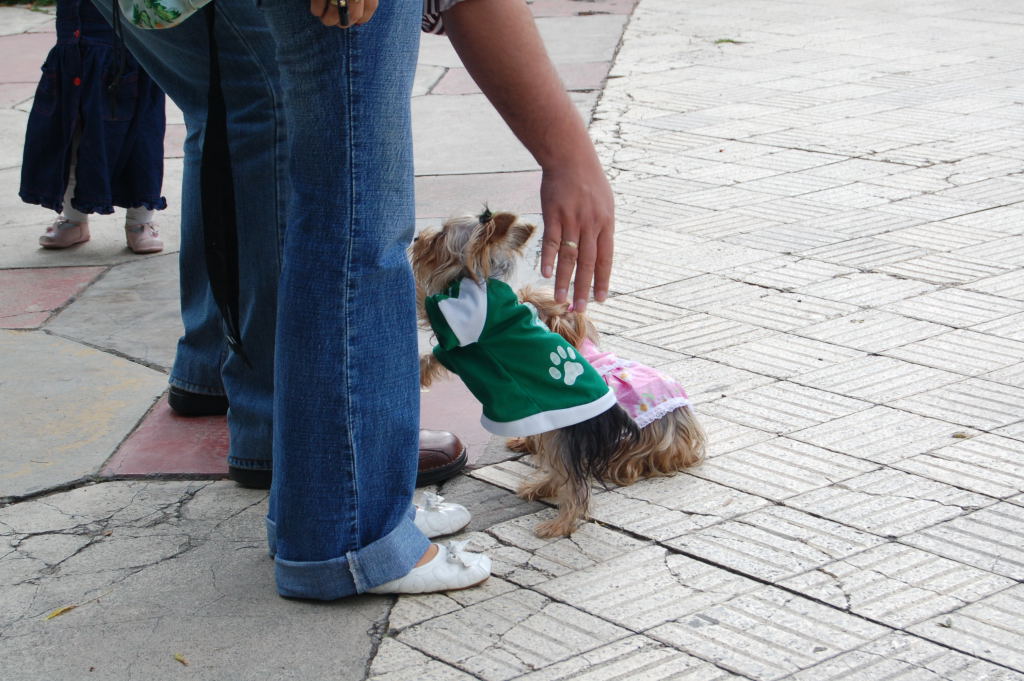
 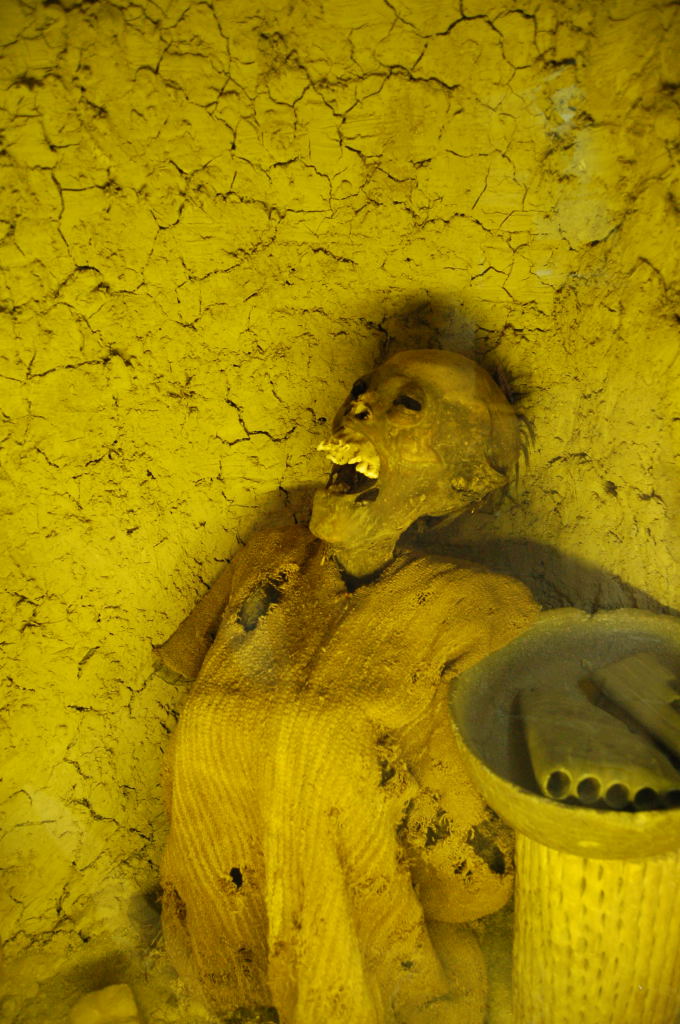 We did however have a good laugh sitting observing people at Plaza Avaroa close to our hotel. People were out walking their dogs and they were all dressed in cute little costumes like small humans...and I thought the Honkies were crazy.
I am hoping that the south is nice. I have kept Kim from buying too many things so far promising her that there would be plenty of chances...I hope that this is correct as some of the things we saw up north were really nice. Bolivia is pretty cheap to travel in (same prices as Thailand) and my dad would love it here (as well as in Peru). I could however travel a lot cheaper if I got to choose the mode of transport and the hotels...Kim gets to choose the hotels we stay in which from a local aspect is the upper range hotels (but still cheap by australian standards) and the criteria is hot water, blankets, heating, cleanetc. We have however been lucky with a couple of hostels we have found (one that we will stay in once we return to La Paz and we stayed in one in Copacabana). I think over time I will get her hardened up enough to check out the hostels first and then afterwards increase the comfort levels if we dont find anything of a decent standard...but so far it is ok that she gets a bit of comfort...it is her first backpacking/roughing trip and she is doing really well so far (getting into the spirit of finding cheap restaurants etc.).
Click here to see more photos from Bolivia
10. March 2008 08:00
by Rene Pallesen
0 Comments
|
Lørdag 13. November 2004
Afrejse til Ægypten
Vores familie måtte af sted kl. 3.30
for at nå flyet kl. 6.55; 4½ time senere ankom vi til Cairo
lufthavn. Jeg har en svag hukommelse om en meget varm lufthavn med komplet
kaos, med mennesker, der skubber for at få deres kufferter igennem,
råbende gennem en masse larm. Nu fandt vi en næsten ren
og ikke tætpakket lufthavn.Vi mødte AP-Travels repræsentant,
som tog os til Hotel Pyramissa, hvor vi tilsyneladende blev glemt i
Pianobaren, til en af os fik den lyse ide,
at bede om vores værelsesnøgler.
Vores familie deltes om en toværelses
suite med et stort fællesrum. Vores første eftermiddag
blev brugt til en spadseretur rundt i kvarteret
for evt. at finde et sted for familien at spise. Vores hotel lå
på den anden side af floden i forhold til centrum, så der
var ikke meget at se på sammen med, at mange butikker var lukket
p.g.a. Ramadanen, den Islamiske fasteperiode fra daggry til solnedgang.
Søndag var sidste dag i Ramadanen, så mange var i gang
med at forberede den sidste faste.
Sluttelig spiste familien til aften i hotellets
"Orientel" restaurant i Ægyptisk stil. Vi regnede med
at få ordentlig Ægyptisk mad, men blev skuffede over at
få lunkent mad. Risen var meget tør, lammekødet
var meget småt og maden var en blandet fornøjelse. Til
vores overraskelse, efter vores kommentarer, fik vi serveret ekstra
tallerkner med lokal Ægyptisk frugt så som friske dadler
og duava. Til vores morskab smagte alle Ægyptiske vine ens, uanset
mærke. Der var masser af Ægyptisk øl og selvfølgelig
levede danskerne op til deres drikkeevner og Bedstemor gav maden til
alle.
|
Søndag 14. november 2004
Første nat sov vi ikke så
godt - at sove i en fremmed seng kombineret med koranbøn fra
en nærliggende moske gav os ikke ligefrem en fredfyldt søvn.
Imidlertid var vi alle tidlig oppe for at mødes i Bedstemors
værelse for at overraske hende med danske fødselsdagssange
til flimmer med danske flag og små gaver. Denne familie overrasker
fødselaren og alle synger unisont denne meget søde fødselsdagssang.
Citadellet Muhammad Ali Moskeen
Vores
første besøg gjaldt Citadellet.
Det er byens fort og husede engang den kongelige familie og skønt
det meste af komplekset er åben for besøgende, besidder
militæret stadig en del, som er lukket område. Det tager
en halv dag at komme gennem hele Citadellet, hvilket vi ikke havde mulighed
for. I stedet tilbragte vi vores tid i Muhammed
Ali moskeen.
<== Der er en fantastisk panorama over
byen fra den Vestlige terrasse - fantastisk at Cairo ikke et bygget
af ens mudderfarvede stenbygninger. Det mest bemærkelsesværdige
ved Cairo er imidlertid mangelen på farver og farverne stemmer
overens med ørkenens farver.
Vores
guide Adam/Mohammed gav os en ringe indsigt i funktionen eller historien
af Citadellet, og i stedet pladserede gruppen i hjørnet i hjørnet
af Muhammed Ali moskeen som en gruppe skolebørn, og gav en lektion
om Islamisk lov og sædvane.
Da René vovede sig til at spørge
om mere om Citadellet, blev han skældt ud for at afbryde og fik
besked på at lytte. Vi fik aldrig muligheden for at finde 7-tallet
Napoleons tropper hade malet over port for at undgå de uvante
arabiske navne, eller det halvrunde tårn, da vores guide simpelthen
ikke vidste, hvor de var.
I den tid havde jeg muligheden for at spadsere
lidt for mig selv og gå i moskeens skønne alabaster arkader.
Den himmelhvælvede centrale bederum var et glimmer af hundrede
af lys, der hang i koncentriske cirkler. På loftet var der arabiske
inskriptioner i guld. Kvinder skulle være anstændig klædt
og kunne ikke bære ærmeløse trøjer eller korte
shorts eller skørter. I et hjørne af rummet lå sarkofaget
med Muhhamed Ali - grundlægger af moskeen og Albanisk handelsmand,
grundlægger af dynastiet, som herskede til revolutionen i 1952.
Cairo Ægyptisk Museet
Jeg
huske turen rundt i dette museum, hvor jeg kiggede ind i smudsige glas
montre og stirrede på de rynkede ansigter af nogle engang kendte
faroer som Ramses II og undrede mig over, om disse gamle Ægyptere
var giganter i deres store kister.
20
år senere var det næsten umuligt at skubbe sig gennem mængderne
af turister - kun nyttigt fordi deres guider gav flere informationer
end vores. Med kun to timer var det umulig at se hele museet og slet
ikke de kongelige mumier.
Museet
fejrede sit hundred år med en speciel udstilling omkring TutAnkhAmun
- det mest berømte fund. Med rejseguiden i hånden "aaaede"
og "åååede" vi over guldskattene fundet
i hans grav - en guldtrone med den berømte scene med TutAnkhAmons
dronning, der tilbeder ham, kister af ibenholt og elfenben, jagtskjolde
beklædt med gepardskin, buer og pile, alabaster krukker med kong
Tuts mummificerede organer, guld sarkofager - da Howard Carter havde
fundet sådanne skatte for en lille kendt drenge-konge, forestil
jer, hvad Ramses II´s grav har indeholdt. Kong Tuts inderste kiste
af rent guld og og den berømte maske af guld, som alle gerne
vil se, er trykt i mange Ægyptiske billedmaterialer.
Museet
er blevet en ny pengemaskine for Ægypterne med yderligere en entre
for at se de kongelige mumier. Vi måtte være tilfreds med
at se dyremumierne - katte, hunde, fugle, geder, Nile Perch (ja, også
fisk!) og mest fantastisk var en 7 meter krokodillemumie.
Udstillingerne
var på øverste etage opsat efter emne og på underste
etage i kronologisk orden uret rundt fra det Gamle Kongerige, til det
midterste og sluttende med de Nye og Sidste Kongedømmer. Der
var værelser fyldt med kæmpe sarkofager (kister), som hver
ville veje en tons, et værelse fyldt med miniaturer, der viste
daglig liv i Ægypten, et værelse fuld af falmede gamle papyrusskrifter
og værelser fulde af brokker og stykker fra ruiner, statuer, palads
gulve - et sted, man kan tilbringe dage med en ordentlig rejse guide.
|
Khan Al-Khalili
Efter
et stop på en Ægyptisk parfumefabrik
og en frokostpause, kom vi til Khan
Al-Khalili, det ældste basar i Ægypten, som går
tilbage til 1300-tallet. Gamle tiders købere besøgte Khanen
for at kigge på varerne bragt dertil af handelskaravanerne. Vi
finder ikke længere slaver, silke, juveler eller diamanter, men
træ guitarer, skønne klude tæpper, klæder,
t-shirts, papyrustryk, vandpiber, bunker af tøj, aromaen af krydderier
breder sig og boder med stakke af rødt, guld og blå pulver
og sække med frø og bønner. Kobbersmede udhamrer
fade, terriner, kaffekander og enorme halvmåneformede toppe til
minareter. Det er et ritual i basarer at tinge om priserne, lokale såvel
som gæster - almindeligvis til en tiendedel af den budte pris
- har du betalt en tredjedel, har du betalt for meget. Vi havde kun
en time til vores rådighed, men mange af boderne var lukkede for
siesta og for ramadanen. Ulla og jeg pegede på nogle sække
af mangefarvede krydderier. Han ville have 50£ (50 kr.), men efter
jeg sagde "da ketir awi" (det koster for meget) og gik, fulgte
sælgeren efter os en kilometer mens han reducerede prisen fra
40£ til 30£, 25£, 20£, og efter vi i spøg
råbte 10£, tilbød han 15£, 10£ og endelig
5£ før han opgav os. Efter megen tingen lykkedes det os
få to udsmykkede parfumeglas flasker for 20£ (20 kr.).
|
Bedstemor's fødselsdagfest
Irene
og Ole havde sørget for et privat værelse til Bedstemors
fødselsdagsfest. Et enkelt langt bord i et værelse
i Ægyptisk stil. Sølv fade i to rækker midt på
bordet med ild under holdt maden varm.
Vi fik kommen-panneret stegt fisk, kyllinge
filleter på Ægyptisk stil, kanel-krydret ravioli, ris, kartoffelmos
og steg i pebbersauce, "sang" og brød med Ægyptisk
vin og øl til Bedstemor.
Mens børnene legede i et hjørne,
var der meget snak bordet rundt, og aftenen sluttede med chokolade og
frugt kage pyntet med "Happy Pirthday" (det er ikke en fejl)
og vi morede os over os over overfloden af Ægyptiske kager - bagværk,
semulje tærte, rosenvands krydrede tærter og tærter,
der smagte af flydende honning… Ulla ville gerne have resten af
desserten med sig (undtagen den rosenvands krydrede - det var morsomt
at se hendes udtryk - rosenvand dufter næsten som parfume). Tjenerne
var hele tiden meget opmærksomme, passerede hver andet minut for
at opvarte os.
Det bedste var, at Bedstemor blev som to
årig, da hun skulle puste lysene på kagerne ud. Som danskerne
ville sige, "det var meget hyggeligt!"
|
Mandag 15. november 2004 (start 7:30)
Fra de grå bygninger og gader I Cairo
kørte vi 24 km mod sydøst til Saqqara, skiftende fra ensartet
brun til frodige grøne marker med grøntsager og hundrede
af dadelpalmer. Det var som en oase, hvor et fint slør gav en
uvirkelig meter and then stops, changes direction and then goes another kilometer before doing the same again...in total it takes the train 7-8 direction changes to make it to the top of the hill.
And the Macchu Pichusite itself is really spectacular in itself. We spent close to 6 hours exploring the area and had we known earlier that they closed access to one of the peaks at 1pm then we could easily have spend more time exploring.
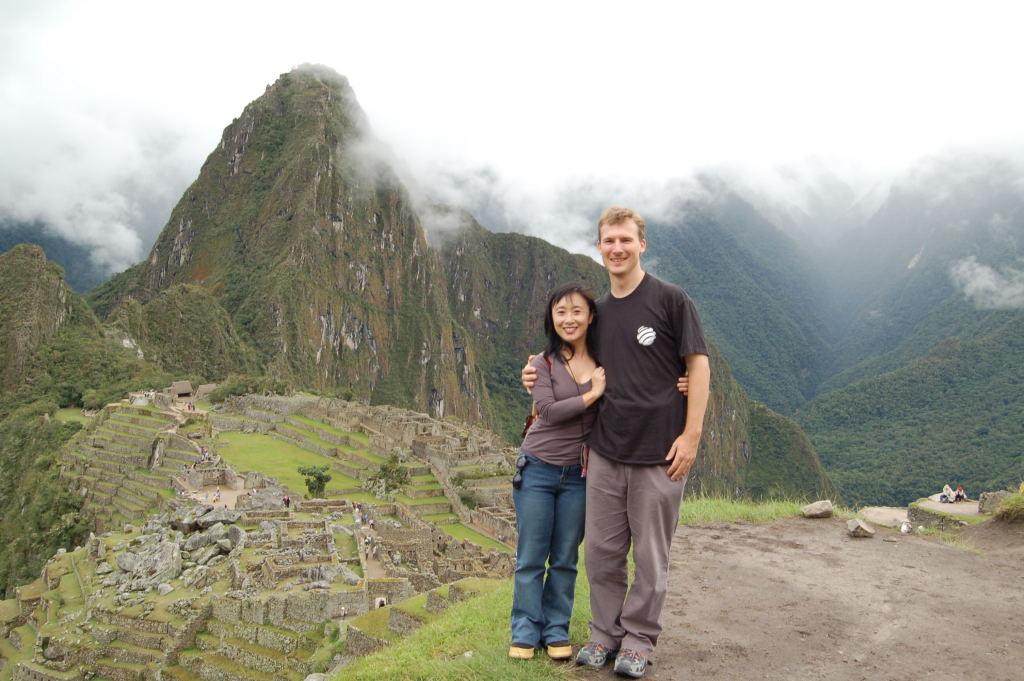
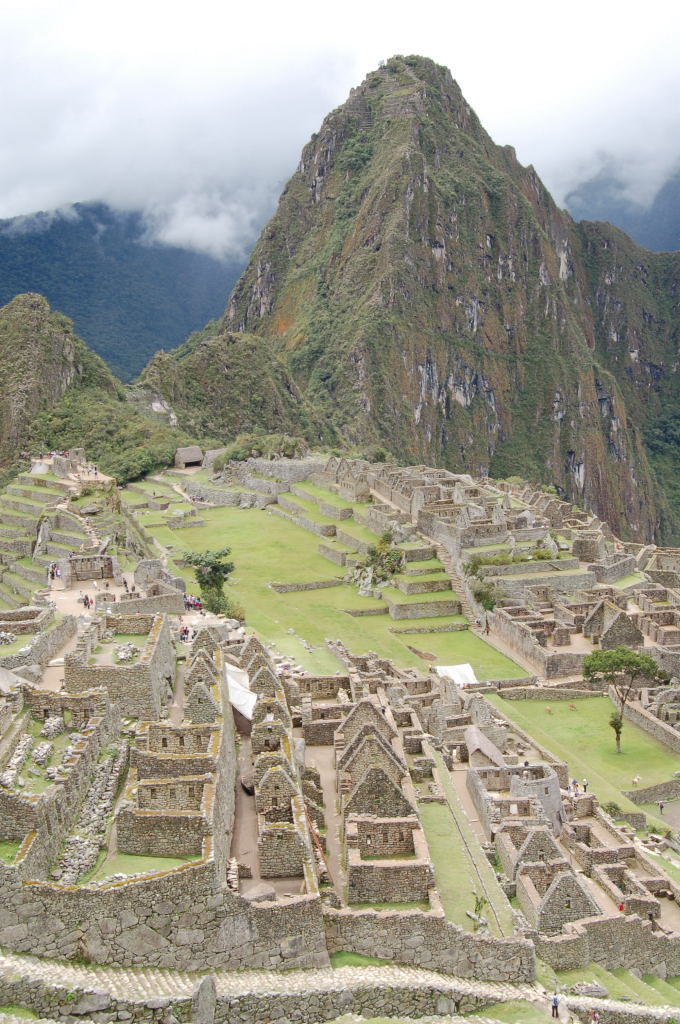
Wednesday we checked out of the hotel in Cusco and booked ourselves a night bus to Copacabana in Bolivia. The remainder of the day we spent visiting other Inka sites around the area by local bus. Some of the sites especially the one closest to Cusco called Saqsaywaman is pretty spectachlar.
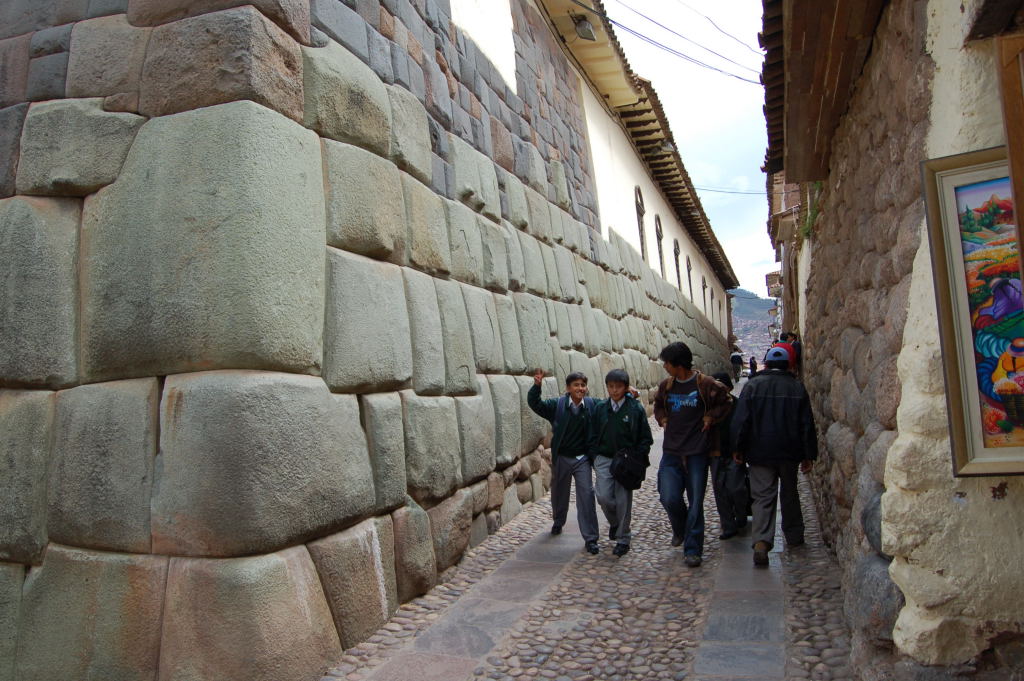 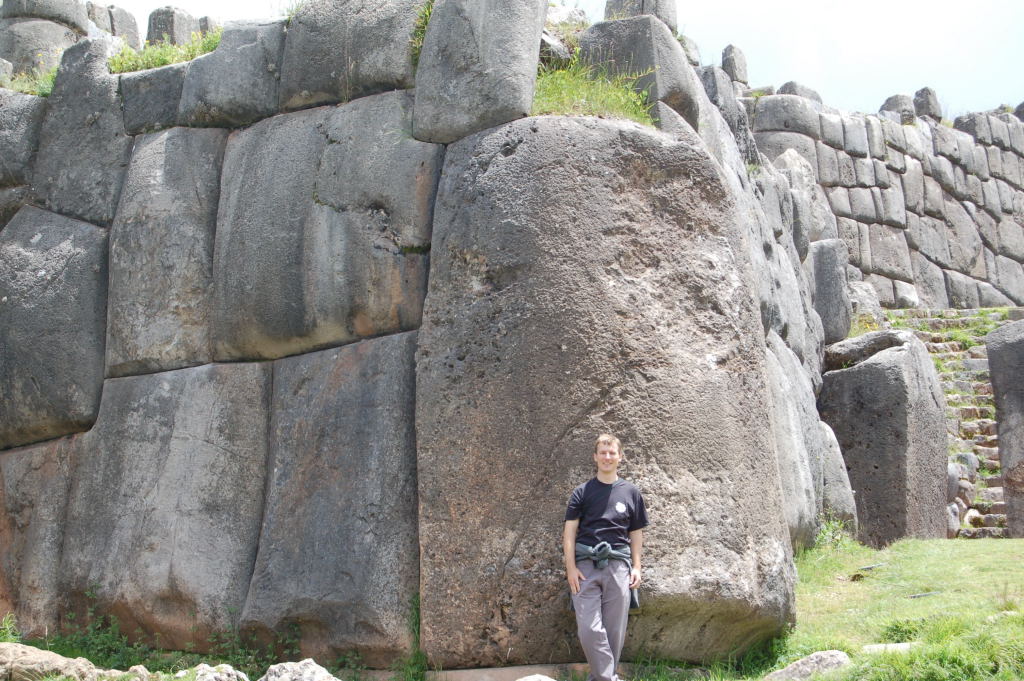
We had a really scary incident where we got attached by two really vicious dogs. The first dog went for me an I kicked ouut after it and just missed it, but it was just enough to surprise the dog and make it back off. Out of the corner of my eye I saw the second dog attack Kim and I saw her try and kick it as well whereafter it also back off (probably because the fist dog got scared). After that they kept their distance...a close encounter but walked away unhurt but with our hearts pounding.
Click here to see more photos from Peru
2. March 2008 10:14
by Rene Pallesen
0 Comments
The last couple of days Kim and I have been in Santiago de Chile. Kim arrived a day late due to mechanical problems with the aircraft from Sydney and I arrived 6 hours late with Chris (my colleague) at 3am in the morning. Chris and I got ripped off by the taxi due to us not having studied the local conversion rates...but after that we had no other problems.
The first day we spent sleeping and familiarizing ourselves with the area around Providencia and Bellavista. There are some gorgeous little bars and restaurants in these areas. Santiago is a very modern city. It is very clean and you don´t see the same problems as for instance in Buenos Aires with street kids. I can see why my cousin Ulla decided to live in this city for a while.
The Metro in Santiago is really good...there are trains every few minutes and they cost about $1 USD regardless of where you get off...a lot cheaper than catching taxis and a lot faster too.
Next day we went sightseeing around Santiago city centre. The highlight was Cerro Santa Lucia which is an old castle converted into a lovely park area used very much by couples out for a romantic afternoon.
As for food...it seems that most locals eat hotdogs and pizza for lunch so we had a hard time finding something reasonably healthy.
We spent a lot of the late afternoon and evening sorting out luggage storage. We are staying in a serviced apartment with no storage facilities so we had to go to the bus terminal on the other side of the city to store it. When we got back we received an email from the lady renting us the apartment saying that she´d store it for us. I feel a lot more happy about her storing it than in the terminal especially as my work laptop is in the bag.
Next morning it was again time to go to the Airport...this time to fly to Peru.
23. February 2008 08:13
by Rene Pallesen
0 Comments
1. February 2008 12:04
by Rene Pallesen
0 Comments
I haven't blogged much this year yet. Mainly because not a lot has happened this month (January traditionally is a quiet month) but also because it has been very hot and wet which is not a good combination for outdoor activities. The next two months however are going to be really busy as I will be traveling in Latin and South America. I am looking forward to the trips as it will take me to most of South America such as Mexico, Argentina, Chile, Peru, Bolivia and Brazil. As I travel I'll start posting pictures and entries in this blog.
4. January 2008 12:50
by Rene Pallesen
0 Comments
I was glad that I didn't have too much to drink on New Years Eve, because the day after turned out to be a busy one.
In the morning we had breakfast with Kims family at the cemetery where her mum is buried.
Right after this we went to the golf course at the coast and played 18 holes. It was a pretty hot day, but there was a nice breeze along the coast and the course is in such a spectacular location.
 Click here to download video of Playing Golf #1
Click here to download video of the Golf Course #2
Click here to download video of Playing Golf #1
Click here to download video of the Golf Course #2
Most of the beaches in Queensland and New South Wales were closed due to dangerous surf conditions. There is a hurricane off the coast of Queensland creating some huge waves along all of Australia's east coast.
In the evening we had dinner with Kims family having steam boat and those rice paper things that you roll up (not sure what it is called)...and it was yummi.
They have this fermented fish that has been fermented over 3-4 years and it is really nice as a dipping sauce with a few chillies mixed in.
Click here to see more photos from New Years Day
4. January 2008 12:31
by Rene Pallesen
0 Comments
The year 2007 has now ended and it is time to start some new adventures in the new year.
2007 was full of traveling and other adventures and I expect 2008 to be much of the same.
Take some time to look at what is happening in 2008 as well as what happened in 2007.
Click on this link to see the events of 2007
Also please bookmark this page and also have a look at the RSS feed features of this page.
14. November 2004 10:52
by Rene Pallesen
0 Comments
Created: Dec 2004Last Updated:
21-Jan-2005
14. November 2004 10:38
by Rene Pallesen
0 Comments
|
| Al-Khalili's Bazaar / Markets, is the
oldest market in Egypt, established some time in the 12th century. The
surviving towers of the original markets go back to the 1500s and miles
of shops adorn the streets. | | I was looking forward to purchasing
some papyrus paintings and some t-shirts, but it was rather quiet with
half the shops closed. | | However, we did see plenty selling
wooden guitars, brightly tattered pouffe covers, egyptian clothes, spices,
t-shirts, crappy papyrus paintings, plenty of bong-like pipes. | |
Wherever we went, we would see a couple of individuals
smoking "water-pipes" (or what I would've called "bongs").
These bongs were brightly coloured, some intricately ornate and were
inexpensive - AUD$40 for the ignorant tourist, less than AUD$10 for
the savvy bargain-hunter.
| |
Afterward only an hour, we all met up at a typical
Egyptian coffee-house. We met up here because it seems, Adam wanted
to smoke his water-pipe...
|
Created: Dec 2004Last Updated:
24-Jan-2005
|