Home

11. March 2018 22:03
by Rene Pallesen
0 Comments

Monks - Laos

11. March 2018 22:03 by Rene Pallesen | 0 Comments

Religion is an integral part of Laos society where the majority are Budhists.


The monks dressed in orange and red ropes are still visible everywhere and it is largely seen as becoming a novice (junior monk) is seen as an opportunity to get an education and support your family if you come from a poor rural area.


The high influx of tourists, especially to Luang Prabang is therefore a bit of a win-win situation for everyone. The tourists support the temples in the area by paying their admission fees to visit and on both my trips I have found that the monks are keen to have a conversation as it is a way of practicing their language skills.

In Luang Prabang the monks walk in procession every morning to collect rice from worshipper along the roads. Before sunrise there are hundreds of monks walking the streets in every direction. There is an equal horde of tourists trying to take photos of these monks and equally tourists handing out (sometimes dubious) rice to them.


There are posters around the city encouraging being there and seeing the monks as well as providing some guidelines such as keeping a certain distance, not using flash photography and if you hand out rice then where to get it from. Most of it common sense really, so it was sad to see how some would be blocking the paths and sticking their camera phones with flashes into the monks faces.
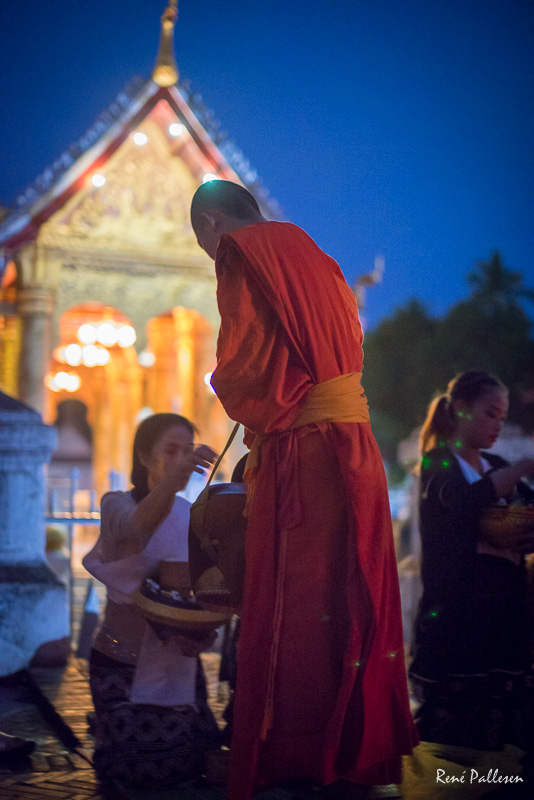


Sacha and I went there a couple of mornings, but because of the time of the year everything was dark and because the monks move quite fast through the streets it was a challenge getting good shots.


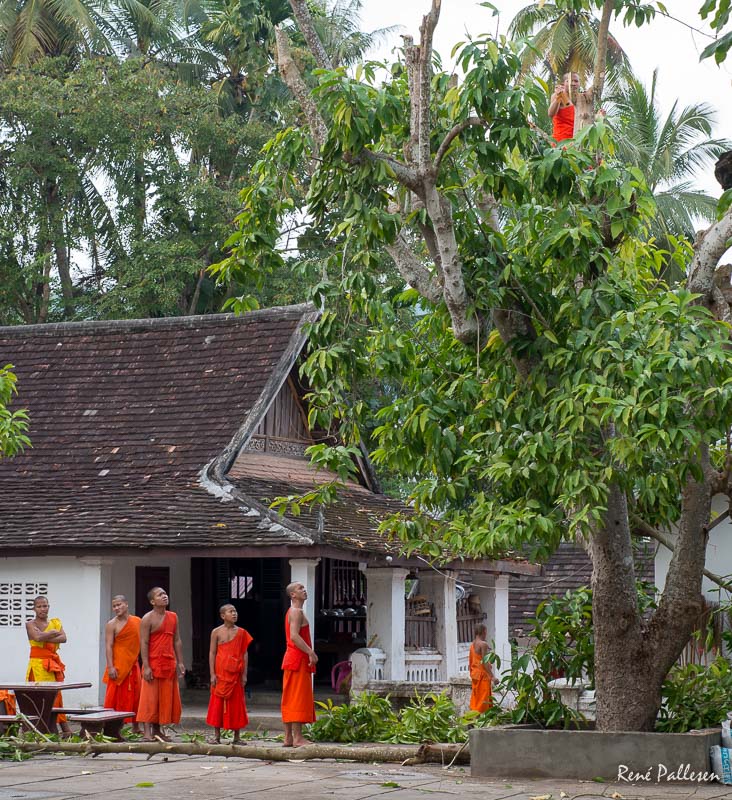
One afternoon we walked past a temple and a group of monks were in progress of cutting down a large tree and afterwards trimming off the branches. They were going to use some of the tree trunk for traditional drums and the rest for ornamental purposes inside the temple.


In the late afternoons you would hear them chanting in the small rooms of meditations, chanting and prayer. These are often smaller places of worship and not part of the main temples which are used for more ceremonial purposes.
One evening I heard such chanting and went to investigate and found these monks. Definitely one of my favourite moments in Luang Prabang.


A common assumption and misconception is that the monks live by an ancient code with a simple life, so it is quite interesting to see that even they have adopted modern technology with smart phones and cameras.


11. February 2018 22:03
by Rene Pallesen
0 Comments

Locals transport - Laos

11. February 2018 22:03 by Rene Pallesen | 0 Comments

The locals are still relying on motorbikes to get around. They are far cheaper and more convenient i
The locals are still relying on motorbikes to get around. They are far cheaper and more convenient in the towns. It is even possible to fit an entire family onto a single motorbike.


Younger kids and high schoolers ride their push bikes for transport.


Although Aiden and the other kids definitely preferred the motor bikes.


Nothing too flash for weddings - a normal new car will suffice. If you notice the sign on the door, then I am not sure if the bride was expecting to come home to 'Meat & Sausage'.


There are also some vintage cars around which have survived since colonial times - like this 1952 Citroen.

10. February 2018 07:03
by Rene Pallesen
0 Comments

Bowling - Laos

10. February 2018 07:03 by Rene Pallesen | 0 Comments

On the last day in Luang Prabang we went to the local ten pin bowling alley.We had heard and read th
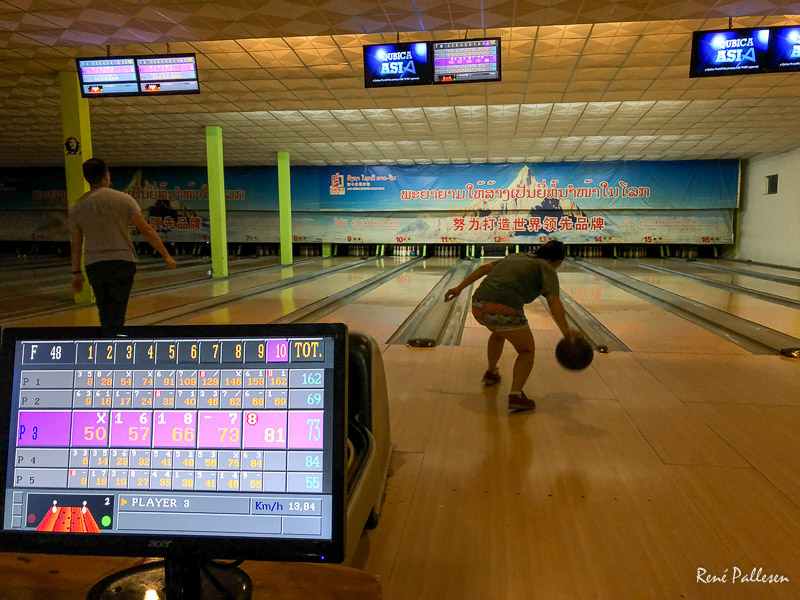
On the last day in Luang Prabang we went to the local ten pin bowling alley.

We had heard and read that this is the place where things are happening in Laos. When we got there the place was totally deserted apart from a few staff members.

We did play bowling and it is a bit surreal to play by ourselves in this fairly modern centre in Laos.


They didn't have any support rails for the kids, but Aiden especially did really well and the kids managed to beat Kim on points.


9. February 2018 07:03
by Rene Pallesen
0 Comments

Water fall - Laos

9. February 2018 07:03 by Rene Pallesen | 0 Comments

Just outside Luang Prabang there is this amazing waterfall cascading down a limestone creek.We decid
Just outside Luang Prabang there is this amazing waterfall cascading down a limestone creek.

We decided to get up early to go a take photos, so that we could be there early before all the crowds arrived.


At the entrance to the park there is also a Bear rehabilitation centre. They rescue bears from captivity and keep them until it is safe to release them back into the wild (if ever). The bears have a big area and seem to love climbing and sleep in the hammocks provided.


8. February 2018 22:03
by Rene Pallesen
0 Comments

The kids and families of Laos

8. February 2018 22:03 by Rene Pallesen | 0 Comments

What I especially remember from my last trip to Laos was the kids. One of my most cherished photos i
What I especially remember from my last trip to Laos was the kids. One of my most cherished photos is one of two little girls holding a bouquet of flowers that I took 20 years ago (it is on this blog if you look for it through the search function).

The children are still there. They are still very shy, dirty and smiling.


They make up their own games such as these kids at a school playing marbles with tamarind seeds.


These kids were playing a game where the kid under the table had to poke the feet of the kids above the table.


And some things never change, kids teasing each other.


The girls in the school yard 'hang out'.


Visiting a local school was great for our kids to get a glimpse of how other kids live.


Along the road we stopped and a family was outside with the mother breastfeeding her son in their outdoor living room. This is where everything happened such as the cooking, washing, feeding etc.


The chicken were running around freely


Here is a rare shot that Kim took with my camera in it.


It is a very family oriented life they live


8. February 2018 22:03
by Rene Pallesen
0 Comments

Our kids - Laos

8. February 2018 22:03 by Rene Pallesen | 0 Comments

Our kids had a blast of a time in Laos. They loved each other company (for the most part) and someti
Our kids had a blast of a time in Laos. They loved each other company (for the most part) and sometime looked like real little travellers.


They were respectful at the temples and even offered a prayer.


At other times they behaved like animals and should be lock away in a cage.


But for the most part they liked exploring things that us adults wouldn't see such as this crater from a crash landed U.F.O.

7. February 2018 21:03
by Rene Pallesen
0 Comments

Catching local transport - Laos

7. February 2018 21:03 by Rene Pallesen | 0 Comments

For getting around the towns in Laos we mainly used Tuk-Tuks. These are small motorbike powered mini

For getting around the towns in Laos we mainly used Tuk-Tuks. These are small motorbike powered minibuses and the experience can be very mixed. Most of them are generally good, but some have bad brakes have a plume of smelly two stroke engine smoke trailing behind them. We could easily fit our two families into one and I'd joke that there would even be room for another couple of adults.


The kids loved the tuk-tuks and have the fresh air blowing in their hair while riding.


The only downside is that you'd never quite know what the fare would be until you started bargaining and from town to town the fares seemed to be very different. Even though I believe I am reasonable proficient at bargaining, I'm still confident that we paid more that the locals would be paying for the same trips.


For the longer trips we would catch either local buses (mini vans) or in some instances it was worthwhile us hiring a private bus as we were enough people to fill it.

From Vang Vieng to Luang Prabang we hired a private van taking us across the mountain pass at Kasi. Last time I went through here it was in an open bus and at the pass it was raining and really cold. This time round we had a beautiful clear day with a great view of the valley below from the top.


The week before they had a lot of rain and a landslide had taken out large parts of the last section of road (I read in the local newspaper a few days earlier that the road was closed). Our little van was struggling getting enough grip and our driver had to reverse to get enough of a run-up in the next attempt to make it through the steep and muddy section.

The larger trucks were really struggling getting through.


6. February 2018 16:03
by Rene Pallesen
0 Comments

Morning Markets - Laos

6. February 2018 16:03 by Rene Pallesen | 0 Comments

The morning markets are interesting. This is where the locals still go to buy their fresh produce an
The morning markets are interesting. This is where the locals still go to buy their fresh produce and all kinds of specialties are being sold here. It would be easy to go here and get the ingredients for some really delicious food.

There are also some unusual things that we don't see in our western kitchens. such as:

Dried Squids:


Fresh fish - of cause, but this have sharp teeth.


A protein and herb table that would make most chefs (and diners) salivate:


The Chillies in Lao are more hot than in Thailand - We loved the heat.


A pig:


River crabs:


Beetles:


Dried rats:


Caterpillar - these are yummi when fried:


Frogs:

River snails:


Dried squid, shrimps and fish:


5. February 2018 16:03
by Rene Pallesen
0 Comments

Silk - Laos

5. February 2018 16:03 by Rene Pallesen | 0 Comments

They still manufacture silk they way they used to. It was interesting for the kids to see the proces
They still manufacture silk they way they used to. It was interesting for the kids to see the process from small caterpillar eggs that hatch to worms to the production of the silk itself.


I had always wondered where the colour blue (Indigo) came from. I knew it used to come from a seashell, but I was fairly certain that this wouldn't be the case here. It turns out that they use a special leaf from a plant that when mixed with water and left fermenting/oxidising turns into a blue dye.


They also use plants for most of the other colours.


After they spin the thread they use traditional weaves to make it into pieces of garment. These days the silk garments are fairly expensive - hundreds of dollars, but it used to be really cheap.

5. February 2018 16:03
by Rene Pallesen
0 Comments

Bamboo Bridges - Laos

5. February 2018 16:03 by Rene Pallesen | 0 Comments

During the dry season the people of Luang Prabang builds traditional bamboo bridges across the small
During the dry season the people of Luang Prabang builds traditional bamboo bridges across the smaller river. This saves them a lot of time (and cost) to cross directly into the centre of town rather than a long detour to the other larger bridges.

It also earns them a small income to charge foreigners a small fee to cross the bridges.


Perfect Moments Photography | A Rene Pallesen Journal

Home

27. March 2019 14:03
by Rene Pallesen
0 Comments

Nikko - Japan

27. March 2019 14:03 by Rene Pallesen | 0 Comments


27. March 2019 14:03
by Rene Pallesen
0 Comments

Kanasawa - Japan

27. March 2019 14:03 by Rene Pallesen | 0 Comments


25. March 2019 10:03
by Rene Pallesen
0 Comments

Australian Formula 1 grand prix

25. March 2019 10:03 by Rene Pallesen | 0 Comments

On the weekend I went to the Formula 1 grand prix in Melbourne. It was a work sponsored event with o
On the weekend I went to the Formula 1 grand prix in Melbourne. It was a work sponsored event with one of our vendors and great access to see the race and the pits.

Here is some of the photos from the event.


5. February 2019 11:02
by Rene Pallesen
0 Comments

Japan - Akihababa

5. February 2019 11:02 by Rene Pallesen | 0 Comments


de through South America...the differences between the countries are huge. During the last six weeks I have taken off in aircrafts 20 times:

Sydney to Los Angeles, Los Angeles to Mexico City, Mexico City to Los Angeles, Los Angeles to Sydney, Sydney to Auckland, Auchland to Santiago, Santiago to Buenos Aires, Buenos Aires to Santiago, Santiago to Lima, Lima to Cusco, Sucre to La Paz, La Paz to Iguazu, Iguazu to Santiago, Santiago to Sao Paulo, Sao Paulo to Rio, Rio to Sau Paulo, Rio to Sao Paulo, Sao Paulo to Santiago, Santiago to Auckland, Auckland to Sydney.

In other words...I have an enormous carbon footprint this year which cannot be apologised enough for.

The people in South America were extremely friendly and helpful (Except the girl at the hostel in Potosi). Most people didn't speak anything other than Spanish...but Spanish is almost my second language now (I know at least 70 words)

Argentina was an interesting place. I loved the culture and the dancing. The food was bland with too much meat and Buenos Aires itself didn't have much else to offer and was a bit run down.

Chile is amazing. It is really organised in Santiago and you could be in Northern Europe in terms of cleanliness. They have a really effective public transport system which is a magnitude better than sydneys (close to being as good as Tokyo). People are very friendly...but unfortynately this is also the only location in all of south america where they managed to scam Chris and I on the price of a taxi fare as we didn't know the local exchange rate...in the rest of South America they did try, but generally we paid same price as the locals (and a few times less). Again I can understand why my cousin chose to live in Santiago rather than somewhere else...it is by far the safest and most developed city in this part of the world. The food here is amazing, and you can get everything...this is the only place in South america that we saw a Thai restaurant.


Macchu Picchu in Peru is incredible...it is a fantastic ride into the site and the area around Cusco has got a lot of potential.


Bolivia is a country with so much potential and with people with so little ability and knowledge to tap into it. People in the North are fantastic, but the further south you get the less culture. It has been a privilege to go there and I think they will get there one day.


Brasil...Beautiful by day and dangerous by night. It was fantastic to go here and I'd like to one day come back to Brasil to see other parts of the country. The economy has really taken off here...but in the process left a lot of people behind and that can be seen by all the crime and social problems.


I have now set foot in 52 countries on 6 continents. As I have travelled I've noticed that the world is becoming a smaller place where no major differences in culture and language.


Countries I've set my foot in

in 10-20 years from now everyone will wear the same clothes, listens to the same music and eat the same food (Pizza). The fun and the purpose of travelling will disappear. I can see from the new generation of travelers that they are more interested in thrill seeking and dead buildings rather than people, cultures and observing and learning from differences. Pity as there is so much to learn and it will build appreciation of how lucky we are to have what we have.

Where to next? I don't know...there is one continent down south that I still haven't been to and former Russian republics have got potential....otherwise closer areas like Tonga, Fiji, Indonesia etc.

22. March 2008 06:08
by Rene Pallesen
0 Comments

Rio De Janeiro - Brasil

22. March 2008 06:08 by Rene Pallesen | 0 Comments

rio de janeiro brasil


We are now in Brasil after an overnight stopover in Santiago (The flights here in South America are fairly irregular so it can be difficult to get connecting flights without having stopovers).

We hadn't booked a place to stay but at the airport the tourist information suggested renting an apartment at Ipanema. When we got there it turned out to be really basic, fairly prices and probably a friend of the guy at the tourist information. Instead we went to Copacabana beach to one of the other options we had which also was very basic and a bit far from the beach...but at least non commiting for more than one night. Later in the evening we walked around and eventually found a hotel close to the beach and cheap. It also had big mirrors on the wall and in the ceiling over the bed...and Kim and I was wondering if it was one of those hotels that could be hired by the hour.
It did however turn out to be really nice apart from one evening when some of the other guests tried to get into our room because they got the number on the door wrong.

The day after we went to Ipanema beach to go for a walk. It is very beautiful in Rio and especially this beach is really cool.

Click here for more photos

After lunch we took the local bus to the Sugarloaf mountain. Traffic is really bad in Rio and Taxis are outrageously expensive and just as slow as the busses so it took us about two hours to get there. It turned out to be perfect. We ended up taking the lift of there just before sunset and had a fantastic view from the top.

Click here for more photos

Click here for more photos

Click here for more photos


Click here for more photos

In the evening we had a fantastic meal called a Ridozio (or something like that). It was a 15 course meal (A lot more than we could eat) and only cost around 10 australian.

Next day we decided to go to see the Jesus statue first thing in the morning. Again we took the local bus there to save some money (Rio is really expensive). We then took the train up to the Statue which has got a fantastic view of Rio and all the beaches.

Click here for more photos Click here to see more photos

Click here for more photos

On this trip with Kim I had planning to ask her if she'd marry me. I had three possibly locations in mind..29th Feb in Santiago, Machu Picchu or at the statue in Rio. Kim was very happy when I popped the question and showed her the ring I'd gotten for her (but more about that later), so we are officially no longer boyfriend and girlfriend.

Click here for more photos

Click here for more photos


In the evening we went to a restaurant called Porcao Rios which had been recommended to be by our partner in Mexico to celebrate and later we had a drink down at the beach.

Click here for more photos

We didn't get back to the hotel until very late and I promised that I would never again walk back to the hotel that late at night. There were people from the slums everywhere and I didn't feel safe walking back...so next time we definitely take a taxi. In the daytime you see quite a few police cars and police officers around...but at night they are very hard to spot. It is almost like the movie 'I am Legend'...you are safe during the day, but as soon as night falls and most people have gone off the streets then the kids from the slums rule the city. It is truly a dangerous place at night...not that we were carrying any valuable on us whatsoever except for whatever cash we needed on the night, but the question is....would these kids believe that that was all we were carrying?
All houses an properties in the more wealthy areas are all surrounded by big fences and cages to keep the kids out...but really...not a very comforting way to live if you cant leave your house.

Another thing I noticed is that there also still is a class difference between the white/light and the black. The blacks have all the lowest paid jobs and the ones requiring manual labour. It is also the black people you see living on the street and going through the garbage every night (and there are a lot of these). So even through slavery was abolished several hundred years ago doesn't mean that everyone is equal.

In the morning I had caught some sort of a stomach bug...probably from the one drink I had at the beach and was feeling really weak so we spend the day doing a bit of shopping locally and then went to Ipanema.

Click here for more photos

Click here to see more photos

In the evening I started to feel really weak and felt like vomiting so dinner consisted of some light vegetables followed by coca cola (The ultimate remedy for any stomach problems).


Last day we slept in (ignored the hotel checkout time) and packed out stuff. I still felt a bit weak but otherwise ok (My bug lasted for two days after which I felt really weak but a dose of Imodium eventually took care of it).

Next back to Santiago overnight and then back to Sydney

Click here to see more photos from Brasil

14. March 2008 10:23
by Rene Pallesen
0 Comments

Sucre - Bolivia

14. March 2008 10:23 by Rene Pallesen | 0 Comments

sucre bolivia


Wow, wow, wow...Sucre is everything that La Paz isn´t...it is fantastic.

Click here to see more photos

We took the bus from Potosi yesterday afternoon and drive through a fantastic landscape of deep canyons and high mountains and through passes of 4800 meters altitude. As soon as we arrived into Sucre we fell in love with it. Right from the start at the bus terminal they had fixed prices on taxis. We drove into town with an old gentleman that had a 1970´s Datsun.
He held the door for us at the hoteland made sure we had accomodation.

Oh..yeah...did I mention accomodation. Kim had booked the Hotel Real Audencia the night before and received confiemation. When we got to the Hotel they didn´t have our booking but fortunately the hotel is empty (I think we are the only ones here). They told us that it was $60 per night...Kim said that the booking we had was $45 and they agreed to this price. It later turned out that she by mistake had booked the Real Audencia in Quito Equador 2000km from here...LOL.
Anyway the hotel is fantastic and Kim loves the luxery...not even Hilton compares and it is 1/20th of the price of a similar hotel.

Click here for more photos

Click here for more photos

We then went to this French restaurant La Taverne...fantastic. I spoiled Kim with a 5 star meal that we would have a hard time finding in sydney...price for the two of us...less than $10.

Sucre is a nice and quiet city...it is beautiful with all the old colonial white washed buildings and it is clean and not polluted. There are far less beggers and street kids and far less social problems. Everything is getting very well maintained and it is a really romantic place to walk around at night through the plazas...with people everywhere at night.

Click here for more photos

We were initially planning to go back to Santiago one day early...but because this is such a nice place we stay here another night and then spend as little time as possible in La Paz. We also treat ourselves to a flight to La Paz which takes 45 minutes rather than a terrible 14 hour bus ride.

Sucre is at 2800 meters altitude but probably 20 degrees warmer than Potosi (4000-4500 meters). It is so nice being able to walk around in a T-Shirt during the day and just a thin Alpaca (I´ve bought two for less than $15 each)jumper during the night.

We went out to the dinosaur park. In some limestone they have found some 5000 tracks from more than 400 different species of dinosaurs. The park has only been open for less than two years and will be a major attraction once they get the place conserved and once the word spreads.

Click here for more photos

We also had lunch at this fantasic Cafe Mirador overlooking the whole city...very nice.

Next day we hired a guide to take us through one of the local Inca trails as well as to a small village called Potola. It was raining so in the beginning it was pretty cold and miserable but eventually it stopped and we had a really nice day on the Inka trail (by the way there are thousands of Inka Trails around the Andes...most of them still in use by the locals as the main mode of transport still is on foot).

Click here for more photos

Potola is a small village west of Sucre. It is supposed to have a lot of local still dressed in their local costumes and lost of local handicraft...but really is has none of that. There was far more dressed in local costumes in Copacabana.

Click here for more photos

As such for Bolivia it has got a huge potential for developing tourism...but the people there don't understand how to do it.

Tomorrow...onto Santiago and then continue to Rio De Janeiro

Click here to see more photos from Bolivia

12. March 2008 11:54
by Rene Pallesen
0 Comments

Potosi, The Mines - Bolivia

12. March 2008 11:54 by Rene Pallesen | 0 Comments

potosi the mines bolivia


Today was a really positive day compared to yesterday after I'd written my last post. We found an excellent restaurant (much better than most restaurants in Sydney) called El Meson...and the food was cheap as. For around USD 13 we got a three course dinner that was absolutely fantastic including drinks. It was so good that we decided to go back there tonight.

This morning we had to move hotel. We did try to extend one night at Hotel Eldorado...but everything in this town is fully booked. Late last night we had managed to put through a couple of bookings at other places, but the only one that came through was a local hostel...so this morning we moved there. It is a nice enough place...but the personnel is totally disinterested in providing a service (and no smiling please)...there is no heat in the room so it could be a cold night...but everything else is ok once you chase them for towels, blankets etc.
The told us that we couldn't have the room until 11.30am...so in the mean time we decided to go to the mint museum.

The Mint museum was really good. They had a lot of interesting items there and they provided an english speaking guide for free to explain how the silver was mined in Potosi, the historical significance as well as went through the whole process of producing silver coins which were produced in the same building (All the original equipment is still there). They also have a fantastic art collection there.
We joined the guided tour a bit late, but the guide was kind enough to repeat the first part of the collection so that we didn't miss out.

The highlight for Kim was when I made her a copper coin using an original minting stamp using a large hammer...she got to keep the coin as a souvernir.

After a lunch at La Plata (With the thickest hit chocolate we've ever seen...the spoon could stand upright) we went down to join a tour of the mines in Potosi. It turned out that Kim and I were the only ones on the tour and the guide spoke perfect English.

First we were fitted with overalls and helmets and afterwards the tour went to the miners market. I bought a stick of dynamite for around 5 Bolivianos (75 cents) and our guide gave Kim a fright when he threw the stick at her.

Click here for more photos Click here for more photos

Click here for more photos


After this we went to the processing plant where they do the first extraction of the metals from the rock. We saw how they crush the rock into a fine powder and then using various chemicals extract the metals from the rock as well as using gravity. All the chemicals and side products are then flushed into the Rio Negra where it then is washed into Paraguay and Argentina. Both BHP and Rio Tinto buy minerals from here processed in this way (It it great to see my shares at work). There are 42 such processing plans here in Potosi...because everything is working as coorporatives there is no investing in processing plants and machinery and the various plants refuse to work together although this would benefit everyone...but more about that later.

Click here for more photos

Afterwards we drove up to the mine itself. We expected to be visiting a part of the mine that was no longer being used but this is not the case...the mine was fully functioning so once in a while we had to run for our lives to a location where the tunnel was wide enough for us to jump to the side when one of the small trains came zooming past.

Click here for more photos

As we went further and further into the tunnels the gasses became thicker and thicker. I have never seen so many visible minerals in one location before...you could actually see the zinc, lead, copper, iron and bronce in the walls all over the place. The yellow sulphur was sitting in 2cm thick layers on the wall (but they don't mine this) and there was Albestos hanging in long threads off the ceiling all over the place and the air was think of asbestos dust.

Click here for more photos Click here for more photos


We were covering our mouthes with bandannas but running through the tunnels, the cramped places, the dust and the gasses in the air made it really hard to breathe through the bandanna (Remember that this is all happening at 4500 meters altitude where there is only 25% of the oxygen as at sea level...so there is not much air in the first place!). The miners themselves were chewing coca leaves to tolerate the gasses.


Click here for more photos Click here for more photos


Normally I would be fine, but at one point I thought I'd die and decided to not use the bandanna (I'd rather die young than die instantly)...and at this point we were still only on the first level (3 additional levels and appx 80 meters below us).

Click here for more photos


We got to a 20 meter almost vertical tunnel and halfway down we took a break where we got the chance to ask a lot of questions about the mine. We also asked if the gasses became worse than here and the reply was yes. We were also told that the tunnels were very similar so Kim and I decided that we'd had enough and would like to breathe clean air...also because the mines are still working and a lot of the supporting structures are from the colonial spanish times 350 years ago the mines are really dangerous places.

Click here for more photos

On the way out we say how the used an old electric motor to pull up the rocks from 80 meters below to our level and then dump it onto the trains. They actually have a champer above the level and then use a big hole in the floor to fill the trains...unsuspecting I walked across the pile 2 minutes prior to them opening up the while whereafter a 1 meter whole appeared in the floor.

Click here for more photos

The whole mountain has got more than 700 mines most existing several hundred years where more than 400 of them are in use today. There is no backfilling taking place and there are no geologists or engineers working on stabilising the mines so the whole place is like a swiss cheese that can collapse any time.

Each individual mine is working as a small collective of maybe 50 miners. There is no coordination between the different mines and most regard eachother as enemies. Because of this they still use old inefficient and very dangerous mining methods and equipment. If they instead coordinated their efforts they would be able to mine the whole mountain in a very modern way which would benefit the whole town and actually earn the individual miners 50-100 more money than they do today. The same goes for the processing plants as they currently don't extract the minerals efficiently and have too high production costs. They haven't even bothered exploring the area for other mining sites, but instead mine the same mountain they have done for several hundred years.

The average age in the mine is 25 years old. The youngest is 10 years old and the estimated lifespan is about 10 years before dying from lung cancer from inhaling gasses and asbestos. The miners are chewing coca leaves and their eyes are blood red. On the weekend they drink 96% pure alcohol (50 cents a bottle).

Click here for more photos

For both Kim and I it was real eye openers...we now love our 9-5 jobs. I think everyone should at least once in their life try and enter such a mine...but for me...never again.

Was it a positive experience? Yes absolutely...I have always wanted to see these mines with my own eyes how dangerous they are. Are they dangerous...yes undescribable...I cannot describe with words what a horrible feeling it was just being on the first level of these mines. I have been in other mines and enjoyed it immensely...but this was truly scary and awful. It took several hours before I could breathe normally again from inhaling all the dust and sulpher gasses.


One more night in Potosi and then we continue to Sucre. Click here to see more photos from Bolivia
Perfect Moments Photography | A Rene Pallesen Journal

Home

19. September 2017 15:09
by Rene Pallesen
0 Comments

Aiden starting Year 1

19. September 2017 15:09 by Rene Pallesen | 0 Comments

Aiden is now in Year 1 at school. This photo is from his first day back at school.


19. September 2017 15:09
by Rene Pallesen
0 Comments

Aidens missing teeth

19. September 2017 15:09 by Rene Pallesen | 0 Comments

Aiden lost his front teeth.


19. March 2017 16:03
by Rene Pallesen
0 Comments

Zimbabwe - being chased by Leopards

19. March 2017 16:03 by Rene Pallesen | 0 Comments

I just completed this photo of the boys about to be eaten by a leopard in the dark jungle.At the air
I just completed this photo of the boys about to be eaten by a leopard in the dark jungle.


At the airport in Victoria Falls they had these awesome stuffed animals that I though could be fun for some composite work.

Trying to get the boys to act scared rather than just being silly was a different matter.

Here are some more photos of the animals.


8. March 2017 14:03
by Rene Pallesen
0 Comments

South Africa and Zimbabwe - Travelling with the boys

8. March 2017 14:03 by Rene Pallesen | 0 Comments

Traveling with the two boys can sometimes be a bit of a challenge, but this time it actually went ve
Traveling with the two boys can sometimes be a bit of a challenge, but this time it actually went very will. They behaved well on the flights watching movies, playing, drawing and looking out the windows.


They were even lucky enough to be invited into the cockpit while at the terminal and were allowed to press the big red button on the flight stick (transfers the flight control).


During the trip the boys were sleeping in the same bed (and sometimes in the same room as us), and they were usually so tired after a days of activities that they would sleep rather than muck around.


The accommodation was a combination hotels, lodges, cottages and apartment. (useful to have two toilets sometimes).


They also loved seeing large beetles and grasshoppers - but refused to touch them.


Some of their highlights were the unusual playgrounds they got to play in and the large lollipops at the airport.


And some of my highlights were the local toys such as the cars/tractors made from wires and the homemade slingshots.


3. March 2017 22:03
by Rene Pallesen
0 Comments

South Africa - West Coast National Park

3. March 2017 22:03 by Rene Pallesen | 0 Comments

The West Coast National Park north of Cape Town is something special. During the spring all the Sout
The West Coast National Park north of Cape Town is something special. During the spring all the South Africans go there to see the spring flowers, but it is equally beautiful other times of the year with its remote beaches and azure blue water inside the lagoon.


It was a beautiful spot to have Kim do a bit of modelling.


The boys absolutely loved playing in the water.


Even though it is a long drive (on easy roads) there were some interesting creatures along the way.


Such as Eland


And lots of Ostrich.


And lots of scenit spots in the small villages along the Atlantic coast.

2. March 2017 13:03
by Rene Pallesen
0 Comments

South Africa - Cape Town

2. March 2017 13:03 by Rene Pallesen | 0 Comments

Cape town is a nice place and fairly small by Sydney standards. Although very modern it still has an
Cape town is a nice place and fairly small by Sydney standards. Although very modern it still has an African feel to it.


It is possible to walk through the city and get a pretty good overview of most things in a single day.


In the centre of the city is the Company Gardens which is where the Dutch East India Company used to grow supplies for their ships. This is now a big park full surrounded by old buildings, souvenir stalls and full of squirrels.


On the squares there are people entertaining with dance, music and entertainers everywhere.


At the waterfront it is full a bustling environment of museums and restaurants.


2. March 2017 13:03
by Rene Pallesen
0 Comments

South Africa - Hout Bay

2. March 2017 13:03 by Rene Pallesen | 0 Comments

Hout Bay is just south of Cape Town - Besides from being a nice little fishing village it is also fa
Hout Bay is just south of Cape Town - Besides from being a nice little fishing village it is also famous for its boat tours out to Seal Island. This is an island with a large colony of predominantly male seals.


From the harbour it is a short 45 minute round trip out to see the seals.


Back at the harbour there was one of the locals who had managed to train one of the wild seals to come and get food from him. It would jump out of the water and grab the food from his hand or from his mouth.


It was also tame enough for the boys to touch.


2. March 2017 08:03
by Rene Pallesen
0 Comments

South Africa - Wine lands

2. March 2017 08:03 by Rene Pallesen | 0 Comments

We spent a day driving out through the wine lands around Cape Town, namely Stellenbosch and Franschh
We spent a day driving out through the wine lands around Cape Town, namely Stellenbosch and Franschhoek.


As everywhere else it is a beautiful area surrounded by mountain ranges.


Kim had been recommended a nice restaurant in Franschhoek, but when we got there it was fully booked (or invitation only - not sure), so we ended up at an equally nice french restaurant down the road.


The vineyards there are massive compared to Australia - they are proper estates on massive lands.


One of the estates had this nice McLaran parked outside.


We didn't do much tasting though - the way they do it (you order a sit down wine tasting or a wine package for a fee) didn't really fit with me driving and traveling with kids.

The Boys were as usual more interested in playing.


1. March 2017 20:03
by Rene Pallesen
0 Comments

South Africa - Cheetah Outreach

1. March 2017 20:03 by Rene Pallesen | 0 Comments

One morning we went to the Cheetah Outreach centre outside Cape Town.Here they train dogs to keep wi
One morning we went to the Cheetah Outreach centre outside Cape Town.

Here they train dogs to keep wild cats away from cattle and sheep so that these don't get eaten. The idea is that if the farmers keep dogs to keep their animals safe then they don't have to set traps to kill the wild cats. Interesting idea, but I would think that it would take a lot of dogs, and the farmers would probably still shoot or trap the wild cats anyhow.

The centre also keeps some cheetahs that visitors are allowed to pat (for a fee).


1. March 2017 20:03
by Rene Pallesen
0 Comments

South Africa - Cape Peninsula

1. March 2017 20:03 by Rene Pallesen | 0 Comments

The Cape Peninsula is a beautiful area with nice views and little isolated beaches where ever you lo
The Cape Peninsula is a beautiful area with nice views and little isolated beaches where ever you look. We spent a whole day exploring along the coast...breathtaking.