Home

2. April 2019 13:10
by Rene Pallesen
0 Comments

Japan - Onsen Osaka

2. April 2019 13:10 by Rene Pallesen | 0 Comments

While in Japan we had to try a traditional Japanese bathhouse. We found a small one in the suburbs o
While in Japan we had to try a traditional Japanese bathhouse. We found a small one in the suburbs of Osaka that had good reviews and was also suited for the boys.

As most of the bath houses men and women are in different sections, so I took the boys with me which was a fun experience for them.

The bath house had a section that was full of yellow rubber ducks, and the boys spent a fair amount of time playing with them.

It also had a lot of other pools that varied from really hot to freezing cold pools as well a various mineral baths with water pumped up from deep underground.

It is difficult to describe the feeling, but both Kim and I felt amazing afterwards. No photos allowed inside, so the outside and the poster at the local trans station will have to do.


2. April 2019 13:10
by Rene Pallesen
0 Comments

Japan - Universal Studios Osaka

2. April 2019 13:10 by Rene Pallesen | 0 Comments

In Osaka we went to the Universal Studios theme park. It was just before Halloween, so everywhere in
In Osaka we went to the Universal Studios theme park. It was just before Halloween, so everywhere in the park people were dressed up in 'scary' costumes.

After dark the park put on the most amazing zombie show with hundreds of actors and dancers dressed up as zombies - No One celebrates Halloween like the Japanese - amazing!!!!


1. April 2019 20:10
by Rene Pallesen
0 Comments

Japan - Nara

1. April 2019 20:10 by Rene Pallesen | 0 Comments

Nara is an area a couple of hours outside Kyoto that is full of temples and deer roaming the streets
Nara is an area a couple of hours outside Kyoto that is full of temples and deer roaming the streets.

It has a massive temple with one of the pillars with a hole in it. Apparently if you can squeeze through then you are enlightened.

The deers are good fun although Kim and and boys took a while to get used to them.


1. April 2019 18:10
by Rene Pallesen
0 Comments

Japan - Nijo-jo Castle Kyoto

1. April 2019 18:10 by Rene Pallesen | 0 Comments

This castle is close to the centre of the city. It is quite big and lit up at night. Out hotel was j
This castle is close to the centre of the city. It is quite big and lit up at night. Out hotel was just around the corner so we passed it almost every day.

We didn't go inside it as there were too many other things to see.


1. April 2019 18:10
by Rene Pallesen
0 Comments

Japan - Other Kyoto temples

1. April 2019 18:10 by Rene Pallesen | 0 Comments

There are lots of temples in Kyoto. This is mainly because the city wasn't bombed during the second
There are lots of temples in Kyoto. This is mainly because the city wasn't bombed during the second world war.

For historical reasons they are mostly outside the city centre in the hills - apparently they were banned from the city centre long time ago due to the monks growing influence.


1. April 2019 13:10
by Rene Pallesen
0 Comments

Japan - Kinkakuji (Golden Pavilion) Kyoto

1. April 2019 13:10 by Rene Pallesen | 0 Comments

The golden pavillion in Kyoto is one of the most iconic sights in Kyoto. It is a small zen temple su
The golden pavillion in Kyoto is one of the most iconic sights in Kyoto. It is a small zen temple surrounded by a beautifully manicured landscape.

It is however very touristy with large tour buses and large crowds, but still worth the visit.


1. April 2019 09:10
by Rene Pallesen
0 Comments

Japan - Asiyama at Kyoto

1. April 2019 09:10 by Rene Pallesen | 0 Comments

Asiyama is on the outskirts of Kyoto and this is where people go to see the Bamboo forest but there
Asiyama is on the outskirts of Kyoto and this is where people go to see the Bamboo forest but there is also lots of other things to see in the area such as monkeys and more traditional sights such as temples.


The bamboo forest itself is very crowded and the foot paths are fenced in and to be honest there are so many bamboo forests in Japan in the land districts that it is hard to see why this particular forest is so special.


It is lovely to see people in traditional kimono's being transported in rickshaws.


From the place where there are monkeys, there is also a view of all of Kyoto.


1. April 2019 09:10
by Rene Pallesen
0 Comments

Japan - Gion District in Kyoto

1. April 2019 09:10 by Rene Pallesen | 0 Comments

The Gion district in Kyoto is the traditional Geisha district and one of the very few places in Japa
The Gion district in Kyoto is the traditional Geisha district and one of the very few places in Japan where it is still possible to spot Geishas and see them perform.


It is a lovely little district with all its narrow lanes and old traditional wooden buildings.


We went there a late afternoon and were lucky enough to see a couple of Geishas heading out to perform.


Later in the evening we went to a performance where they both had Geishas perform as well as some traditional Japanese theatre, comedy and tea ceremony.


Perfect Moments Photography | A Rene Pallesen Journal

Home

15. September 2000 11:05
by Rene Pallesen
0 Comments

New Car in 2000 . . .

15. September 2000 11:05 by Rene Pallesen | 0 Comments

new car in 2000


In September 2000, just after I returned from my trip to Borneo, I had to buy this new car because my girlfriend had written off my car whilst I was away! *smile*

I did not look forward to hunting around for a new car, but I found a good buy locally. This car is a 1997 Ford Futura, with 4.0 litre, 6-cylinder, 220-horsepower, power-steering, central locking and electronic windows (I think I am starting to sound like a car advertisement...)

Frontal view of car


Side view of car

It is pretty much the same colour as my old car, and it feels so nice to drive!

As you can see, pretty similar, but I also really miss my old car! It had a lot of computerised features - from a digital odometer, to adjusting the internal temperature of the car. It was a pretty cool car and wished I could have kept it for another few more years.

Frontal view of car


Side view of car

My first car in Australia!

A huge contrast to my first car!

It is a red hatchback that I bought early 1998, a few months after I arrived in Australia. But someone wrote it off a few months after I bought it. It was a pretty bad accident, but luckily I was alright. I was only covered by Third Party insurance, and to go through a lot of paperwork just to get reimbursement for the car!

15. August 2000 10:43
by Rene Pallesen
0 Comments

Away from Headquarters . . .

15. August 2000 10:43 by Rene Pallesen | 0 Comments

away from headquarters
Ecochallenge ( Sabah 2000 )

Magellan HotelMoving into SilamRepeater StationInjured CompetitorTransporting a Repeater StationBeetleKids in Village
ArrivalSilam / Jungle OpsRepeater StationsThe CompetitorsHelicopterJungle Around UsThe Village

Village people
Away from Headquarters . . .

I managed to explore the villages at Silam.

The people here wore this white stuff on their faces - I guess their form of sunscreen.

These people were refugees from the Philippines.

Kids in the village

The kids were fighting to fit into the photo!

Kids in the village


The kids here were really cute.Caught Monkey

These kids here, had caught a monkey and was trying to sell it at the camp for 5 ringgit (AUD$2.50).


No-one wanted to buy it because they knew if they bought it, and set it loose, the kids would just catch it again, and try to sell it.

In general, there were lots of great photos at Silam village.

Car in a ditch


One of the helicopter pilots was driving through the jungle roads, took a corner too fast, and had a minor mishap.


All of us having dinnerHuge crab dinner!

We headed into Lahad Datu to get some seafood!

An escape from camp food. Camp food was disgusting. There were live worms in the vegetables (yes, after cooked). Most of the food was not fresh, and was pretty boring. The seafood was fantastic here. Whenever we had the chance, we ate lots of seafood.

Yum... Paul did not get to eat all of the crabs - all of us had a portion of it.

Huge lobsterHuge lobster

Yummm... they were huge, but we did not eat them. They were too big for us to eat, pretty impressive though. They were the biggest lobsters I have seen in my life. We saw these at the same place we ate our seafood and frogs (below).

Frog


We had this frog for dinner about 2 min after I took the photo.


This was actually when I went out with Glen in Kota Kinabalu - he asked me to pick some food and to surprise him.

I did not tell him till a year later that he ate frog meat. He asked me what it was, because he reckoned it tasted funny, but I did not tell him at the time.

I think he will only eat it again. Only if he really had to.

The tallest building in the world


Petronis Towers - the tallest twin towers in the world.

Actually, they are the tallest buildings in the world, followed by the Sears Towers in Chicago.

The towers are joined by some sort pedestrian platform.

These towers are located in Kuala Lumpur.

I went to Kuala Lumpur to pick up my Permanent Residency for Australia.

Woohoo!!! After 2 years of lots of paperwork, and correspondence back and forth with Berlin, I finally managed to get it!

The inconvenience of it all, was that I actually had to leave Australia ie collect my PR before re-entering Australia.


Below, is the only photo I have of the Lateral Linking Team that I worked with during the race.

The radio communications team

Back to Top

Return to Borneo Homepage


Created: 7 Dec 2001

15. August 2000 10:42
by Rene Pallesen
0 Comments

Helicopters . . .

15. August 2000 10:42 by Rene Pallesen | 0 Comments

helicopters
Ecochallenge ( Sabah 2000 )

Magellan HotelMoving into SilamRepeater StationInjured CompetitorTransporting a Repeater StationBeetleKids in Village
ArrivalSilam / Jungle OpsRepeater StationsThe CompetitorsHelicopterJungle Around UsThe Village

Helicopters . . .
The radio communications team had to arrive a few days before that because we had to hand out over 2,000 pieces of radio equipment. We had problems getting the necessary approvals for helicopters so they were grounded! I ended having to hand out most of the equipment as Glen and Paul had to sort out our use of the helicopters.

We had to fly all the equipment to Silam before the start of the race, and our team managed to fly to Silam the day before the race started.

Do you believe that Paul managed to take a photo of me whilst I was flying the chopper? He was standing to the side of me, and took the photo at night time, with the door open ...

Jeez, I would love to be the pilot!Don't you think I look good as the chopper's pilot?

Just kidding.

A couple of days before the race started, I was at the airport most of the day. We had some problems with the radios in the helicopters... I must have been in and out of those helicopters at least 200 times.

I did manage to get someone to take some photos of me in a helicopter, looking very much like the pilot!

I had hoped that I had the time to explore Kota Kinabalue, but we were so busy, it had to wait.

Helicopters at HQ

Here is the 212 or "Huey" - a twin-turbine Vietnam helicopter taking off. It is a hell a lot more powerful than some of the other helicopters we were using, which were 206s.
Landing at HQ


Here are the medical guys practising abseiling out of the helicopters (Aussie style)!

At the start of the race, I was sitting there listening to the first rescue on the radio.

3 hours after the start, four boats had capsized... helicopters and boats were very busy!

The competitors were due to arrive at Silam (another checkpoint) the next day (21st Aug).

For the first few days after the race started, I had to help organise to get the fuel to the top of the mountain.

After that the helicopter came in useful. It brought up 100 litres of fuel on the 4th day so I did not have to ferry fuel anymore!

Glen with repeater stationAt site of repeater station

At the end of the race, we had to sling-load the repeaters, to get them off the mountain. That means we had to strap them onto the helicopters, and pull them off the mountains that way - quite effective really.

Transporting Equipment Photo 2Transporting Equipment Photo 6Transporting Equipment Photo 4Transporting Equipment Photo 5
Transporting Equipment Photo 1Transporting Equipment Photo 3


Repeater station finally airborne!


You can see a pole in the right photo.
My girlfriend asked me what it was for - it helps balance the load so that it does not keep swinging whilst airborne.


Below, you will see some pretty good photos from the chopper.

View from chopper - over the riverView from chopper of jungles belowView from chopper - over the river


Towards the end of the race, we had to scan the rivers for the last competitors coming in - to make sure they had completed this section of the race course. It was low-altitude flying of the river-bed.

The photo on the left shows the chopper approaching Silam Village. This village was located just outside of Silam HQ.

Aerial view of the villageMe sitting in helicopter


Glen liked wanted to have a photo of the back of my head - and I ruined the photo by turning my head as he took it...

Here's a sunset shot of the helicopters flying around.

I had to put in this fantastic photo - the lighting gives a really nice feel to the photo.

Sunset shot


Back to Top

Return to Borneo Homepage


Created: 7 Dec 2001

15. August 2000 10:42
by Rene Pallesen
0 Comments

The Wildlife in Borneo . . .

15. August 2000 10:42 by Rene Pallesen | 0 Comments

the wildlife in borneo
Ecochallenge ( Sabah 2000 )

Magellan HotelMoving into SilamRepeater StationInjured CompetitorTransporting a Repeater StationBeetleKids in Village
ArrivalSilam / Jungle OpsRepeater StationsThe CompetitorsHelicopterJungle Around UsThe Village

Jungles of Borneo
The Wildlife in Borneo . . .


The jungles in Borneo are really dense, dark and humid.

You will find that some of the photos look as though they have been over-exposed, but in reality, it is just the humidity in the air.

Me in the jungle


I have a photo of this at home - Glen enlarged it for me, and framed it!

Don't ask me why - I think I look rather wasted there.

Glen and I tried to race through the jungle.

The climb to the top of the mountain is rated as a 1.5 hour climb... Glen and I have done it in 26 minutes... actually I was confident that I could do it in less than 20 and so I did!

I held the record of taking 17 minutes to race to the top of Mt Silam, covering a distance of approx 4 kilometres through the jungle, up a mountain.

I was getting really fit (My girlfriend was proud of me).

Glen in the jungleGlen in the jungleGlen in the jungle

This photo shows how dense and dark the jungle can be. It was so humid there... no, not because I hadn't cleaned my lenses.

Glen in the jungleMe in the jungle


You can see how muddy it is in the jungle - I became quite dirty after many trips into the jungle.

Look how big these trees are!Me standing in front of one of these big trees!They look almost as big as the Californian Redwoods!

I think these trees are just as big as the Californian Redwoods. They might not be as old, but definitely just as big.

Beetle


This was taken with a 300mm lens, from 1.5 metres.


The most amazing thing about them, is when they are scared, the curl up into little "marbles".

It looks like a small bug, but it is actually at least 7cm long, which is actually quite big.

Moth in palm of hand


I noticed in Borneo, most of the insects there were huge.


The wingspan of the brown moth was about 15cm wide - huge!

They are mostly active at night, which is quite common for creatures in the jungle.

A couple of the girls stationed in the jungles, was stationed here. Not a wise decision, considering these girls were paranoid about the insects.

(Note: in the photo below, I still had conjunctivitis) I had the red eyes for most of the trip.
Moth on my elbowBrown moth

Big and beautiful, don't you think? You can see how big the black moth is compared to the size of the telephone.

Black mothMoth on wall

Plant with leaves in hexagon formation


These plants were kind of special because each branch split into two, so by the end of it, they formed a hexagonal pattern.


Below, are plants known as the "pitcher" plant.

The pitcher plants are meat-eating plants - you have watch out not to fall into them because they will swallow you whole.

Pitcher plant

If you just believed that, you are very gullible! *laugh*


The pitcher plant, like other carnivorous plants, feed on insects.

They have sweet-smelling nectar that attract the unsuspecting insect to it.

When the insect lands, it finds the surface slippery and fall straight into the “pitcher”, where the plants juices drowns it and is digested by the plant.

You may have heard of other type of carnivorous plants such as the Venus Fly Trap, and the Sundew plants.

Me holding a dead snake

Yes, you see me holding the snake with a leaf.


It was a poisonous snake, and I was worried about it's venom getting on my skin.

For example a puff adder, contact with the venom numbs the skin.

I was not familiar with the snakes in Borneo, and was not about to risk it.
A Tarantella


The tarantella was sitting inside the catering tent hunting.

Everyone was looking at it and admiring it, which was pretty amazing, considering I know many people who would willingly kill a spider in sight.

Back to Top
Return to Borneo Homepage


Created: 7 Dec 2001

15. August 2000 10:41
by Rene Pallesen
0 Comments

Repeater Stations . . .

15. August 2000 10:41 by Rene Pallesen | 0 Comments

repeater stations
Ecochallenge ( Sabah 2000 )

Magellan HotelMoving into SilamRepeater StationInjured CompetitorTransporting a Repeater StationBeetleKids in Village
ArrivalSilam / Jungle OpsRepeater StationsThe CompetitorsHelicopterJungle Around UsThe Village

Repeater Stations . . .

Paul and repeater Station in aircraftMe and repeater Station in aircraft

Here, you see Paul and I transporting some of the repeater stations by air.

From Silam, we flew down to DFVC. We stayed there for three days before going back to Silam.

Me at site of repeater station

I am at one of the repeater sites. Here, the top of one of the mountains was cleared, so we could safely land a helicopter there.

Oh... did I forget to mention that I almost chopped one of my fingers in half at the repeater site?

On top of my infected eye, I had another thing for the medical team to look at. The fingernail had been chopped in half and there was not much I could do about it except clean it up and try to avoid infections. The medical team was great there... they were extremely good.

Site of Repeater Station


We had a few problems with some of the communications gear.


Paul and Glen were handling it, and at times I tried to assist.

The first few days had been really tough.

Solar Panel Photo 1Solar Panel Photo 2
The top of Silam is covered in clouds for most of the afternoons, so the solar panels are quite useless. A survey of the conditions made prior to the race was useless.


If you ask any of the locals, they would have told us that the peak is always covered in clouds... but apparently no-one asked them!!!

Generator


We had problems keeping the generators running - they were using more power than predicted and there was no sun on the top of Silam to recharge the batteries.


The generator itself was a re-built petrol engine with a car alternator on it.

We basically tried to use a system where we used a jerry can, cut holes into it, and relied on the force of gravity to transport the fuel to the generator.

This design ended up working best for us.

Site of repeater stationSite of repeater station
Our helicopter pilot sitting on the side there, just grinning...


On the third day of the race, I hiked up the mountain three times. I was really tired and all I could think of was getting a bit of a rest and some food. I managed to get a bit once I got to Danum. In Danum I managed to get 6 hours sleep before someone woke me up and told me that the repeater had died in Silam... again all the cars had to leave in a convoy... so rush, rush to find my driver and managed (just) to get into the convoy!

The road to Danum closes at 6.30pm and all the cars had to go in the convoy.

Helicopter at Repeater Site Photo 1Helicopter at Repeater Site Photo 2
The helicopter flew all of us to the top of the mountain, and waited there for us till we were finished. Glen quite often told the pilot, "You don't have to shut down, because we'll only be here for 5 minutes." Well... quite often, we were there for as long as an hour and half! (Don't worry, the pilot was sensible enough to shut down immediately... he got to know Glen very well.)


I went up there often make sure that it was still running. It is much better getting a helicopter to fly me up there so that I can bring some fuel with me !

Glen fixing generator Photo 1Glen fixing generator Photo 2

Glen has mostly been on top of the mountain getting the generator back online.
We have to keep the generator running 24 hours per day until the end of the race.


Glen fixing repeater Photo 1


On the third night after the race started, one of the repeaters went dead.


I had to hike up the mountain on the previous day as the generator had died.

I did not leave the mountain until it was dark, so I had to climb down through the jungle in the dark!

Fortunately I had my torch with me!

Glen fixing repeater Photo 4


Paul later gave me strict instructions to make sure that I leave the mountain so that I could be back at HQ while there was still light!


I found out that I did not have any problems navigating at night... I even offered Paul to go back up when the repeater died!

Anyhow, we ended up having to send the airborne repeater up!

Helicopter at Repeater Site Photo 3Helicopter at Repeater Site Photo 4
Glen fixing repeater Photo 2Glen fixing repeater Photo 3


Back to Top


Return to Borneo Homepage


Created: 7 Dec 2001

15. August 2000 10:41
by Rene Pallesen
0 Comments

The Competitors . . .

15. August 2000 10:41 by Rene Pallesen | 0 Comments

the competitors
Ecochallenge ( Sabah 2000 )

Magellan HotelMoving into SilamRepeater StationInjured CompetitorTransporting a Repeater StationBeetleKids in Village
ArrivalSilam / Jungle OpsRepeater StationsThe CompetitorsHelicopterJungle Around UsThe Village

The Competitors . . .

The competitors did not rest... three of the teams were half way through the 600 kilometre course after only three days... pretty amazing!

Two of the teams were Australian. 18 teams were out of the race. At least 10 of these were due to medical problems.

Hardly any people around here get enough sleep... the place is active 24 hours per day because there are always competitors coming in!

I was keen to find out how the Danish team would turn out. At the beginning of the race, they were not very sociable. But by the end of the race, I think the tension of the race had gone, and I managed to have a chat with them. By the third day, the Danes are doing pretty well... they had a 22nd place!

Race on mountain bikesRace on mountain bikes

This was the mountain-bike leg of the race.

The guy you see being transported to hospital in the helicopter (photos below), was doing this part of the race. He was rounding a corner on his bike and rode straight into a large branch.

Rush to medical facilitiesRush to medical facilities

We had a lot of medical urgencies... we almost lost a guy with a punctured lung !
I got some great photos and helped getting the guy into the mobile hospital. There was a lot publicity on the website and through the media about it.


Fortunately, he was only 15 minutes away from HQ, so it was possible for us to get him to the helicopter very quickly, and to the nearest hospital.

River Race

Another leg of the race involved rowing in these “sampans”, a Malay term for “boat”. At some point, the teams in the race had to also split up - some of them swimming, some of them rowing, to complete the water leg of the race.

Below, the competitors had to use a flying fox to cross the canyons. I managed to have a go at it - compared to rock-climbing... well, I found it pretty boring *smile*. I imagine most people would find it quite fun though.

Setting up of flying foxSetting up of flying fox


There are no places to climb here.

I had hoped to take one of the helicopters to Madai Caves to check out the 200 metre abseil. The road to the Madai Caves lead directly through the tiny village of Gua Madai - a small cluster of homes, their wood bleached grey.

The town’s main sources of income are tourism and birds’ nests. The nests are found high up the walls of the cave, tucked away in cracks and crevasses, and can command thousands of dollars. They are harvested about three times a year.

My girlfriend mentioned trying "bird's nest soup" whilst I was there. She said normally the bird's nest they use belong to the swallow. It is a delicacy to many Asians, and similar to shark's fin soup - that is if you have tried it. Normally the nests are made out of the birds' saliva.
Headquarters flooded!


There was so much rain at Silam that HQ was often flooded.


Many of the competitors took the opportunity to get some sleep and the slept on whatever they could find.


Back to Top

Return to Borneo Homepage


Created: 7 Dec 2001

15. August 2000 10:40
by Rene Pallesen
0 Comments

Silam and Jungle Ops . . .

15. August 2000 10:40 by Rene Pallesen | 0 Comments

silam and jungle ops
Ecochallenge ( Sabah 2000 )

Magellan HotelMoving into SilamRepeater StationInjured CompetitorTransporting a Repeater StationBeetleKids in Village
ArrivalSilam / Jungle OpsRepeater StationsThe CompetitorsHelicopterJungle Around UsThe Village

Silam and Jungle Ops . . .
It is so bloody hot in Silam! It must have been at least 40 degrees and 100% humidity!

Silam was the overall headquarters, and Danum Valley Field Centre (DVFC) was referred to as Jungle Ops. Jungle Ops controlled all radio communications and conducted the race through the the jungle.

From Kota Kinabalu, we flew to Lahad Datu and drove the rest of the way to Silam. Silam was the site of one of the repeater stations. We had to set up a HQ a few kilometres from this station... heaps of opportunities for a few walks in the jungle.

The operation at Silam was huge!... I had never seen such a busy place before. The place was crawling with energy. It was bigger than any military operation I had ever seen! You would be amazed to see the logistics involved in this project ! At the time I did not have the time to take a lot of photos.

We had many army trucks transporting the competitors' equipment - very good cooperation from the military. They helped out with the preparation and set-up of HQ, and with the transportation of fuel.

Arrival of army trucks at SilamArrival of army trucks at Silam

Office at HQ

This is the headquarters on the left.

The whole Ecochallenge race is governed from this office.

The map in the background contains the position of all the checkpoints at which the competitors have to go through.

View from helipcopter

Aerial view of headquarters
Both of the above photos are aerial shots of HQ and were taken from a helicopter.


I managed to get a nice aerial shot of Silam HQ. The big white patch in the middle is where the competitors stored all their equipment. Just to the left are the containers from where the race is controlled. The 4 'finger-like' white pads on the right are the heli-pads. The long rectangle to the left is the eating area, and just above it is the hospital.

Aerial view of Jungle Ops HQ


Approaching DVFC in helicopter.


This is actually a research centre in the middle of the jungle - commonly known as DVFC (Danum Valley Field Centre).

DVFC is not normally accessible the tourists and the general public, only to researchers.

DVFC is concerned about contamination into the jungle.

Jungle Ops HQ


Outside Jungle Ops HQ.

The green boxes contain bottled drinking water.

By the time the race was over, most of this had been consumed - quite amazing really, considering there were really only 10 people at Jungle Ops.

During the competitors were not allowed any help from us, and that included the provision of drinking water.

Paul at HQ


Paul with some of the radio equipment at Silam.


He is standing next to the HQ matrix, which contained all the communications equipment for headquarters.

Paul is also standing next to the only 2 beds in the HQ building. These were used by the radio operators to nap in between shifts.


Below, you see me sitting in the catering tent at Silam.


I think it must have been a good day, to have been sitting there, smiling... I am just guessing here, because obviously I did not take the photo, and I cannot remerber the place.

Me relaxing at Silam

Bad hair day

Bad hair day?


I did not have a shower for a very long time, and to hold my hair in place, I adopted various techniques, such as the sunglasses-hairband...

This place is a breathing ground for tropical diseases!

As you can see, my right eye is really red. I somehow managed to get conjunctivitis and did not know it was contagious. I did not want to trouble the medics as they were pretty tied up with the competitors. When my vision on the left eye was getting blurry and I had problems seeing what was in front of me, I was ordered to get it checked. Just as well I did!

In Kota Kinabalu, I had the same problem on the other eye... at one point both my eyes were infected. It started on my left eye on the way to Kota Kinabalu in the plane ! It then spread to my right eye. The nurse at Silam told me that I should be careful because it could re-infect to my left eye. It started to look and feel a lot better after using the eyedrops that they gave me.

Back to Top

Return to Borneo Homepage


Created: 7 Dec 2001

15. August 2000 10:39
by Rene Pallesen
0 Comments

Preparations at the Magellan Hotel

15. August 2000 10:39 by Rene Pallesen | 0 Comments

preparations at the magellan hotel
Ecochallenge ( Sabah 2000 )

Magellan HotelMoving into SilamRepeater StationInjured CompetitorTransporting a Repeater StationBeetleKids in Village
ArrivalSilam / Jungle OpsRepeater StationsThe CompetitorsHelicopterJungle Around UsThe Village

View from from balcony of our room


Preparations at the Magellan Hotel
( Kota Kinabalu ) . . .


All the Ecochallenge teams gathered together at the Magellan Hotel in anticipation of the race, which was due to start on 20th August.

During our stay at Kota Kinabalu, we were staying at the most extravagant hotel - as pictured on the right. It is huge! It has 3 swimming pools, and takes us an hour to walk around the perimeter.

The radio communications team had to arrive a few days before the start of the race because we had to hand out over 2,000 pieces of radio equipment. We had problems getting the necessary approvals for helicopters so I ended up having to hand out most of the equipment whilst Glen and Paul sorted out the issue of the helicopters. We had to get all the equipment and our team to Silam before the the race started.

Paul & Glen preparing the equipmentPaul & Glen preparing the equipmentPaul & Glen preparing the equipment

Glen and Paul checking all the equipment and re-programming some of the radios.
Yes, I'm busy working too!


Behind me are all the radio equipment, ready to be handed out. I am standing here waiting for the competitors to arrive as I have to sign out the equipment as I give them out.


We had to improvise a lot of the furniture, using old crates to set up tables.

Vegging in really nice rooms


After the race, Glen and I decided to make most of the luxury and just veg... aaahhh... bliss!

Relaxing on our balcony


Created: 7 Dec 2001

15. August 2000 10:39
by Rene Pallesen
0 Comments

Ecochallenge ( Sabah 2000 )

15. August 2000 10:39 by Rene Pallesen | 0 Comments

ecochallenge sabah 2000
Ecochallenge ( Sabah 2000 )

Magellan HotelMoving into SilamRepeater StationInjured CompetitorTransporting a Repeater StationBeetleKids in Village
ArrivalSilam / Jungle OpsRepeater StationsThe CompetitorsHelicopterJungle Around UsThe Village

Click here for full size map of Sabah, Borneo

Ecochallenge in 2000 was held on the east coast of Borneo, in the jungles of Sabah. It was an extreme race where the competitors taking part have to endure 10 days of running through the jungles; kayaking and swimming many kilometres offshore; and mountain-biking for 150km on dirt roads. All in all, the fastest competitors travelled 600km in a space of just over 5 days!


I had the privilege of being there, being the developer of software that was used by the radio communications team. I also helped out with the setting up of all equipment and made many trips to the repeater stations.

Being in the jungles of Sabah, let alone part of the Ecochallenge preparations, has proved to be a challenge and an experience worth remembering, and hope to be part of any future Ecochallenge events.

As shown in the map, the red trails are where most of the competitors either ran or walked. The purple trail was the kayaking/canoeing leg. The orange trail was the mountain-bike leg and the blue trail was where the competitors had to swim with all their equipment.

Back to Top


Return to Contents page


Created: 7 Dec 2001

4. March 2000 11:07
by Rene Pallesen
0 Comments

Chilli Festival ( 4th March 2000 ) . . .

4. March 2000 11:07 by Rene Pallesen | 0 Comments

chilli festival 4th march 2000
Three Dancing girls


On this particular Saturday, I drove to Terrigal to see the Mexican Chilli Festival... it was excellent. I shot two rolls of film up there. Some of these pictures have turned out beautifully!

A couple of my Mexican friends were doing the entertainment there. Victor is very good at playing the mexican harp. His wife, Shiraz, is an excellent dancer.

I took a series of shots in colour and a series in black & white. I shall first show you the ones in colour and then in b&w, as the b&w ones are very artistic!

Victor playing the harp

Victor playing the harp

Victor playing the harp

Victor plays the harp like a dream!

I was once at Lance's place - Lance was helping Victor record his music onto CD. The harp does not look like your ordinary orchestral harp. It was ornate and somehow different. It is was a very beautiful instrument.


One of 3 dancers

Shiraz

One of 3 dancers

As you can see, these women are gorgeous! Something about silk stockings, I think...

Shiraz is the photo in the middle. She did quite a few numbers, and this was one of them. All 3 girls danced in a colourful combination!


Dancing couple

Dancing couple

Dancing couple

Here you see Shiraz dancing in a duet.

I have seen her do this dance at a similiar concert May last year, here in Lindfield. Victor and a couple of guitarists provided accompaniment to the dancing. Shiraz moved so fast that at times, all you could see was this colourful wave of skirts.

Her partner's costume reminded me of the costumes the Spanish toledos wore (except without the cape).


Shiraz in white

Shiraz with feathers

Shiraz in red

As you can see, Shiraz danced a number of dances that day.

It takes a lot of energy to do those dances!
Perfect Moments Photography | A Rene Pallesen Journal

Home

14. November 2004 11:06
by Rene Pallesen
0 Comments

Pyramid of Cheops

14. November 2004 11:06 by Rene Pallesen | 0 Comments

pyramid of cheops


The largest pyramids were built by Khafre (Cheops) and his son Kefren (Chephren).
Khafre's pyramid stood 147 metres tall. Each side was 230 metres (with only 0.2% margin error - can you believe that?)


René's mum stands at the foot of Kefren's pyramid.
It is almost a one-kilometre walk around the whole pyramid.


It is taller than Kefren's pyramid but does not look so as it sits on lower ground.
It is estimated that something like 2.3 million blocks were used to build the pyramid.
Right: There once lay a solar-boat. Khafre's mummy was placed into this boat as the ancient Egyptians believed the pharaoh sailed to the after-life.
The boat is now housed in a building next to the pyramid.


Created: Dec 2004Last Updated: 24-Jan-2005

14. November 2004 11:05
by Rene Pallesen
0 Comments

Cairo's Hotel Pyramisa Coffee-shop

14. November 2004 11:05 by Rene Pallesen | 0 Comments

cairo s hotel pyramisa coffee shop


Whilst we were waiting to check-in, the family decided to get something to eat as we had not eaten anything since breakfast on the plane.


Created: Dec 2004Last Updated: 24-Jan-2005

14. November 2004 11:04
by Rene Pallesen
0 Comments

Bedstemor's 85 års fødselsdag ( 13 - 20 Nov 2004 )b

14. November 2004 11:04 by Rene Pallesen | 0 Comments

bedstemor s 85 rs f dselsdag 13 20 nov 2004 b
Bedstemor's 85 års fødselsdag ( 13 - 20 Nov 2004 )
Oversættelse Freddy Pallesen © 2004


Det gamle Ægyptens historier og legender har længe markeret sig gennem film som "Kleopatra", "Mumien" og begejstret os kvinder med Omar Sharifs optræden i "Lawrence of Arabia" og "Doctor Zhivago og senere i tegnefilm som "The Prince of Egypt". Der er en vis mystik omkring mellemøsten skildret for os i en meget ung alder, når vi hørte godnathistorier som "Ali Baba og de 40 røvere" eller "Sinbad Søfareren" - de fleste af os har en drøm om at se pyramiderne.

Jeg var meget heldig at få muligheden for 20 år siden sammen med mine forældre at komme til Ægypten, men som 10 årig er der ikke så meget et barn kan huske. Men dette år samles Familien Pallesen igen engang for "Matriarkens" 85 års fødselsdag. Det er tradition for familien at samles og rejse til et eksotisk land - tidligere har det været Tunesien, Marokko, Tyrkiet og Gambia - og nu for Bedstemors ønske om at se Ægyptens pyramider, som hendes mand så for 50 år siden.

Bedstemors tre børn, seks børnebørn (Nikolai kunne ikke komme med), fire oldebørn og respektive ægtefæller, alle tog sammen til det magiske Ægypten. Det er efterår med varme dage og kølige nætter - en kontrast til den kommende vinter i Danmark.


Lørdag 13. November 2004
Afrejse til Ægypten

Vores familie måtte af sted kl. 3.30 for at nå flyet kl. 6.55; 4½ time senere ankom vi til Cairo lufthavn. Jeg har en svag hukommelse om en meget varm lufthavn med komplet kaos, med mennesker, der skubber for at få deres kufferter igennem, råbende gennem en masse larm. Nu fandt vi en næsten ren og ikke tætpakket lufthavn.Vi mødte AP-Travels repræsentant, som tog os til Hotel Pyramissa, hvor vi tilsyneladende blev glemt i Pianobaren, til en af os fik den lyse ide, at bede om vores værelsesnøgler.Pallesen familie venter på værelser

Vores familie deltes om en toværelses suite med et stort fællesrum. Vores første eftermiddag blev brugt til en spadseretur rundt i kvarteret for evt. at finde et sted for familien at spise. Vores hotel lå på den anden side af floden i forhold til centrum, så der var ikke meget at se på sammen med, at mange butikker var lukket p.g.a. Ramadanen, den Islamiske fasteperiode fra daggry til solnedgang. Søndag var sidste dag i Ramadanen, så mange var i gang med at forberede den sidste faste.

Sluttelig spiste familien til aften i hotellets "Orientel" restaurant i Ægyptisk stil. Vi regnede med at få ordentlig Ægyptisk mad, men blev skuffede over at få lunkent mad. Risen var meget tør, lammekødet var meget småt og maden var en blandet fornøjelse. Til vores overraskelse, efter vores kommentarer, fik vi serveret ekstra tallerkner med lokal Ægyptisk frugt så som friske dadler og duava. Til vores morskab smagte alle Ægyptiske vine ens, uanset mærke. Der var masser af Ægyptisk øl og selvfølgelig levede danskerne op til deres drikkeevner og Bedstemor gav maden til alle.


Søndag 14. november 2004

Første nat sov vi ikke så godt - at sove i en fremmed seng kombineret med koranbøn fra en nærliggende moske gav os ikke ligefrem en fredfyldt søvn. Imidlertid var vi alle tidlig oppe for at mødes i Bedstemors værelse for at overraske hende med danske fødselsdagssange til flimmer med danske flag og små gaver. Denne familie overrasker fødselaren og alle synger unisont denne meget søde fødselsdagssang.

Citadellet Muhammad Ali Moskeen
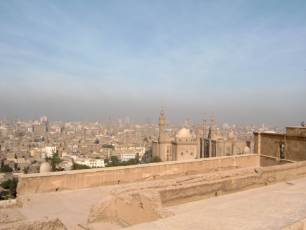
Udsigten fra CitadelletVores første besøg gjaldt Citadellet. Det er byens fort og husede engang den kongelige familie og skønt det meste af komplekset er åben for besøgende, besidder militæret stadig en del, som er lukket område. Det tager en halv dag at komme gennem hele Citadellet, hvilket vi ikke havde mulighed for. I stedet tilbragte vi vores tid i Muhammed Ali moskeen.

<== Der er en fantastisk panorama over byen fra den Vestlige terrasse - fantastisk at Cairo ikke et bygget af ens mudderfarvede stenbygninger. Det mest bemærkelsesværdige ved Cairo er imidlertid mangelen på farver og farverne stemmer overens med ørkenens farver.
Mohammed Ali MosqueVores guide Adam/Mohammed gav os en ringe indsigt i funktionen eller historien af Citadellet, og i stedet pladserede gruppen i hjørnet i hjørnet af Muhammed Ali moskeen som en gruppe skolebørn, og gav en lektion om Islamisk lov og sædvane.

Da René vovede sig til at spørge om mere om Citadellet, blev han skældt ud for at afbryde og fik besked på at lytte. Vi fik aldrig muligheden for at finde 7-tallet Napoleons tropper hade malet over port for at undgå de uvante arabiske navne, eller det halvrunde tårn, da vores guide simpelthen ikke vidste, hvor de var.

Ind i Mohammed Ali Mosque


I den tid havde jeg muligheden for at spadsere lidt for mig selv og gå i moskeens skønne alabaster arkader. Den himmelhvælvede centrale bederum var et glimmer af hundrede af lys, der hang i koncentriske cirkler. På loftet var der arabiske inskriptioner i guld. Kvinder skulle være anstændig klædt og kunne ikke bære ærmeløse trøjer eller korte shorts eller skørter. I et hjørne af rummet lå sarkofaget med Muhhamed Ali - grundlægger af moskeen og Albanisk handelsmand, grundlægger af dynastiet, som herskede til revolutionen i 1952.

Cairo Ægyptisk Museet

Jeg huske turen rundt i dette museum, hvor jeg kiggede ind i smudsige glas montre og stirrede på de rynkede ansigter af nogle engang kendte faroer som Ramses II og undrede mig over, om disse gamle Ægyptere var giganter i deres store kister.
20 år senere var det næsten umuligt at skubbe sig gennem mængderne af turister - kun nyttigt fordi deres guider gav flere informationer end vores. Med kun to timer var det umulig at se hele museet og slet ikke de kongelige mumier.
Museet fejrede sit hundred år med en speciel udstilling omkring TutAnkhAmun - det mest berømte fund. Med rejseguiden i hånden "aaaede" og "åååede" vi over guldskattene fundet i hans grav - en guldtrone med den berømte scene med TutAnkhAmons dronning, der tilbeder ham, kister af ibenholt og elfenben, jagtskjolde beklædt med gepardskin, buer og pile, alabaster krukker med kong Tuts mummificerede organer, guld sarkofager - da Howard Carter havde fundet sådanne skatte for en lille kendt drenge-konge, forestil jer, hvad Ramses II´s grav har indeholdt. Kong Tuts inderste kiste af rent guld og og den berømte maske af guld, som alle gerne vil se, er trykt i mange Ægyptiske billedmaterialer.
Museet er blevet en ny pengemaskine for Ægypterne med yderligere en entre for at se de kongelige mumier. Vi måtte være tilfreds med at se dyremumierne - katte, hunde, fugle, geder, Nile Perch (ja, også fisk!) og mest fantastisk var en 7 meter krokodillemumie.
Udstillingerne var på øverste etage opsat efter emne og på underste etage i kronologisk orden uret rundt fra det Gamle Kongerige, til det midterste og sluttende med de Nye og Sidste Kongedømmer. Der var værelser fyldt med kæmpe sarkofager (kister), som hver ville veje en tons, et værelse fyldt med miniaturer, der viste daglig liv i Ægypten, et værelse fuld af falmede gamle papyrusskrifter og værelser fulde af brokker og stykker fra ruiner, statuer, palads gulve - et sted, man kan tilbringe dage med en ordentlig rejse guide.


Khan Al-Khalili

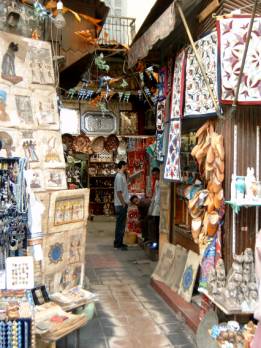
På gaderne af Ægypts største bazar, Khan Al KhaliliEfter et stop på en Ægyptisk parfumefabrik og en frokostpause, kom vi til Khan Al-Khalili, det ældste basar i Ægypten, som går tilbage til 1300-tallet. Gamle tiders købere besøgte Khanen for at kigge på varerne bragt dertil af handelskaravanerne. Vi finder ikke længere slaver, silke, juveler eller diamanter, men træ guitarer, skønne klude tæpper, klæder, t-shirts, papyrustryk, vandpiber, bunker af tøj, aromaen af krydderier breder sig og boder med stakke af rødt, guld og blå pulver og sække med frø og bønner. Kobbersmede udhamrer fade, terriner, kaffekander og enorme halvmåneformede toppe til minareter. Det er et ritual i basarer at tinge om priserne, lokale såvel som gæster - almindeligvis til en tiendedel af den budte pris - har du betalt en tredjedel, har du betalt for meget. Vi havde kun en time til vores rådighed, men mange af boderne var lukkede for siesta og for ramadanen. Ulla og jeg pegede på nogle sække af mangefarvede krydderier. Han ville have 50£ (50 kr.), men efter jeg sagde "da ketir awi" (det koster for meget) og gik, fulgte sælgeren efter os en kilometer mens han reducerede prisen fra 40£ til 30£, 25£, 20£, og efter vi i spøg råbte 10£, tilbød han 15£, 10£ og endelig 5£ før han opgav os. Efter megen tingen lykkedes det os få to udsmykkede parfumeglas flasker for 20£ (20 kr.).


Bedstemor's fødselsdagfest

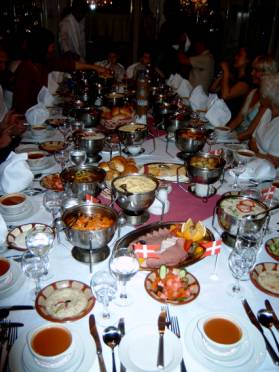
Bedstemors festIrene og Ole havde sørget for et privat værelse til Bedstemors fødselsdagsfest. Et enkelt langt bord i et værelse i Ægyptisk stil. Sølv fade i to rækker midt på bordet med ild under holdt maden varm.

Vi fik kommen-panneret stegt fisk, kyllinge filleter på Ægyptisk stil, kanel-krydret ravioli, ris, kartoffelmos og steg i pebbersauce, "sang" og brød med Ægyptisk vin og øl til Bedstemor.

Mens børnene legede i et hjørne, var der meget snak bordet rundt, og aftenen sluttede med chokolade og frugt kage pyntet med "Happy Pirthday" (det er ikke en fejl) og vi morede os over os over overfloden af Ægyptiske kager - bagværk, semulje tærte, rosenvands krydrede tærter og tærter, der smagte af flydende honning… Ulla ville gerne have resten af desserten med sig (undtagen den rosenvands krydrede - det var morsomt at se hendes udtryk - rosenvand dufter næsten som parfume). Tjenerne var hele tiden meget opmærksomme, passerede hver andet minut for at opvarte os.

Det bedste var, at Bedstemor blev som to årig, da hun skulle puste lysene på kagerne ud. Som danskerne ville sige, "det var meget hyggeligt!"


Mandag 15. november 2004 (start 7:30)

Fra de grå bygninger og gader I Cairo kørte vi 24 km mod sydøst til Saqqara, skiftende fra ensartet brun til frodige grøne marker med grøntsager og hundrede af dadelpalmer. Det var som en oase, hvor et fint slør gav en uvirkelig følelse af de frodige områder i det gamle Ægypten. Kvinder i hellange sorte "abeeyas" fordelt i markerne, den gamle mand, der vandrede omkring - en stor kontrast til mylderet i Cairos centrum.

Saqqara's Trin Pyramide

Grundlagt som et nekropolis (begravelses by) for det gamle Kongedømme og et af de rigeste arkæologiske områder i Ægypten.

Trin pyramiden er mindre end halv så høj, som den største pyramide ved Giza, men dette monument var en forløber for de glatte pyramider. Tidligere var gravene bygget af soltørrede muddersten, rektangulære byggesten, der dækkede gravstedet. Men arkitekten Imhotep havde Zosers trinpyramide i Sakkaraden lyse ide at bygge med sten og bygge den trinagtige struktur fen gange ovenpå hinanden, og skabte den første pyramide.

Vi kom ind gennem den store sydlige gård - på størelse med en fodboldbane - gennem en koridor af 40 søjler inspireret af bundter af bundne rør. Mens Adam holdt endnu en af sine taler, blev jeg antastet af en klæde og turbanklædt Ægypter, som førte mig op til toppen, hvor jeg fik et godt skud af de fantastiske søjlers top, før jeg blev skældt ud af Adam og tigget for "baksheesh". Jeg var taknemmelig for at blive reddet fra Ægypteren, som ikke ville lade mig gå uden baksheesh, af et par Italienere. Da jeg kom ud fra koridoren blev jeg imidlertid blændet af det hvide sand og den enorme pyramide alene omgivet af sten fra andre ruiner og en meget mindre trekantet høj af sten i baggrunden. Selv om morgenen var køkig, så varmede solen os, mens vi vandrede nord omkring pyramiden.


Memphis

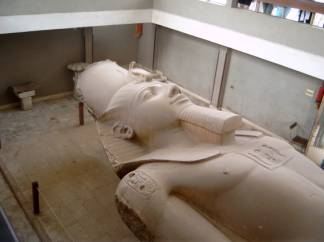
Ramses II ligger på Memphis' lille museetEngang hovedstaden i det gamle Ægypten, uudgravet på grund af landsbyen, bygget over den gamle by, og det hævede grundvandsspejl på grund at Asuan-dæmningen. Der er en lille park med nogle få fund, brokker og stykker, men den mest spændende ting at se er en kolos af Ramses II, der