Home

9. February 2018 07:03
by Rene Pallesen
0 Comments

Water fall - Laos

9. February 2018 07:03 by Rene Pallesen | 0 Comments

Just outside Luang Prabang there is this amazing waterfall cascading down a limestone creek.We decid
Just outside Luang Prabang there is this amazing waterfall cascading down a limestone creek.

We decided to get up early to go a take photos, so that we could be there early before all the crowds arrived.


At the entrance to the park there is also a Bear rehabilitation centre. They rescue bears from captivity and keep them until it is safe to release them back into the wild (if ever). The bears have a big area and seem to love climbing and sleep in the hammocks provided.


8. February 2018 22:03
by Rene Pallesen
0 Comments

Our kids - Laos

8. February 2018 22:03 by Rene Pallesen | 0 Comments

Our kids had a blast of a time in Laos. They loved each other company (for the most part) and someti
Our kids had a blast of a time in Laos. They loved each other company (for the most part) and sometime looked like real little travellers.


They were respectful at the temples and even offered a prayer.


At other times they behaved like animals and should be lock away in a cage.


But for the most part they liked exploring things that us adults wouldn't see such as this crater from a crash landed U.F.O.

8. February 2018 22:03
by Rene Pallesen
0 Comments

The kids and families of Laos

8. February 2018 22:03 by Rene Pallesen | 0 Comments

What I especially remember from my last trip to Laos was the kids. One of my most cherished photos i
What I especially remember from my last trip to Laos was the kids. One of my most cherished photos is one of two little girls holding a bouquet of flowers that I took 20 years ago (it is on this blog if you look for it through the search function).

The children are still there. They are still very shy, dirty and smiling.


They make up their own games such as these kids at a school playing marbles with tamarind seeds.


These kids were playing a game where the kid under the table had to poke the feet of the kids above the table.


And some things never change, kids teasing each other.


The girls in the school yard 'hang out'.


Visiting a local school was great for our kids to get a glimpse of how other kids live.


Along the road we stopped and a family was outside with the mother breastfeeding her son in their outdoor living room. This is where everything happened such as the cooking, washing, feeding etc.


The chicken were running around freely


Here is a rare shot that Kim took with my camera in it.


It is a very family oriented life they live


7. February 2018 21:03
by Rene Pallesen
0 Comments

Catching local transport - Laos

7. February 2018 21:03 by Rene Pallesen | 0 Comments

For getting around the towns in Laos we mainly used Tuk-Tuks. These are small motorbike powered mini

For getting around the towns in Laos we mainly used Tuk-Tuks. These are small motorbike powered minibuses and the experience can be very mixed. Most of them are generally good, but some have bad brakes have a plume of smelly two stroke engine smoke trailing behind them. We could easily fit our two families into one and I'd joke that there would even be room for another couple of adults.


The kids loved the tuk-tuks and have the fresh air blowing in their hair while riding.


The only downside is that you'd never quite know what the fare would be until you started bargaining and from town to town the fares seemed to be very different. Even though I believe I am reasonable proficient at bargaining, I'm still confident that we paid more that the locals would be paying for the same trips.


For the longer trips we would catch either local buses (mini vans) or in some instances it was worthwhile us hiring a private bus as we were enough people to fill it.

From Vang Vieng to Luang Prabang we hired a private van taking us across the mountain pass at Kasi. Last time I went through here it was in an open bus and at the pass it was raining and really cold. This time round we had a beautiful clear day with a great view of the valley below from the top.


The week before they had a lot of rain and a landslide had taken out large parts of the last section of road (I read in the local newspaper a few days earlier that the road was closed). Our little van was struggling getting enough grip and our driver had to reverse to get enough of a run-up in the next attempt to make it through the steep and muddy section.

The larger trucks were really struggling getting through.


6. February 2018 16:03
by Rene Pallesen
0 Comments

Morning Markets - Laos

6. February 2018 16:03 by Rene Pallesen | 0 Comments

The morning markets are interesting. This is where the locals still go to buy their fresh produce an
The morning markets are interesting. This is where the locals still go to buy their fresh produce and all kinds of specialties are being sold here. It would be easy to go here and get the ingredients for some really delicious food.

There are also some unusual things that we don't see in our western kitchens. such as:

Dried Squids:


Fresh fish - of cause, but this have sharp teeth.


A protein and herb table that would make most chefs (and diners) salivate:


The Chillies in Lao are more hot than in Thailand - We loved the heat.


A pig:


River crabs:


Beetles:


Dried rats:


Caterpillar - these are yummi when fried:
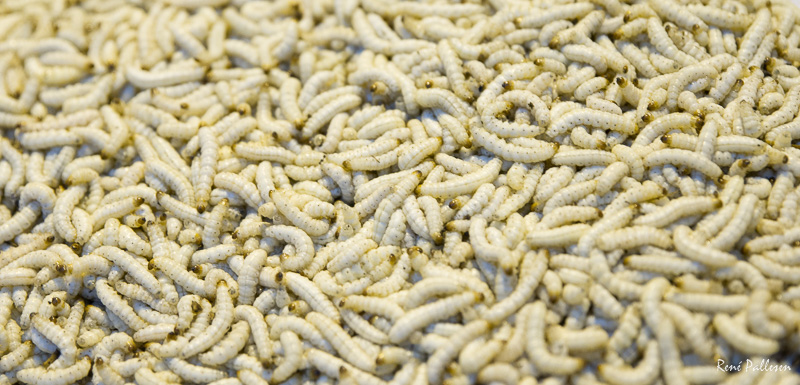

Frogs:

River snails:


Dried squid, shrimps and fish:


5. February 2018 16:03
by Rene Pallesen
0 Comments

Bamboo Bridges - Laos

5. February 2018 16:03 by Rene Pallesen | 0 Comments

During the dry season the people of Luang Prabang builds traditional bamboo bridges across the small
During the dry season the people of Luang Prabang builds traditional bamboo bridges across the smaller river. This saves them a lot of time (and cost) to cross directly into the centre of town rather than a long detour to the other larger bridges.

It also earns them a small income to charge foreigners a small fee to cross the bridges.


5. February 2018 16:03
by Rene Pallesen
0 Comments

Silk - Laos

5. February 2018 16:03 by Rene Pallesen | 0 Comments

They still manufacture silk they way they used to. It was interesting for the kids to see the proces
They still manufacture silk they way they used to. It was interesting for the kids to see the process from small caterpillar eggs that hatch to worms to the production of the silk itself.


I had always wondered where the colour blue (Indigo) came from. I knew it used to come from a seashell, but I was fairly certain that this wouldn't be the case here. It turns out that they use a special leaf from a plant that when mixed with water and left fermenting/oxidising turns into a blue dye.


They also use plants for most of the other colours.


After they spin the thread they use traditional weaves to make it into pieces of garment. These days the silk garments are fairly expensive - hundreds of dollars, but it used to be really cheap.

4. February 2018 22:02
by Rene Pallesen
0 Comments

Pak Ou cave - Laos

4. February 2018 22:02 by Rene Pallesen | 0 Comments

A two hour boat ride north of Luang Prabang is the Pak Ou cave. Since we were traveling two families
A two hour boat ride north of Luang Prabang is the Pak Ou cave. Since we were traveling two families the best way to get there was to hire a slow boat just for us.
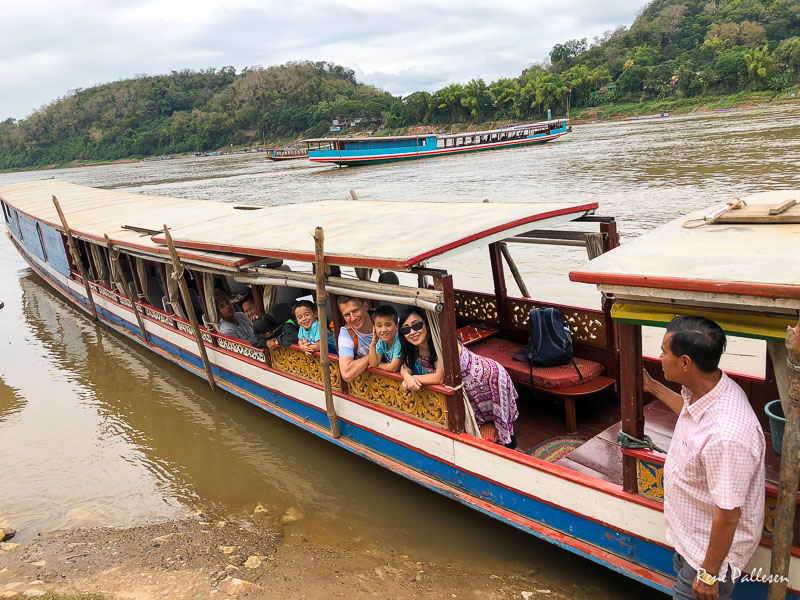


The flow boats are long narrow boats that are ideal for navigating the Mekong River. This part of the river is full of underwater rocks but the boats seem to navigate these treacherous waters with ease.

Having the boat for ourselves gave us more flexibility with regards to how long we wanted to spend at the cane and also meant that we have more room to move around.
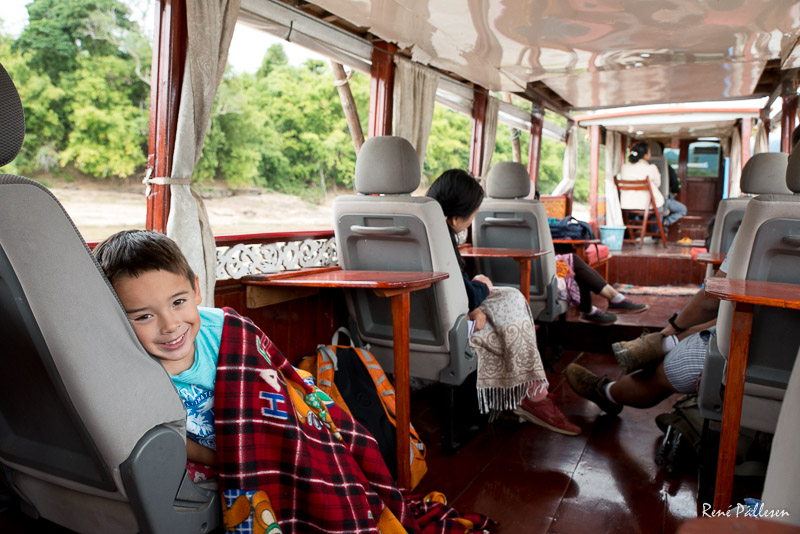


The front of the boar is where the captain sits and steers the boat. After this there is a section for the passengers followed by a small pump toilet and then the living quarters for the captain and his family. Out the back there is a small kitchen for them to do the cooking.

The cave is upstream into an area full of limestone mountains.
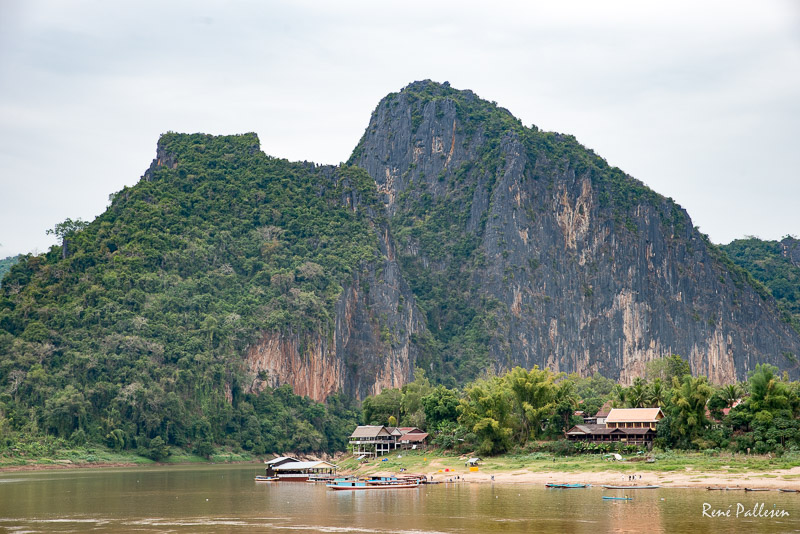


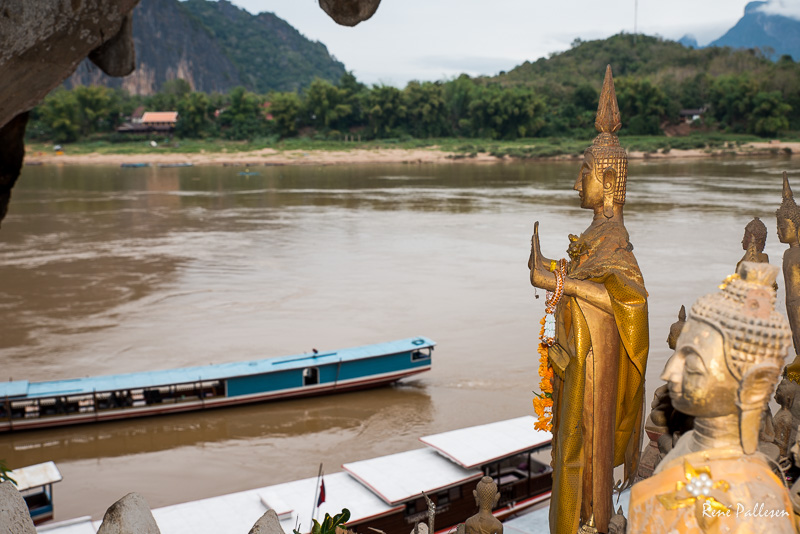
The many boats moor at a long and wobbly floating bamboo bridge that takes you to the cave itself.
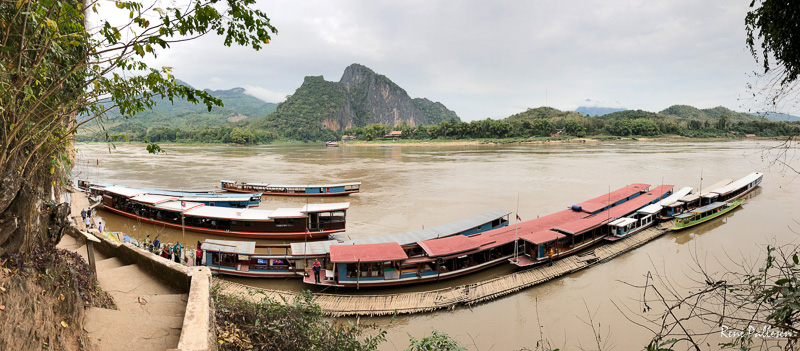
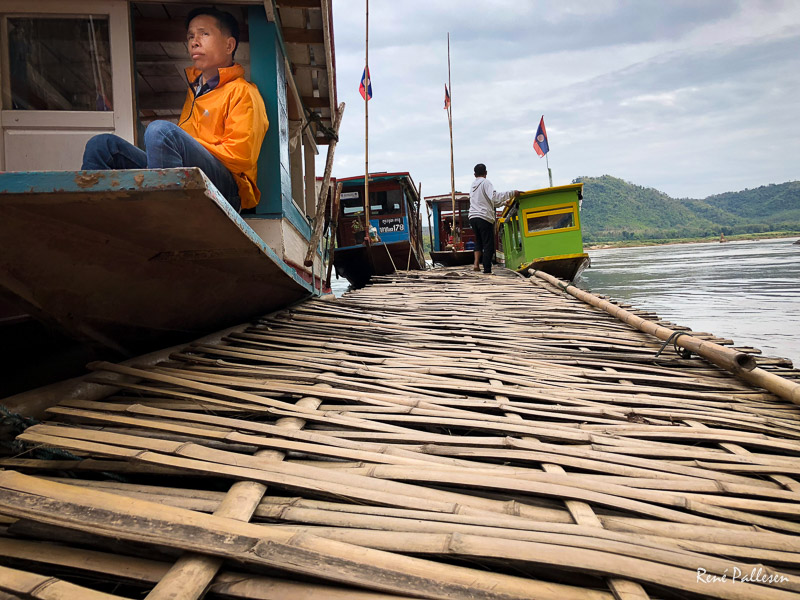


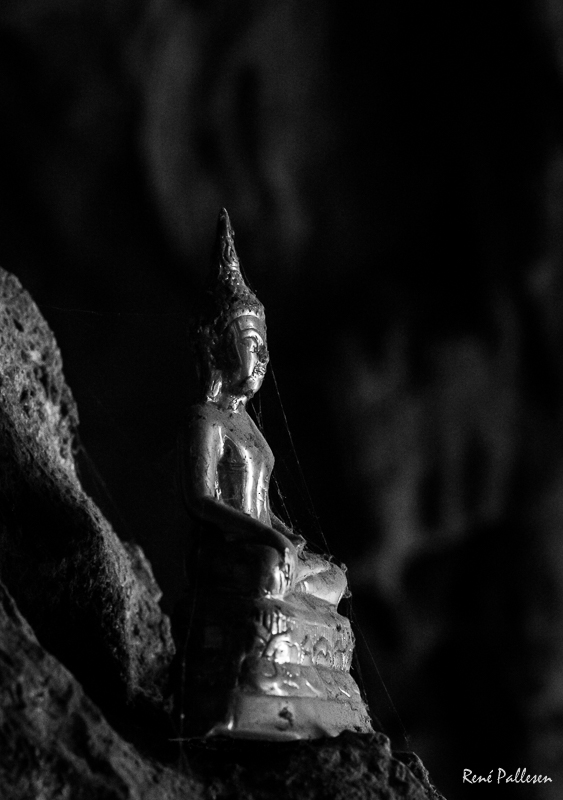
The cave itself is not big but it is full of small Buddhas that have been put there over hundreds of years. You can tell that this used to be an important place of worship.
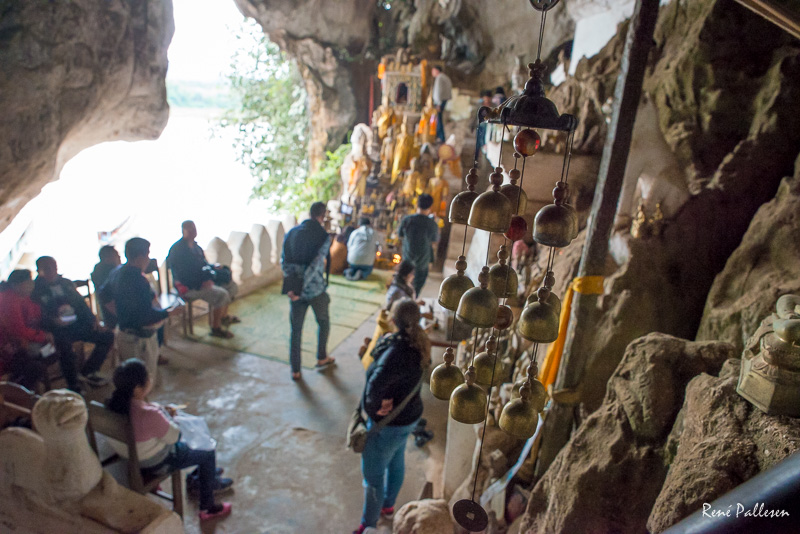


Now however the place is so crowded with tourists (guilty here too) coming in on boats that it is hard to move around. I could not stop myself from taking this photo of Buddha holding up his hands to stop more boats arriving.


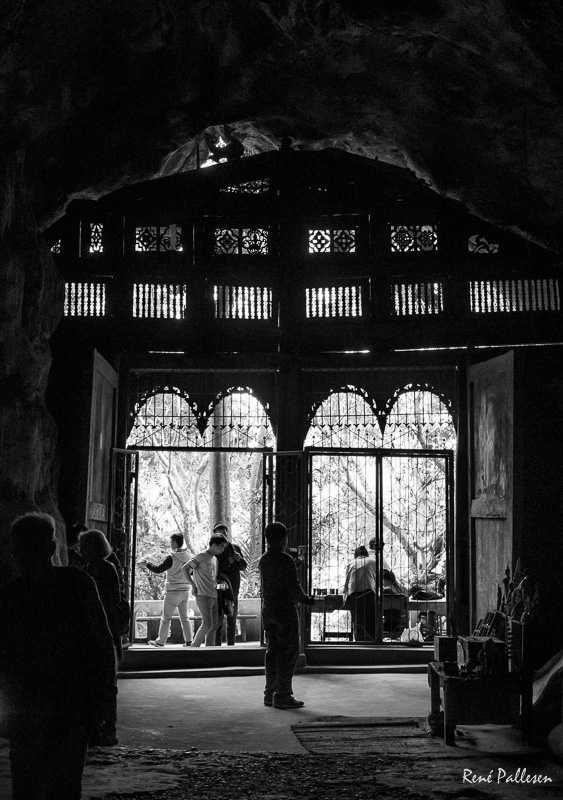
At the top of the hill the hill there is what I think is a more 'pleasant' cave. It is equally interesting and much less crowded because most tourists don's make it up the many steps to the top.
4. February 2018 16:03
by Rene Pallesen
0 Comments

Lao Lau (rice whiskey) - Laos

4. February 2018 16:03 by Rene Pallesen | 0 Comments

The traditional Lao Lau is still being made. Just north of Luang Prabang on the river there is a lit
The traditional Lao Lau is still being made. Just north of Luang Prabang on the river there is a little village on the river called Whiskey village whos main income is from the production of Lao Lau.


When I was there two decades ago this is what the locals were drinking (now they drink beer instead). I still remember the foul taste from the home brew that was distilled in large oil drums after having been fermented in large clay pots. Whenever I see it I always wonder if distilling strong alcohol right next to an open flame is the wisest of ideas!?!?


The process itself hasn't changed, but these days most of the whiskey is sold to tourists and I tastes a lot more pleasant that it did back then.


3. February 2018 15:03
by Rene Pallesen
0 Comments

Food - Laos

3. February 2018 15:03 by Rene Pallesen | 0 Comments

The food in Laos is good. It is traditional cooking mostly still cooked over an open fire.You see th
The food in Laos is good. It is traditional cooking mostly still cooked over an open fire.


You see them start cooking the food well before sunrise in big pots.

The food itself is mostly a fusion of Thai and Vietnamese. It has all the noodle soups from Vietnam, but with the more street food and spice of Thailand. The picture below is a typical noodle soup with a traditional cube of coagulated blood.


We were eating a lot from small street type restaurants following the rule that is had to be popular with the locals. The logic behind this is that the locals would know what is good and would also be choosy regarding the quality of the food, so chances are that it would be fresh and not cause food poisoning (none of us or the kids had any issues on the trip).


There are some dubious food there, such as some of the meat BBQ where they sometimes have the meet cooked earlier on the side of the BBQ and then just re-heat it when you order it.


Also be careful with some of the food stalls where the food may have been sitting there for most of the day and often from the day before.


From a 'snack' perspective there are some personal favourites that I absolutely love such as the BBQ fried squid - the packet stuff is just not the same.


Also the Bamboo and coconut fried rice is delicious - they sell them at bus and train stations and especially the purple rice one is yummi!


The freshly made puffed breads over an open fire - they will use two rakes to flip them until they are done.

Perfect Moments Photography | A Rene Pallesen Journal

Home

28. July 2001 11:11
by Rene Pallesen
0 Comments

Photo Gallery

28. July 2001 11:11 by Rene Pallesen | 0 Comments

photo gallery

Photo Gallery

I have placed photos here - those I could not fit on the respective webpages.


Schwedagon
Big Stuba at nightBig StubaBig Stuba at night
Schwedagon 1Schwedagon 2Schwedagon 3


Mandalay
Mandalay facing eastMandalay HillMandalay Fortress


Marionet
Puppet Show 1Puppet Show 2
Musicians


Volleyball


Created: 3 Nov 2001

28. July 2001 10:52
by Rene Pallesen
0 Comments

South East Asia ( 24 July ~ 24 August 2001 ) . . .

28. July 2001 10:52 by Rene Pallesen | 0 Comments

south east asia 24 july 24 august 2001


Map of area I went to

I initially made plans to explore Burma and then make my way across the border into western China at Burma's only border crossing up north. I had not made any definite plans wanted to play it by ear... but in the end my trip consisted of Thailand, Cambodia and restricted areas to Burma.

I was away for a total of 5 weeks and must admit that parts of my trip really frustrated me - there were many restrictions in Burma and being in Bangkok at times stressed me because of all the tourists and crowds. I really only went to Cambodia to see the magnificent Angkor Wat - actually I really did enjoy being there. I think my most enjoyable part of the trip was the days I had climbing on the secluded areas of Krabi.

Burma - Temples at SchwedagonCambodia - Angkor WatThailand - Scuba-diving at Krabi
Burma
(23 Jul ~ 5 Aug)


Cambodia
(6 ~ 10 Aug)
Page available soon
Thailand

Page available soon


28. July 2001 10:51
by Rene Pallesen
0 Comments

Monkeys . . .

28. July 2001 10:51 by Rene Pallesen | 0 Comments

monkeys
There were quite a lot of monkeys at Mt Popa.


Mother & Baby Monkey

Monkeys fighting

Mother feeding baby monkey

The photo above in the middle, shows monkeys that look like they are playing around. They are actually fighting monkeys and can be very dangerous because they bite and also snatch things from you.

They were rather oblivious to me being there, until the flash on my camera went off. Then their attention was on me and they were ready to attack.

I adopted the “monkey mentality” - avoid eye contact and move away backwards - the only way to stop the monkeys from attacking is to not look at them.


Monkey 1

Sitting Monkey

Monkey with eyes closed

Monkey Portrait!

28. July 2001 10:50
by Rene Pallesen
0 Comments

Burma Up North (continued) . . .

28. July 2001 10:50 by Rene Pallesen | 0 Comments

burma up north continued
Volleyball Player Photo 1


Whilst I was up north, I watched a rather interesting game of volleyball.

I have never seen such dexterity and agility amongst the players!

It was amazing to see how flexible these guys were.

Volleyball Player Photo 2

Volleyball Player Photo 3Volleyball Player Photo 4
Volleyball Player Photo 5Volleyball Player Photo 6

Volleyball Player Photo 7Volleyball Player Photo 8

Volleyball Player Photo 9Volleyball Player Photo 10

Volleyball Player Photo 11

28. July 2001 10:50
by Rene Pallesen
0 Comments

Mt Popa . . .

28. July 2001 10:50 by Rene Pallesen | 0 Comments

mt popa
Mt Popa


There is a monastry on Mt Popa - a hill located 50km away from Bagan.

When I was there, it was a cloudy day.

Woman selling petrified wood at Mt Popa

I ran into a woman selling petrified wood - quite silly really, considering the place was covered with it.


Road sign

They must think tourists are stupid! *laugh* I managed to pick up a couple of small pieces to take back with me.


As you can see, there are stacks of them around.

And no... this is not a tombstone.
This is actually a road sign.


Example of petrified wood

You would be surprised how big some of these pieces are - this piece below was actually about a metre long and 40cm wide.

Toilet in Burma

Actually what I found interesting were the toilets in Burma.


My girlfriend tells me that squatting over a toilet is quite common in Asia.

In many of the city areas, they would have toilets as we know them, and they would also have a carved hole in the ground, on which either side, one places their feet on.

Toilets in the rural area are more crude than that - a hole leading into a gaping pit.

However, what I found interesting about these toilets were that recycled running water was used to wash away any excrement. The water is first used for washing one self and then used in the toilets.

As there were a few toilet cubicles a row, sometimes you would see the excrement from a toilet uphill go beneath you! *laugh*

Very clever and environmental system, I think!

Me at Mt Popa


Trying to grab a snooze... *smile*


Like Schweddagon, most of this is real gold as well.

And yes, there is a monkey sitting near my head.

If you click to the next page, you will see that I have taken a series of photos of the monkeys.

28. July 2001 10:49
by Rene Pallesen
0 Comments

Puppet Show . . .

28. July 2001 10:49 by Rene Pallesen | 0 Comments

puppet show
Puppet Show


I saw the most interesting puppet show, known as the “Mandalay Marionettes”

There were 2 or 3 puppeteers out the front, with a live band of musicians.

Unfortunately, it was more of a show for the tourists, rather than the locals.

It cost 1,000 chats or US$2 per show.


4 men manipulating the marionettes A child posing as a 'puppet'
The Marionettes


Lots of bright lights

28. July 2001 10:49
by Rene Pallesen
0 Comments

Burma Up North . . .

28. July 2001 10:49 by Rene Pallesen | 0 Comments

burma up north
Map of Northern Burma


View from train


I decided take a 20-hour train-ride to Myitkyinã *laugh* it took 20-hours to get there by train because there was only one track.


It was definitely faster to run next to the train than to travel in it!

We had to wait for the oncoming train to return before we could travel north.

At one point, we crossed a bridge that was so rickety that I thought it would collapse any moment!

Working in the rice fields


Locals working in the rice fields.

Working in the rice fields


Locals using water-buffaloes to plough rice fields.

Jrrawaddy River


The train travelled along the Jrrawaddy River.


It would have been nice if I was able to travel to Mandalay via a riverboat down the Jrrawaddy River.

People living on lake


It was amazing to find out that people live “on” these lakes, by building houses on stilts.


This sort of housing is quite common in many parts of Asia, especially areas where monsoons quite frequently flood an area.

It is also very environmentally-sound, I think, and hurts the land less.

Most of the houses are made of wood.

Myitkyina in rain


Myitkyinã is pretty dismal in rain!


There is a huge drug problem in Burma, especially through the crossings into China.


I have scanned a copy of a recent newspaper article about this problem in Burma.

28. July 2001 10:48
by Rene Pallesen
0 Comments

Mandalay . . .

28. July 2001 10:48 by Rene Pallesen | 0 Comments

mandalay


Map of Burma


When I initially arrived in Yangon / Rangoon, I wanted to fly up Bhamo - one of the bigger towns north of Burma. I also considered exploring Myitkyinã - a town further north of Bhamo.

My Lonely Planet guide indicated that the only border crossing into China was to the east of Bhamo. My initial plans to Burma also included exploration of western China. However, I was disappointed by the military turning me back, despite the fact that my Lonely Planet guide said I could cross into China at Ruili.

I decided instead to fly to Mandalay, not only because it was cheap to do so, but it saved me a 20-hour bus ride there from Yangon.

City of Mandalay


I heard about a song for sailors.
“To be a real sailor, the sailor would have to have been to Mandalay way upriver”


I quite liked Mandalay.


The photo below, is of Mandalay Hill.
During World War II (20 March 1945), the British and the Japanese fought one another to gain control of the position on this hill.

Important Position in Mandalay Mandalay Hill facing east


The photo to the left is taken from the hill itself facing east - as you can see, it has an aerial view of the whole city, and puts any oncoming enemies at a disadvantage. Control of Mandalay was important during the war, as the soldiers were able to set up artillery and attack anyone approaching the fortress.

This hill was of big strategic importance.

The building you see near the shrine is a monument to the British regiment who managed to take control of this hill from the Japanese.

At the eastern part of the delta, a lot of logging takes place. There was a train line built that used to cart all the trees/wood for export to Thailand.

View of the FortressView of the Fortress


The moat around the fortress is man-made.
Although man-made, comes from the local river.


The original fortress was burnt to the ground.
The whole fortress covered an area of 2.5 x 2.5 km


Fortress at Mandalay

Fortress at Mandalay

Clocktower in Mandalay


The design of Mandalay was quite colonial, and surprisingly, most of the streets were at 90º to one another.


Overall, I found Mandalay the most expensive city to travel to in Burma.

No matter what one does in Mandalay, be it explore Mandalay Hill or the city itself, the locals always had “special” foreigner prices. It really annoyed me.

I tried to use local currency as much as possible. However, FEC (Foreign Exchange Currency) was more valuable and worth more to the locals. FEC is also used in China, and one tries to use local currency as much as possible. Any item you buy has 2 prices - and obviously it is cheaper to use local currency than to use FEC.

I must admit, even Mandalay Hill was not that nice for the price I paid to explore it. It was also expensive just to go into the fortress.

Surprisingly, I could not find maps of the area that was not more that 40 years old.

28. July 2001 10:47
by Rene Pallesen
0 Comments

Medicine . . .

28. July 2001 10:47 by Rene Pallesen | 0 Comments

medicine


The Wares of a 'Medicine Man'
Medicine . . .

My girlfriend, Arumi, tells me one sees the wares of a 'Medicine Man' quite often throughout Asia.

Whether they sit by the roadside, or whether they own a shop in a building, one will see very similar items being sold around Asia.

The “pellets” you see here are in fact different types of roots such as ginger or some unknown vegetable, that have been sun or air dried.

The Medicine Man 1The Medicine Man 1The Medicine Man 1

You will see the antlers of various animals such as deer or even rhino. There are also skulls from different animals - some of these animals may be endangered species, but somehow you will see them being sold in these markets.

The Medicine Man 2


These skulls are definitely not being used as “trophies” around the house!

The Burmese, like many Asians, believe in using very 'natural' remedies to cure common ailments.

Tiger Skull


A Medicine Man may not necessarily be a “doctor” according to western standards - that means he may not have a university degree.

However, a Medicine Man, may be what we know as “witch-doctors”. Some of the remedies they know are very natural and useful.

Unfortunately, not all of these remedies work. Around Asia, you will see shops or Medicine Man selling items like tigers' paws and skulls, or ground ivory tusks. Many of these are sold as cures or enhancements for the sex life.

In Burma, there is virtually no wildlife left.


Selling Tobacco


You will even find that even tobacco is sold naturally.

Not in cigarette form, but in leaf form! The laws in Burma are not quite the same as they are here. Marijuana is also sold very freely.


Fruit of the Lotus Plant
Lotus Fruit . . .


Quite often in Asia, you may see lily pads floating on the water. In fairy-tales, you hear about frogs sitting on a lily pad.

You will be amazed to associate that this fruit here, comes from the flowers/plant growing out of the water near the lily pads.

The yellow seeds come from the flower itself. The seeds are used often in many Asian desserts, and said to promote better blood circulation.

While, the root of the lotus plant is also a delicacy. It is white when cooked, and has a crunchy texture, similar to that of the water chestnut. Mainly used in savoury meals, although used as a dessert as well.

Personally, I think it is too much hassle retrieving the fruit! *smile*

Created: 31 Oct 2001

28. July 2001 10:47
by Rene Pallesen
0 Comments

Burma Religion & Politics . . .

28. July 2001 10:47 by Rene Pallesen | 0 Comments

politics

Politics . . .

Queue for Rations
There is a lot of politics going on in Burma that an outsider should not get involved in - Burma is one of those countries where political opinions are best kept to oneself.

In Burma, use of the Internet and mobile phones is illegal. This is the government's way of controlling the information entering the country. Even access to equipment such as laptops is illegal - the country is so poor that many could not afford such a piece of equipment.

I saw many young women queueing for their rations. They were standing so close together that I thought they were lesbians! *laugh* The girls stand close together so another person cannot jump the queue by pushing in.


Girls Standing Close

Girls Standing Close
Young Girls Working on Roads


The girls here are very young, some have barely reached puberty and are doing some very hard work.


Young Girls Working on Roads


There is a lot of critique by Amnesty International, of Burma's use of young girls to provide maintenance for the roads.

Perfect Moments Photography | A Rene Pallesen Journal

Home

7. January 2018 21:01
by Rene Pallesen
0 Comments

Tribes - Laos

7. January 2018 21:01 by Rene Pallesen | 0 Comments

The tribes of Laos still exist although it is no longer as noticeable. They no longer wear their tra
The tribes of Laos still exist although it is no longer as noticeable.

They no longer wear their traditional costumes but it is possible to glimpse the occasional traditional head wear or dress in one of the shops.


It is especially sad to see the Hmong tribal wear gone as worn below by Mavis and Kim. The Hmong traditionally lived in the mountains. The government has forced them down into the lowlands where they can be controlled and 'integrated' into the the rest of Laos.


6. January 2018 20:01
by Rene Pallesen
0 Comments

Vang Vieng Countryside - Laos

6. January 2018 20:01 by Rene Pallesen | 0 Comments

On the first day in Vang Vieng we hired a local guide to take us through the country side and some o
On the first day in Vang Vieng we hired a local guide to take us through the country side and some of the villages around Vang Vieng.


Hiking through the countryside in Laos is partly magical and at the same time an eye opener. It is not until you get into the country side that you get a glimse of the real Laos and its people, the way of living and their beliefs.

Walking into the first village a group of boys came walking towards us. One of the kids was holding his head with blood dripping down his face. The other boys were taking him home to his parents. I couldn't help but notice that there was a green substance smeared across the wound and asked our guide is he knew what it was. He went over to some bushes and plucked a couple of leaves and said that if you crush them then they will help stop the bleeding. This is when you realise that a lot of the plants in the villages serve a purpose as natural herbal medicine or for eating.

The village was a HMong village and at one of the houses we spotted the little girl above standing in a door opening with her grand mother. There are very few of the traditional bamboo shacks still standing and instead being replaced with brick buildings.


A bit further up the road we heard a sound. Someone was hitting a gong and chanting. Thinking it might be a monk we went to investigate. The sound was coming from one of the local houses. At the back of the house the family was in the process of preparing food, but we couldn't see where the sound was coming from. Our guide asked them and was told that they had a newborn (possibly sick) child and that the Shaman was in the house talking to the 'other world to' attract the good spirits and chase the evil spirits away.


As we walked on we could see him through the opening of the door and I snapped the above photo which is one of my favourite photos of the trip.

In the village people go about their normal life such as this woman removing lice from her daughters hair.


As we walked on we had to walk through the local school. It happened to be recess and the kids in the smaller classes were outside playing.


There was a small stand selling them lunches who also sold lollies, so Kim got the idea to spoil the kids with lollies - but also turned out to be a great opportunity for our kids to interact and see what a classroom in Laos looks like.


The area is still very un-developed. Although there seems to be electricity, this is mainly used for lighting. Cooking is still done by collecting wood and done on wood fired stoves and people still wash their clothes in the rivers and streams.


Although there are still a number of water buffaloes these are mainly used for eating along with any other non-human living animal - such as pigs, dogs, birds etc.


It was very healthy for the boys to see where their food 'potentially' comes from and understand that this is part of life.

The area is full of rice paddies, but these are now worked with mechanical tools rather than buffaloes.


The government has built bridges across the large river to allow access to the villages.


But the smaller streams have bamboo bridges - in this case wide enough to drive a motorbike across, others just a single bamboo to allow a person walk across.


At the far village (Lao and not Hmong) there was a limestone cliff with a small cave in it. This was called elephant cave and inside there was a small shrine along with some bizarre images.


The whole area is spectacular - I can only imagine what it would be like during rice planting season - yes it would be muddy but also stunningly beautiful.


During this whole hike we saw no other travelers. Other than at the cave we didn't get a sense that there frequently came any groups through and I think the feedback from all of us was that this was one of the highlights of the trip - no adrenaline required.

5. January 2018 16:01
by Rene Pallesen
0 Comments

Vang Vieng - Laos

5. January 2018 16:01 by Rene Pallesen | 0 Comments

Vang Vieng is an interesting tourism destination in Laos that has undergone several iterations of re
Vang Vieng is an interesting tourism destination in Laos that has undergone several iterations of re-inventing itself.


When I first visited for an overnight stopover it was a sleepy little town with maybe a handful of backpackers going tubing (more on that later).
I also remember the deserted airport runway from the 'secret war' going through the sleepy little village (Lima site 6) and the stunning mountain scenery in the background. Other than that there wasn't much there.


Ten years later my mum and dad visited the place and told me stories how the place had transformed. It had grown and was full of drunk backpackers with loud rave music and parties throughout the night. During the day they were floating down the river in car tubes again with beers and drinks in their hands.


Then again about 5 years ago, Laos appeared in the Australian news media with stories of young backpackers breaking their necks doing somersaults off the tree branches on the river and lagoons and hitting the rocks. Stories of high highly available drugs were also emerged.

The Lao government stepped in and closed the majority of the bars along the river, stopped the parties and the drugs and implemented a number of other safety restrictions.
It worked, the parties stopped and the young party seeking backpackers fled.

A new crowd has now moved in - this is bus loads of adrenaline seeking Koreans. They go there to go kayaking, zip lining, tubing, buggy riding etc. They eat at the Korean restaurants and stay at the same hotels, but otherwise mostly keep to themselves. This also means that some of the same old sleepy feeling has returned to this town. It also meant that is was easy (or just plain luck from our side) to avoid the tourists.

The airstrip is still there, but I recon most visitors would walk across it and not notice and definitely wouldn't know the history behind the secret war in Laos, let alone the American involvement and the little airstrips around the place. It is a fascinating story and has very much shaped Laos into what it is today.


The area is just absolutely stunning with steep limestone cliffs and rice paddies. I could easily have spent more time there taking photos in the surrounding area.


3. January 2018 21:01
by Rene Pallesen
0 Comments

Pha That Luang - Laos

3. January 2018 21:01 by Rene Pallesen | 0 Comments

A must see in Vientiane is Pha That Luang - It is on every bank note in Laos and they are very proud
A must see in Vientiane is Pha That Luang - It is on every bank note in Laos and they are very proud of it.


Unlike Buddha Park it is surprisingly quiet when it comes to tourists. The majority of people visiting seems to be either Laos or Thai people offering a prayer. The correct way here is to get the insense and flowers and then walk clockwise around the Stuba on the inside of the covered corridor (mostly to keep out of the sun I assume).


Although it is not particularly old (The original 1st century structure was mostly destroyed and has undergone a number of more recent restorations), it is stunningly beautiful and impressive in size.


For me to get some of the panorama photos here with the selection of lenses I'd brought along I had to take multiple photos that I then had to stitch together.

Outside there is a temple that is equally interesting, although nothing compared to further north in Luang Prabang.


There are also street vendors selling cage birds that are supposed to bring good luck and prayers to anyone releasing them.


2. January 2018 10:01
by Rene Pallesen
0 Comments

Buddha Park - Laos

2. January 2018 10:01 by Rene Pallesen | 0 Comments

One of the sights we wanted to visit was Buddha Park outside Vientiane (close to the border crossing
One of the sights we wanted to visit was Buddha Park outside Vientiane (close to the border crossing back into Thailand).


Trying to figure out the most comfortable way to get there we settled on taking the local bus. There aren't any taxis as such in Vientiane and we weren't keen taking a tuk-tuk for 30 kilometers. Most of the tuk-tuks are in an extremely poor shape with failing brakes, wobbling wheels and thick smoke coming out of the exhaust pipes.
They are perfectly fine for shorter trips inside the city (such as hotel to bus station), but not recommended for longer trips.

The bus turned out to be easy to find and we were early enough to all get a seat. The bus was later packed with passengers going to Thailand and it would have been tough to stand up for the one hour bus ride.

The bus is also really convenient in that it stops right outside Buddha Park which is the last stop before the bus turns around and heads back to Vientiane.


Buddha Park itself was apparently established by a Monk building the statues for religious purposes as education of his religious beliefs.


It is actually a nice little area and quite interesting with lots of (to us) weird statues showing bizarre things.


The most obvious is the massive 'pumpkin' at the entrance that you can climb. Each level inside the the sculpture itself represents hell, earth and sky.


The entrance is a head with a clock above it - meaning swallowed up by time?


There is also a massive reclining buddha.


And my favourite was the large centre sculpture carrying the body of a woman...no idea what this is supposed to represent.

2. January 2018 09:01
by Rene Pallesen
0 Comments

Vientiane - Laos

2. January 2018 09:01 by Rene Pallesen | 0 Comments

Vientiane is no longer the sleepy capital city it used to be. It is hustling and bustling with peopl
Vientiane is no longer the sleepy capital city it used to be. It is hustling and bustling with people, cars, motorbikes and shops everywhere.


The once neglected colonial buildings have all been renovated and the red dust flying everywhere is long gone as the roads have been paved. In the outskirts of the city high-rise office towers have started shooting up and I think that given another decade this city will look like any other East Asian capital.


The most striking difference was the banks of the Mekong River. Last time I was there it was really just a dirty path and following it north long enough there would be a string of wooden shacks with local restaurants that would serve some beautiful local dishes, fish and other seafood.
The water then would come right up to the bank and the boats could pull up and during the day the local kids would jump from the trees and swim in the river.
The old path has been replaced by a modern walk way (which actually is really nice) and the shacks have been replaced by some bars closer to the centre catering more for a western clientel - still with some nice seafood on the menu. The water of the Mekon has receeded and there is now a massive sand bank moving the river 2-300 meter back from the city.

Although Vientiane doesn't have a massive amount of things to see, it is definitely worth a visit. The Wats are beautiful and the vertical runway (local Arc de Triumpe - called so because they used cement intended for building an airport) is worth the climb to get a view of the city (and the main road which used to be the only paved road). There is certainly plenty to do for a couple of days.


About 100 meters from the Arc down a side street we had what was probably the best noodle soup of the whole trip. It was just a local mum, dad and grandma run place and it met the critia of being busy having locals eating there which means that it is likely that the food is good and relative fresh.


Even with it being in the middle of the city there was no access to gas or running water, so everything was cooked over wood fired stoves with the broth for the soups likely cooking overnight and the rest cooked fresh on the spot.


On the first afternoon we were sitting in a local coffee place and I started speaking to the girl working there. I asked her for local places to eat great authentic Lao food - not touristy. She recommended a place up neat That Dam (the black stuba) called Soukvinam and she showed me some photos. It looked more like a fine dining place, but the food looked delicious so we decided to give it a go.


It was a quiet place with a nice ambience. We were sitting outside in the courtyard which was ideal with the kids. We ordered a lot of food sticking to specialties we had never tried before such as stuffed frogs, fermented fish eggs etc. and it was all really nice.


By Lao standards it probably wasn't cheap, but for the whole group of us the entire meal ended up costing approximately $100 AUD. On that 'note' it is easy to be an instant millionaire as a foreigner in Laos - change $150 Australian dollars you are there.


We also celebrated New Years Even in Vientiane which was fairly low key with a couple of late night drinks.


1. January 2018 21:01
by Rene Pallesen
0 Comments

Returning to Laos

1. January 2018 21:01 by Rene Pallesen | 0 Comments

Returning to Laos
This year our holiday was going to a country in South East Asia called to the Laos with the boys and some close friends. I went there almost 20 years ago. I had just migrated to Australia and was going on my first holiday. Laos which had only just been opened up by the communist regime, was very much undeveloped after two decades of isolation and happened to be one of the first places I visited in Asia and it was a country that I immediately fell in love with.

It wasn’t the things to see and do in the country that I fell in love with - but the people. I loved the smiles, how welcoming everyone was, and I especially loved the joy of the dirty kids playing in the streets. Everyone was living at very simple lifestyle and yet everyone had what they needed and were happy.


Back then I had no firm plans, but made them up as I went along. I traveled light, caught local transport, I met locals and other travelers along the way on a budget of less than $10/day, and still remember the sticky rice sold to passengers when passing through towns.


I had some incredible experiences in an amazing country. I managed to have a full busload full of locals break down laughing from me trying to read up sentences from my little pocket Lao phrase book. Through this I was invited to visit families and join their local celebrations through festive events. The only local I met up in Northern Laos who could English was a girl working for an NGO. She invited me to join her visits to remote local villages where we had to cross the rivers on bamboo rafts to get to them and experienced the local dragon boat racing.

Since this distant time I had heard and lots about the country from other travelers including my Mum and Dad who visited the country ten years ago. I heard how the country had changed and how mass tourism had ruined the experience. I had heard about the young backpacker rave parties, the drugs and adrenaline junkies in Vang Vieng. I heard about the modernization, cars and traffic in Vientiane.

Going back with family and friends I was worried that they wouldn’t see the country that I saw so many years ago. There isn’t a lot of historical sites to see in Laos other than in Luang Prabang where there are lots of Temples due to many wars destroying major parts of the country. More worried was I that I would be disappointed by the country and the people I saw back then being no more.


When we got there it turned out that, yes, the country has changed a lot. Lots of roads have been paved, there are lots of cars everywhere, the old colonial buildings have been renovated and all the houses are now built in brick and mortar instead of being wooden bamboo shacks. People are on mobile phones, the kids are watching youtube videos, every hotel has wifi, you can buy everything, and major investments are flowing in from neighboring Thailand, China and Vietnam.

There are a lot more tourists in the country, especially in Vang Vieng and Luang Prabang, but they are a different type of tourists than the ones I was dreading.The backpackers have been replaced with mainly adrenalin loving Korean tourists or wealthier middle-aged Europeans and the era of party fueled backpacker tourism is largely gone.


And most importantly getting outside the towns, the Laos I loved back then still very much exists if you go look for it. The modern tourists are surprisingly easy to avoid. They all stay in the same places and visit the same top ten sites or visit the same restaurants that Tripadvisor recommended they go to. They go back home and tell everyone that they have experienced Laos, not knowing that their comfort has eluded them of the real magic of Laos.


The Lao people everywhere are still very loving, smiling and friendly, there are dirty kids, chickens, cows, dogs and cats roaming the streets everywhere and the remnants of the old tribes that I saw back then still exists through their ancient traditions although the traditional costumes and houses are largely gone now due to government policies.


Had we gone even further afield that we did on this trip, I’m convinced that little has changed in those villages I once visited two decades ago. Prior to going I was scared what I would find there, but now I feel blessed that my family and friends have experienced some of the glimpses of ‘my’ Laos together with me…Laos still has a big place in my heart.


9. October 2017 12:10
by Rene Pallesen
0 Comments

Christmas 2016 - family photos

9. October 2017 12:10 by Rene Pallesen | 0 Comments

Here are some more photos from Christmas 2016


9. October 2017 12:10
by Rene Pallesen
0 Comments

Kims old photos

9. October 2017 12:10 by Rene Pallesen | 0 Comments

Kims dad has some old photos hanging of Kim when she was little.This is Kims mum when she was young.
Kims dad has some old photos hanging of Kim when she was little.


This is Kims mum when she was young.


This is Kims dad when he was young


9. October 2017 12:10
by Rene Pallesen
0 Comments

Malabar headland

9. October 2017 12:10 by Rene Pallesen | 0 Comments

Malabar headland is now open to the public. We have been there a few time now taking the kids walkin

Malabar headland is now open to the public. We have been there a few time now taking the kids walking.

Here are some photos from various walks.


Perfect Moments Photography | A Rene Pallesen Journal

Home

27. March 2019 14:03
by Rene Pallesen
0 Comments

Nikko - Japan

27. March 2019 14:03 by Rene Pallesen | 0 Comments


25. March 2019 10:03
by Rene Pallesen
0 Comments

Australian Formula 1 grand prix

25. March 2019 10:03 by Rene Pallesen | 0 Comments

On the weekend I went to the Formula 1 grand prix in Melbourne. It was a work sponsored event with o
On the weekend I went to the Formula 1 grand prix in Melbourne. It was a work sponsored event with one of our vendors and great access to see the race and the pits.

Here is some of the photos from the event.


5. February 2019 11:02
by Rene Pallesen
0 Comments

Japan - Akihababa

5. February 2019 11:02 by Rene Pallesen | 0 Comments


5. February 2019 09:02
by Rene Pallesen
0 Comments

Japan - Shinjuku

5. February 2019 09:02 by Rene Pallesen | 0 Comments


28. August 2018 19:08
by Rene Pallesen
0 Comments

Outdoor Artnude photography workshop

28. August 2018 19:08 by Rene Pallesen | 0 Comments

all
I did an art nude photoshoot over on the other side or Botany bat at Kurnell with a group of photographers and a Elen who was the model and organiser.


Perfect Moments Photography | A Rene Pallesen Journal

Home

3. October 2014 08:10
by Rene Pallesen
0 Comments

Open day - Melanie

3. October 2014 08:10 by Rene Pallesen | 0 Comments

Melanie was back for this shoot and in high demand with lots of photographers wanting to photograph
Melanie was back for this shoot and in high demand with lots of photographers wanting to photograph her.

I only had the chance when she was with Sophia at the goods elevator as I didn't want to waste a lot of time at some of the other sets standing in line waiting.


Here is one of her and Sophia Angeleena.


And here is a photo someone took of me in action.


Set: Studio 1A Sydney
Model: Melanie Bowers (and Sophia Angelena)
HMUA:
Photo: Rene Pallesen