Home

14. November 1999 11:10
by Rene Pallesen
0 Comments

Donkey Day Out . . .

14. November 1999 11:10 by Rene Pallesen | 0 Comments

donkey day out
Grandparents on donkeys


Whilst we were in Morocco, our whole family went riding on donkeys.

That included my grandparents! They needed a bit of support to keep their balance, but otherwise they were doing all right.

You can see my grandmother, my brother Claus and my mother in succession behind by grandfather.

My father on a donkey!


Here is my father! Do you not think that he looks so much like his brother in one of the photos on the 80th birthday page?


Claus on a donkey!


Here is my brother on the donkey. It is quite amazing how much these small animals can carry.


Mum on a donkey!


My mum on her donkey. Not quite as elegant (maybe relaxing a bit would have helped) as the rest of the family, but at least she didn’t fall off!


This is one of the few pictures I have of her where she is not smoking! (oh, and the other one at my grandmother's 80th, of course! It was a very nice picture of her smiling!

Me on my donkey!

Finally, someone got a photo of me on my donkey!

14. November 1999 10:59
by Rene Pallesen
0 Comments

Morocco ( 1999 ) . . .

14. November 1999 10:59 by Rene Pallesen | 0 Comments

morocco 1999


Our main reason for the trip to Morocco, was to come together as a family and attend my grandmother's 80th birthday. We also managed to explore Morocco, and even had a fun day riding donkeys - yes, the whole family - my grandparents, parents and brother!

We met different people and there were some really beautiful women in this country. There were some interesting buildings and we even found some strange goats!

The Women of Morocco . . .


One beautiful girlAnother beautiful girl

Girl being offered


People in the city tend to be more extremist/fundamentalist when it comes to religion, then those who come from the country areas.

One reason could be that the people living in the cities are mainly Arabic, and those living in the countryside are Berbers.

Berber women are less dressed up than in the cities.

Some of them are extremely beautiful.

Also, I noticed that those in the city tend to be more self-conscious of photos being taken than those in the country.People are naturally a bit shy, but by showing friendliness, it a makes it a lot easier to take good photos.

Hmmm... Do you know that I was actually offered to buy this girl on the right for two camels? I do not know why they wanted to get rid of her. Maybe she was making too much trouble in the village?

Anyway…I refused the offer.

Henna hands


The girls decorate themselves with what is called henna. It is a dye that stains there hands for a long time. They paint different patterns onto their hands and it actually looks very pretty. Much nicer than tattoos - which are permanent!


Return to Top


Goats . . .

A goat in a treeA goat in a tree (black & white)More goats in a tree!

We came across a couple of trees full of goats. They were climbing around the tree to reach all the green leaves. Our first though was that someone put them there, but they were too much out of reach for that idea.

14. November 1999 10:34
by Rene Pallesen
0 Comments

My Grandmother's Birthday ( Morrocco 1999 )

14. November 1999 10:34 by Rene Pallesen | 0 Comments

my grandmother s birthday morrocco 1999


Mon Grandmere

My whole family was in Morocco to celebrate my grandmother's 80th birthday.

This is my grandmother. Even as an 80-year-old woman, I find her pretty cool (you should see some of the pictures I’ve got of her with dark Blues Brothers sunglasses).

(No need to say that the flags are Danish.)

It was a family reunion. We do not all live in the same place, but all of us make this journey as it is one of the few times that we all get together. Unfortunately, there were a few of us who could not make it.

It was important for me to be there it was hard to tell whether the whole family will ever come together again as a large group, as my grandparents are no longer living there.


My brother


My brother, Claus!

Another person I find pretty cool is my brother.

He has not been well in the last few years, but I love him anyway
( Definitely can't do without my big brother )
My


Mum's pretty cool too! She will probably hate me for putting this photo on my homepage. But it is a really nice photo of Mum with a big smile.

She hates the idea of me climbing mountains, but at the same time she bought me a climbing helmet as a Christmas present. She thought it will keep me safer when I am so far off the ground.

Thanks Mum for supporting me.

I also find my dad pretty cool. He’s a bit of a nerd just like me which means that we probably understand each other better than anyone else in the family.

My Dad's brother & his wife


This is my dads brother and his wife. The resemblance is unequalled. My dad and his brother looks very much like each other. They have the same bad habits (just like my grandfather) and both their wives are smoking like chimneys.
Me stuffing myself!


Finally, a picture of me...

I do belong to the family even though most of them have probably forgotten about it by now!

I am sitting outside one of the food places on the local market. We each got a serve of excellent calamari, shrimp and fish. I think this was the best meal I had while I was in Morocco.

Most tourists would avoid a place like this just because of the hygiene, but I have never had diarrhoea because I had been eating local food.

Perhaps all this travelling I do has made me immune to germs and bugs! Or maybe I just pick good food!


Do you want to see my family on a Donkey Day out?
Click Here!


Created: Jan 2000 Last Updated: 16 Sept 2001

15. March 1999 11:00
by Rene Pallesen
0 Comments

Laos

15. March 1999 11:00 by Rene Pallesen | 0 Comments

laos 1999


Laos is not a place one can forget.

One day I would like to go back there again in my travels.

It is a beautiful place with friendly people who welcomed me with open hearts.

It is also a place of sorrow because of war and loss.
Yet the people try to go on with their lives despite the war.
They live in hope and their beliefs keep them going.

There are tribes there who seem unaffected by western influence and change and keep to their tradition after all this time.

I met many children there, some happy, some sad.

I also spent time with a special family and also managed to enjoy the local food.



War . . .


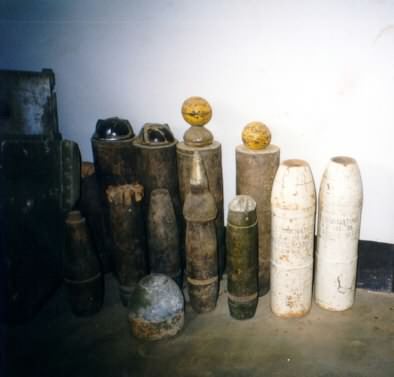
Various types of bombsMore bombs

All the eastern parts of Laos was heavily bombed during the Vietnam War. More bombs were dropped in this area than the number of bombs dropped during the entire Second World War (approximately 10,000 bombs for every citizen of Laos). Laos has the sad reputation of being the most heavily bombed country in the world ...

Ever.

The Ho Chi Min trail went through Laos, and the Americans tried to destroy it with every means. They tried everything from carpet bombing, dropping cases of Budweiser Beer (hoping that the Vietnamese soldiers would get drunk) to dropping washing detergent during the wet season (hoping the trail would get slippery). It is estimated that the Americans only succeeded in stopping 10 percent of the traffic on the trail.


In Vietnam, the Americans were not allowed to bomb within 500 meters from temples and hospitals. Their rules of engagement furthermore said that they were not allowed to return to their home base with a bomb load. The result was that they flew across the border to Laos and dropped all their bombs there. In Laos, there were no rules of engagement. They could bomb whereever they wanted to bomb.
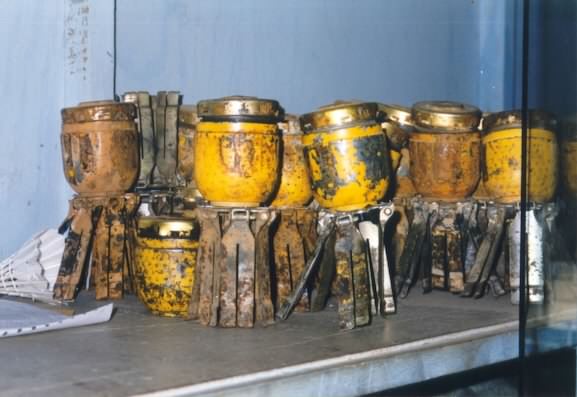
Cluster bombs


This also means that there is quite a large amount of UXO (Unexploded ordnance) in the country. Land mines and unexploded cluster bombs (shown on left) are some of the biggest problems.

In Laos, there are still approximately 4 accidents per day resulting from UXO.

Bombs outside a house


Sad as this may seem, people have been pretty creative about using some of the leftover bombs. In this case they have used a couple of 2000-pound bombs as decoration outside the house.
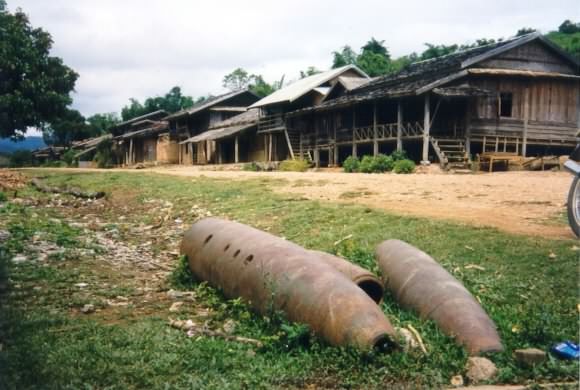
Bombs everywhere


No matter where you go you are reminded of the war.

In all the local villages there are unexploded bombs and shells from the cluster bombs.

Bombs used as scrap metal


A lot of the remains from the war are sold as scrap metal. In this pile there are shells from cluster bombs, wheels from tanks etc. >>>
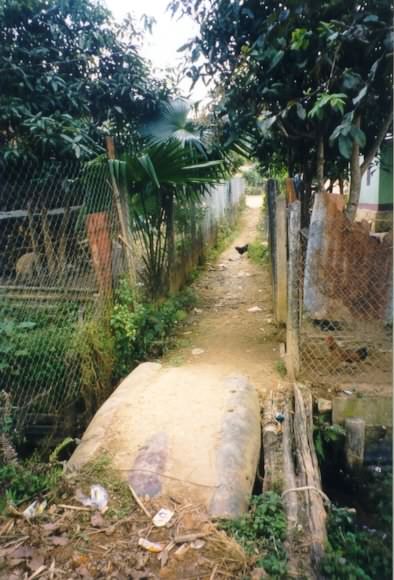

Bridge made from bombs


<<< Shells from the cluster bombs have been used to make this bridge.


Fences made from bombs


Here as fence posts outside a house. >>>
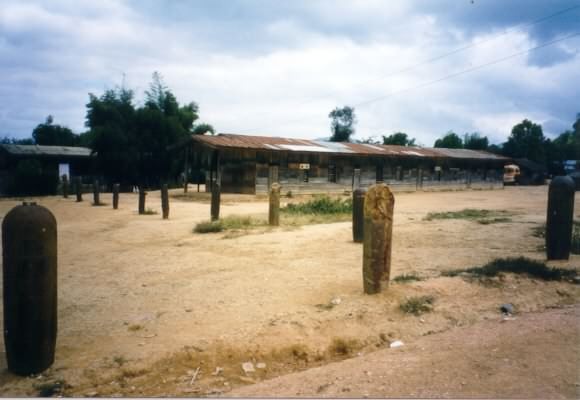
School with bombs


Outside a school, the schoolyard was surrounded by the shells from the American cluster bombs.


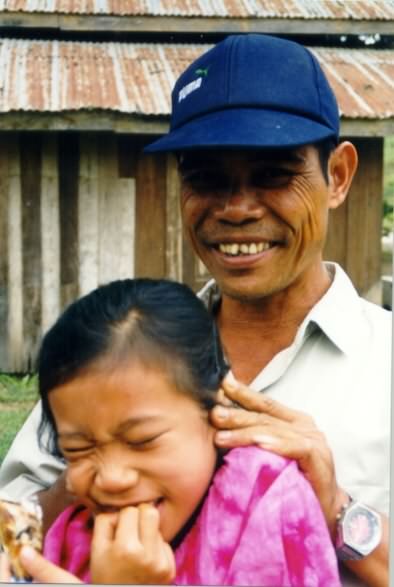
Grandfather  his orphan granddaughterSorrow . . .


This girl's parents were both killed by Hmong guerillas in 1997.

There are still areas where there are lots of problems with guerilla warfare. This is especially the case on Route 7, along the eastern border towards Vietnam and in the western part of Laos west of Vientiane, in the area between the Mekong River and Thailand.

The government is trying to control these problems, but it is difficult with such wast areas of jungle.

Unfortunately such incidents have affected a lot of people. This girl is not the only person in Laos who has lost her family.

Remember that the area has virtually been a permanent warzone since the Vietnam war, until the mid 90’s.

The person behind the girl is her grandfather.
He is now looking after her to make sure that she gets an education

He is after all, her only family left.
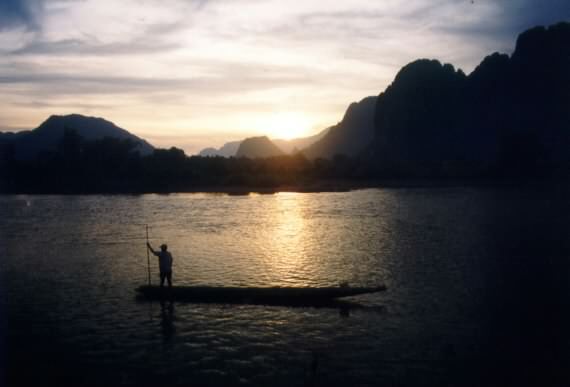


Beautiful SunsetHope . . .


Looking at this beautiful photo, it seems really serene and calm.

You couldn't really tell that things are pretty bad in some parts of the country.

The northern part of Laos is especially poor. The mountainous terrain limits what can be grown. Outdated farming methods using “slash-and-burn” of whole mountainsides are not very appropriate for feeding a growing population. A lot of the western countries are represented in Laos with health care workers. What Laos really needs at the moment is help using more environmentally-friendly farming methods, which at the same time improve the growing of crops. The slash-and-burn method basically means they burn a whole mountainside to grow rice. There is nothing left to hold back the nutrients in the soil, and fertiliser is not added. After a few years there are no more nutrients on this mountainside and they move on to the next mountainside. They need to learn how to grow crops in terraces and add fertiliser from their animals to the soil.
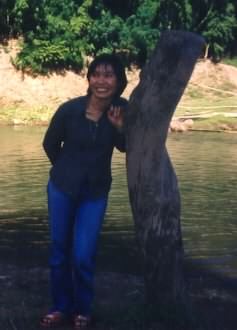

Vinchu - a Red Cross worker

One of the problems with growing rice is that the men are unempleyed most of the year while they are waiting for the rice to grow.

Vinchu is working for the Swiss Red Cross. She intends to buy a piece of land in the 32-kilometre village of Muang Xai, and convert it into a fish farm. This would keep some of the men occupied for most of the year. The profit from the fish farm could be used to take care of the village’s basic needs such as education of the children and buying medicine.

Vinchu is one of the few catholics in the country. She is fluent in English and has had a primary healthcare education. This has enabled her to get a job for one of the foreign representatives in the country, which means she is getting a salary that is considerably higher than what her peers get. Also she gets paid in US dollars instead of kip, the local currency.

On average, the government employed in Laos receives 100.000 kip a month (approx US$30). This is not enough to survive on, so most people have either two jobs or let the wife work as well. Lots of people have small vegetable gardens. This allows them to grow a few things to sell at the markets.
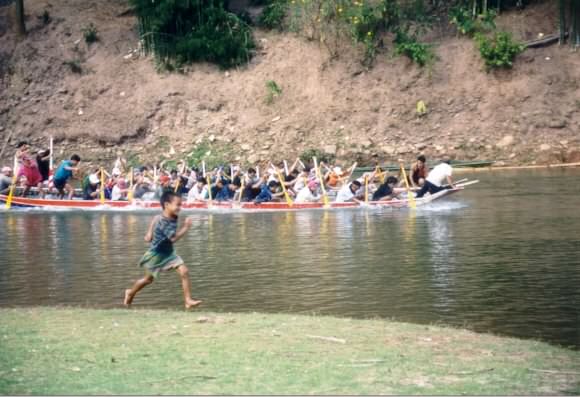

Dragon Boat Race


The employees from the hospital in Muang Xai have not received any money from the government for more than 6 months. The government declared that they should participate in the annual dragon boat race.

Vinchu paid for transportation of the employees to the local river, and other expenses, from her own paycheque.

Most of the people in the boat are doctors and people from the hospital.
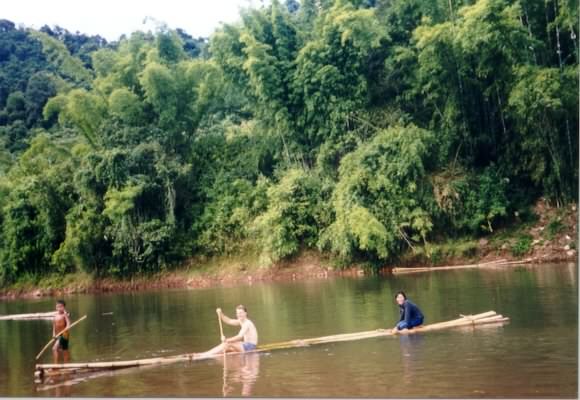


Me in a sailing raft


Vinchu and I in a sailing raft!


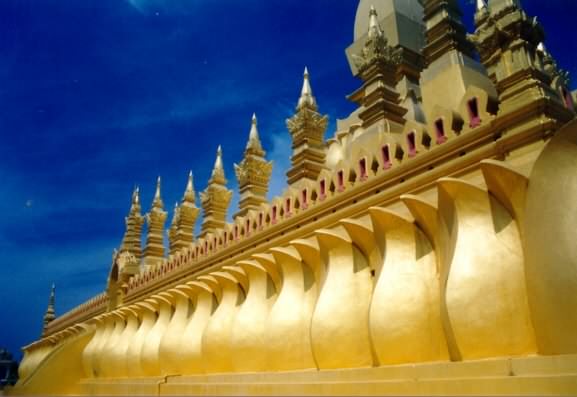
Great Stupa at Vientiene
Religion . . .


Buddhism is a big part of Laos.

The holiest place in Laos is the stupa in Vientiane. There are practically no temples in the eastern part of Laos due to heavy bombardment during the Vietnam War. The only great temples around is the one in Vientiane and Luang Prabang.
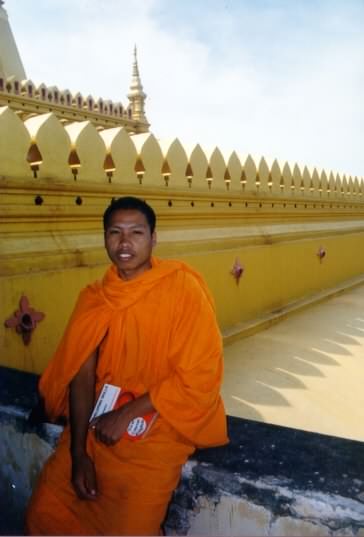

Monk at Great Stupa


The Buddhists in Laos are a bit less extremist than in Thailand. People do not have small alters in their homes, and it is not compulsory for the males to become monks.

In Laos, becoming a monk is voluntary. It is mainly people from the poorer parts of the country that become monks, because it is a good and cheap way to get an education. Some of them are studying English and are therefore very eager to practice their English on the tourists.
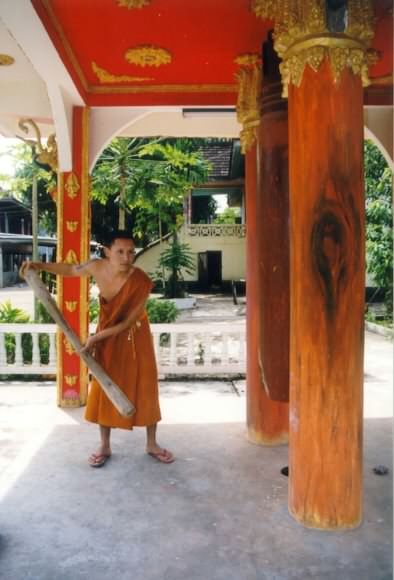
Monk calling for prayer


When they call the monks in for prayer, they either beat a big drum or the use a wooden ram to chime the bell.


Tribes . . .

3 Hmong girls in traditional garb

There are three main tribes in Laos. One of these tribes is called Lao Tsung (or HMong).

They live mainly in the northern part of the country.
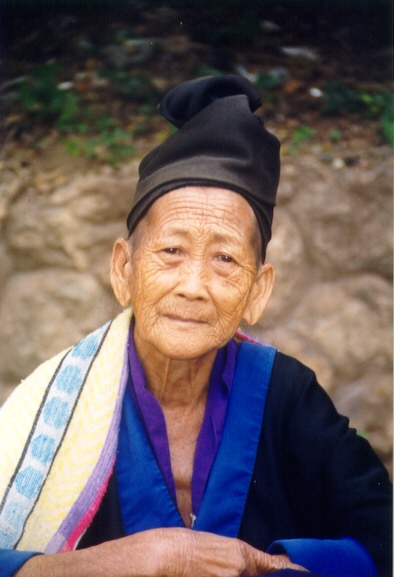
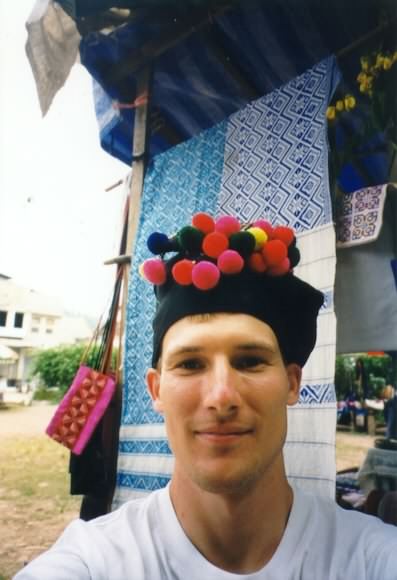
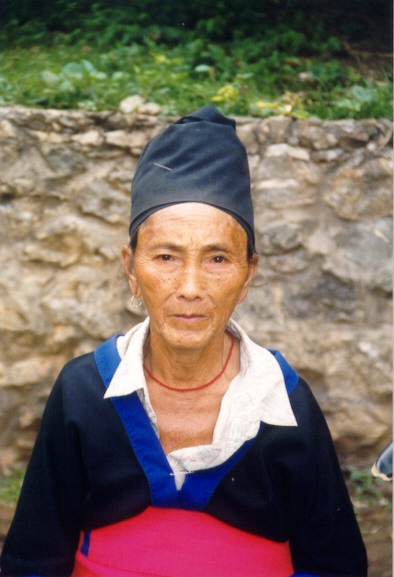
Old Hmong WomanMe wearing a Hmong hatOld Hmong Woman 2

The women still wear traditional clothing. I am wearing a traditional Hmong hat.

A Hmong Woman and I

The Hmong have a dialect that is different from the other tribes. They keep to themselves and are very isolated from the rest of the society.
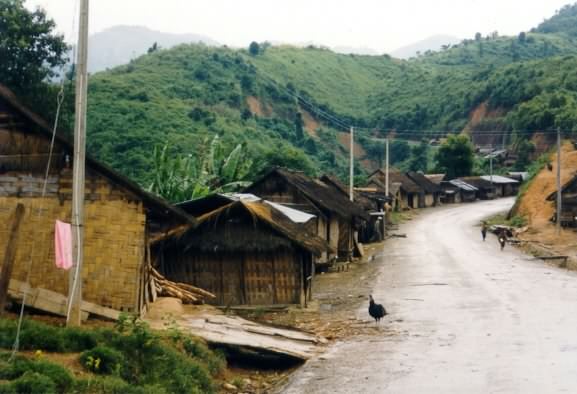
Hmong Village

The difference between the Hmong village and the other villages is that the Hmong build their houses on the ground instead of on stilts.

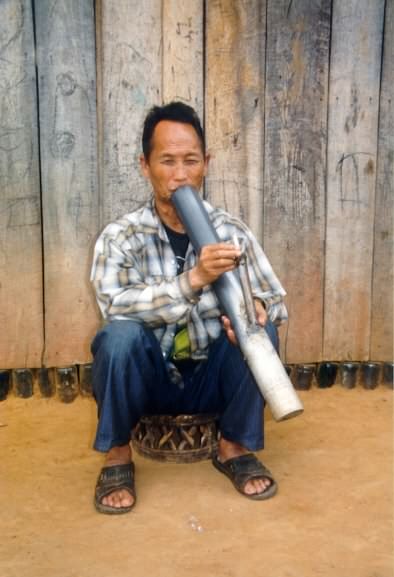
An Opium PortraitMan smoking opium

The Hmong is responsible for most of the opium growing and trading in Laos. The government is trying to stop this trade, but it is difficult as the Hmong live in areas that are not easily accessible.

The Hmong are also responsible for most of the problems in the area around Route 7.


The Children of Laos . . .

The kids in Laos are wonderful. There are always kids around you no matter where you go and they are always very joyful and curious to find out who you are.
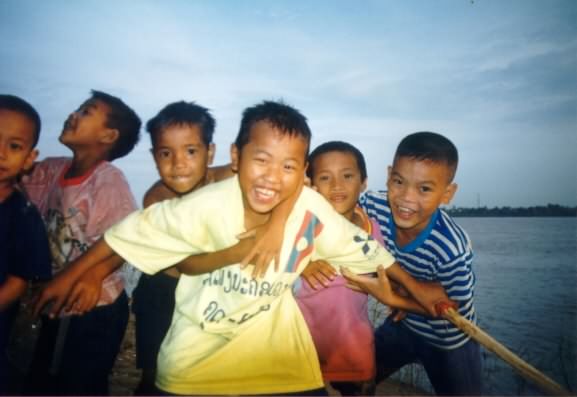
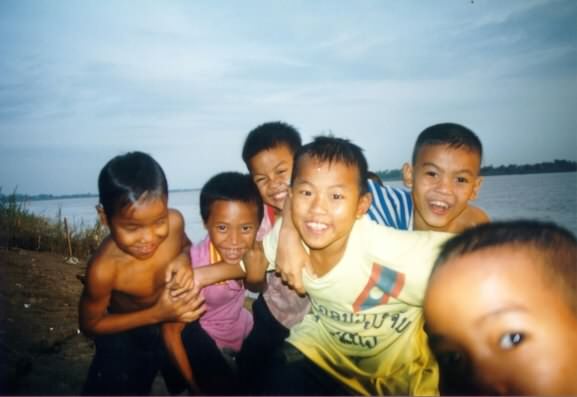
Kids playing by a riverKids playing by a river

You see a lot more kids playing with each other in Laos than in the western world. I guess it also somehow encourages them to grow up being socially responsible. This could be the simple reason why people are so friendly and welcoming in this country.

Lots of people say that it is because of the religion but I believe that it is something more fundamental than that. People in the western world have just forgotten how to be responsible towards each other. Why? Maybe they do not spend enough time in one another's company.
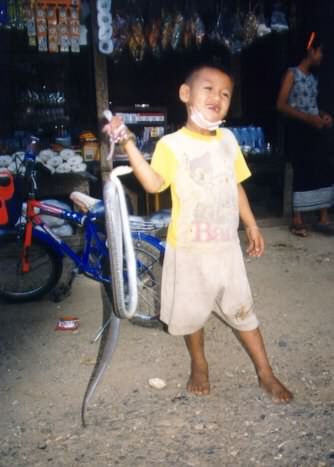
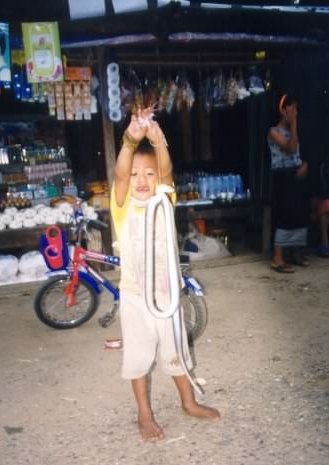
Kid playing snakeKid playing snake

In Vang Vieng, I saw a kid playing around with a snake. It did not seem to bother him or his parents that it might be poisonous.
I don't know if the pad on his chin was caused by the snake. I doubt it though since he had been very sick.

He was pretty proud of his snake.
I am not sure what kind of snake it was. I did see a few other snakes around, especially at the temples.
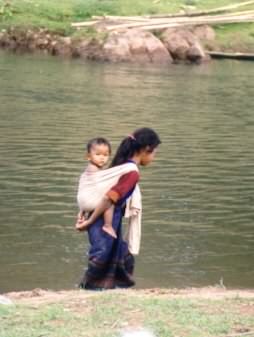
Girl carrying child


It tends to be the elder children’s task to look after their younger brothers and sisters while the parents are busy. The system seems to work fairly well since the whole group of children play together, no matter what their age group. It is therefore not such a big burden as some might think.

The photo was taken approx 40 kilometres north of Muang Xai (where Vinchu was).
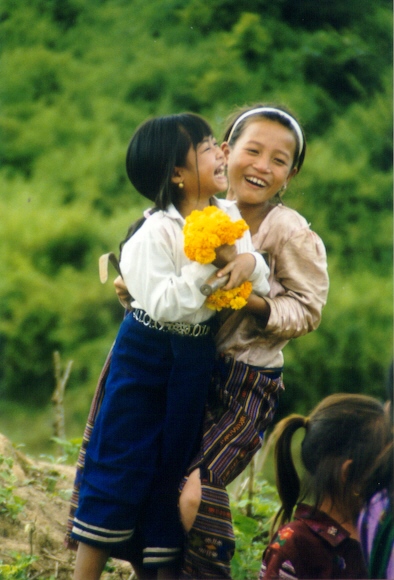
Beautiful flower girls


This photo on the right is one of my favourites.

It was taken in the northern part of Laos, at the 32-kilometer village outside Muang Xai.

The girls were collecting flowers outside one of the local schools.
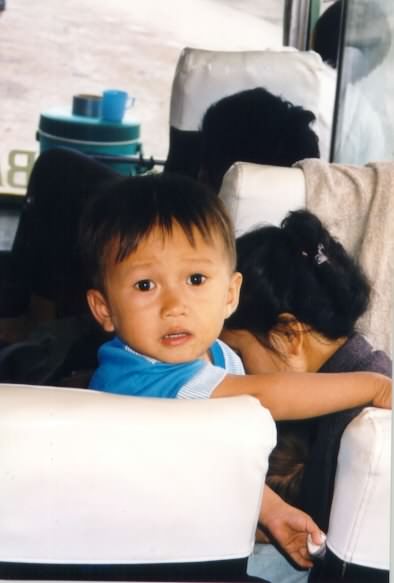
Beautiful flower girls


The younger kids tend to be afraid of Europeans. Most of them have never seen a white face before.

This little fellow here was a bit worried about my presence...
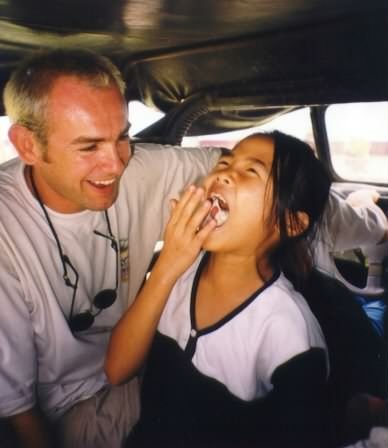
Girl eating chewing gum


This is the girl’s first piece of chewing gum... Pretty interesting to watch! *smile*


In the cities kids love to have their picture taken.
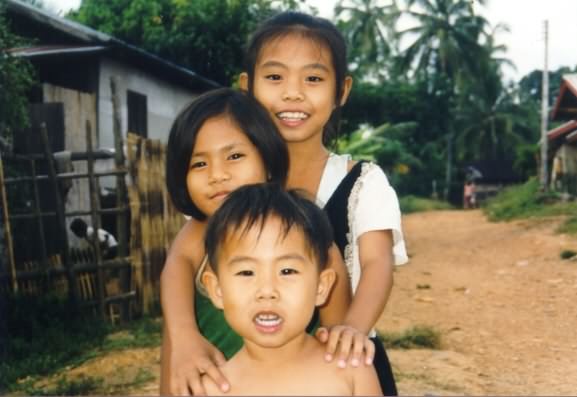
3 kids


Tanoy's mother and friend


The Tanoy Family . . .

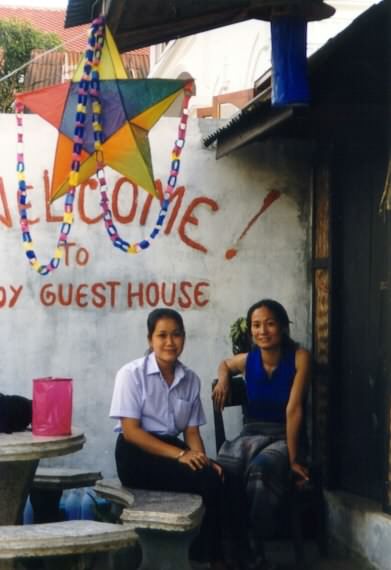
I stayed a few days with a family running the Tanoy Guest house.

The eldest daughter of the place was called Tanoy.

The girl on the left of this photo is one of Tanoy’s friends from school.
The woman on the right is Tanoy's mum. Tanoy’s mum is 40 years old and has had 6 kids. She does not look that old and still looks absolutely stunning.


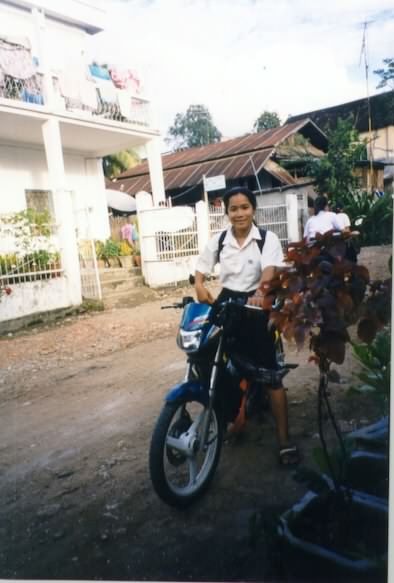
Below are a series of shots of Tanoy herself.

I guess she will one day take over the guest house.


Tanoy herselfTanoyTanoy on scooter

Whilst I was staying at the Tanoy Guest House, I saw the preparations for the annual Water Festival.

Every year when the monsoon ends and Water Festival coincides with the full moon, The festival included Dragon Boat racing.
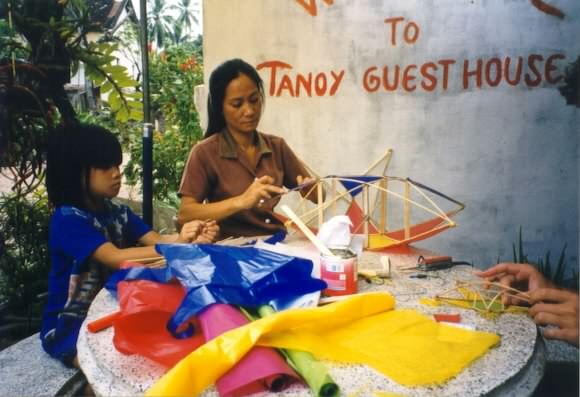
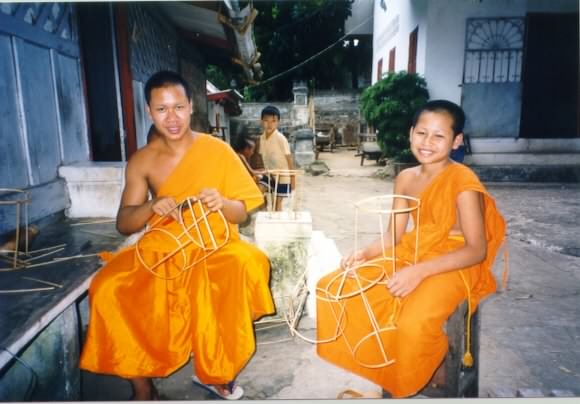
Tanoy's mother making lanterns for the Water FestivalMonks making lanterns for the Water Festival

Everyone was taking part by making lanterns for this festival, including the monks!

All the monks were making lanterns to decorate the temples.

Man drinking already!Party starts!Girl on my shoulders

The festival lasts for three days.

During the festival, they celebrate with all their friends and families. They also drink a lot of “Lao Lao” (or Laos Whisky), which is a kind of rice wine.

Everyone walks down to the river during the day to watch the boat races.

Later in the evening, everyone parties some more and drinks more beer. It does not matter that it is pouring down. The whole village is at the party and everyone is happy.
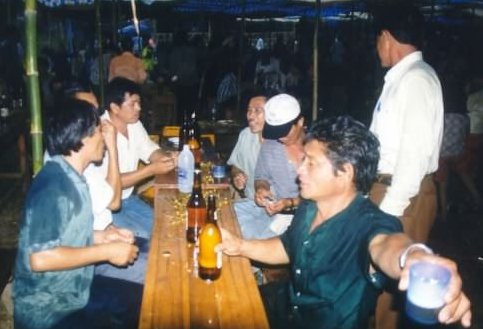
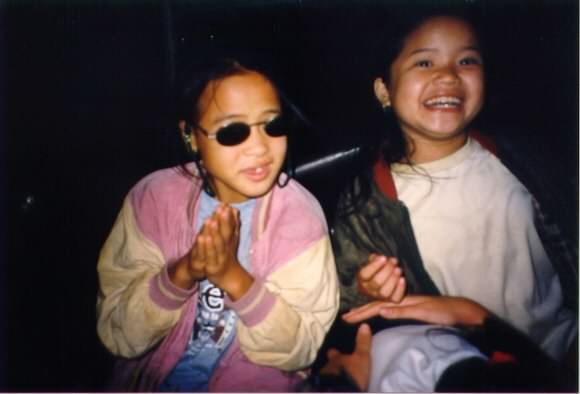
Drinks galore!The kids are also having a good time!

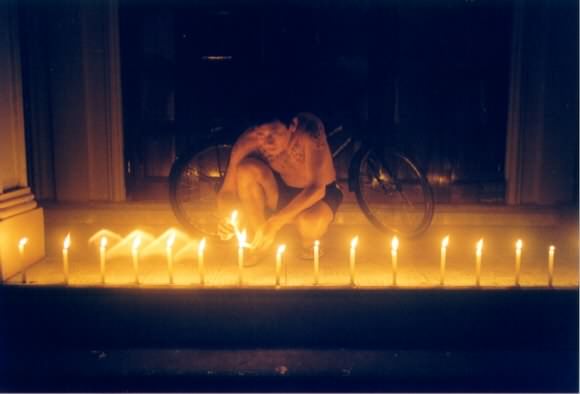
On the night of the festival, people light candles. They also float the candles in the rivers. House lit with candlesMan lighting candles

Unfortunately it was raining a lot that night, so people had difficulties keeping the candles lit.
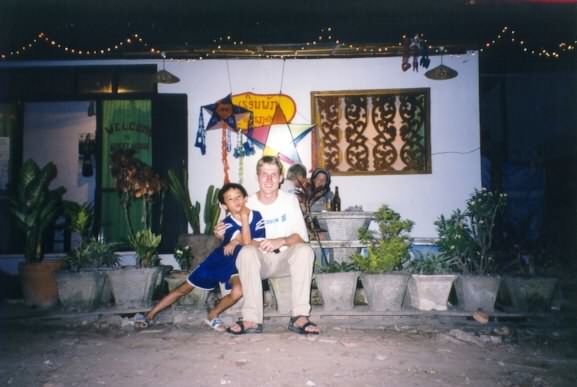
Outside the Tanoy House

At the end of the day, I managed to get a photo of me sitting outside the Tanoy Guest House!


Food . . .
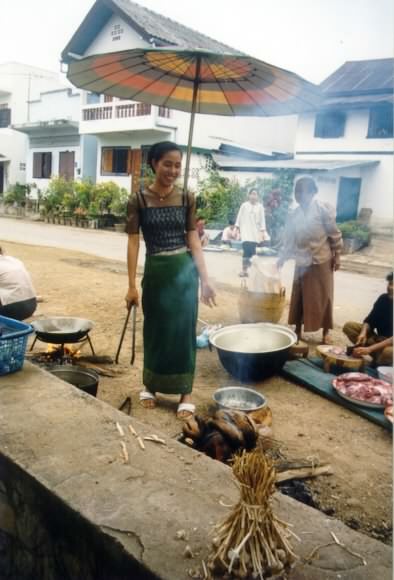
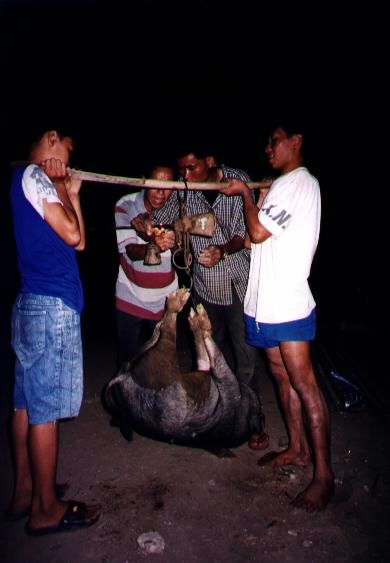
Young woman cookingPig being weighedWater buffalo

The food is excellent in Laos.
It takes some time to get used to eating noodle soup for breakfast, but once you get used to it, it is excellent.

There are pigs and turkeys all over the place. Above is a pig being weighed.

An essential part of farming is the water buffalo - it is important for pulling the heavy plough and there feet are designed to walk in water-logged gxround.

Old woman carrying heavy basketsGirl throwing rice

All ingredients used are very fresh. People are walking around selling vegetables on the streets.

It is hard work getting the rice ready for eating. First the rice is to be pounded to break the husks. Then thrown up in the air to remove the husks from the rice itself.


Created: Jan 2000 Last Updated: 16 Sept 2001

15. March 1999 10:32
by Rene Pallesen
0 Comments

Thailand

15. March 1999 10:32 by Rene Pallesen | 0 Comments

thailand
Statue at Grand Palace
Thailand ( 1999 ) . . .

On my way back from Laos, I stayed in Bangkok for a few days, visiting a friend whom I have known for a long time.

On the right, I am standing in front of a huge statue at the Grand Palace in Bangkok. There are many statues like this, very ornate and detailed. They are brightly coloured and some of them can look scary! As you can see in the background, the architecture and design of the roof is also very detailed and many of these were built a very long time ago by very gifted artists.

Nui


Here is Nui on the left.

She was the girlfriend of one of my friends at University in Denmark. She used to be a lecturer at the University of Bangkok and specialised in software design.

I stayed at her family's house for a few days in the outskirts of Bangkok. It was very nice to get away from all the pollution, noise and chaos of inner city.

You will now be happy to know that Nui has finally married Søren after all these years!

Me on a canal cruise


I am on a canal cruise!

Much of the water near the cities are very polluted, but it is very interesting to see the floating markets in Bangkok - yes, you will see people selling vegetables and meat from little boats...


Created: Jan 2000 Last Updated: 16 Sept 2001

15. March 1999 10:31
by Rene Pallesen
0 Comments

Working in Australia . . .

15. March 1999 10:31 by Rene Pallesen | 0 Comments

work


Dilbert

I can apply a lot of Dilbert's Principles to my work, that is why I always go to the Dilbert website to see what else Dilbert has come up with. More importantly, I thought Dilbert an accurate description of what I do, hence the first think you see on this page is... Dilbert!

The group I worked with at Cochlear

I had the privilege of working as a contractor in the world's leading company in bionic implants, Cochlear. I worked there for 1½ years as the head designer/developer of the software programming the bionic implants. I worked with some of the best developers, and had a lot of fun whilst I was at it.

On the Bridge ClimbOn the Bridge Climb

I had the chance to go on the Harbour Bridge climb, organised by the company. It is quite an expensive trip up over thte top of the bridge and normally would not pay to do it, but had the opportunity to do this with my colleagues. It is very windy up there and the view spectacular. There is quite a lot of people on the bridge climb - average about 10-15 per group, with about 3-5 groups on the bridge at a time. The whole walk from the bottom, to the top and back the other side takes about 2 hours. Many tourists take the opportunity to try out the climb, and I am told that the trip at sunset is spectacular.

Staff at PMP

I took this trip on a Douglas DC-3 (from the 1930-40's) with PMP Software. PMP Software was the company I worked for during the years I was waiting to get my permanent residency in Australia. I had the chance to see this state from an aerial view. There were quite a few Danes working for PMP, and at present, Kenneth is also working for them.


15. June 1998 10:33
by Rene Pallesen
0 Comments

New Zealand South Island 1998

15. June 1998 10:33 by Rene Pallesen | 0 Comments

new zealand south island 1998
Map of New Zealand
New Zealand ( June 1998 ) . . .


My first trip to New Zealand took place in June 1998. I travelled with the Lenehans - friends I have known since my arrival in Australia. This was one of many trips I took with Lance and Anne. We rented a campervan and decided to explore the south island of NZ.

I have since been to New Zealand again - NZ has some of the most beautiful mountains and I had the chance to go there again in January 2001 to do a technical ice-climbing course.

I took so many photos and would have loved to place all of them on this webpage.

Instead, I have selected a few to show some of the places I managed to go to, such as Milford Sound, Nelson, Arthurs Pass and Mt Cook.

There were many glaciers in NZ and lots of seals to go with them!

NZ is a beautiful country with many unusual natural formations. It is a photographer's haven. We ended our trip with a farewell dinner in Christchurch.


Seals . . .

The Lenehans and I decided to spend 2 weeks in New Zealand in the winter of 1998. We flew to Christchurch from Sydney, and drove north to Nelson.

On the way to Nelson, on the east coast of the southern island, there are hundreds of seals. It was a spectacular sight and I managed to get quite close to them to take photos.

SealTired sealWet seal

They did not seem to mind me taking a few photos. Some of the seals look tired - I guess even seals, like humans become tired. Who wouldn't like to pet a seal? They look different when they are wet though.

Anne sitting on stone

This was taken near where the seals were. I like the blend of colours and the harmony of the picture.

A lot of friends have commented on this photo! Most of them really like the photo, and feel there is something calm about it.


Nelson . . .

Nelson is located at the northern most part of the southern island.

We explored the area around Lake Rotoiti.


On the ridgeOn the ridge

These were taken from the ridge itself.

There is a lake at the end of the mountain ridge. From here, it is all downhill. We camped just below the lake at 1,500 metres altitude.

It was snowing the next morning and all water was frozen. We estimated the temperature to be around -7 degrees celcius.


Side of ridgeLenehans  I

The side of the ridge was one big stonefall.

It was very cold and the wind was strong that day so it was necessary to wear gloves hat.

We managed to get a group shot from the top of the ridge. The mountains in the background are knows as the McAngus ridge at Lake Rotoiti. Mountains at Lake Rotoiti

Here are the mountains at Lake Rotoiti.


Morning MistMorning Frost

The mornings are incredibly beautiful at Lake Rotoiti. Here you can see the morning mist floating gently on the water.

It is also very cold here - that is why there is ice on the bridge in the foreground.
Lance  Anne crossing bridge

The photo on the right shows the Lenehans crossing one of the suspension bridges at Lake Rotoiti.

At this point we had walked 15 kilometres, with a 1,000 metre descent. We had yet another 7 to 8 kilometres to go that day!

The Renet

This is what happens when you do not use a tripod. The effect is quiet interesting and makes the photo look like a painting by Monet.

This photo has has been dubbed "The Renet" among my friends.


Ladder at Goat Pass trackArthurs Pass . . .


We drove to Arthurs Pass, on the way from Nelson to Queenstown further south.

There is a place called Goat Pass, and there is only one way in - on foot.

Here, you can see Anne climbing up ladders on the Goat Pass track.

Inside our 'hut'

It was raining so much that we were not able to get down through the canyon on the other side of the Pass. We therefore decided to go back the way we came.

Further down the track, we had passed a bivouak and decided to stay ther during the night. It was very dirty and Anne would rather sleep outside in the rain.

Everything was wet so she changed her mind and came back in. *laugh*

Anne trying to cross a river

She wore plastic bags on her feet, in her boots are so that she could wear her boots without getting cold feet! Aussies will never get used to the cold.

Here is Anne crossing one of the rivers.

Every time she crossed a river, she would sit and massage her feet for 10 minutes until they warm again.

I guess Aussies will never get used to the cold. Neither will Danes for that matter! An Australian winter is like a Danish summer - so you can imagine how cold Denmark is! Still, Danes cannot get used to it - just ask Kenneth or Soeren!

Who's this?

Sleeping ???

Aussies will never learn to live with the cold!

I must admit I hate the cold. I loved it when I lived in Kenya - so hot and humid!

Even living in Denmark for all those year did not make me like cold weather any more than I used to. That is why I love Australia - warm summers and mild winters. Sometimes winter in Australia is a bit too cold for me! But I do not usually wear more than a T-shirt or a thin jumper in winter. My girlfriend was complaining about me having the heater on full-blast in the car during spring!

Okay, so I love the heat!

Lance  Anne in the campervan


Inside the campervan.

Temperature was down to -10 degrees Celcius during the night and there was no heating in the van.


This explains why Anne was wearing a thick blanket. There was only enough water for a two minute shower. That is why Anne is wearing a hat indoors.


See the expression on her face? She knows I will write a stupid description for this photo.

Black  white photo of me


In the campervan I had the top bunk.

This is one of my girlfriend's favourite photos!


On the way to Milford Sound, we saw some unusual formations - The Pancake Rocks. The Pancake Rocks are located near Hokitika, between Kumara and Ross.

Pancake RockPancake Rock

They do not taste as good as real pancakes - you get sand in your teeth...

The Remarkables near QueenstownThe Remarkables at sunset

At Queenstown, we had the most glorious view of "The Remarkables". The Remarkables are the mountains in the background - don't ask me why they call The Remarkables, I don't know. But the photo on the left shows Queenstown with these mountains in the background.

The photo on the right shows the a sunset at The Remarkables (with snow on top!) Pretty 'remarkable', huh?


Putting chains on campervanMilford Sound . . .


Milford Sound is located near the southern-most tip of the south island of NZ. It is the series of 'islands' that you can see on the western tip of NZ on the map.

To get to Milford Sound, we had to take a huge detour from Queenstown. To come back from Milford Sound, we had to take the same detour before heading east from Queenstown.

Driving down to Milford Sound, we had to put chains on the tyres of the campervan.

In the pass, there was at least 10 centimetres of snow on the road, and it was illegal to continue on without chains. Chains help create friction on the roads and makes it easier for the vehicle to drive on in icy conditions.

We managed tto here. We have however booked a tour into the mines tomorrow afternoon which should be exciting and I´d like to see the Mint museum.

Click here for more photos

We are also considering what to do next before going to Brazil on the 17th...so far looks like we will go to Sucre (3 hours from here) day after tomorrow and then fly to La Paz from there (maybe even re-shedule flight to go to Rio a day or two earlier). Click here to see more photos from Bolivia

10. March 2008 08:29
by Rene Pallesen
0 Comments

La Paz - Bolivia

10. March 2008 08:29 by Rene Pallesen | 0 Comments

la paz bolivia


The bus ride to La Paz was interesting. It was a local bus so full of locals heading into La Paz 4 hours away. After about one hours drive through the high plains (4300 meters altitude) we suddenly arrived to a strait. I hadn´t studies the map properly and hadn´t realised that Copacabana was on a peninsular with no Bolivian direct access to mainland Bolivia (you would have to pass back into Peru to drive directly)...so at the strait we got offloaded from the bus and then had to get onto a smaller boat for the passengers while the bus was ferried across on a big wooden pram.

Click here to see more photos

Also at this strait is the only division of Bolivias Navy (I think they still hope to eventually get access to the ocean through Chile (They lost 350 kilometers of coastline in a war with Chile back in time).
On the other side Kim missed using the toilet so when we stopped at a petrol station a couple of hours later we took the oppertunity...when the bus took off she wasn´t back yet...and she would have been standing there alone if I hadn´t told the bus driver that we were missing a passenger.
Unfortunately it was cloudy so we could only see the bottom bits of the Huyana Potosi and Illimani (6500 meters).

The drive into La Paz is stunning...they outer suburbs is totally disorganised with mud houses and mud roads...but suddenly you drive over the escarpment and see all of La Paz in a big crater below.

Once we got out of the bus we were however less impressed. La Paz is a town like any other...it is full of traffic, pollution and there has been no city planning whatso ever. Once you get over the escarpment wow factor it is really an ugly city full of social problems, beggers, street kids, pollution, crime etc.
Even the backpacker area is totally uninteresting and has been totally spoiled by young kids going for white water rafting, mountain biking without any interest whatsoever in the local culture.

Our plan was to spend a day here and then continue down to Potosi and we decided we would spend the next day before heading south looking around and see if the city would reveal its more beautiful side. In the morning I went to the bus station to organise bus tickets and I hope I´ve got the promised ticket (sleeper bus, with toilet onboard and sitting in the front of the bus away from the toilets...but Bolivia is full of surprises...but that is part of the adventure).
Afterwards wewent for a walk around the city and found a couple of nice spots but not enough to convince us that this is a city worthwhile spending a lot of time in.

Click here for more photos Click here for more photos


The witches market if full of souvernirs that are no-where near as good quality as what we saw in Copacabana, The museums were all closed on Sundays (except the music instrument museum which was interesting), and we are unable to find any decent local food in La Paz (only pizza, pasta etc.).

Click here for more photos Click here for more photos

We did however have a good laugh sitting observing people at Plaza Avaroa close to our hotel. People were out walking their dogs and they were all dressed in cute little costumes like small humans...and I thought the Honkies were crazy.

Click here for more photos


I am hoping that the south is nice. I have kept Kim from buying too many things so far promising her that there would be plenty of chances...I hope that this is correct as some of the things we saw up north were really nice.

Bolivia is pretty cheap to travel in (same prices as Thailand) and my dad would love it here (as well as in Peru). I could however travel a lot cheaper if I got to choose the mode of transport and the hotels...Kim gets to choose the hotels we stay in which from a local aspect is the upper range hotels (but still cheap by australian standards) and the criteria is hot water, blankets, heating, cleanetc. We have however been lucky with a couple of hostels we have found (one that we will stay in once we return to La Paz and we stayed in one in Copacabana). I think over time I will get her hardened up enough to check out the hostels first and then afterwards increase the comfort levels if we dont find anything of a decent standard...but so far it is ok that she gets a bit of comfort...it is her first backpacking/roughing trip and she is doing really well so far (getting into the spirit of finding cheap restaurants etc.). Click here to see more photos from Bolivia

10. March 2008 08:00
by Rene Pallesen
0 Comments

Copacabana - Bolivia

10. March 2008 08:00 by Rene Pallesen | 0 Comments

copacabana bolivia


The bus ride from Cusco was interesting...but probably more for Kim than I (she called it horrendous). The company that we had bought our ticket from in Cusco came and picked us up at the hotel at 9.30 pm in a taxi and then drove us to the bus terminal a couple of kilometers out of town. The ticket was a direct ticket to Copacabana in Bolivia in a sleeper bus...but when we got to the station it turned out that the bus was going to drop us off 15 kilometers out of Copacabana...the guy from the company gave us a little cach and told us to use it to bribe the bus driver to drive us all the was to Copacabana.
We then had a talk to the company and they agreed to organise with the bus driver to drive us all the way. The bus was ok and full of other gringos also going to Copacabana or La Paz. Kim was greatfull that the bus had a toilet and less gratefull that it was pitch black in the middle of the night and couldn´t flush...so very stinky. About 30 kilometers from the border we got dropped off by the bus (so much for the promise of a direct bus)and loaded into a minibus with far too little seating. The bus wouldn´t start so we had to get out and push. It then started to rain and there was 2-3cm of snow on the road at certain places (4000 meters altitude) once we reached the Peru border we were again off loaded and had to walk across the border...the border crossing itself was smooth although we had to wai a while for the office to open at 7.30am.

On the bolivia side we then took another bus (which we had to pay for) to Copacabana about 8 kilometers away.
Copacabana is a small town next to Lake Titicaca and Kim had researched hotels...but after looking where some of the other people on the bus would stay she agreed to stay the same place (after we got some towels and a heater).
The rest of the day we spent in Copacabana which is a pleasant but very small place and hos got a cheap backpacker feel to it in a positive way (A lot of backpackers out searching for the meaning of life rather than partying an ruining it for others).
In the evening after dinner we found a little cafe playing live music. For dinner they had these set 3-4 course menus for around $2 USD per person at the various restaurants which is a lot cheaper than a-la-carte.

The next day we took a boat to Isla del Sol (Island of the Sun) on the lake and spent a couple of hours walking the 11 km from one end to the other (I am quite proud of Kim on this trip being happy to walk long distances with me) and then in the afternoon we took the boat back to Copacabana. On the Island I bought a jumper made from Alpaca wool for around USD $7 and Kim bought a local scarf.

Click here to see more photos Click here to see more photos


Back in Copacabana Kim found some really nice local jewellery so she was busy spending the rest of the evening shopping (I have told her not to buy too much because it is difficult to carry).

Click here to see more photos

In the morning next day we took the bus to La Paz (about USD $2 per person for a 4 hour drive).
Click here to see more photos from Bolivia

4. March 2008 02:07
by Rene Pallesen
0 Comments

Cusco - Peru

4. March 2008 02:07 by Rene Pallesen | 0 Comments

cusco peru


Sunday we flew from Santiago to Cusco in Peru via Lima.

Lima is very dry...almost a desert whereas the flight into Cusco was spectacular surrounded by tall green mountains. The hotel came to pick us up from the airport and the hotel is very centrally located in the middle of the city. It is a spectacular place, the people are very different from elsewhere (indians) and you can buy craftmanship everywhere really cheap.

Click here to see more photos

You can see the remains of the inca buildings everywhere. Cusco is located in 3500 meters altitude so we decided to take it easy on the first day to acclimatise (none of us have got any headaches so far)and then head up an see Macchu Picchu in a couple of days time. So on the first evening we decided to treat ourselves to a nice dinner where we got the most important menu items out of the way...alpaca and cuy (Lama and Guinea Pig). The lama was really nice (like a tender beef) but the Guinea Pig was a bit tough (especially the skin) and there wasn't much meat on it (but tasty).

Click here to see more photos

Click here to see more photos

Tuesday we bought a train ticket to Macchu Pichu (USD 96...so quite expensive and then on top comes bus up to the site $12 and the entrance to the site itself $40...so a good $150 USD per person) which is a 4 hour ride each way. Despite the expensive trip there it would be a shame to come all this way and not go there...and believe me...it is worth it. Just the train trip there is pretty spectacular between deep gorges and roaring rivers. The first hourin the train is spent climbing the hillside in Cusco...the train rides along for one kilometer and then stops, changes direction and then goes another kilometer before doing the same again...in total it takes the train 7-8 direction changes to make it to the top of the hill.
And the Macchu Pichusite itself is really spectacular in itself. We spent close to 6 hours exploring the area and had we known earlier that they closed access to one of the peaks at 1pm then we could easily have spend more time exploring.


Click here to see more photos

Click here to see more photos

Wednesday we checked out of the hotel in Cusco and booked ourselves a night bus to Copacabana in Bolivia. The remainder of the day we spent visiting other Inka sites around the area by local bus. Some of the sites especially the one closest to Cusco called Saqsaywaman is pretty spectachlar.

Click here to see more photosClick here to see more photos

We had a really scary incident where we got attached by two really vicious dogs. The first dog went for me an I kicked ouut after it and just missed it, but it was just enough to surprise the dog and make it back off. Out of the corner of my eye I saw the second dog attack Kim and I saw her try and kick it as well whereafter it also back off (probably because the fist dog got scared). After that they kept their distance...a close encounter but walked away unhurt but with our hearts pounding. Click here to see more photos from Peru

2. March 2008 10:14
by Rene Pallesen
0 Comments

Santiago de Chile

2. March 2008 10:14 by Rene Pallesen | 0 Comments

santiago de chile

The last couple of days Kim and I have been in Santiago de Chile. Kim arrived a day late due to mechanical problems with the aircraft from Sydney and I arrived 6 hours late with Chris (my colleague) at 3am in the morning. Chris and I got ripped off by the taxi due to us not having studied the local conversion rates...but after that we had no other problems.

The first day we spent sleeping and familiarizing ourselves with the area around Providencia and Bellavista. There are some gorgeous little bars and restaurants in these areas. Santiago is a very modern city. It is very clean and you don´t see the same problems as for instance in Buenos Aires with street kids. I can see why my cousin Ulla decided to live in this city for a while.
The Metro in Santiago is really good...there are trains every few minutes and they cost about $1 USD regardless of where you get off...a lot cheaper than catching taxis and a lot faster too.

Next day we went sightseeing around Santiago city centre. The highlight was Cerro Santa Lucia which is an old castle converted into a lovely park area used very much by couples out for a romantic afternoon.
As for food...it seems that most locals eat hotdogs and pizza for lunch so we had a hard time finding something reasonably healthy.

We spent a lot of the late afternoon and evening sorting out luggage storage. We are staying in a serviced apartment with no storage facilities so we had to go to the bus terminal on the other side of the city to store it. When we got back we received an email from the lady renting us the apartment saying that she´d store it for us. I feel a lot more happy about her storing it than in the terminal especially as my work laptop is in the bag.

Next morning it was again time to go to the Airport...this time to fly to Peru.

23. February 2008 08:13
by Rene Pallesen
0 Comments

Buenos Aires - Argentina

23. February 2008 08:13 by Rene Pallesen | 0 Comments

buenos aires argentina


This week I am in Buenos Aires in Argentina for our annual International Partner Conference and sales Kickoff meeting.

I arrived Thursday night after a long flight with my colleagues and early Friday morning we started our meetings with new product introductions as well as briefing on what is going to take place the next week or so...and as the week progresses I will keep you up to date here.

Friday night we went to a restaurant called the winery and had finger food and tasted a range of different wines. Afterwards in the late evening I decided to go for a walk through the streets of Buenos Aires. It seems to be a very cultural city with some of the normal problems for a large city. There are a lot of people in the streets in the evening especially around the pedestrian areas.

Awards night

It is interesting that all the tourist maps here display the Islas Malvinas (Falkland Islands) as belonging to Argentina. I think the Argentinians really should move on and start accepting that the islands belong to the UK and that they cannot claim them just because they captured them for a few months back in 1982 or because they are closer to Argentina than to the UK.

Buenos Aires is not a place to go for a beach holiday. The water is brown and muddy...I though it was because of the recent rain, but looking at other photos it seems that is is always muddy.


On the first evening we had an opening party at the local Yacht club. Two girls were singing and providing some pleasant entertainment and the morning opening ceremony also provided entertainment.


On the official opening night we went to a restaurant displaying some extremely good tango dancing. It is some of the fastest and most impressive dancing that I've ever seen live.


And of cause I needed to have a try as well.


On the closing night we went to a local restaurant and one of the sponsors provided the entertainment in the form of some dancing girls.

Click here to see more photos from Argentina

11. February 2008 12:49
by Rene Pallesen
0 Comments

Mexico - Mexico City

11. February 2008 12:49 by Rene Pallesen | 0 Comments

mexico mexico city


This week I am in Mexico City assisting some of our partners.

I flew in Saturday evening and had Sunday to do a bit of sightseeing before meeting up with our partners in the evening. I took a tour to the big pyramids outside Mexico City (Pyramid of the Sun is the third largest pyramid in the world...apparently the largest is also here in Mexico). It was fantastic seeing the Pyramids and it is one of the few things that I've always wanted to see in Mexico...so now: been here done that.


The whole complex is huge it is 3-4 kilometers long so it takes a fair amount of work to walk from one end to the other...especially with all the stairs and sections.

Click here to see more photos

Pyramid of the Sun

We also saw the most holy cathedral in Mexico...a place where they keep a piece of cloth with an image of Virgin Mary that was left after someone carried flowers in the cloth. It is a beautiful piece of cloth...but I don't buy the flower story.

Click here to see more photos


Monday to Friday was work days and the first couple of days were spent training with our partners and customers. Here in Mexico they don't start work until around 10am...but also don't finish until after 6-7pm and then followed by dinners etc. with the partners mean that some days go on until around midnight.

I find that Mexican food here is very different from the Mexican food that we get in Australia and elsewhere (but I already knew that). The food is still very unhealthy and full of meat and cheese...but much more tasty and much more variation. Our partners were very impressed on the first evening with them that I was able to eat whole chillies in the tacos...but when I explained to them that I was used to Asian food and to chop up fresh chillies into my day-to-day food then they understood.


In the big intersections in the city there are children dressed as clowns doing tricks to earn a few pesos. The other day I say three kids standing on each others shoulders which was very impressive...I also saw an older woman dressed as a clown walking around with a bucket with a dark cloth in it and throwing it at the cars...very freaky and I think she needs to change her tricks if she want to make any money. One of the more disturbing was a mother with a three year old kid who lay down on the street in the middle of the traffic while the kid was making somersaults on top.


On the last evening we went to Plaza Garibaldi. This is the place that all the great Mariachi bands came/come from. The whole square is filled with bands that you can hire to play music for you. When you drive to the square the Mariachis line the streets and run alongside the car trying to convince you that you should hire them to play some music for you.

Click here to see more photos

We went into a restaurant where they besides the Mariachi also had other entertainment such as cockfighting and lasso dancing. Afterwards we went this cantina where a lot of bands were playing simultaneously at various table. All very Mexican and a great tradition. I wonder if the Mariachis will still exist in 20 years from now...but seeing the reaching of the mexicans they probably will. The food was excellent and I tried another couple of great traditions such as beer with lemon and chili in it as well as the mandatory Tequilas (El Tequila Loco).

Click here to see more photos

The hospitality of our partners here has been excellent. They have taken me out every night and made sure that I tried everything Mexican.

Here's some videos:


Cockfightting
Indian Dancers
Lasso Dancing
Plaza Garibaldi
Mariachi


Click here to see more photos from Mexico

1. February 2008 12:04
by Rene Pallesen
0 Comments

Travelling

1. February 2008 12:04 by Rene Pallesen | 0 Comments

travelling


I haven't blogged much this year yet. Mainly because not a lot has happened this month (January traditionally is a quiet month) but also because it has been very hot and wet which is not a good combination for outdoor activities.

The next two months however are going to be really busy as I will be traveling in Latin and South America.

I am looking forward to the trips as it will take me to most of South America such as Mexico, Argentina, Chile, Peru, Bolivia and Brazil.

As I travel I'll start posting pictures and entries in this blog.

4. January 2008 12:50
by Rene Pallesen
0 Comments

New Years Day

4. January 2008 12:50 by Rene Pallesen | 0 Comments

new years day


I was glad that I didn't have too much to drink on New Years Eve, because the day after turned out to be a busy one.

In the morning we had breakfast with Kims family at the cemetery where her mum is buried.

Right after this we went to the golf course at the coast and played 18 holes. It was a pretty hot day, but there was a nice breeze along the coast and the course is in such a spectacular location.

Click here for more photos Click here to download video of Playing Golf #1
Click here to download video of the Golf Course #2


Most of the beaches in Queensland and New South Wales were closed due to dangerous surf conditions. There is a hurricane off the coast of Queensland creating some huge waves along all of Australia's east coast.

In the evening we had dinner with Kims family having steam boat and those rice paper things that you roll up (not sure what it is called)...and it was yummi.

They have this fermented fish that has been fermented over 3-4 years and it is really nice as a dipping sauce with a few chillies mixed in. Click here to see more photos from New Years Day

4. January 2008 12:31
by Rene Pallesen
0 Comments

2007 has ended

4. January 2008 12:31 by Rene Pallesen | 0 Comments

2007 has ended


The year 2007 has now ended and it is time to start some new adventures in the new year.

2007 was full of traveling and other adventures and I expect 2008 to be much of the same.

Take some time to look at what is happening in 2008 as well as what happened in 2007.

Click on this link to see the events of 2007

Also please bookmark this page and also have a look at the RSS feed features of this page.
Perfect Moments Photography | A Rene Pallesen Journal

Home

12. May 2015 11:05
by Rene Pallesen
0 Comments

Grandparents and Great Grand parents

12. May 2015 11:05 by Rene Pallesen | 0 Comments

Going through some old photos I came across these of my great grand parents (on my mothers side).I a
Going through some old photos I came across these of my great grand parents (on my mothers side).


I am pretty sure that the little girl on the left is my Mum (So the photos must have been taken around 1943-1944) and the other two girls are her sisters (My Aunties) Eli on the right and Yrsa in the middle.

I assume that the women in the back are their grand parents (my great grands) with the woman on the right being my grandmothers (mormor's) mum and the one on the right being grandad's (morfar'd) mum.


Here is a family photo of what I assume is my grandmothers (mormor's) family. I think it is my grandma in the middle right behind my great grandmother.


I assume this is my great grandparents, but I cannot be certain.


This must be a birthday for my grandmother.


This was taken outside the farm where my mum grew up. It is my grandad (morfar) in the middle on the right and it could be my grandmother (mormor) on the stairs with her mum. The farm is still there today owned by my uncle.


This must be some of the family on my grandads (morfar's) side, so possibly some of his siblings.

Perfect Moments Photography | A Rene Pallesen Journal

Home

15. September 2000 11:05
by Rene Pallesen
0 Comments

New Car in 2000 . . .

15. September 2000 11:05 by Rene Pallesen | 0 Comments

new car in 2000


In September 2000, just after I returned from my trip to Borneo, I had to buy this new car because my girlfriend had written off my car whilst I was away! *smile*

I did not look forward to hunting around for a new car, but I found a good buy locally. This car is a 1997 Ford Futura, with 4.0 litre, 6-cylinder, 220-horsepower, power-steering, central locking and electronic windows (I think I am starting to sound like a car advertisement...)

Frontal view of car


Side view of car

It is pretty much the same colour as my old car, and it feels so nice to drive!

As you can see, pretty similar, but I also really miss my old car! It had a lot of computerised features - from a digital odometer, to adjusting the internal temperature of the car. It was a pretty cool car and wished I could have kept it for another few more years.

Frontal view of car


Side view of car

My first car in Australia!

A huge contrast to my first car!

It is a red hatchback that I bought early 1998, a few months after I arrived in Australia. But someone wrote it off a few months after I bought it. It was a pretty bad accident, but luckily I was alright. I was only covered by Third Party insurance, and to go through a lot of paperwork just to get reimbursement for the car!

15. August 2000 10:43
by Rene Pallesen
0 Comments

Away from Headquarters . . .

15. August 2000 10:43 by Rene Pallesen | 0 Comments

away from headquarters
Ecochallenge ( Sabah 2000 )

Magellan HotelMoving into SilamRepeater StationInjured CompetitorTransporting a Repeater StationBeetleKids in Village
ArrivalSilam / Jungle OpsRepeater StationsThe CompetitorsHelicopterJungle Around UsThe Village

Village people
Away from Headquarters . . .

I managed to explore the villages at Silam.

The people here wore this white stuff on their faces - I guess their form of sunscreen.

These people were refugees from the Philippines.

Kids in the village

The kids were fighting to fit into the photo!

Kids in the village


The kids here were really cute.Caught Monkey

These kids here, had caught a monkey and was trying to sell it at the camp for 5 ringgit (AUD$2.50).


No-one wanted to buy it because they knew if they bought it, and set it loose, the kids would just catch it again, and try to sell it.

In general, there were lots of great photos at Silam village.

Car in a ditch


One of the helicopter pilots was driving through the jungle roads, took a corner too fast, and had a minor mishap.


All of us having dinnerHuge crab dinner!

We headed into Lahad Datu to get some seafood!

An escape from camp food. Camp food was disgusting. There were live worms in the vegetables (yes, after cooked). Most of the food was not fresh, and was pretty boring. The seafood was fantastic here. Whenever we had the chance, we ate lots of seafood.

Yum... Paul did not get to eat all of the crabs - all of us had a portion of it.

Huge lobsterHuge lobster

Yummm... they were huge, but we did not eat them. They were too big for us to eat, pretty impressive though. They were the biggest lobsters I have seen in my life. We saw these at the same place we ate our seafood and frogs (below).

Frog


We had this frog for dinner about 2 min after I took the photo.


This was actually when I went out with Glen in Kota Kinabalu - he asked me to pick some food and to surprise him.

I did not tell him till a year later that he ate frog meat. He asked me what it was, because he reckoned it tasted funny, but I did not tell him at the time.

I think he will only eat it again. Only if he really had to.

The tallest building in the world


Petronis Towers - the tallest twin towers in the world.

Actually, they are the tallest buildings in the world, followed by the Sears Towers in Chicago.

The towers are joined by some sort pedestrian platform.

These towers are located in Kuala Lumpur.

I went to Kuala Lumpur to pick up my Permanent Residency for Australia.

Woohoo!!! After 2 years of lots of paperwork, and correspondence back and forth with Berlin, I finally managed to get it!

The inconvenience of it all, was that I actually had to leave Australia ie collect my PR before re-entering Australia.


Below, is the only photo I have of the Lateral Linking Team that I worked with during the race.

The radio communications team

Back to Top

Return to Borneo Homepage


Created: 7 Dec 2001

15. August 2000 10:42
by Rene Pallesen
0 Comments

Helicopters . . .

15. August 2000 10:42 by Rene Pallesen | 0 Comments

helicopters
Ecochallenge ( Sabah 2000 )

Magellan HotelMoving into SilamRepeater StationInjured CompetitorTransporting a Repeater StationBeetleKids in Village
ArrivalSilam / Jungle OpsRepeater StationsThe CompetitorsHelicopterJungle Around UsThe Village

Helicopters . . .
The radio communications team had to arrive a few days before that because we had to hand out over 2,000 pieces of radio equipment. We had problems getting the necessary approvals for helicopters so they were grounded! I ended having to hand out most of the equipment as Glen and Paul had to sort out our use of the helicopters.

We had to fly all the equipment to Silam before the start of the race, and our team managed to fly to Silam the day before the race started.

Do you believe that Paul managed to take a photo of me whilst I was flying the chopper? He was standing to the side of me, and took the photo at night time, with the door open ...

Jeez, I would love to be the pilot!Don't you think I look good as the chopper's pilot?

Just kidding.

A couple of days before the race started, I was at the airport most of the day. We had some problems with the radios in the helicopters... I must have been in and out of those helicopters at least 200 times.

I did manage to get someone to take some photos of me in a helicopter, looking very much like the pilot!

I had hoped that I had the time to explore Kota Kinabalue, but we were so busy, it had to wait.

Helicopters at HQ

Here is the 212 or "Huey" - a twin-turbine Vietnam helicopter taking off. It is a hell a lot more powerful than some of the other helicopters we were using, which were 206s.
Landing at HQ


Here are the medical guys practising abseiling out of the helicopters (Aussie style)!

At the start of the race, I was sitting there listening to the first rescue on the radio.

3 hours after the start, four boats had capsized... helicopters and boats were very busy!

The competitors were due to arrive at Silam (another checkpoint) the next day (21st Aug).

For the first few days after the race started, I had to help organise to get the fuel to the top of the mountain.

After that the helicopter came in useful. It brought up 100 litres of fuel on the 4th day so I did not have to ferry fuel anymore!

Glen with repeater stationAt site of repeater station

At the end of the race, we had to sling-load the repeaters, to get them off the mountain. That means we had to strap them onto the helicopters, and pull them off the mountains that way - quite effective really.

Transporting Equipment Photo 2Transporting Equipment Photo 6Transporting Equipment Photo 4Transporting Equipment Photo 5
Transporting Equipment Photo 1Transporting Equipment Photo 3


Repeater station finally airborne!


You can see a pole in the right photo.
My girlfriend asked me what it was for - it helps balance the load so that it does not keep swinging whilst airborne.


Below, you will see some pretty good photos from the chopper.

View from chopper - over the riverView from chopper of jungles belowView from chopper - over the river


Towards the end of the race, we had to scan the rivers for the last competitors coming in - to make sure they had completed this section of the race course. It was low-altitude flying of the river-bed.

The photo on the left shows the chopper approaching Silam Village. This village was located just outside of Silam HQ.

Aerial view of the villageMe sitting in helicopter


Glen liked wanted to have a photo of the back of my head - and I ruined the photo by turning my head as he took it...

Here's a sunset shot of the helicopters flying around.

I had to put in this fantastic photo - the lighting gives a really nice feel to the photo.

Sunset shot


Back to Top

Return to Borneo Homepage


Created: 7 Dec 2001

15. August 2000 10:42
by Rene Pallesen
0 Comments

The Wildlife in Borneo . . .

15. August 2000 10:42 by Rene Pallesen | 0 Comments

the wildlife in borneo
Ecochallenge ( Sabah 2000 )

Magellan HotelMoving into SilamRepeater StationInjured CompetitorTransporting a Repeater StationBeetleKids in Village
ArrivalSilam / Jungle OpsRepeater StationsThe CompetitorsHelicopterJungle Around UsThe Village

Jungles of Borneo
The Wildlife in Borneo . . .


The jungles in Borneo are really dense, dark and humid.

You will find that some of the photos look as though they have been over-exposed, but in reality, it is just the humidity in the air.

Me in the jungle


I have a photo of this at home - Glen enlarged it for me, and framed it!

Don't ask me why - I think I look rather wasted there.

Glen and I tried to race through the jungle.

The climb to the top of the mountain is rated as a 1.5 hour climb... Glen and I have done it in 26 minutes... actually I was confident that I could do it in less than 20 and so I did!

I held the record of taking 17 minutes to race to the top of Mt Silam, covering a distance of approx 4 kilometres through the jungle, up a mountain.

I was getting really fit (My girlfriend was proud of me).

Glen in the jungleGlen in the jungleGlen in the jungle

This photo shows how dense and dark the jungle can be. It was so humid there... no, not because I hadn't cleaned my lenses.

Glen in the jungleMe in the jungle


You can see how muddy it is in the jungle - I became quite dirty after many trips into the jungle.

Look how big these trees are!Me standing in front of one of these big trees!They look almost as big as the Californian Redwoods!

I think these trees are just as big as the Californian Redwoods. They might not be as old, but definitely just as big.

Beetle


This was taken with a 300mm lens, from 1.5 metres.


The most amazing thing about them, is when they are scared, the curl up into little "marbles".

It looks like a small bug, but it is actually at least 7cm long, which is actually quite big.

Moth in palm of hand


I noticed in Borneo, most of the insects there were huge.


The wingspan of the brown moth was about 15cm wide - huge!

They are mostly active at night, which is quite common for creatures in the jungle.

A couple of the girls stationed in the jungles, was stationed here. Not a wise decision, considering these girls were paranoid about the insects.

(Note: in the photo below, I still had conjunctivitis) I had the red eyes for most of the trip.
Moth on my elbowBrown moth

Big and beautiful, don't you think? You can see how big the black moth is compared to the size of the telephone.

Black mothMoth on wall

Plant with leaves in hexagon formation


These plants were kind of special because each branch split into two, so by the end of it, they formed a hexagonal pattern.


Below, are plants known as the "pitcher" plant.

The pitcher plants are meat-eating plants - you have watch out not to fall into them because they will swallow you whole.

Pitcher plant

If you just believed that, you are very gullible! *laugh*


The pitcher plant, like other carnivorous plants, feed on insects.

They have sweet-smelling nectar that attract the unsuspecting insect to it.

When the insect lands, it finds the surface slippery and fall straight into the “pitcher”, where the plants juices drowns it and is digested by the plant.

You may have heard of other type of carnivorous plants such as the Venus Fly Trap, and the Sundew plants.

Me holding a dead snake

Yes, you see me holding the snake with a leaf.


It was a poisonous snake, and I was worried about it's venom getting on my skin.

For example a puff adder, contact with the venom numbs the skin.

I was not familiar with the snakes in Borneo, and was not about to risk it.
A Tarantella


The tarantella was sitting inside the catering tent hunting.

Everyone was looking at it and admiring it, which was pretty amazing, considering I know many people who would willingly kill a spider in sight.

Back to Top
Return to Borneo Homepage


Created: 7 Dec 2001

15. August 2000 10:41
by Rene Pallesen
0 Comments

Repeater Stations . . .

15. August 2000 10:41 by Rene Pallesen | 0 Comments

repeater stations
Ecochallenge ( Sabah 2000 )

Magellan HotelMoving into SilamRepeater StationInjured CompetitorTransporting a Repeater StationBeetleKids in Village
ArrivalSilam / Jungle OpsRepeater StationsThe CompetitorsHelicopterJungle Around UsThe Village

Repeater Stations . . .

Paul and repeater Station in aircraftMe and repeater Station in aircraft

Here, you see Paul and I transporting some of the repeater stations by air.

From Silam, we flew down to DFVC. We stayed there for three days before going back to Silam.

Me at site of repeater station

I am at one of the repeater sites. Here, the top of one of the mountains was cleared, so we could safely land a helicopter there.

Oh... did I forget to mention that I almost chopped one of my fingers in half at the repeater site?

On top of my infected eye, I had another thing for the medical team to look at. The fingernail had been chopped in half and there was not much I could do about it except clean it up and try to avoid infections. The medical team was great there... they were extremely good.

Site of Repeater Station


We had a few problems with some of the communications gear.


Paul and Glen were handling it, and at times I tried to assist.

The first few days had been really tough.

Solar Panel Photo 1Solar Panel Photo 2
The top of Silam is covered in clouds for most of the afternoons, so the solar panels are quite useless. A survey of the conditions made prior to the race was useless.


If you ask any of the locals, they would have told us that the peak is always covered in clouds... but apparently no-one asked them!!!

Generator


We had problems keeping the generators running - they were using more power than predicted and there was no sun on the top of Silam to recharge the batteries.


The generator itself was a re-built petrol engine with a car alternator on it.

We basically tried to use a system where we used a jerry can, cut holes into it, and relied on the force of gravity to transport the fuel to the generator.

This design ended up working best for us.

Site of repeater stationSite of repeater station
Our helicopter pilot sitting on the side there, just grinning...


On the third day of the race, I hiked up the mountain three times. I was really tired and all I could think of was getting a bit of a rest and some food. I managed to get a bit once I got to Danum. In Danum I managed to get 6 hours sleep before someone woke me up and told me that the repeater had died in Silam... again all the cars had to leave in a convoy... so rush, rush to find my driver and managed (just) to get into the convoy!

The road to Danum closes at 6.30pm and all the cars had to go in the convoy.

Helicopter at Repeater Site Photo 1Helicopter at Repeater Site Photo 2
The helicopter flew all of us to the top of the mountain, and waited there for us till we were finished. Glen quite often told the pilot, "You don't have to shut down, because we'll only be here for 5 minutes." Well... quite often, we were there for as long as an hour and half! (Don't worry, the pilot was sensible enough to shut down immediately... he got to know Glen very well.)


I went up there often make sure that it was still running. It is much better getting a helicopter to fly me up there so that I can bring some fuel with me !

Glen fixing generator Photo 1Glen fixing generator Photo 2

Glen has mostly been on top of the mountain getting the generator back online.
We have to keep the generator running 24 hours per day until the end of the race.


Glen fixing repeater Photo 1


On the third night after the race started, one of the repeaters went dead.


I had to hike up the mountain on the previous day as the generator had died.

I did not leave the mountain until it was dark, so I had to climb down through the jungle in the dark!

Fortunately I had my torch with me!

Glen fixing repeater Photo 4


Paul later gave me strict instructions to make sure that I leave the mountain so that I could be back at HQ while there was still light!


I found out that I did not have any problems navigating at night... I even offered Paul to go back up when the repeater died!

Anyhow, we ended up having to send the airborne repeater up!

Helicopter at Repeater Site Photo 3Helicopter at Repeater Site Photo 4
Glen fixing repeater Photo 2Glen fixing repeater Photo 3


Back to Top


Return to Borneo Homepage


Created: 7 Dec 2001

15. August 2000 10:41
by Rene Pallesen
0 Comments

The Competitors . . .

15. August 2000 10:41 by Rene Pallesen | 0 Comments

the competitors
Ecochallenge ( Sabah 2000 )

Magellan HotelMoving into SilamRepeater StationInjured CompetitorTransporting a Repeater StationBeetleKids in Village
ArrivalSilam / Jungle OpsRepeater StationsThe CompetitorsHelicopterJungle Around UsThe Village

The Competitors . . .

The competitors did not rest... three of the teams were half way through the 600 kilometre course after only three days... pretty amazing!

Two of the teams were Australian. 18 teams were out of the race. At least 10 of these were due to medical problems.

Hardly any people around here get enough sleep... the place is active 24 hours per day because there are always competitors coming in!

I was keen to find out how the Danish team would turn out. At the beginning of the race, they were not very sociable. But by the end of the race, I think the tension of the race had gone, and I managed to have a chat with them. By the third day, the Danes are doing pretty well... they had a 22nd place!

Race on mountain bikesRace on mountain bikes

This was the mountain-bike leg of the race.

The guy you see being transported to hospital in the helicopter (photos below), was doing this part of the race. He was rounding a corner on his bike and rode straight into a large branch.

Rush to medical facilitiesRush to medical facilities

We had a lot of medical urgencies... we almost lost a guy with a punctured lung !
I got some great photos and helped getting the guy into the mobile hospital. There was a lot publicity on the website and through the media about it.


Fortunately, he was only 15 minutes away from HQ, so it was possible for us to get him to the helicopter very quickly, and to the nearest hospital.

River Race

Another leg of the race involved rowing in these “sampans”, a Malay term for “boat”. At some point, the teams in the race had to also split up - some of them swimming, some of them rowing, to complete the water leg of the race.

Below, the competitors had to use a flying fox to cross the canyons. I managed to have a go at it - compared to rock-climbing... well, I found it pretty boring *smile*. I imagine most people would find it quite fun though.

Setting up of flying foxSetting up of flying fox


There are no places to climb here.

I had hoped to take one of the helicopters to Madai Caves to check out the 200 metre abseil. The road to the Madai Caves lead directly through the tiny village of Gua Madai - a small cluster of homes, their wood bleached grey.

The town’s main sources of income are tourism and birds’ nests. The nests are found high up the walls of the cave, tucked away in cracks and crevasses, and can command thousands of dollars. They are harvested about three times a year.

My girlfriend mentioned trying "bird's nest soup" whilst I was there. She said normally the bird's nest they use belong to the swallow. It is a delicacy to many Asians, and similar to shark's fin soup - that is if you have tried it. Normally the nests are made out of the birds' saliva.
Headquarters flooded!


There was so much rain at Silam that HQ was often flooded.


Many of the competitors took the opportunity to get some sleep and the slept on whatever they could find.


Back to Top

Return to Borneo Homepage


Created: 7 Dec 2001

15. August 2000 10:40
by Rene Pallesen
0 Comments

Silam and Jungle Ops . . .

15. August 2000 10:40 by Rene Pallesen | 0 Comments

silam and jungle ops
Ecochallenge ( Sabah 2000 )

Magellan HotelMoving into SilamRepeater StationInjured CompetitorTransporting a Repeater StationBeetleKids in Village
ArrivalSilam / Jungle OpsRepeater StationsThe CompetitorsHelicopterJungle Around UsThe Village

Silam and Jungle Ops . . .
It is so bloody hot in Silam! It must have been at least 40 degrees and 100% humidity!

Silam was the overall headquarters, and Danum Valley Field Centre (DVFC) was referred to as Jungle Ops. Jungle Ops controlled all radio communications and conducted the race through the the jungle.

From Kota Kinabalu, we flew to Lahad Datu and drove the rest of the way to Silam. Silam was the site of one of the repeater stations. We had to set up a HQ a few kilometres from this station... heaps of opportunities for a few walks in the jungle.

The operation at Silam was huge!... I had never seen such a busy place before. The place was crawling with energy. It was bigger than any military operation I had ever seen! You would be amazed to see the logistics involved in this project ! At the time I did not have the time to take a lot of photos.

We had many army trucks transporting the competitors' equipment - very good cooperation from the military. They helped out with the preparation and set-up of HQ, and with the transportation of fuel.

Arrival of army trucks at SilamArrival of army trucks at Silam

Office at HQ

This is the headquarters on the left.

The whole Ecochallenge race is governed from this office.

The map in the background contains the position of all the checkpoints at which the competitors have to go through.

View from helipcopter

Aerial view of headquarters
Both of the above photos are aerial shots of HQ and were taken from a helicopter.


I managed to get a nice aerial shot of Silam HQ. The big white patch in the middle is where the competitors stored all their equipment. Just to the left are the containers from where the race is controlled. The 4 'finger-like' white pads on the right are the heli-pads. The long rectangle to the left is the eating area, and just above it is the hospital.

Aerial view of Jungle Ops HQ


Approaching DVFC in helicopter.


This is actually a research centre in the middle of the jungle - commonly known as DVFC (Danum Valley Field Centre).

DVFC is not normally accessible the tourists and the general public, only to researchers.

DVFC is concerned about contamination into the jungle.

Jungle Ops HQ


Outside Jungle Ops HQ.

The green boxes contain bottled drinking water.

By the time the race was over, most of this had been consumed - quite amazing really, considering there were really only 10 people at Jungle Ops.

During the competitors were not allowed any help from us, and that included the provision of drinking water.

Paul at HQ


Paul with some of the radio equipment at Silam.


He is standing next to the HQ matrix, which contained all the communications equipment for headquarters.

Paul is also standing next to the only 2 beds in the HQ building. These were used by the radio operators to nap in between shifts.


Below, you see me sitting in the catering tent at Silam.


I think it must have been a good day, to have been sitting there, smiling... I am just guessing here, because obviously I did not take the photo, and I cannot remerber the place.

Me relaxing at Silam

Bad hair day

Bad hair day?


I did not have a shower for a very long time, and to hold my hair in place, I adopted various techniques, such as the sunglasses-hairband...

This place is a breathing ground for tropical diseases!

As you can see, my right eye is really red. I somehow managed to get conjunctivitis and did not know it was contagious. I did not want to trouble the medics as they were pretty tied up with the competitors. When my vision on the left eye was getting blurry and I had problems seeing what was in front of me, I was ordered to get it checked. Just as well I did!

In Kota Kinabalu, I had the same problem on the other eye... at one point both my eyes were infected. It started on my left eye on the way to Kota Kinabalu in the plane ! It then spread to my right eye. The nurse at Silam told me that I should be careful because it could re-infect to my left eye. It started to look and feel a lot better after using the eyedrops that they gave me.

Back to Top

Return to Borneo Homepage


Created: 7 Dec 2001

15. August 2000 10:39
by Rene Pallesen
0 Comments

Preparations at the Magellan Hotel

15. August 2000 10:39 by Rene Pallesen | 0 Comments

preparations at the magellan hotel
Ecochallenge ( Sabah 2000 )

Magellan HotelMoving into SilamRepeater StationInjured CompetitorTransporting a Repeater StationBeetleKids in Village
ArrivalSilam / Jungle OpsRepeater StationsThe CompetitorsHelicopterJungle Around UsThe Village

View from from balcony of our room


Preparations at the Magellan Hotel
( Kota Kinabalu ) . . .


All the Ecochallenge teams gathered together at the Magellan Hotel in anticipation of the race, which was due to start on 20th August.

During our stay at Kota Kinabalu, we were staying at the most extravagant hotel - as pictured on the right. It is huge! It has 3 swimming pools, and takes us an hour to walk around the perimeter.

The radio communications team had to arrive a few days before the start of the race because we had to hand out over 2,000 pieces of radio equipment. We had problems getting the necessary approvals for helicopters so I ended up having to hand out most of the equipment whilst Glen and Paul sorted out the issue of the helicopters. We had to get all the equipment and our team to Silam before the the race started.

Paul & Glen preparing the equipmentPaul & Glen preparing the equipmentPaul & Glen preparing the equipment

Glen and Paul checking all the equipment and re-programming some of the radios.
Yes, I'm busy working too!


Behind me are all the radio equipment, ready to be handed out. I am standing here waiting for the competitors to arrive as I have to sign out the equipment as I give them out.


We had to improvise a lot of the furniture, using old crates to set up tables.

Vegging in really nice rooms


After the race, Glen and I decided to make most of the luxury and just veg... aaahhh... bliss!

Relaxing on our balcony


Created: 7 Dec 2001

15. August 2000 10:39
by Rene Pallesen
0 Comments

Ecochallenge ( Sabah 2000 )

15. August 2000 10:39 by Rene Pallesen | 0 Comments

ecochallenge sabah 2000
Ecochallenge ( Sabah 2000 )

Magellan HotelMoving into SilamRepeater StationInjured CompetitorTransporting a Repeater StationBeetleKids in Village
ArrivalSilam / Jungle OpsRepeater StationsThe CompetitorsHelicopterJungle Around UsThe Village

Click here for full size map of Sabah, Borneo

Ecochallenge in 2000 was held on the east coast of Borneo, in the jungles of Sabah. It was an extreme race where the competitors taking part have to endure 10 days of running through the jungles; kayaking and swimming many kilometres offshore; and mountain-biking for 150km on dirt roads. All in all, the fastest competitors travelled 600km in a space of just over 5 days!


I had the privilege of being there, being the developer of software that was used by the radio communications team. I also helped out with the setting up of all equipment and made many trips to the repeater stations.

Being in the jungles of Sabah, let alone part of the Ecochallenge preparations, has proved to be a challenge and an experience worth remembering, and hope to be part of any future Ecochallenge events.

As shown in the map, the red trails are where most of the competitors either ran or walked. The purple trail was the kayaking/canoeing leg. The orange trail was the mountain-bike leg and the blue trail was where the competitors had to swim with all their equipment.

Back to Top


Return to Contents page


Created: 7 Dec 2001

4. March 2000 11:07
by Rene Pallesen
0 Comments

Chilli Festival ( 4th March 2000 ) . . .

4. March 2000 11:07 by Rene Pallesen | 0 Comments

chilli festival 4th march 2000
Three Dancing girls


On this particular Saturday, I drove to Terrigal to see the Mexican Chilli Festival... it was excellent. I shot two rolls of film up there. Some of these pictures have turned out beautifully!

A couple of my Mexican friends were doing the entertainment there. Victor is very good at playing the mexican harp. His wife, Shiraz, is an excellent dancer.

I took a series of shots in colour and a series in black & white. I shall first show you the ones in colour and then in b&w, as the b&w ones are very artistic!

Victor playing the harp

Victor playing the harp

Victor playing the harp

Victor plays the harp like a dream!

I was once at Lance's place - Lance was helping Victor record his music onto CD. The harp does not look like your ordinary orchestral harp. It was ornate and somehow different. It is was a very beautiful instrument.


One of 3 dancers

Shiraz

One of 3 dancers

As you can see, these women are gorgeous! Something about silk stockings, I think...

Shiraz is the photo in the middle. She did quite a few numbers, and this was one of them. All 3 girls danced in a colourful combination!


Dancing couple

Dancing couple

Dancing couple

Here you see Shiraz dancing in a duet.

I have seen her do this dance at a similiar concert May last year, here in Lindfield. Victor and a couple of guitarists provided accompaniment to the dancing. Shiraz moved so fast that at times, all you could see was this colourful wave of skirts.

Her partner's costume reminded me of the costumes the Spanish toledos wore (except without the cape).


Shiraz in white

Shiraz with feathers

Shiraz in red

As you can see, Shiraz danced a number of dances that day.

It takes a lot of energy to do those dances!