7. November 2010 02:35
by Rene Pallesen
0 Comments
Today it is Aidens Birthday....he is now 5 Months old (when you are less than 6 months old you get to have birthday every month).
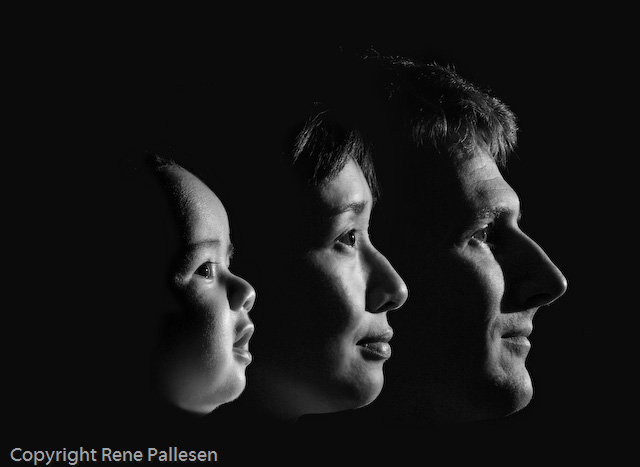
He is a good/easy little boy. He is now able to keep his head up, but still unable to sit or roll around onto his tummy. He sleeps through the night and wakes up around 7.30 to get a feed. On weekends he is happy to go back to sleep so his Mummy and Daddy can sleep in.
He is very quiet when in crowded places and likes to just sit and observe (Kims dad is saying that he has got that after me).
It has taken me a long time to get this photo done. I had to wait for him to keep his head up and even then it was pretty hard to get hime to look in the right direction.
3. November 2010 11:50
by Rene Pallesen
0 Comments
I have now finished the second portrait in the series of the four elements...just Fire and Air left. This one is "Water". The yellow blob is a Weedy Sea Dragon.

...Really helping my Photoshop skills. Not sure if anyone else thinks these photos are cool...but they are cool to make and are different from what I'd otherwise be doing.
1. November 2010 09:50
by Rene Pallesen
0 Comments
This weekend Kim and I went to see the musical Fame at Capitol theatre with a couple of friends Audrey and John.

Most of the cast was made up of dancers from “So you think you can dance” so there was a potential for a really good performance with some excellent dancing.
Our friends had organised a babysitter for the night and Aiden was being looked after by Kim’s dad and sister.
The performance was good (but not great). I think we were expecting more singing and dancing (It was a musical) and less dialogue. The second half of the play was a lot better than the first half with more dancing.

Unfortunately our friends missed this part as she was worried about their kid left alone with the babysitter (that is kinda the point of getting a babysitter) and left during the intermission.
At the end they got everyone in the audience up from their chairs for the famous "Fame" song.
Kim and I however had a good night out…and she looked smashing!
20. October 2010 11:11
by Rene Pallesen
0 Comments
Lately I have been playing around with Photoshop a lot more going through different tutorials.
Main purpose is to enable me to manipulate photos and add a different dimension to these photos. I have especially been trying to create some interesting profile photos that I can use of facebook and the like.
The portraits don't necessarily mean anything...mainly created them to see if I could do something out of the ordinary.The plan is to see if I can make a series Earth - Water - Fire - Air following the four basic elements.
It was really hard to get the starting photo right in my studio. It is almost impossible to do a photo of one-self and have it in focus...eventually Kim had to step in a help me (which I am very grateful for). In total it took me about 2-3 hours from start (taking the photo) to the finished result.

18. October 2010 09:19
by Rene Pallesen
0 Comments
Yesterday we went to the beach to have a coffee with a couple of friends. While Kim was catching up on all the gossip I went out to see if I could get some good photos of the surfers (The surf was pretty good that day).


18. October 2010 09:02
by Rene Pallesen
0 Comments
On the weekend I had a bit of fun with Aiden. I bought a world map on email just so that I could take the following photos of him...


And this last photo I call "Is this where you grew up daddy??"

He is now 4 months old and still doesn't like being on his belly...so I had to be pretty quick with the setup.
18. October 2010 08:46
by Rene Pallesen
0 Comments
Sunday night Kim and I was looking after Ethan and Kayla while Chong and KC went out for dinner.
Kims
dad and Dylan popped over for a couple of hours (Kims dad wanted to see
Aiden ;-)) and after dinner and after Aiden was asleep I set up the
studio to take some portraits of the kids. Main purpose was to
experiment a little to improve my photography skills...especially my study of shadows (It is easy to light, but harder to create meaningful shadows).
Lately I
have been doing more photography using all my flashes with wireless
triggers to get interesting angles and effects. A couple of days ago I
bought a couple of pieces of fabric in different colours (blue and red)
to use as backgrounds and the following photos are a result of Sunday
nights photoshoot.

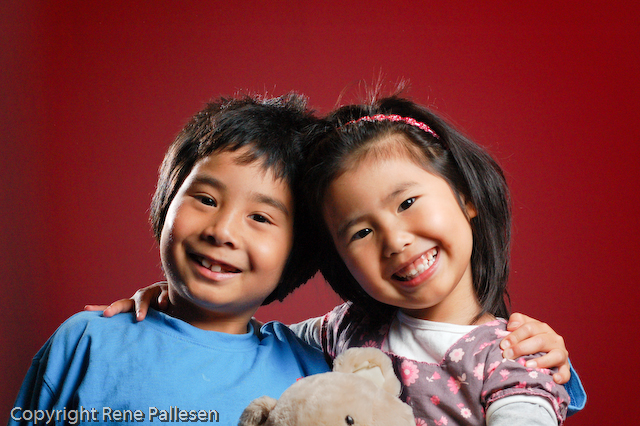

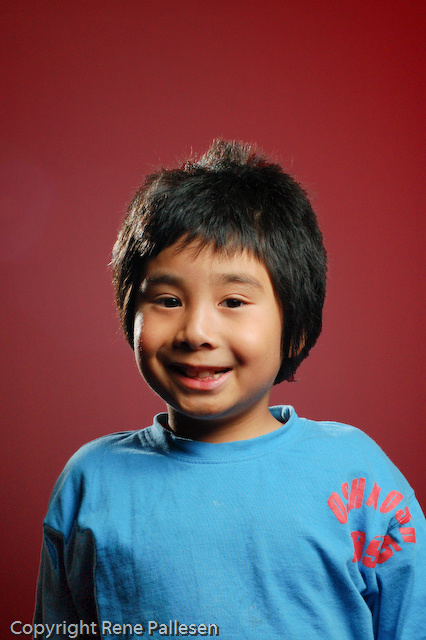
I used one flash camera right in a 60*60 softbox, Hair light behind
camera left snooted. In retrospect I should have taken my 3rd flash and
used this to light the coloured backdrops to create better seperation...the highlights above are done in Post processing.
27. September 2010 12:21
by Rene Pallesen
0 Comments
I had a bit of fun on the weekend and spent a little time using photoshop doing something different for a self portrait. Just a bit of fun for a Facebook profile photo.
It took me about 5 minutes to take the photo and about 25-45 in photoshop to modify the image.

After taking the image I modified the background, de-saturated the colours, saturated the green colours, added the cat-eye contact lenses and extended the canine teeth slightly...done! Not perfect, but good enough for what I wanted to try and accomplish.
19. September 2010 10:31
by Rene Pallesen
0 Comments
This week there was a big low pressure system of the coast of Tasmania resulting in 18 meter waves there. It was predicted that some of this swell would hit Sydney this weekend resulting in 3-4 meter waves on south facing beaches. This Saturday morning I went down to Maroubra to have a look...The waves weren't as big as I had expected, but there were lots of surfers there and I did manage to take a couple of reasonable photos (I may try again tomorrow).


I am sure that there were a lot of professional/semi professional surfers out there, but unfortunately I would not be able to recognise anyone. Some of the photos I took with my 28-200mm lens which is super sharp. I also took some with an old 500mm mirror lens...it is reasonable ok...but almost impossible to keep in focus.
10. September 2010 11:05
by Rene Pallesen
0 Comments
Some people have said that Aiden looks like me (mostly) and some says that he looks more like Kim.
Here is a photo of Kim and I with Aiden as well as my mum holding me after I was born (I think):

I REST MY CASE!!!!!