Home

21. August 2011 02:09
by Rene Pallesen
0 Comments

Driving to Bled via Karlovac - Slovenia

21. August 2011 02:09 by Rene Pallesen | 0 Comments

driving to bled via karlovac slovenia


Driving to Slovenia we again chose to take the scenic route rather than take the highway to Zagreb and then to Slovenia from there. Instead we took the scenic road to Karlovac and then straight north across the border from there.

The was a very small road through a hilly landscape consisting mostly of farms and forests. A great and very enjoyable drive.

When we arrived to Karlovac I noticed a field just outside the city limits where they had deposited a lot of military hardware such as tanks, planes and artilery.

We decided to stop and have a look and it was almost like a museum, but there didn't seem to be anyone taking and entrance fee. There were also a number of bombed out buildings surrounding the field.

Karlovac was badly damaged during the war. Especially the southern part where this field was was totally destroyed. It was pretty much on the frontline between the croats and the serbs. The United nations tried to keep the parties apart, but the croats detroyed the UN observation posts.


Click here for more photos

The serbs responded with a heavy bombardment of Karlovac firing 5-6,000 grenades into the city every day (that is a lot) as well as by firing missiles into Zagreb.

One of the things on display was one very much shot up and crashed Mig 21...I would assume from the Yugoslav/Serbian Army based on the markings.


Click here for more photos

The Croatian markings were different on the other Mig21 on display.

Click here for more photos

Besides from this there were a lot of other hardware such as tanks and artilery as well as one russian missile launcher. I am pretty sure the first tank is an M84 and I think the other ones are Russian T55's.


Click here for more photos

Click here for more photos

Click here for more photos

Click here for more photos

Click here for more photos

Click here for more photos

Click here for more photos


Click here for more photos

It was obvious that most of the equipment here had been used in action and some of the equipment was improvised and was also badly shot up such as this armoured personel car.

Click here for more photos

Afterwards we drove through the city itself and it was obvious that the scars of the war on the buildings were very visible just like in Mostar.

Ironically the main industry in Kardovac today is Arms production and they are a major producer and exporter of handguns.

Driving north from Karlovac we entered a mountain range leading us across the border. On the top we found the Slovenian border and crossed it easily.

It was now lunch time and coming down on the other side we started looking for a place to have eat. We found a restaurant at the foorhills and decided to order todays special having no idea what the price was. We decided to skip the initial soup that was part of the menu and went straight to some very solid mains. The waiter then brought us deserts as well. In total the bill came to 18 Euros including drinks...Kim called this the greatest bargain on our trip.

Not far from there we again joined up with the highway that would take us to Bled. After a while we came to the check for Road Tolls. Not knowing how it worked and not sure which lane I was supposed to be in I had to just go through the gates without paying. After another 30 kilometers we encountered we came to another toll gate and this time I decided to go through the truck/bus lane as it seemed like this one had a cashier. I asked him how the system worked and he said that I had to purchase a weekly pass (so we did). I also asked him what would happen if I didn't have a pass and he told me that I would get a 300 Euro fine...Oouch!!! But he also said that the controls were manual controls, so unless I was stopped I would be ok.....Whewww!!!

The rest of the drive to Bled was a breeze from there on. During our whole trip we used my GPS navigator extensively. Although it wasn't totally accurate all the time for these countries it would still get us most of the way and the driving would definitely have been a lot less enjoyable if we had to use a map all the time.

20. August 2011 07:32
by Rene Pallesen
0 Comments

Plitvice Lakes - Croatia

20. August 2011 07:32 by Rene Pallesen | 0 Comments

plitvice lakes croatia


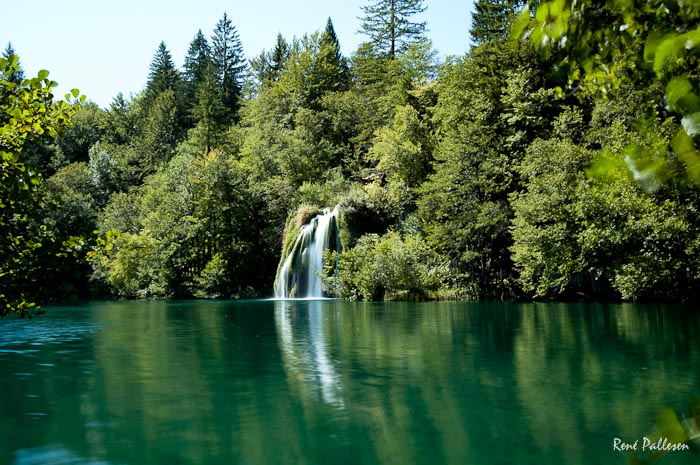
We had heard a lot about Plitvice Lakes before we arrived to Croatia. One of the travel shows went as far as saying 'You haven't been to Croatia is you haven't been to Plitvice'. It is also one of the first natural sites that was listed as a UNESCO World Heritage site.
Click here to see more photos

Some of the photos/footage we had seen from there was stunning.
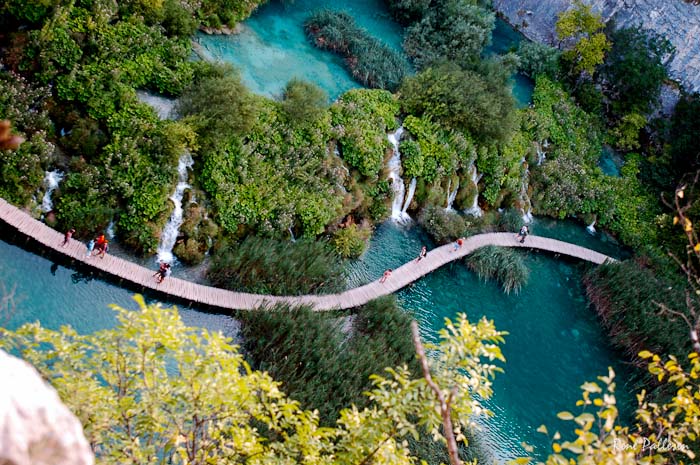


Click here for more photos

Click here for more photos

When we arrived to the villa we were staying in the girl who checked us it provided us with a map of the national park and said that we should go there in the afternoon and get the big waterfalls out of the way. I asked her about Aiden and how easy it would be with his pram. She said that there were some steps, that once you were down at the lakes then it was mainly flat. She also said that on the second day we should do the other waterfalls. This route was longer but flat most of the way.
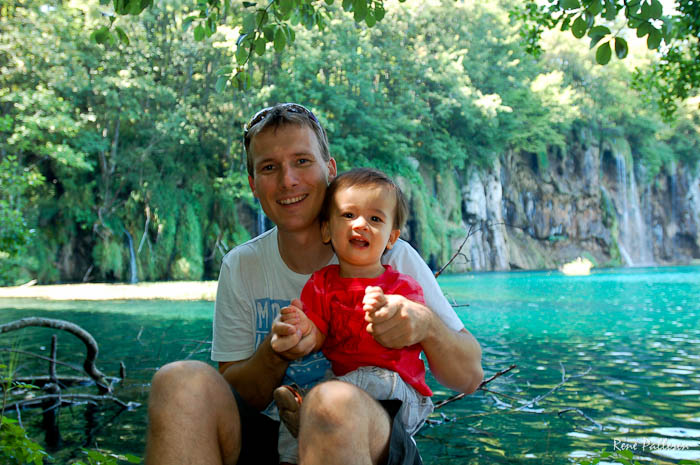
Click here to see more photos

We arrived to the park and sorted out the park entrace fee and figured out how the parking worked. The decent down to the lakes was a long ramp...easy with the pram.
Once we arrived to the bottom this turned into a wooden walkway. The planks used hadn't been levelled but were just raw pieces of timber and it was very difficult and very bumpy for Aiden in the pram. The narrow walkway (without railing) was full of busloads of japanese tourists whick made it even harder to get through it. We were so busy strugling with getting through the crowds that it was very hard to enjoy and take in the scenery. The walkway was constructed only a few metres from some of the smaller but more scenic waterfalls and with all the people even without the pram it would have been not so as enjoyable as it could have been.

Fortunately the walkway was fairly short and once we hit gravel walkways the going became a lot easier. By this time the busloads had also turned back the same way they came so less crowds. At the end of the circuit we came to this little picturesque lake that had these small tour boats running on it to transport people from one side of the lakes to the other.

Click here to see more photos

We took the boat across to the other side and found the dreaded 200 steps (I think Kim counted 211) from the lake shore back up to the busstop for the bus that would take us back to the carpark. At this point stairs were easy as long as there were no wooden logs or crowds.

Dinner tasted extra good this evening...a massive trout.

Next morning we went back to the park and started on the second circut that had been suggested to us. Again we encountered the wooden log walkways and this time they just kept going. we saw other people with prams who were also struggling. I did have a carrying harness with me, but it was fairly hot and Aiden doesn't like sitting in it for very long so I only carried him in it for short periods of time.
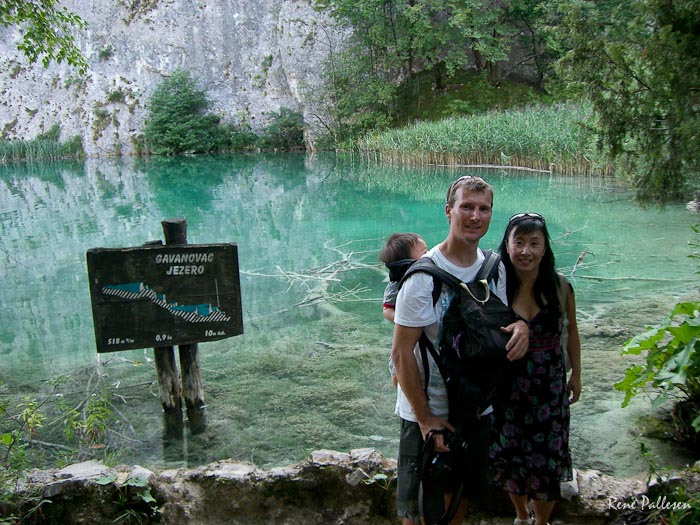
Click here for more photos

The walks themselves were not that crowded, but every time there was a waterfall it was really crowded and hard to get an unobstructed view.
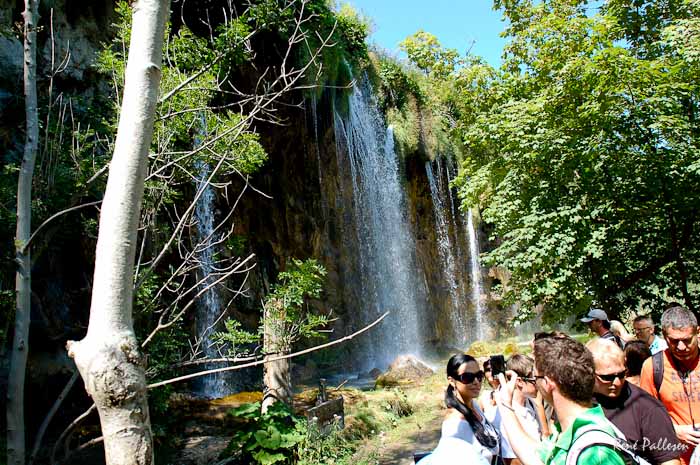
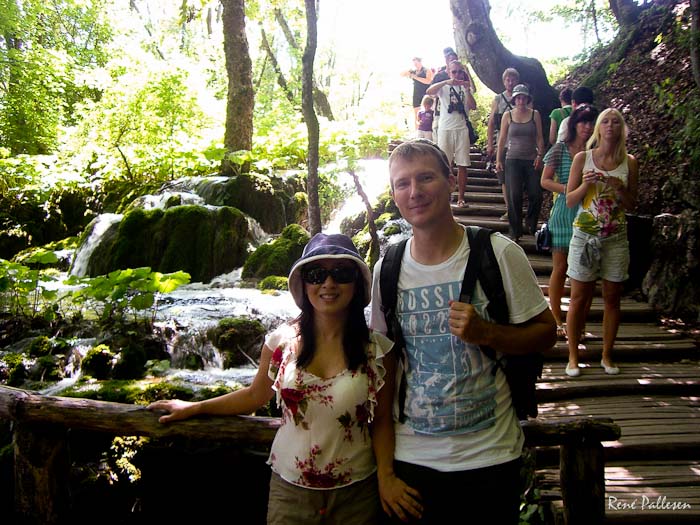
Click here for more photos

Click here for more photos


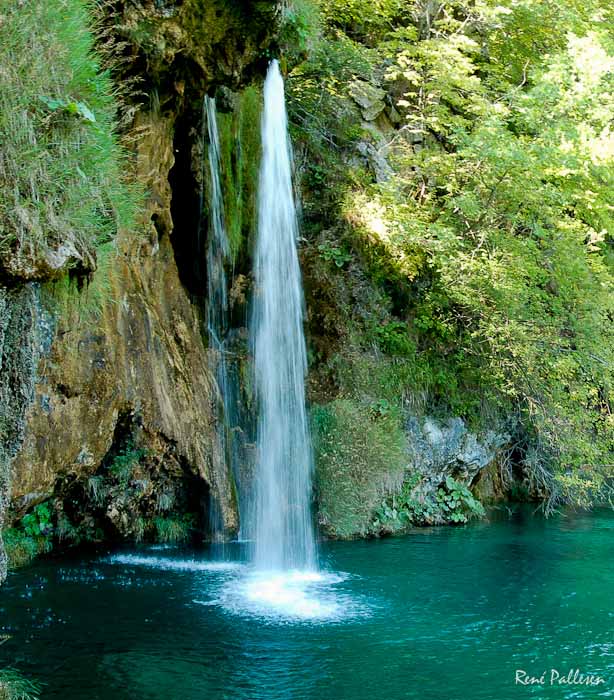
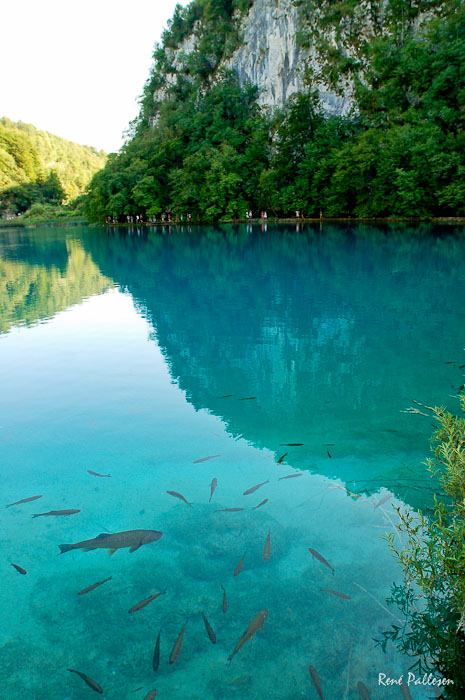
The walk itself was really nice and the water in the lakes has this amazing turquiose blue colour from the limestone deposits in the water.

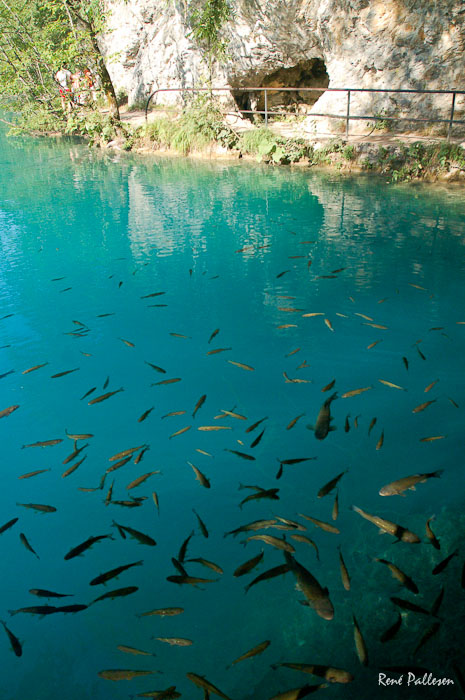
And the water is so clear that you can see all the fish swimming around.
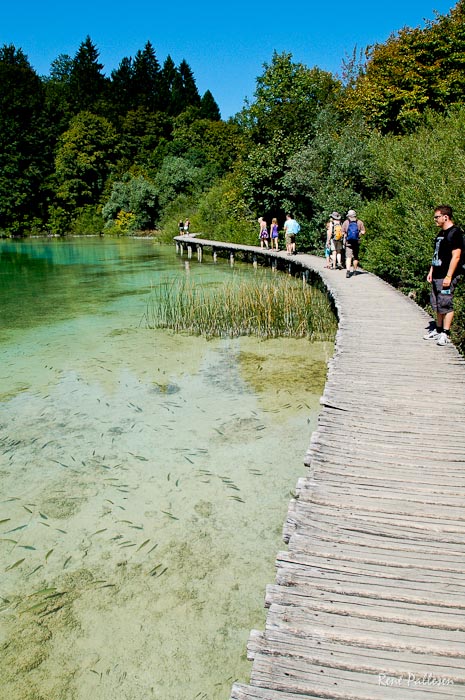
Click here for more photos

Click here for more photos


Click here for more photos

It is these deposits that form the lakes and the waterfalls.
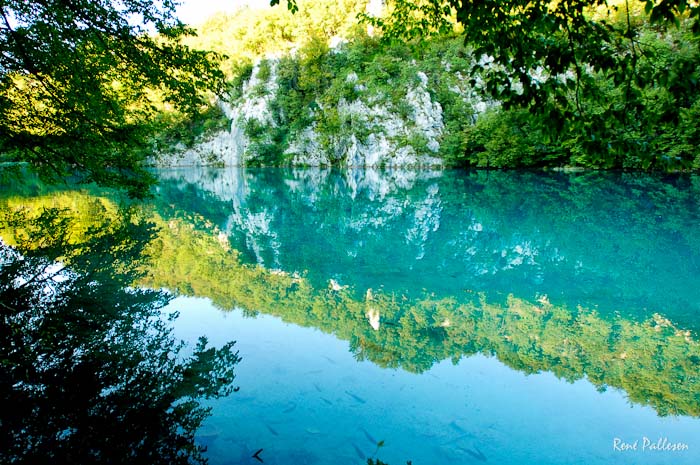
Click here for more photos


The track ended up at the same lake as the day before so we had to take the tourboat across. One of the families with a pram tried to jump the queue by carrying their pram down the hill and he dropped their baby out of the pram...what a chaos, but fortunately the baby was ok.
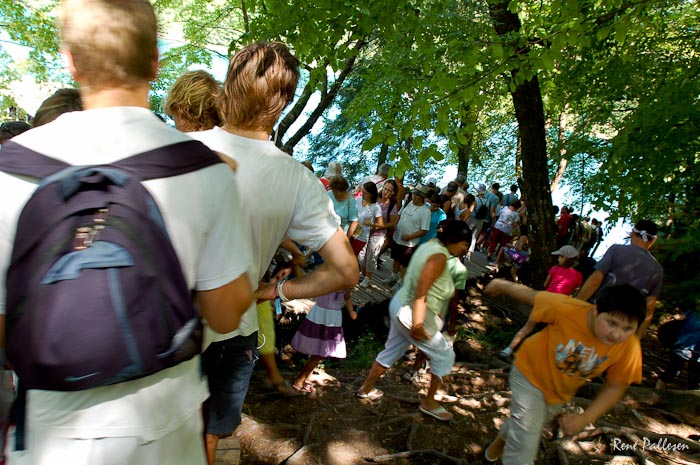
Click here for more photos

In the afternoon when we returned to the villa we put Aiden to bed and rushed back down to the park to re-do part of the walk from the day before. It was later in the afternoon so it wasn't as crowded and we found it a lot more pleasurable.

Kim kept asking about a partucular viewpoint of the waterfalls. We were unable to find this viewpoint, but there was a particular track that was closed for maintenance and I am sure that the viewpoint is from this track.
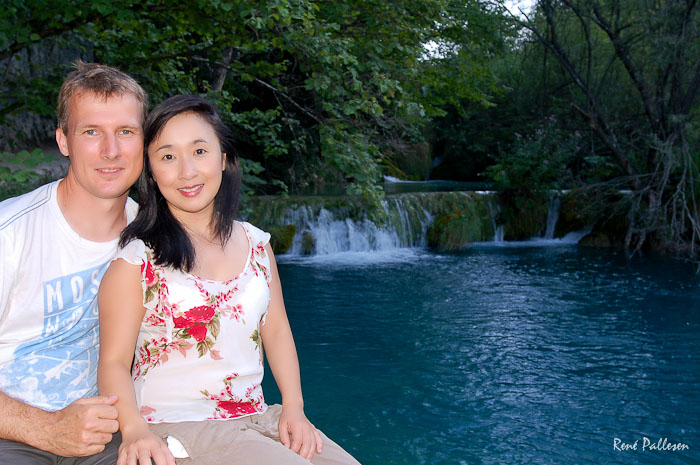
Click here for more photos

Anyway...in terms of expectations we found that Plitvice under delivered. we found that Krka National Park was amazing, less crowded (or a least more of a local Croatian crowd) and more pram friendly.


19. August 2011 07:31
by Rene Pallesen
0 Comments

Drive to Plitvice Lakes - Croatia

19. August 2011 07:31 by Rene Pallesen | 0 Comments

drive to plitvice lakes croatia


Driving to the Lakes we decided to take the old road rather than the highway.This road crosses the mountain range and then catches up with one of the larger roads further inland. We were told that after the highway was built there was less traffic on this road, but when we got onto it, it was completely empty of any traffic whatso ever.

The drive across the range was very different. It was very scenic and the road was in great condition. The landscape was very rocky and very dry, almost dessert like with low scrubs and there were many old farms and houses that had been left probably because life was too hard up here. I would have thought it would be the typical place to have goats roaming around, but we didn't see a single goat up on the high plateau. The farms looked like they were several hundred years old. It was the typical farms you see in these areas where the farmers every year pick up the stones they see in their fields and put them to the side to eventually form a type of fence line/walls around the field. Some of these walls were several metres high for even very small fields meaning that they were very old and that it would have taken a lot of really backbreaking work to be able to grow anything up here.

After about seventy kilometres we were across the plateau and one of the first larger town we arrived to was Knin. We decided to stop here to pick up a few supplies and site down and have some lunch. Not far from the supermarket was the trainstation and here was the very nice old steam locomotive. It was built in Budapest (possibly in 1955) and was now just sitting there rusting.

Click here for more photos

Click here for more photos


Click here for more photos

Knin was also the only place on our trip where we saw a significant military presence. I later found out that this was one of the Serbian strongholds during the was and they tried to break free of the newly independent croatia in 1991 as the Republic of Serbian Krajina. As it attempted to break off from Croatia in 1991 they ethnically cleansed the area of non-Serbs and set up their own local government. In 1995, the Croatian army retook the region and the majority of the Serb population fled or was displaced. There are today still some tension in the area and there are not a lot of opportunities. It is also close to the border and strategically located so hence the large military presence.

Just outside Knin we passed this weird structure on one of the farms. It was liks a big silo, but with a large chimney on top. Next to it there was a a wooden structure with some hoisting structure in it. I have no idea what this structure was for. It could be some sort of a furnace for melting something, but to be honest I have no idea...I would love to find out what this structure was for?? Today it looks like the building is used to store cow manure. There are some vineyards in the area so this could possible provide a clue. My guess is that it was for burning limestone (plenty of that around) to produce cement or mortar.


Click here for more photos

Click here for more photos

The remainder of the drive was on a much more busy road with large trucks. We managed to get to the lakes early afternoon. Just in time to have a quick visit to the lakes...but more about that in the next post.


18. August 2011 07:02
by Rene Pallesen
0 Comments

Coastal drive to Trogir - Croatia

18. August 2011 07:02 by Rene Pallesen | 0 Comments

coastal drive to trogir croatia


The coastal drive from Dubrovnik back up to Trogir just north of Split is absolutely amazing. It follows the coastline closely all the way and it is both a fun drive and incredibly scenic. I found it better than the Great Ocean Road here in Australia.

One minute the road is really close to the water and you can see all these little bays with crystal clear water and sometimes with small beaches and people swimming. Next minute the road is up high and you get an incredible view of all the high mountains and islands off the coast. The whole route is dotted with small towns and beautiful little churches.

Click here for more photos

The road is really winding and does not have too much traffic on it, so it is a very pleasant and never boring. To complete the drive we also had to cross back into to Bosnia only to cross the border back into Croatia a few kilometers later.


Unfortunately both Kim and Aiden missed out on much of the scenery as they were sleeping most of the way.

Along the way we stopped in Markarska to get a bite to eat. It is an incredible little natural harbour with a steep backdrop to the mountains behind.

Click here to see more photos

Click here to see ore photos

We stopped for the night in a small island town called Trogir. It is a charming little town with narrow passageways and very nice little restaurants. It is very popular with the rich in their 150 foot motor boats.

Click here for more photos

Click here for more photos


Click here for more photos

Kim had found a hotel right in the centre of the old town so we had to park outside the city and then walk in. We were only staying for one night, so it was easy for us to just pack one bag and leave the rest of our things in the boot of the car.

Arriving to the hotel we found that the Aircon and TV wasn't working...we complained to the reception desk and they came to have a look at it. It turned out to have been turned off at the fuse box. We turned on the Aircon and it was quite noisy but at least it was somewhat working.

Kim went to have a shower and suddenly I heard a very loud vacumm cleaner type sound and then Kim started screaming. I went out to the bathroom and there was water and soap everywhere...the walls, the doors (even the outside of the door) and the floor. The Jacuzzi in the bathroom had suddenly automatically turned itself on in the middle of her shower and the off switch wasn't working. The only way we could turn it off was on the fuse box...so now we knew why it was off when we arrived.

This turned out to be probably the worst of the hotels (Hotel Fontana) that we stayed in...it was really unbearable hot in the room, we couldn't open the window because we would be attacked my moscitoes, and if we wanted to turn on the noisy aircondition then the jacuzzi would automatically start every 10 minutes and disrupt our sleep. And the included breakfast was also not worth writing home about.

But besides from that Trogir was very nice. We spent a fair bit of time getting lost in the small alleys. Kim would ask if I had any idea where we were or where we were going...and I'd say "No, we are definitely lost" (Trogir is a very small island so you are never truly lost).

Click here for more photos

Click here for more photos

16. August 2011 09:49
by Rene Pallesen
0 Comments

Dinner in Montenegro

16. August 2011 09:49 by Rene Pallesen | 0 Comments

dinner in montenegro


After the Peljesac Peninsular we thought we'd drive to Montenegro for dinner.

The border to Montenegro is about 30 kilometers from Dubrovnik and Herzeg Novi a coastal town is just on the other side of the border.

Crossing the border we saw a 2 kilometer long queue of cars trying to get back to Croatia. Every car was being stopped and checked for how many cigarettes they were bringing across. We though "Oh My...we have to get back through this is a couple of hours time". Fortunately by the time we returned the queue had cleared and we were processed really fast at the border.

It was a pleasant evening in the city and we had dinner along the seashore. People were really very friendly as well.

Click here for more photos

Click here for more photos

The food was very nice and especially the Tiramisu and chocolate pancakes were indulgent.

Click here for more photos

Click here for more photos


Click here for more photos

It was very hot so we used the opportunity to do some funny photos of Aiden.

Click here for more photos

16. August 2011 05:48
by Rene Pallesen
0 Comments

Peljesac Peninsular

16. August 2011 05:48 by Rene Pallesen | 0 Comments

peljesac peninsular


While in Dubrovnik we went for a drive up along the Peljesac Peninsular.

It has some really nice litte beaches and the town of Ston has the most amazing fortres defence line running across the mountain tops. It is almost like the great wall of China. In total the town has 6km of defensive walls around it.


Click here for more photos

We also came across this beautiful little abandoned church.

Click here for more photos

We spent the afternoon at one of the beaches just dazing in the sun and letting Aiden play in the water.

Click here for more photos

Some of the bay have small picturesque islands and there are lots of oyster and mussel farms that have been in operation since roman times.

Click here for more photos

15. August 2011 03:30
by Rene Pallesen
0 Comments

Dubrovnik - Croatia

15. August 2011 03:30 by Rene Pallesen | 0 Comments

dubrovnik croatia


After Bosnia we headed back to Croatia (and we then quickly had to cross back through Bosnia on the way to get there because of the geography) to Dubrovnik.

Dubrovnik was founded in the 7th Century as a refugee camp after the fall of the roman empire. A Slavic invation forced the romans to seek further south and eventually barricaded themselves on a rocky outcrop at Dubrovnik buy using a natual channel and building big walls as a defence.


Click here for more photos Dubrovnik as such prospered and became a powerful trading port in the adriatic sea. Now it is probably one of the largest tourist attactions on the the eastern side of the adriatic sea.


Click here for more photos

Click here for more photos


Click here for more photos

As usual Kim had done a great job finding accomidation in an apartment only 100 metres from one of the main gates to the city, so it was a easy stroll to the old town.


My first impression of Dubrovnik was something along the lines of 'Holy @#@$@%...there are so many stairs here" (tough job carrying Aiden up and down stairs with a pram).

Click here for more photos

Fortunately we found an easier way that did involve very little more walking, but no carrying...so all a happy family.

Click here for more photos

The main street through the middle of Dubrovnik is very nice and full of nice places to eat and shop. There are a lot of people everywhere and in general everything is really expensive compared to elsewhere is Croatia. Parking for example was equivalent to $48 per day for street parking...and again considering it is a big tourist destination people are not that helpful with advise and guidance.


Click here for more photos

There are also several churces that are very nice. Our favourite one (by far) was the St. Ignatius Church.


Click here for more photos

Click here for more photos


Click here for more photos

Inclucing some museums such as the national archives which used to be the Sponza palace.


Click here for more photos

Click here for more photosThis is the handrailing for the stairs


Click here for more photos

As well as some great little Franciscan and Dominican monesteries. These both had some great little courtyard garden with palm and orange trees.


Click here for more photos

Click here for more photos

Click here for more photos

Click here for more photos


As well as some cool water fountains (Aiden was very happy with these) and really likes a cool splash whenever he could get the chance.


Click here for more photos

In more modern times, Dubrovnik was under heavy shelling by Serbian and Montenegro forces during the Yugoslav war in 1991 although it had absolutely no strategic value whatsoever.

Click here to see a video of the shelling of Dubrovnik

Today It is hard see any scars of this conflict as most of the buildings have been repaired although there are some signs of the shelling.

Click here for more photos

Click here for see more photos

And again I managed to sneak out for a couple of evening photos. Evening shots were really hard to take as they were usually around the time where we either had to have dinner or get Aiden ready for bed.


Click here for more photos

Click here for more photos

Click here for more photos


Click here for more photos

13. August 2011 05:39
by Rene Pallesen
0 Comments

Mostar - Bosnia

13. August 2011 05:39 by Rene Pallesen | 0 Comments

mostar bosnia


After Split we headed across the border into Bosnia to a town called Mostar. Some will remember Mostar from the terrible fighting that took place here during the war in Yugoslavia in 1992 and 1993. The town has this beautiful river running through it with this anciant bridge running across it. During the war this bridge was blown up by the Bosnian Croat forces but has now been re-built thanks to the United Nations and especially Spain. The original bridge was built during the ottoman empire during the 16th Century.

Click here for more photos

Click here for more photos

The Bridge looks even more stunning at night and especially with all the mosques in the surrounding area.

Click here for more photos


Click here for more photos

Click here for more photos


Click here for more photos

Mostar is only a few hours drive from the border up through this beautiful valley. Today a fair number of tourists go to Mostar to see the bridge, but most of them only stay for one night and then move on. We decided to stay for two nights because it was easier with Aiden. Again Kim had done a good job finding accomodation in at Old museum (more like a beautiful old house really)...the was also the only house that was left more or less intact after the war (only a few mortar shells through the top floor).

Click here for more photos

Click here for more photos


Click here for more photos

During the day we spent a few hours on the river going for a swim. The water was quite cool coming from the mountains and there was a lot of current so Kim and Aiden stayed at the edge, but I jumped in a few times and let the current take me a couple of meters before heading back to shore.

Click here for more photos

Click here for more photos

The locals jump off the bridge and into the river...and it is a fairly high jump from the bridge to the water (24 metres apparently). Every year there is a special festival where they do it, but now they mainly do it to entertain the tourists for a bit of money in return.

Click here for more photos

Click here for more photos


Click here for more photos

People were very friendly in Bosnia, of all the places we travelled through we probably found the croats the least approachable and helpful.


During the war the town was surrounded by Bosnian Croat forces and the population consisting mainly of muslims decided to defend themselves. The city was hammered to pieces by Croat artiliry fire and even today it is hard to find a house without scars from bulletholes and grenades.

It is worthwhile to have a look at the following video to see what happened here in 1993: Mostar in 1993


Click here for more photos

Click here for more photos

Mostar is surrounded by steaphills and it would have been almost impossible to find cover from snipers and artiliery from above.


Now almost 20 years later there are still many ruins right in the centre of east Mostar where we were staying and there are lots of house that are full of bulletholes and people are still living in these houses.In the houses that have not been repaired it is almost impossible to find a 30 by 30cm patch that does not have a bullet hole or grenade fragments in it. It would have been a hell on earth living or fighting here during these times.


Click here for more photos

Click here for more photos

Inside the city limites there are three cemeteries and they are all full of victims killed in 1993...all mixed with Muslim, Christian and Orthodox. It is a very sobering experience to see that every grave is marked with the exact same year and that almost every victim was born at about the same time as Kim and myself.

Click here for more photos

Click here for more photos

Today the population seems to be getting along regardless of background and religion.

Click here for more photos

The surrounding hills in the valley driving in from Croatia also have old castles and ruins on them. It is a very scenic drive and highly recommended.


Click here for more photos

We have a very nice time in Bosnia and we can highly recommend that people go there to visit.

Click here for more photos

People should not forget Mostar and especially not forget what happened here in 1992 and 1993.

Click here for more photos


12. August 2011 10:55
by Rene Pallesen
0 Comments

Krka National Park - Croatia

12. August 2011 10:55 by Rene Pallesen | 0 Comments

krka national park croatia


We spent a day driving to a National Park along the Krka river.This park has the most amazing waterfalls and clear blue water to swim in.

Click here for more photos

Click here for more photos

Kim and I both agree that this park is much better and less overcrowded than Plitvice National Park. There are also fewer steps and better tracks whick made it more pram friendly.


Click here for more photos

Click here for more photos

Click here for more photos

The park is full of small waterfalls.


Click here for more photos

Back in time the water from the river was used to drive a watermill, which is still functioning to this day.

Click here for more photos

The lower falls you can swim in. We all went for a swim and the water was beautiful...Aiden didn't want to leave.


Click here for more photos

Click here for more photos


10. August 2011 12:25
by Rene Pallesen
0 Comments

Split - Croatia

10. August 2011 12:25 by Rene Pallesen | 0 Comments

split croatia


After Denmark we went to Croatia. Our first stop was Split arriving late at night into Split Airport, picking up the rental car and baby seat and then navigating our way to the apartment we had rented for a few days.

The apartment was very nice (Kim is good at finding accomodation) and they had provided a baby cot for Aiden to sleep in (all the places we stayed provided a cot for us), next to the best beach in town and it was about a kilometers walk from the central part of the city.

Click here for more photos

Split is famous because of the Diocletians Palace, which is an enormous and fairly well preserved palace in the middle of the city. The Palace was built for the retirement of the Roman emperor Diocletian at around 300AD. There are still a lot of well preserved buildings and cellars within the palace walls, but there is also a lot of more 'modern' houses, shops, restaurants etc.

Click here for more photos

Click here for more photos

Click here for more photos


Click here for more photos

Walking around and getting lost in the small alleys was really pleasant.


Just outside the Gold gate there is an enormous status, and it is said that if you touch the toe of the statue then it brings you luck and guarantees your return to Split (We did drive past Split a week later....maybe that counts).

Click here for more photos

Click here for more photos


Click here for more photos

In the evenings it was pleasant walking along the shore and take in the views of the city.

Click here for more photos

Click here for more photos

Click here for more photos

And all the locals were out stretching their legs too...

Click here for more photos

And we really enjoyed the fresh seafood.

Click here for more photos

Click here for more photos

Aiden loved the food and the decor of some of the restaurants.

Click here for more photos
Perfect Moments Photography | A Rene Pallesen Journal

Home

4. February 2018 22:02
by Rene Pallesen
0 Comments

Pak Ou cave - Laos

4. February 2018 22:02 by Rene Pallesen | 0 Comments

A two hour boat ride north of Luang Prabang is the Pak Ou cave. Since we were traveling two families
A two hour boat ride north of Luang Prabang is the Pak Ou cave. Since we were traveling two families the best way to get there was to hire a slow boat just for us.


The flow boats are long narrow boats that are ideal for navigating the Mekong River. This part of the river is full of underwater rocks but the boats seem to navigate these treacherous waters with ease.

Having the boat for ourselves gave us more flexibility with regards to how long we wanted to spend at the cane and also meant that we have more room to move around.


The front of the boar is where the captain sits and steers the boat. After this there is a section for the passengers followed by a small pump toilet and then the living quarters for the captain and his family. Out the back there is a small kitchen for them to do the cooking.

The cave is upstream into an area full of limestone mountains.


The many boats moor at a long and wobbly floating bamboo bridge that takes you to the cave itself.


The cave itself is not big but it is full of small Buddhas that have been put there over hundreds of years. You can tell that this used to be an important place of worship.


Now however the place is so crowded with tourists (guilty here too) coming in on boats that it is hard to move around. I could not stop myself from taking this photo of Buddha holding up his hands to stop more boats arriving.


At the top of the hill the hill there is what I think is a more 'pleasant' cave. It is equally interesting and much less crowded because most tourists don's make it up the many steps to the top.

4. February 2018 16:03
by Rene Pallesen
0 Comments

Lao Lau (rice whiskey) - Laos

4. February 2018 16:03 by Rene Pallesen | 0 Comments

The traditional Lao Lau is still being made. Just north of Luang Prabang on the river there is a lit
The traditional Lao Lau is still being made. Just north of Luang Prabang on the river there is a little village on the river called Whiskey village whos main income is from the production of Lao Lau.


When I was there two decades ago this is what the locals were drinking (now they drink beer instead). I still remember the foul taste from the home brew that was distilled in large oil drums after having been fermented in large clay pots. Whenever I see it I always wonder if distilling strong alcohol right next to an open flame is the wisest of ideas!?!?


The process itself hasn't changed, but these days most of the whiskey is sold to tourists and I tastes a lot more pleasant that it did back then.


3. February 2018 15:03
by Rene Pallesen
0 Comments

Food - Laos

3. February 2018 15:03 by Rene Pallesen | 0 Comments

The food in Laos is good. It is traditional cooking mostly still cooked over an open fire.You see th
The food in Laos is good. It is traditional cooking mostly still cooked over an open fire.


You see them start cooking the food well before sunrise in big pots.

The food itself is mostly a fusion of Thai and Vietnamese. It has all the noodle soups from Vietnam, but with the more street food and spice of Thailand. The picture below is a typical noodle soup with a traditional cube of coagulated blood.


We were eating a lot from small street type restaurants following the rule that is had to be popular with the locals. The logic behind this is that the locals would know what is good and would also be choosy regarding the quality of the food, so chances are that it would be fresh and not cause food poisoning (none of us or the kids had any issues on the trip).


There are some dubious food there, such as some of the meat BBQ where they sometimes have the meet cooked earlier on the side of the BBQ and then just re-heat it when you order it.


Also be careful with some of the food stalls where the food may have been sitting there for most of the day and often from the day before.


From a 'snack' perspective there are some personal favourites that I absolutely love such as the BBQ fried squid - the packet stuff is just not the same.


Also the Bamboo and coconut fried rice is delicious - they sell them at bus and train stations and especially the purple rice one is yummi!


The freshly made puffed breads over an open fire - they will use two rakes to flip them until they are done.

2. February 2018 00:02
by Rene Pallesen
0 Comments

Temples - Laos

2. February 2018 00:02 by Rene Pallesen | 0 Comments

The temples in Luang Prabang are some of the most beautiful anywhere. Yes, Thailand has some amazing
The temples in Luang Prabang are some of the most beautiful anywhere. Yes, Thailand has some amazing temples, but these are different. They are smaller, and more intricately decorated.


1. February 2018 23:02
by Rene Pallesen
0 Comments

Luang Prabang - Laos

1. February 2018 23:02 by Rene Pallesen | 0 Comments

Luang Prabang is without a doubt the cultural highlight of Laos. The old part of the city is beautif
Luang Prabang is without a doubt the cultural highlight of Laos. The old part of the city is beautiful and there are good reasons why is has been heritage protected.

I believe it has the most beautiful temples of South East Asia - they are not the largest or even the oldest, but the amount of details that has been put into them is absolutely stunning.


In addition to this there are a lot of other very interesting things to see in and do in the city, which I will cover in later posts.

The city itself is situated between two rivers where one of them is the Mekong which is still fairly busy with slow boats and ferries (The chinese are building a large bridge across the river north of the city)


The section between the two rivers form the city itself which consist of four parallel streets each about a kilometer long.


Everything within the city itself can be covered on foot and in the evening the main streets are blocked for card and reserved for pedestrians.

The place is dominated by a big hill with a small temple and stuba on top. It is very popular with tourists to climb the hill around sunset. And there is a great view of the mountains from the top.


There are some things that have changed in the city since I was there the last time. The most noticeable is the amount of tourists and fine hotels - and here it is really the more wealthy middle aged Europeans you see. The main street of the old city is full of modern western European influenced restaurants, souvenir and antique stores.


Fortunately you don't have to travel further that to the parallel streets to fine more low key Laos places to eat.

Also, last time I visited, I stayed in a small guest house near the city centre called Tanoy Guest House. When I stayed here I became good friends with the family and the place was named after the oldest daughter who's name was Tanoy.

The place is still there and apart from a larger fence it looks pretty much unchanged.


29. January 2018 21:01
by Rene Pallesen
0 Comments

The War - Laos

29. January 2018 21:01 by Rene Pallesen | 0 Comments

The 'secret' war in the 60's and 70's had a major impact on the country. A massive amount of bombs w
The 'secret' war in the 60's and 70's had a major impact on the country. A massive amount of bombs were dropped by mostly the Americans in mostly the Northern and Eastern part of the country. This was partly an internal civil war but also to stop the North Vietnamese using the country as a supply route.

To get an insight into this was I can highly recommend the books by Christoper Robbins called 'The Ravens' and 'Air America'.

The impact today is that un-exploded ordnance (mines, cluster bombs etc.) is covering large parts of the country and that every year lots of people including children gets injured or killed.

It is also very noticable, especially in the Hmong villages that there is no presence of old men. This is because most of these were killed either during the war where especially they took heavy casualties despite the American support or through 'education' camps after the war.

Last time I went to Laos I went to Plains of Jars which was one of the most heavily bombed areas and the debris was everywhere. We weren't going there on this trip, but to give the family and friends an insight into the history and the dangers to present people we visited the COPE organisation in Vientiane.

Here is Aiden in front of an unexploded (disarmed) clusterbomb. Looks just like a ball and tempting for kids to play with.


These were dropped from canisters on aircraft with several hundred in each load. It is estimated that 1/3 of these didn't explode on impact.


This map shows the areas most effected.


If you look for the bombs they you see them everywhere - mostly disarmed and used as fence posts.


There is also remains of anti aircraft guns such as this one in Luang Prabang. The barrel had been removed but everything else still worked on it and they could turn it by rotating the handles, much to the amusement of the kids. During the war kids only a little older than our kids would have been fighting at the front lines.

16. January 2018 21:03
by Rene Pallesen
0 Comments

People - Laos

16. January 2018 21:03 by Rene Pallesen | 0 Comments

One thing that I love taking photos of on my travels are People.A lot of the photos of the people of
One thing that I love taking photos of on my travels are People.


A lot of the photos of the people of my travels are in the other posts, but here is a selection that didn't really fit into the other stories.

This is an old woman sitting doing preparing food or doing her handicraft outside her house while observing the street life.


Someone was shooting a wedding, I used the opportunity to snap a photo of my own.


A woman bathing in the Mekong


A girl posing for her boyfriend on top of the hill at Luang Prabang


A woman walking down the street


Another woman doing handicraft outside her shop

12. January 2018 00:02
by Rene Pallesen
0 Comments

Fishing - Laos

12. January 2018 00:02 by Rene Pallesen | 0 Comments

The fishing along the rivers in Laos are still very traditional.It is the circular throw out nets, f
The fishing along the rivers in Laos are still very traditional.

It is the circular throw out nets, fish traps and people foraging along the river banks to collect river seaweed and snails for eating.


In most places they still use dugout canoes for the fishing.


In the various town you see people sitting repairing their fishing nets.


Kim told us that when she was a little girl she used to help the family repair the fishing nets, but that she's forgotten how to do it.


One of the delicacies in Loang Prabang is the local riverweed. We saw multiple people collecting it and also sitting cleaning it.


11. January 2018 19:01
by Rene Pallesen
0 Comments

Vang Vieng - Kids highlights

11. January 2018 19:01 by Rene Pallesen | 0 Comments

Some of the other highlights for the kids in Vang Vieng was the gym at our hotel. The local guys use
Some of the other highlights for the kids in Vang Vieng was the gym at our hotel. The local guys used it to train for kick boxing and the kids felt inspired.


Also, one evening we spotted someone launching wishing lanterns. We asked where they came from and through a lot of pointing we found a local shop keeper selling them.

We bought one and launched it an the kids loved the experience.


Also, one of the trees at the hotel had two little monkeys staying there most of the day. The kids loved standing there shouting profanities at them.


Perfect Moments Photography | A Rene Pallesen Journal

Home

14. March 2010 08:17
by Rene Pallesen
0 Comments

Week 25

14. March 2010 08:17 by Rene Pallesen | 0 Comments

week 25


It is now week 25 and almost the third trimester. Kim is certainly getting a lot bigger these days but is still very active with swimming, yoga and walking (According to Kim baby is very active too). Both baby and mum are so far doing fine.


Week 25


They say that most of the growth is in the third trimester...she could be huge!


We have finished painting the baby room and we have bought the most essential furniture such as a cot, a chest of drawers, car seats etc. It is now up to Kim to decorate the room so that it looks nice.

13. March 2010 09:05
by Rene Pallesen
0 Comments

Taste of Sydney

13. March 2010 09:05 by Rene Pallesen | 0 Comments

taste of sydney


Today Kim and I met up with Sasha and his wife to go to 'Taste of Sydney'. This is an annual event where the premier restaurants of sydney and food and wine producers showcase their food and wine.

This year it was held in Centennial park which is the largest park in sydney which is pretty convenient for us.

At the event they had what the call 'Chef's table'. This is where you can sit down with the chefs of some of the premier restaurants and they will tell you about their restaurants, their food and you can ask them questions. In the mean time they were serving us seafood, wine and cheese (I discovered a new cheese that I in particular really liked).


They also had showcases where some of the chefs from some of sydney best restaurants show you how to cook different dishes. We went to one session where we saw Matt Moran from Aria prepare a lovely cured trout. This was cured like Gravad laks using salt, sugar, coreander and fennel and then cured a secod time using dijon mustard and dill.

Cured Trout


The different restaurants were also having some of their food for sale. Some of it was quite nice (I had a nice yellowfin tuna), but I don't think it was a proper representation of their food. It is difficult to prepare and cook in large quantities without access to proper kitchen facilities, so most of the food was more fancy fast food.


10. March 2010 10:05
by Rene Pallesen
0 Comments

King Lear

10. March 2010 10:05 by Rene Pallesen | 0 Comments

king lear


Last weekend Kim and I went to see King Lear at the Sydney Opera House. Kim had managed to get cheap preview tickets on the third row from the stage which is pretty unheard of.

King Lear

The play wasn't anything fancy in terms of stage production, costumes or anything (Actually some of the actors were wearing fairly modern denim jeans).

On the side of the stage they had positioned a drumkit and a girl was banging away all throughout the first half of the performance. I found this very distracting and annoying since I was already trying hard to concentrate on understanding the old Shakespearean English.

During the second half they moved the drumkit off the stage, so I must say that I actually started to enjoy the play a lot more.

Given that we got pretty cheap tickets I found the evening pretty good value, but I don't think I'd pay full price for this one.

22. February 2010 02:04
by Rene Pallesen
0 Comments

Swimming at Maroubra

22. February 2010 02:04 by Rene Pallesen | 0 Comments

swimming at maroubra


Sunday I convinced Kim that we should go to the Beach. I wanted to try my underwater casing for my pocket camera in the waves to see if I could get some good photos. In 2000 I went to the World Press Photo exhibition and saw these great underwater photos from the surf and was inspired to see if I could re-create them.


Kim insisted that we picked up a beach shelter on the way there so that she would have some shade. We found on in K-Mart and then went on our way to the beach.

The first few minutes folding up the beach shelter was a disaster (It was one of those quick fold out ones where you just pull a string...junk!!) and eventually we just threw it all back in the bag deciding to return it on the way home (we'll get a pop-up one instead).


Taking the photos turned out to be a lot trickier than expected. It was fairly windy and the visibility wasn't great. Also the pocket camera tries to auto focus prior to taking the photo which was difficult with everything moving around constantly so most of the time the camera didn't take the photo.It was also quite hard to aim the camera while being battered around by the waves.


I did however manage to take these photos that turned out somewhat alright. I might try again one day when the conditions are better (and I've figured out how to lock the focus on the camera)

22. February 2010 01:12
by Rene Pallesen
0 Comments

Uncle and Auntie in Sydney

22. February 2010 01:12 by Rene Pallesen | 0 Comments

uncle and auntie in sydney


For the past three weeks my uncle and auntie (Eli & Henning) has been travelling in New Zealand with a tour group.

On the way home they did a 24 hour stopover with the group so do some quick sightseeing before continuing their journey.

They had a tightly packed program arriving late in the afternoon, out for a late dinner and then spend then morning next day on a tour around the city before heading back to the airport.

Kim and I managed to catch up with them in the evening for dinner at Nicks at King Street Wharf. Afterwards we went for a walk down to Circular Quay so that they could have a look at the Harbour bridge and the Opera House at night.

Dinner with Eli and Henning

By the time we got back to the hotel it was midnight and they had to check out of their hotel early next morning.

We hope that they enjoyed the sightseeing the day after (it was a fairly warm day) and that they had a good journey back to Denmark. Apparently there is a lot of snow there currently so they were prepared for the fact that they would have to do a fair bit of digging to get to their car and into their house.

It is not very often that we have visiting family from Denmark so it is always a pleasure to see them.

19. February 2010 05:00
by Rene Pallesen
0 Comments

More garden critters

19. February 2010 05:00 by Rene Pallesen | 0 Comments

more garden critters


This weekend I was cutting down the bouganvillae in the garden. Whenever I cut down some of the vegetation in the garden it is always interesting what insects I discover in the process. Because of the variety of plants there is always something new to discover. I try not to use pesticides in the garden itself...better to just let nature find a balance.

On this occation I discovered a large Garden spider and a Green Praying mantis (I have seen a Mantis before in the garden and they are great to have a pest control). Both are totally harmless.


Green Praying Mantis Common garden spider


This is what a website had to say about this Common Garden Spider:

"Now this is your classic common garden spider from Sydney. The Australian Museum page on garden orb weaving spiders tells me there is a second, almost identical species (edulis) but that that lives further inland. There must be hundreds of people each summer who can be seen jumping madly up and down in their gardens swiping at themselves just to be sure to get rid of this guy from their clothing after they've walked through a web. Although certainly large enough, this spider is reluctant to bite humans. "


Last week I did however see a redback spider on the other side of the house. Needless to say that I killed it before I got a chance to take a photo (They are extremely venoumous and the closest relative to a Black Widow). To be honest it is the first time I've seen one in the wild for more that 10 years so fortunately they are very rare.

13. February 2010 07:35
by Rene Pallesen
0 Comments

Open Air Cinema

13. February 2010 07:35 by Rene Pallesen | 0 Comments

open air cinema


This saturday Kim had booked tickets for 'The wolf man' at the open air cinema.


Every year in January and February Sydney hosts a number of events such as operas, concerts and cinemas.

The open Air cinema is located at Ms Macquaries Chair in the botanical garden overlooking the city, the opera house and the bridge.

Open Air Cinema

Open Air Cinema

It is a spectacular setting, especially when the weather is really nice as it was saturday (last year it was pouring down with rain). This years all the seats were sold out within 30 minutes, but Kim was quick to get a couple (smart cookie).

Even though we got there two hours early most of the seats had already been taken. We did manage to find two seats that were really good eventually (we were worried that we'd have to sit on one of the first rows right in front of the screen.


Opera House

The movie was about warewolves and it was funny to listen to people reaction when large fruit bats from the botanical garden flew down in front of the set.

2. February 2010 03:08
by Rene Pallesen
0 Comments

Hamilton Island 2010

2. February 2010 03:08 by Rene Pallesen | 0 Comments

hamilton island 2010


This weekend we went for an extended (4 nights) weekend to Hamilton Island with Kims Family.

Click here for more photos Click here for more photos


Hamilton Island is located 1500 kilometers north of Sydney (2.5 hours flight) in the Whitsundays group of islands near the great barrier reef.

This time of the year it is rain season up there and the first three days it was raining a fair bit. This didn't stop us from spending time in the pool or at the beach though. In the evenings we would spend time in the cocktail bars, dining our or playing blackjack.

Click here for more photos

On the first and the last morning morning we did some catemaran sailing. The wind was a bit patchy with periods with no wind and other with lots of wind.The last day however was beautiful and I gave Kim a very basic first course in sailing after which she took over the steering.


Click here for more photos Click here for more photos Click here for more photos

Click here to see a video from the catemaran


One of the other days there was too much wind for them to allow the catemarans going out. I managed to convince the people at the beach to let me take out one of the windsurfers. It was a pretty short session as I found that I am totally out of shape but as least Chong managed to have a bit of a go as well.

Click here for more photos Click here for more photos

Click here to see a video from the windsurfing


We booked an afternoon of snorkeling up near Hayman island. It was a day with pretty rough seas and even though it was a pretty big boat it was really thrown around and a lot of people on the boat got sea sick (Dylan got a bit sick, but otherwise everyone else in the family was ok). After about an hour of sailing the captain said that the seas were too rough and that the water was too murky and dangerous to continue, so he cancelled the trip and returned to port. A bit of a disappointment, but at least we got a refund and a bit of a sailing trip out of it.

Click here for more photos


I brought a waterproof pouch for my pocket camera which meant that I could take photos under the water and while sailing. This resulted in some pretty good photos in the pool.

Click here for more photos Click here for more photos Click here for more photos

The kids (Kims nephews and niece) recently started swimming lessons. They are still a little uncomfortable with the water although this did improve while we were at Hamilton. Especially Ethan is not very comfortable as you can tell from this video:

Video of Ethan swimming


We also took some nice photos of some of the local wildlife and flora on the island and in the dining places.

Click here for more photos Click here for more photos Click here for more photos Click here for more photos Click here for more photos Click here for more photos Click here for more photos Click here for more photos


2. February 2010 02:39
by Rene Pallesen
0 Comments

Junior

2. February 2010 02:39 by Rene Pallesen | 0 Comments

baby


We (Kim that is) are now almost half way through the pregnancy.

Last week we went to another ultrasound scan to check if everything is on track and to count the number of fingers and toes. Both baby and mum is fine so far. And how is daddy you ask? He is worried how he is going to handle being a dad...such a big responsibility and worried that he will be a lousy dad.


Click here for more photos

We now also know the sex of the baby...and it is going to be a BOY and is still due in mid-June!!! He has already started kicking according to Kim, so he may be an active one.


We were hoping for a girl because there is already more than enough boys in the family (Kayla started crying when she heard that is was a boy...she was hoping for someone to play with).

Click here for more photos

Anyway we can now start looking a good names for a boy.I suggested to Kim that we would start an auction on eBay where the winner would get the naming rights...Kim said NOOOO!!! So there goes my retirement plans and all the millions!


For anyone who is planning ahead and start buying stuff for the boy...check with Kim or myself first with regards to what we need (Sizes, Colours and brands).


Rules for toys:


1) No dolls or pink fluffy stuff....it is a boy for christ sake!
2) Climbing harness and shoes are perfect around year 4
3) A pair of skis at age 6
4) First Ice axe and crampons at age 10
5) Toys that required assembling and dis-assembling by the kid is perfect
6) Toys that can be assembled in more than one way is perfect (ie. Lego)
7) Toys that are created with the intension of making noise are banned
8) And the most important: Don't buy a toy unless you can explain to me what valuable lesson you hope the kid will learn from using that toy.


2. February 2010 01:45
by Rene Pallesen
0 Comments

Critters

2. February 2010 01:45 by Rene Pallesen | 0 Comments

critters


It is common for Australian households to get a number of critters (mainly insects) into their houses during the summertime.

This may range from anything as harmless as flies to more serious things such as spiders. The worst of the spiders is probably the Funnel Webs although they are quite rare and I've never seen one inside.

The more scary but relatively harmless ones are the Huntsman spiders. These can get huge (the size of a dinner plate) and they are quite common inside. We get them inside probably 2-3 times a year and they always scare the #$@#$@ out of us!

The one picture below was inside the shower cabin and scared Kim.

Huntsman Spider

We also get smaller spiders inside...one of these is the Whitetail. It is a smaller spider but they can give a nasty bite that can get infected (but it is very rare for anyone to get bitten). I notice a lot of them outside when I'm watering the grass. I still haven't decided whether it is a problem I need to deal with as they also help controlling other insects.

We also get a lot of lot of other critter such as grasshoppers and caterpillars in the garden. Most of the insects I don't mind...the more biodiversity the more indication of a healthy micro ecosystem...if I could just get rid of the mosquitoes and the fruit flies.

Grashopper A fly

Whitetail spider

Caterpillar


Perfect Moments Photography | A Rene Pallesen Journal

Home

14. November 1999 11:10
by Rene Pallesen
0 Comments

Donkey Day Out . . .

14. November 1999 11:10 by Rene Pallesen | 0 Comments

donkey day out
Grandparents on donkeys


Whilst we were in Morocco, our whole family went riding on donkeys.

That included my grandparents! They needed a bit of support to keep their balance, but otherwise they were doing all right.

You can see my grandmother, my brother Claus and my mother in succession behind by grandfather.

My father on a donkey!


Here is my father! Do you not think that he looks so much like his brother in one of the photos on the 80th birthday page?


Claus on a donkey!


Here is my brother on the donkey. It is quite amazing how much these small animals can carry.


Mum on a donkey!


My mum on her donkey. Not quite as elegant (maybe relaxing a bit would have helped) as the rest of the family, but at least she didn’t fall off!


This is one of the few pictures I have of her where she is not smoking! (oh, and the other one at my grandmother's 80th, of course! It was a very nice picture of her smiling!

Me on my donkey!

Finally, someone got a photo of me on my donkey!

14. November 1999 10:59
by Rene Pallesen
0 Comments

Morocco ( 1999 ) . . .

14. November 1999 10:59 by Rene Pallesen | 0 Comments

morocco 1999


Our main reason for the trip to Morocco, was to come together as a family and attend my grandmother's 80th birthday. We also managed to explore Morocco, and even had a fun day riding donkeys - yes, the whole family - my grandparents, parents and brother!

We met different people and there were some really beautiful women in this country. There were some interesting buildings and we even found some strange goats!

The Women of Morocco . . .


One beautiful girlAnother beautiful girl

Girl being offered


People in the city tend to be more extremist/fundamentalist when it comes to religion, then those who come from the country areas.

One reason could be that the people living in the cities are mainly Arabic, and those living in the countryside are Berbers.

Berber women are less dressed up than in the cities.

Some of them are extremely beautiful.

Also, I noticed that those in the city tend to be more self-conscious of photos being taken than those in the country.People are naturally a bit shy, but by showing friendliness, it a makes it a lot easier to take good photos.

Hmmm... Do you know that I was actually offered to buy this girl on the right for two camels? I do not know why they wanted to get rid of her. Maybe she was making too much trouble in the village?

Anyway…I refused the offer.

Henna hands


The girls decorate themselves with what is called henna. It is a dye that stains there hands for a long time. They paint different patterns onto their hands and it actually looks very pretty. Much nicer than tattoos - which are permanent!


Return to Top


Goats . . .

A goat in a treeA goat in a tree (black & white)More goats in a tree!

We came across a couple of trees full of goats. They were climbing around the tree to reach all the green leaves. Our first though was that someone put them there, but they were too much out of reach for that idea.

14. November 1999 10:34
by Rene Pallesen
0 Comments

My Grandmother's Birthday ( Morrocco 1999 )

14. November 1999 10:34 by Rene Pallesen | 0 Comments

my grandmother s birthday morrocco 1999


Mon Grandmere

My whole family was in Morocco to celebrate my grandmother's 80th birthday.

This is my grandmother. Even as an 80-year-old woman, I find her pretty cool (you should see some of the pictures I’ve got of her with dark Blues Brothers sunglasses).

(No need to say that the flags are Danish.)

It was a family reunion. We do not all live in the same place, but all of us make this journey as it is one of the few times that we all get together. Unfortunately, there were a few of us who could not make it.

It was important for me to be there it was hard to tell whether the whole family will ever come together again as a large group, as my grandparents are no longer living there.


My brother


My brother, Claus!

Another person I find pretty cool is my brother.

He has not been well in the last few years, but I love him anyway
( Definitely can't do without my big brother )
My


Mum's pretty cool too! She will probably hate me for putting this photo on my homepage. But it is a really nice photo of Mum with a big smile.

She hates the idea of me climbing mountains, but at the same time she bought me a climbing helmet as a Christmas present. She thought it will keep me safer when I am so far off the ground.

Thanks Mum for supporting me.

I also find my dad pretty cool. He’s a bit of a nerd just like me which means that we probably understand each other better than anyone else in the family.

My Dad's brother & his wife


This is my dads brother and his wife. The resemblance is unequalled. My dad and his brother looks very much like each other. They have the same bad habits (just like my grandfather) and both their wives are smoking like chimneys.
Me stuffing myself!


Finally, a picture of me...

I do belong to the family even though most of them have probably forgotten about it by now!

I am sitting outside one of the food places on the local market. We each got a serve of excellent calamari, shrimp and fish. I think this was the best meal I had while I was in Morocco.

Most tourists would avoid a place like this just because of the hygiene, but I have never had diarrhoea because I had been eating local food.

Perhaps all this travelling I do has made me immune to germs and bugs! Or maybe I just pick good food!


Do you want to see my family on a Donkey Day out?
Click Here!


Created: Jan 2000 Last Updated: 16 Sept 2001

15. March 1999 11:00
by Rene Pallesen
0 Comments

Laos

15. March 1999 11:00 by Rene Pallesen | 0 Comments

laos 1999


Laos is not a place one can forget.

One day I would like to go back there again in my travels.

It is a beautiful place with friendly people who welcomed me with open hearts.

It is also a place of sorrow because of war and loss.
Yet the people try to go on with their lives despite the war.
They live in hope and their beliefs keep them going.

There are tribes there who seem unaffected by western influence and change and keep to their tradition after all this time.

I met many children there, some happy, some sad.

I also spent time with a special family and also managed to enjoy the local food.


War . . .


Various types of bombsMore bombs

All the eastern parts of Laos was heavily bombed during the Vietnam War. More bombs were dropped in this area than the number of bombs dropped during the entire Second World War (approximately 10,000 bombs for every citizen of Laos). Laos has the sad reputation of being the most heavily bombed country in the world ...

Ever.

The Ho Chi Min trail went through Laos, and the Americans tried to destroy it with every means. They tried everything from carpet bombing, dropping cases of Budweiser Beer (hoping that the Vietnamese soldiers would get drunk) to dropping washing detergent during the wet season (hoping the trail would get slippery). It is estimated that the Americans only succeeded in stopping 10 percent of the traffic on the trail.


In Vietnam, the Americans were not allowed to bomb within 500 meters from temples and hospitals. Their rules of engagement furthermore said that they were not allowed to return to their home base with a bomb load. The result was that they flew across the border to Laos and dropped all their bombs there. In Laos, there were no rules of engagement. They could bomb whereever they wanted to bomb.

Cluster bombs


This also means that there is quite a large amount of UXO (Unexploded ordnance) in the country. Land mines and unexploded cluster bombs (shown on left) are some of the biggest problems.

In Laos, there are still approximately 4 accidents per day resulting from UXO.

Bombs outside a house


Sad as this may seem, people have been pretty creative about using some of the leftover bombs. In this case they have used a couple of 2000-pound bombs as decoration outside the house.
Bombs everywhere


No matter where you go you are reminded of the war.

In all the local villages there are unexploded bombs and shells from the cluster bombs.

Bombs used as scrap metal


A lot of the remains from the war are sold as scrap metal. In this pile there are shells from cluster bombs, wheels from tanks etc. >>>


Bridge made from bombs


<<< Shells from the cluster bombs have been used to make this bridge.


Fences made from bombs


Here as fence posts outside a house. >>>

School with bombs


Outside a school, the schoolyard was surrounded by the shells from the American cluster bombs.


Grandfather  his orphan granddaughterSorrow . . .


This girl's parents were both killed by Hmong guerillas in 1997.

There are still areas where there are lots of problems with guerilla warfare. This is especially the case on Route 7, along the eastern border towards Vietnam and in the western part of Laos west of Vientiane, in the area between the Mekong River and Thailand.

The government is trying to control these problems, but it is difficult with such wast areas of jungle.

Unfortunately such incidents have affected a lot of people. This girl is not the only person in Laos who has lost her family.

Remember that the area has virtually been a permanent warzone since the Vietnam war, until the mid 90’s.

The person behind the girl is her grandfather.
He is now looking after her to make sure that she gets an education

He is after all, her only family left.


Beautiful SunsetHope . . .


Looking at this beautiful photo, it seems really serene and calm.

You couldn't really tell that things are pretty bad in some parts of the country.

The northern part of Laos is especially poor. The mountainous terrain limits what can be grown. Outdated farming methods using “slash-and-burn” of whole mountainsides are not very appropriate for feeding a growing population. A lot of the western countries are represented in Laos with health care workers. What Laos really needs at the moment is help using more environmentally-friendly farming methods, which at the same time improve the growing of crops. The slash-and-burn method basically means they burn a whole mountainside to grow rice. There is nothing left to hold back the nutrients in the soil, and fertiliser is not added. After a few years there are no more nutrients on this mountainside and they move on to the next mountainside. They need to learn how to grow crops in terraces and add fertiliser from their animals to the soil.


Vinchu - a Red Cross worker

One of the problems with growing rice is that the men are unempleyed most of the year while they are waiting for the rice to grow.

Vinchu is working for the Swiss Red Cross. She intends to buy a piece of land in the 32-kilometre village of Muang Xai, and convert it into a fish farm. This would keep some of the men occupied for most of the year. The profit from the fish farm could be used to take care of the village’s basic needs such as education of the children and buying medicine.

Vinchu is one of the few catholics in the country. She is fluent in English and has had a primary healthcare education. This has enabled her to get a job for one of the foreign representatives in the country, which means she is getting a salary that is considerably higher than what her peers get. Also she gets paid in US dollars instead of kip, the local currency.

On average, the government employed in Laos receives 100.000 kip a month (approx US$30). This is not enough to survive on, so most people have either two jobs or let the wife work as well. Lots of people have small vegetable gardens. This allows them to grow a few things to sell at the markets.


Dragon Boat Race


The employees from the hospital in Muang Xai have not received any money from the government for more than 6 months. The government declared that they should participate in the annual dragon boat race.

Vinchu paid for transportation of the employees to the local river, and other expenses, from her own paycheque.

Most of the people in the boat are doctors and people from the hospital.


Me in a sailing raft


Vinchu and I in a sailing raft!


Great Stupa at Vientiene
Religion . . .


Buddhism is a big part of Laos.

The holiest place in Laos is the stupa in Vientiane. There are practically no temples in the eastern part of Laos due to heavy bombardment during the Vietnam War. The only great temples around is the one in Vientiane and Luang Prabang.


Monk at Great Stupa


The Buddhists in Laos are a bit less extremist than in Thailand. People do not have small alters in their homes, and it is not compulsory for the males to become monks.

In Laos, becoming a monk is voluntary. It is mainly people from the poorer parts of the country that become monks, because it is a good and cheap way to get an education. Some of them are studying English and are therefore very eager to practice their English on the tourists.

Monk calling for prayer


When they call the monks in for prayer, they either beat a big drum or the use a wooden ram to chime the bell.


Tribes . . .

3 Hmong girls in traditional garb

There are three main tribes in Laos. One of these tribes is called Lao Tsung (or HMong).

They live mainly in the northern part of the country.

Old Hmong WomanMe wearing a Hmong hatOld Hmong Woman 2

The women still wear traditional clothing. I am wearing a traditional Hmong hat.

A Hmong Woman and I

The Hmong have a dialect that is different from the other tribes. They keep to themselves and are very isolated from the rest of the society.

Hmong Village

The difference between the Hmong village and the other villages is that the Hmong build their houses on the ground instead of on stilts.

An Opium PortraitMan smoking opium

The Hmong is responsible for most of the opium growing and trading in Laos. The government is trying to stop this trade, but it is difficult as the Hmong live in areas that are not easily accessible.

The Hmong are also responsible for most of the problems in the area around Route 7.


The Children of Laos . . .

The kids in Laos are wonderful. There are always kids around you no matter where you go and they are always very joyful and curious to find out who you are.

Kids playing by a riverKids playing by a river

You see a lot more kids playing with each other in Laos than in the western world. I guess it also somehow encourages them to grow up being socially responsible. This could be the simple reason why people are so friendly and welcoming in this country.

Lots of people say that it is because of the religion but I believe that it is something more fundamental than that. People in the western world have just forgotten how to be responsible towards each other. Why? Maybe they do not spend enough time in one another's company.

Kid playing snakeKid playing snake

In Vang Vieng, I saw a kid playing around with a snake. It did not seem to bother him or his parents that it might be poisonous.
I don't know if the pad on his chin was caused by the snake. I doubt it though since he had been very sick.

He was pretty proud of his snake.
I am not sure what kind of snake it was. I did see a few other snakes around, especially at the temples.

Girl carrying child


It tends to be the elder children’s task to look after their younger brothers and sisters while the parents are busy. The system seems to work fairly well since the whole group of children play together, no matter what their age group. It is therefore not such a big burden as some might think.

The photo was taken approx 40 kilometres north of Muang Xai (where Vinchu was).

Beautiful flower girls


This photo on the right is one of my favourites.

It was taken in the northern part of Laos, at the 32-kilometer village outside Muang Xai.

The girls were collecting flowers outside one of the local schools.

Beautiful flower girls


The younger kids tend to be afraid of Europeans. Most of them have never seen a white face before.

This little fellow here was a bit worried about my presence...

Girl eating chewing gum


This is the girl’s first piece of chewing gum... Pretty interesting to watch! *smile*


In the cities kids love to have their picture taken.

3 kids


Tanoy's mother and friend


The Tanoy Family . . .

I stayed a few days with a family running the Tanoy Guest house.

The eldest daughter of the place was called Tanoy.

The girl on the left of this photo is one of Tanoy’s friends from school.
The woman on the right is Tanoy's mum. Tanoy’s mum is 40 years old and has had 6 kids. She does not look that old and still looks absolutely stunning.


Below are a series of shots of Tanoy herself.

I guess she will one day take over the guest house.


Tanoy herselfTanoyTanoy on scooter

Whilst I was staying at the Tanoy Guest House, I saw the preparations for the annual Water Festival.

Every year when the monsoon ends and Water Festival coincides with the full moon, The festival included Dragon Boat racing.

Tanoy's mother making lanterns for the Water FestivalMonks making lanterns for the Water Festival

Everyone was taking part by making lanterns for this festival, including the monks!

All the monks were making lanterns to decorate the temples.

Man drinking already!Party starts!Girl on my shoulders

The festival lasts for three days.

During the festival, they celebrate with all their friends and families. They also drink a lot of “Lao Lao” (or Laos Whisky), which is a kind of rice wine.

Everyone walks down to the river during the day to watch the boat races.

Later in the evening, everyone parties some more and drinks more beer. It does not matter that it is pouring down. The whole village is at the party and everyone is happy.

Drinks galore!The kids are also having a good time!

On the night of the festival, people light candles. They also float the candles in the rivers. House lit with candlesMan lighting candles

Unfortunately it was raining a lot that night, so people had difficulties keeping the candles lit.

Outside the Tanoy House

At the end of the day, I managed to get a photo of me sitting outside the Tanoy Guest House!


Food . . .

Young woman cookingPig being weighedWater buffalo

The food is excellent in Laos.
It takes some time to get used to eating noodle soup for breakfast, but once you get used to it, it is excellent.

There are pigs and turkeys all over the place. Above is a pig being weighed.

An essential part of farming is the water buffalo - it is important for pulling the heavy plough and there feet are designed to walk in water-logged gxround.

Old woman carrying heavy basketsGirl throwing rice

All ingredients used are very fresh. People are walking around selling vegetables on the streets.

It is hard work getting the rice ready for eating. First the rice is to be pounded to break the husks. Then thrown up in the air to remove the husks from the rice itself.


Created: Jan 2000 Last Updated: 16 Sept 2001

15. March 1999 10:32
by Rene Pallesen
0 Comments

Thailand

15. March 1999 10:32 by Rene Pallesen | 0 Comments

thailand
Statue at Grand Palace
Thailand ( 1999 ) . . .

On my way back from Laos, I stayed in Bangkok for a few days, visiting a friend whom I have known for a long time.

On the right, I am standing in front of a huge statue at the Grand Palace in Bangkok. There are many statues like this, very ornate and detailed. They are brightly coloured and some of them can look scary! As you can see in the background, the architecture and design of the roof is also very detailed and many of these were built a very long time ago by very gifted artists.

Nui


Here is Nui on the left.

She was the girlfriend of one of my friends at University in Denmark. She used to be a lecturer at the University of Bangkok and specialised in software design.

I stayed at her family's house for a few days in the outskirts of Bangkok. It was very nice to get away from all the pollution, noise and chaos of inner city.

You will now be happy to know that Nui has finally married Søren after all these years!

Me on a canal cruise


I am on a canal cruise!

Much of the water near the cities are very polluted, but it is very interesting to see the floating markets in Bangkok - yes, you will see people selling vegetables and meat from little boats...


Created: Jan 2000 Last Updated: 16 Sept 2001

15. March 1999 10:31
by Rene Pallesen
0 Comments

Working in Australia . . .

15. March 1999 10:31 by Rene Pallesen | 0 Comments

work


Dilbert

I can apply a lot of Dilbert's Principles to my work, that is why I always go to the Dilbert website to see what else Dilbert has come up with. More importantly, I thought Dilbert an accurate description of what I do, hence the first think you see on this page is... Dilbert!

The group I worked with at Cochlear

I had the privilege of working as a contractor in the world's leading company in bionic implants, Cochlear. I worked there for 1½ years as the head designer/developer of the software programming the bionic implants. I worked with some of the best developers, and had a lot of fun whilst I was at it.

On the Bridge ClimbOn the Bridge Climb

I had the chance to go on the Harbour Bridge climb, organised by the company. It is quite an expensive trip up over thte top of the bridge and normally would not pay to do it, but had the opportunity to do this with my colleagues. It is very windy up there and the view spectacular. There is quite a lot of people on the bridge climb - average about 10-15 per group, with about 3-5 groups on the bridge at a time. The whole walk from the bottom, to the top and back the other side takes about 2 hours. Many tourists take the opportunity to try out the climb, and I am told that the trip at sunset is spectacular.

Staff at PMP

I took this trip on a Douglas DC-3 (from the 1930-40's) with PMP Software. PMP Software was the company I worked for during the years I was waiting to get my permanent residency in Australia. I had the chance to see this state from an aerial view. There were quite a few Danes working for PMP, and at present, Kenneth is also working for them.


15. June 1998 10:33
by Rene Pallesen
0 Comments

New Zealand South Island 1998

15. June 1998 10:33 by Rene Pallesen | 0 Comments

new zealand south island 1998
Map of New Zealand
New Zealand ( June 1998 ) . . .


My first trip to New Zealand took place in June 1998. I travelled with the Lenehans - friends I have known since my arrival in Australia. This was one of many trips I took with Lance and Anne. We rented a campervan and decided to explore the south island of NZ.

I have since been to New Zealand again - NZ has some of the most beautiful mountains and I had the chance to go there again in January 2001 to do a technical ice-climbing course.

I took so many photos and would have loved to place all of them on this webpage.

Instead, I have selected a few to show some of the places I managed to go to, such as Milford Sound, Nelson, Arthurs Pass and Mt Cook.

There were many glaciers in NZ and lots of seals to go with them!

NZ is a beautiful country with many unusual natural formations. It is a photographer's haven. We ended our trip with a farewell dinner in Christchurch.


Seals . . .

The Lenehans and I decided to spend 2 weeks in New Zealand in the winter of 1998. We flew to Christchurch from Sydney, and drove north to Nelson.

On the way to Nelson, on the east coast of the southern island, there are hundreds of seals. It was a spectacular sight and I managed to get quite close to them to take photos.

SealTired sealWet seal

They did not seem to mind me taking a few photos. Some of the seals look tired - I guess even seals, like humans become tired. Who wouldn't like to pet a seal? They look different when they are wet though.

Anne sitting on stone

This was taken near where the seals were. I like the blend of colours and the harmony of the picture.

A lot of friends have commented on this photo! Most of them really like the photo, and feel there is something calm about it.


Nelson . . .

Nelson is located at the northern most part of the southern island.

We explored the area around Lake Rotoiti.


On the ridgeOn the ridge

These were taken from the ridge itself.

There is a lake at the end of the mountain ridge. From here, it is all downhill. We camped just below the lake at 1,500 metres altitude.

It was snowing the next morning and all water was frozen. We estimated the temperature to be around -7 degrees celcius.


Side of ridgeLenehans  I

The side of the ridge was one big stonefall.

It was very cold and the wind was strong that day so it was necessary to wear gloves hat.

We managed to get a group shot from the top of the ridge. The mountains in the background are knows as the McAngus ridge at Lake Rotoiti. Mountains at Lake Rotoiti

Here are the mountains at Lake Rotoiti.


Morning MistMorning Frost

The mornings are incredibly beautiful at Lake Rotoiti. Here you can see the morning mist floating gently on the water.

It is also very cold here - that is why there is ice on the bridge in the foreground.
Lance  Anne crossing bridge

The photo on the right shows the Lenehans crossing one of the suspension bridges at Lake Rotoiti.

At this point we had walked 15 kilometres, with a 1,000 metre descent. We had yet another 7 to 8 kilometres to go that day!

The Renet

This is what happens when you do not use a tripod. The effect is quiet interesting and makes the photo look like a painting by Monet.

This photo has has been dubbed "The Renet" among my friends.


Ladder at Goat Pass trackArthurs Pass . . .


We drove to Arthurs Pass, on the way from Nelson to Queenstown further south.

There is a place called Goat Pass, and there is only one way in - on foot.

Here, you can see Anne climbing up ladders on the Goat Pass track.

Inside our 'hut'

It was raining so much that we were not able to get down through the canyon on the other side of the Pass. We therefore decided to go back the way we came.

Further down the track, we had passed a bivouak and decided to stay ther during the night. It was very dirty and Anne would rather sleep outside in the rain.

Everything was wet so she changed her mind and came back in. *laugh*

Anne trying to cross a river

She wore plastic bags on her feet, in her boots are so that she could wear her boots without getting cold feet! Aussies will never get used to the cold.

Here is Anne crossing one of the rivers.

Every time she crossed a river, she would sit and massage her feet for 10 minutes until they warm again.

I guess Aussies will never get used to the cold. Neither will Danes for that matter! An Australian winter is like a Danish summer - so you can imagine how cold Denmark is! Still, Danes cannot get used to it - just ask Kenneth or Soeren!

Who's this?

Sleeping ???

Aussies will never learn to live with the cold!

I must admit I hate the cold. I loved it when I lived in Kenya - so hot and humid!

Even living in Denmark for all those year did not make me like cold weather any more than I used to. That is why I love Australia - warm summers and mild winters. Sometimes winter in Australia is a bit too cold for me! But I do not usually wear more than a T-shirt or a thin jumper in winter. My girlfriend was complaining about me having the heater on full-blast in the car during spring!

Okay, so I love the heat!

Lance  Anne in the campervan


Inside the campervan.

Temperature was down to -10 degrees Celcius during the night and there was no heating in the van.


This explains why Anne was wearing a thick blanket. There was only enough water for a two minute shower. That is why Anne is wearing a hat indoors.


See the expression on her face? She knows I will write a stupid description for this photo.

Black  white photo of me


In the campervan I had the top bunk.

This is one of my girlfriend's favourite photos!


On the way to Milford Sound, we saw some unusual formations - The Pancake Rocks. The Pancake Rocks are located near Hokitika, between Kumara and Ross.

Pancake RockPancake Rock

They do not taste as good as real pancakes - you get sand in your teeth...

The Remarkables near QueenstownThe Remarkables at sunset

At Queenstown, we had the most glorious view of "The Remarkables". The Remarkables are the mountains in the background - don't ask me why they call The Remarkables, I don't know. But the photo on the left shows Queenstown with these mountains in the background.

The photo on the right shows the a sunset at The Remarkables (with snow on top!) Pretty 'remarkable', huh?


Putting chains on campervanMilford Sound . . .


Milford Sound is located near the southern-most tip of the south island of NZ. It is the series of 'islands' that you can see on the western tip of NZ on the map.

To get to Milford Sound, we had to take a huge detour from Queenstown. To come back from Milford Sound, we had to take the same detour before heading east from Queenstown.

Driving down to Milford Sound, we had to put chains on the tyres of the campervan.

In the pass, there was at least 10 centimetres of snow on the road, and it was illegal to continue on without chains. Chains help create friction on the roads and makes it easier for the vehicle to drive on in icy conditions.

We managed to rent a set of chains in Te Anau because we had heard rumours about chains being mandatory.

If you go to New Zealand during the winter, then make sure you have a set of chains for the car.

Milford


How many postcards have you seen from Milford Sound, where there was snow on top of the mountains?

It is beautiful, but nothing compared to the Mount Cook area.

Milford


The sun rising in the Milford Sound area.


Glaciers . . .

The Tasman Glacier

Most of the glaciers we went to were located on the main range.

We had to drive inland when we were heading south on the west coast because the Westland was too rough and wild to drive through.

Here on the right is the Tasman glacier near Mt Cook village. It is 35 km long - a hundred years ago it was 85km long. The ice is 600m thick and used to be 1,300m thick.

Where the glacier ends at the water on the photo, the ice is more than 200m thick.

The Fox Glacier


Both the Fox and Franz Josef glaciers are located on the west coast.

On the left is The Fox Glacier.

It is so huge that if you built a house at the end where the ice begins (or ends since it is a glacier), you would not be able to see it on this picture.

Me at the Franz Josef glacier


The pile of ice behind me are 3 to 4 times bigger than the size of a house.

I am standing about half a kilometre from the glacier.


Keas on the campervanA Kea

At the Franz Josef glacier, people have been feeding the keas. The kea is the only alpine parrot in the world.

This means the keas associate every man-made thing with something edible.

They are therefore making the attempt to eat the cars. You can see the keas on the roof of our campervan.

It is a very weird bird. They can survive in extreme conditions with freezing temperatures and snow.


Mt CookMount Cook . . .


On the way back to Christchurch, we went to Mt Cook.

Here is Mt Cook as seen from the west coast.

I achieved my goal to climb it in January 2001! You can see the photos from this trip.


View of Mt Cook from Linde PassAnother view of Mt Cook from Linde Pass

Take a look at the colours. The photos were taken at Lindes Pass, just north of Mount Cook.

There was no sound up there. You could not hear the wind or any birds. The only sound you could hear was yourself breathing.

Lance taking a photo


Lance praying towards Mecca???

No just Lance in a weird posture taking a video of Mt Cook.

My favourite photo of Mt Cook


One of my favorite photos.
"The man and his mountain". Kerenyaga.

Here is Mt Cook in the background (almost 4,000 meters). I am so glad that I had the opportunity to go back to NZ and actually climb on Mt Cook!


Sunrise on the East Coast of New Zealand!Farewell Dinner . . .


From Milford Sound, back to Queenstown, we then drove back to Christchurch via the east coast. We saw some pretty spectacular sunrises along the way.

During our last night in New Zealand, we went to a restaurant called "The Sign of the Takahe". We had our farewell dinner at Christchurch before returning to Sydney.

It is an old castle/house built in the same style as the old English castles. The atmosphere and food is excellent.

This is the place to bring a date.

Someone was playing quiet piano music in the hall.

The photo is taken with a long exposure because I wanted to capture the atmosphere with the woman playing the piano in these old surroundings.

Atmosphere in the restaurantGroup shot at the restaurant


Created: Jan 2000 Last Updated: 19 Sept 2001

15. March 1998 11:09
by Rene Pallesen
0 Comments

Cockatoos . . .

15. March 1998 11:09 by Rene Pallesen | 0 Comments

cockatoos
Cockatoos on my balconyCockatoo up close

I have the most spectacular view from my home in Narrabeen.

It is an apartment on the beach, only 10 metres away from the sand. As you can see from the picture on the left, this was taken from my balcony, with the beach in the background.

Almost every morning, these beautiful white birds, come in abundance to visit me. I usually hand-feed them sunflower seeds, but you have to be extremely careful because sometimes they mistake your fingers for food!

Cockatoos are approximately the same size as a duck. They are very intelligent and not afraid of humans. However, along with the cockatoos, I also get the pesky pigeons - I wish I could get rid of them!!!

Cockatoos on my balconyCockatoos on my balconyCockatoos on my balcony


Created: 12 Aug 2001 Last Updated: 25 Oct 2002