Home

28. July 2001 10:48
by Rene Pallesen
0 Comments

Mandalay . . .

28. July 2001 10:48 by Rene Pallesen | 0 Comments

mandalay


Map of Burma


When I initially arrived in Yangon / Rangoon, I wanted to fly up Bhamo - one of the bigger towns north of Burma. I also considered exploring Myitkyinã - a town further north of Bhamo.

My Lonely Planet guide indicated that the only border crossing into China was to the east of Bhamo. My initial plans to Burma also included exploration of western China. However, I was disappointed by the military turning me back, despite the fact that my Lonely Planet guide said I could cross into China at Ruili.

I decided instead to fly to Mandalay, not only because it was cheap to do so, but it saved me a 20-hour bus ride there from Yangon.

City of Mandalay


I heard about a song for sailors.
“To be a real sailor, the sailor would have to have been to Mandalay way upriver”


I quite liked Mandalay.


The photo below, is of Mandalay Hill.
During World War II (20 March 1945), the British and the Japanese fought one another to gain control of the position on this hill.

Important Position in Mandalay Mandalay Hill facing east


The photo to the left is taken from the hill itself facing east - as you can see, it has an aerial view of the whole city, and puts any oncoming enemies at a disadvantage. Control of Mandalay was important during the war, as the soldiers were able to set up artillery and attack anyone approaching the fortress.

This hill was of big strategic importance.

The building you see near the shrine is a monument to the British regiment who managed to take control of this hill from the Japanese.

At the eastern part of the delta, a lot of logging takes place. There was a train line built that used to cart all the trees/wood for export to Thailand.

View of the FortressView of the Fortress


The moat around the fortress is man-made.
Although man-made, comes from the local river.


The original fortress was burnt to the ground.
The whole fortress covered an area of 2.5 x 2.5 km


Fortress at Mandalay

Fortress at Mandalay

Clocktower in Mandalay


The design of Mandalay was quite colonial, and surprisingly, most of the streets were at 90º to one another.


Overall, I found Mandalay the most expensive city to travel to in Burma.

No matter what one does in Mandalay, be it explore Mandalay Hill or the city itself, the locals always had “special” foreigner prices. It really annoyed me.

I tried to use local currency as much as possible. However, FEC (Foreign Exchange Currency) was more valuable and worth more to the locals. FEC is also used in China, and one tries to use local currency as much as possible. Any item you buy has 2 prices - and obviously it is cheaper to use local currency than to use FEC.

I must admit, even Mandalay Hill was not that nice for the price I paid to explore it. It was also expensive just to go into the fortress.

Surprisingly, I could not find maps of the area that was not more that 40 years old.

28. July 2001 10:47
by Rene Pallesen
0 Comments

Burma Religion & Politics . . .

28. July 2001 10:47 by Rene Pallesen | 0 Comments

politics

Politics . . .

Queue for Rations
There is a lot of politics going on in Burma that an outsider should not get involved in - Burma is one of those countries where political opinions are best kept to oneself.

In Burma, use of the Internet and mobile phones is illegal. This is the government's way of controlling the information entering the country. Even access to equipment such as laptops is illegal - the country is so poor that many could not afford such a piece of equipment.

I saw many young women queueing for their rations. They were standing so close together that I thought they were lesbians! *laugh* The girls stand close together so another person cannot jump the queue by pushing in.


Girls Standing Close

Girls Standing Close
Young Girls Working on Roads


The girls here are very young, some have barely reached puberty and are doing some very hard work.


Young Girls Working on Roads


There is a lot of critique by Amnesty International, of Burma's use of young girls to provide maintenance for the roads.

28. July 2001 10:47
by Rene Pallesen
0 Comments

Medicine . . .

28. July 2001 10:47 by Rene Pallesen | 0 Comments

medicine


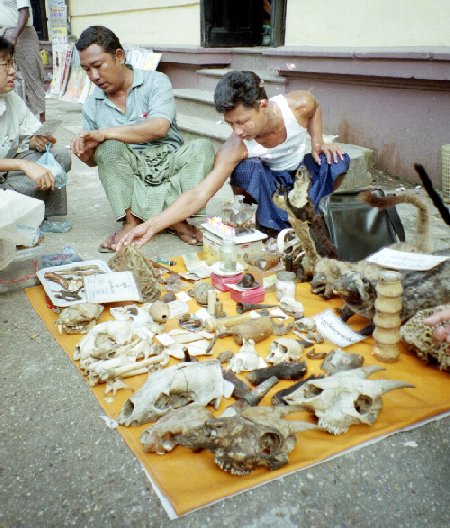
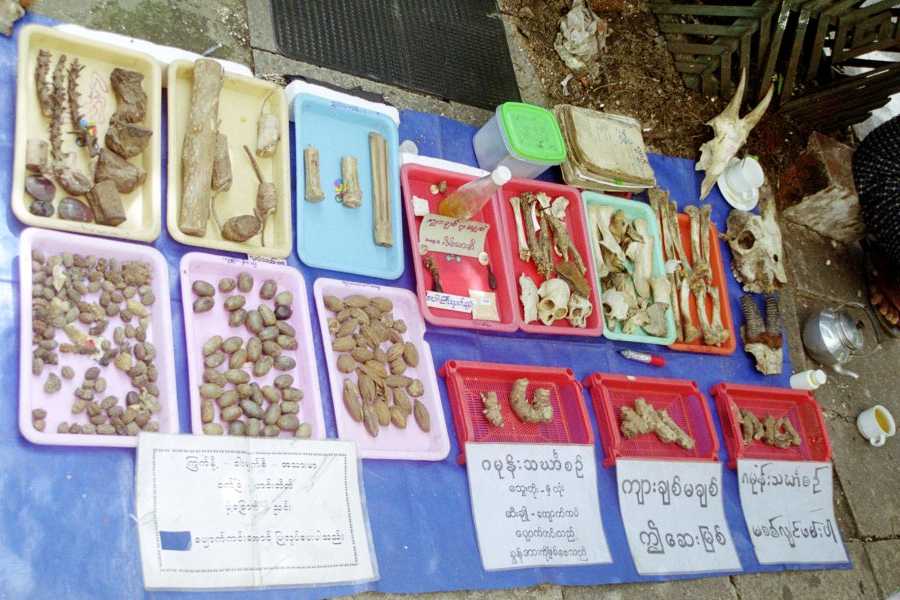
The Wares of a 'Medicine Man'
Medicine . . .

My girlfriend, Arumi, tells me one sees the wares of a 'Medicine Man' quite often throughout Asia.

Whether they sit by the roadside, or whether they own a shop in a building, one will see very similar items being sold around Asia.

The “pellets” you see here are in fact different types of roots such as ginger or some unknown vegetable, that have been sun or air dried.
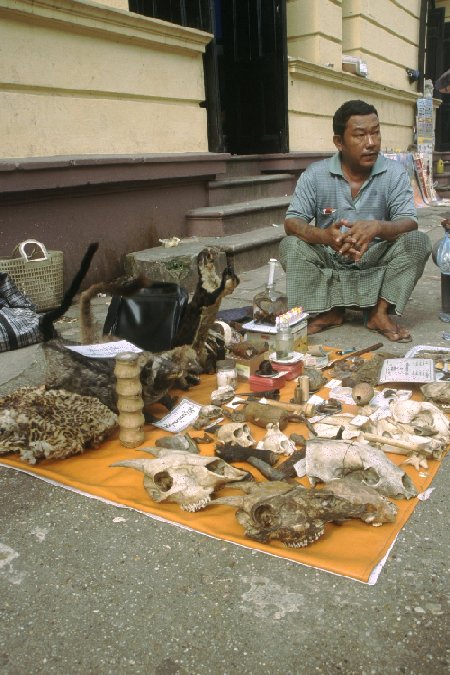
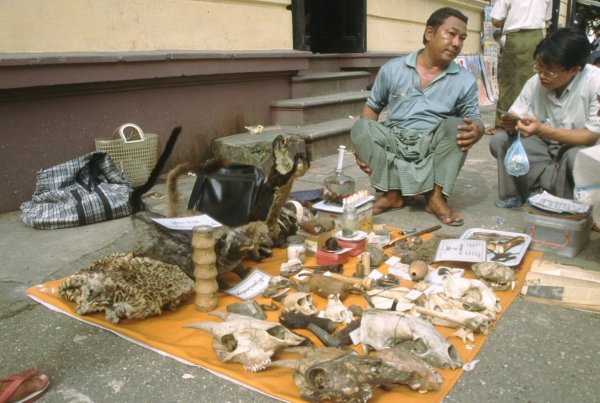
The Medicine Man 1The Medicine Man 1The Medicine Man 1

You will see the antlers of various animals such as deer or even rhino. There are also skulls from different animals - some of these animals may be endangered species, but somehow you will see them being sold in these markets.
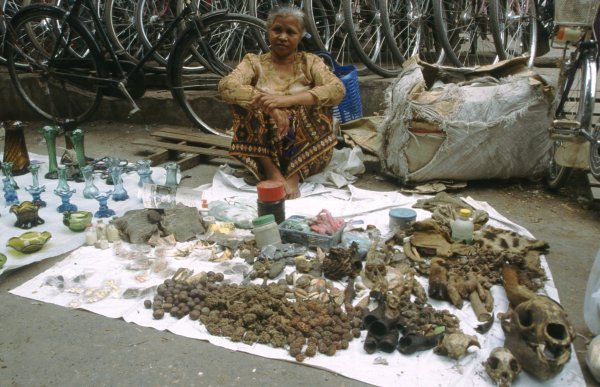
The Medicine Man 2


These skulls are definitely not being used as “trophies” around the house!

The Burmese, like many Asians, believe in using very 'natural' remedies to cure common ailments.
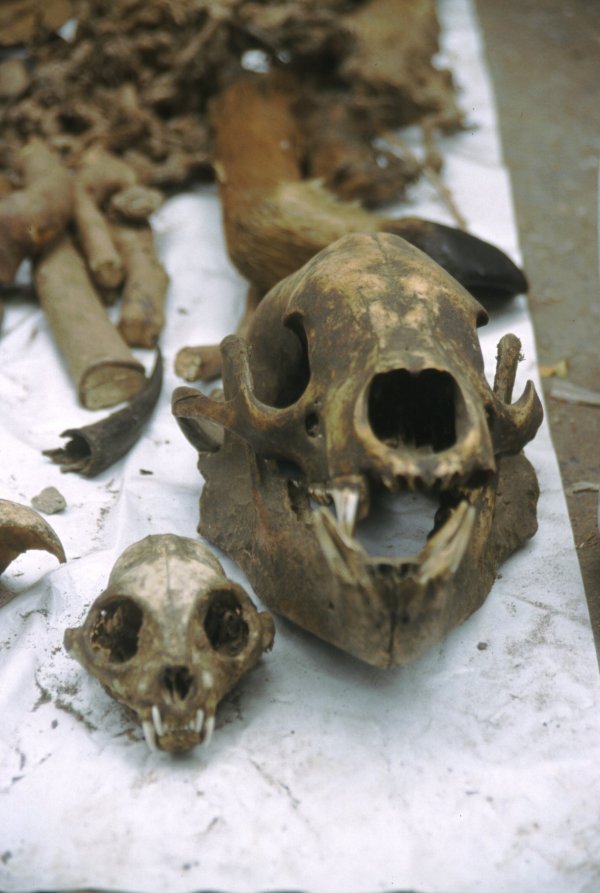
Tiger Skull


A Medicine Man may not necessarily be a “doctor” according to western standards - that means he may not have a university degree.

However, a Medicine Man, may be what we know as “witch-doctors”. Some of the remedies they know are very natural and useful.

Unfortunately, not all of these remedies work. Around Asia, you will see shops or Medicine Man selling items like tigers' paws and skulls, or ground ivory tusks. Many of these are sold as cures or enhancements for the sex life.

In Burma, there is virtually no wildlife left.
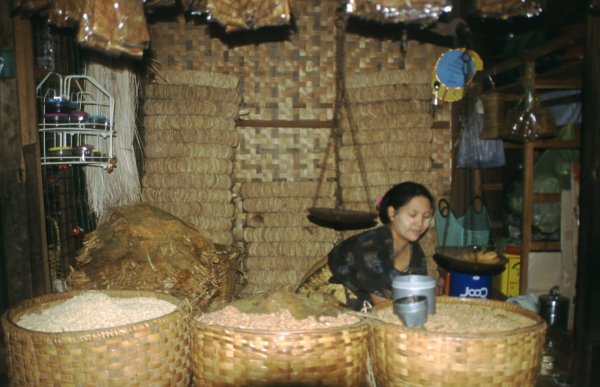

Selling Tobacco


You will even find that even tobacco is sold naturally.

Not in cigarette form, but in leaf form! The laws in Burma are not quite the same as they are here. Marijuana is also sold very freely.

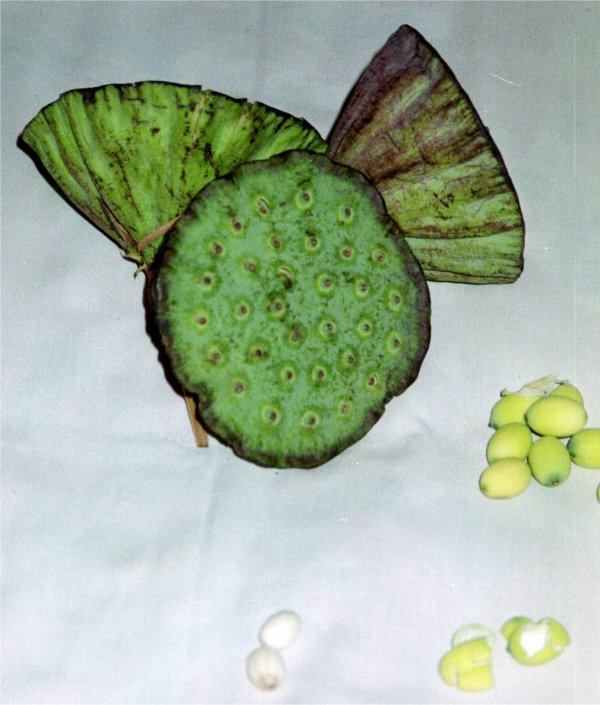

Fruit of the Lotus Plant
Lotus Fruit . . .


Quite often in Asia, you may see lily pads floating on the water. In fairy-tales, you hear about frogs sitting on a lily pad.

You will be amazed to associate that this fruit here, comes from the flowers/plant growing out of the water near the lily pads.

The yellow seeds come from the flower itself. The seeds are used often in many Asian desserts, and said to promote better blood circulation.

While, the root of the lotus plant is also a delicacy. It is white when cooked, and has a crunchy texture, similar to that of the water chestnut. Mainly used in savoury meals, although used as a dessert as well.

Personally, I think it is too much hassle retrieving the fruit! *smile*

Created: 31 Oct 2001

28. July 2001 10:46
by Rene Pallesen
0 Comments

Schwedagon . . .

28. July 2001 10:46 by Rene Pallesen | 0 Comments

schwedagon
Escalator leading up to Schwedagon


Schwedagon was a holy place with extremely large and beautiful temples.

To get to Schwedagon, you had to travel up very long escalators. I took this photo because these escalators were the only escalators I had seen during my whole trip in Burma. As Schwedagon is a very religious place for the locals, I guess to travel up these escalators give the sense of travelling to a higher and holier place.

Temples at Schwedagon Photo 1

The temples at Schwedagon were really impressive.

Temples at Schwedagon Photo 2
Another Temple


I was told that collectively, these temples were built with 39 tonnes of pure gold.

Cleaning Up


At the end of the day, the locals all contributed in cleaning the place. They clean all the tiles and are very organised.

Big StubaBig Stuba at Night

Buddhas at base of Big Stuba


Here is the 'Big Stuba'. All that gold...


Up close, the temples are a glorious sight. Especially at night!

Can you see those lights at the base of the Big Stuba? Each is a 'mini temple', illuminating a Buddha.


Lots of Gold


You can really see the magnificence of these temples!

Praying to BuddhaPraying to BuddhaIntricate Carvings


There are lots of rules or procedures about the way one prays to the Buddhas - very complicated to an outsider!

I saw a couple of the buddhists pour water onto the statue of the Buddha. Depending on the day of the week a buddhist is born, the individual would pour the respective number of bowls for the day of the week. A buddhist believes that by doing this, it would bring them luck.

At Schwedagon, I noticed there were hardly any tourists, mostly locals paying homage.

Can you see how intricate the carvings are in the foreground?

Praying Monk 1Praying Monk 2

Large Bell


The monks rung this bell to announce prayer times.


It brought luck to ring the bell.
For example, if you were born on the 1st day of the week, you rung it once to bring good luck. If you were born on the 6th day of the week, you rung it 6 times etc.


28. July 2001 10:45
by Rene Pallesen
0 Comments

Myanmar ( Burma ) 23 July ~ 5 Aug 2001 . . .

28. July 2001 10:45 by Rene Pallesen | 0 Comments

myanmar burma 23 july 5 aug 2001
Click here for full size Map of Burma


Burma/Myanmar surprised me in many ways. I would have liked to see more of Burma than I did, but due to military restrictions, I only had access to certain parts of Burma and was not able to see any of the indigenous people along the border as I had initially planned.Burma is a very poor country. It was difficult to travel... travelling 100 kilometres could sometimes take up to 6 hours.

One of the most beautiful places in Burma, I thought, was Bagan.

I took many photos in Burma, and tried to order them in the following pages:
  • I spent some days in Yangon, which had a heavy colonial influence.
  • Schwedagon was another place full of temples, a place laden with pure gold.
  • Whilst travelling, I could not help notice how influenced the people were by religion, and Burma's politics is one thing an outsider should not get involved in.
  • I was fascinated by what the Burmese used for medicine. They also had some rather interesting local fruit.
  • Mandalay also had an interesting colonial battle history. Whilst there, I watched the “Mandalay Marionettes”.
  • With the restrictions up north, I did not get to see much. But you would not believe how the Burmese play volleyball!
  • Finally, at Mt Popa, I went there to see a local monastry, and saw a lot of wild monkeys there.


Yangon ( Rangoon ) . . .

One of the main streets in Burma


This is the city-centre of Rangoon. Rangoon is the capital city of Burma.


It is actually a pretty big city if you compare it with other parts of Burma on a map.

Most of the buildings are from the old colonial period when the British occupied Burma. Unfortunately they have not been very well-maintained.

Can you see the green bits on the clocktower?

Clocktower with vegetation growing on it


If you are thinking it is vegetation growing on it, you are right! There is quite a bit growing on most of the buildings in the city.


Colonial Building 1Colonial Building 2The Strand HotelColonial Building 3

Man feeding pigeons


There were so many pigeons!


I managed to catch a pictures of a pigeon flying mid-air - can you see the blurred grey thing near the tree in the middle of the photo?


NextNext Page


Return to SE Asia menu

Return to Top


Created: 22 Sept 2001

15. June 2001 10:27
by Rene Pallesen
0 Comments

3rd Place in Photo Competition!

15. June 2001 10:27 by Rene Pallesen | 0 Comments

competition photo 2001


I took part in a photo competition in November 2001, using one of the photos I had taken during my trip to Mt Cook in January 2001. This photo was of Kevin, the alpine guide from my group in the technical climbing course.

The following photo and comments appeared on the Planet Fear website, in the Front Line Photography Competition - not long after I was notified that I was one of 20 winners, and I was even more surprised to find out that I had come third!

The comments above the photo were my comments that I had emailed to them when I sent the photo. The comments below the photo were (one of the judges) comments about my photo.
3. Rene Pallesen

The attached photo was taken in New Zealand on the main range near Mount Cook. The valleys to the west are filled with clouds formed by the moisture from the forests underneath. The snowcovered mountains in the north are visible through the clouds. The photo was taking using a Nikon FM10 using a Fuji Sensia 100 film.

Kevin in the Clouds

Literally bathed in atmosphere. It would be easy to muff this high key exposure but Rene is spot on. The vertical format adds to a shot capturing all the euphoria of life on the tops. Reminds me of the legendary Mountain mag front covers.
~ Comment by Ian Parnell, Planet Fear
Feel free to see my photo on their website.

Also, you could go to the Planet Fear website to view the other winning photos.

15. January 2001 11:14
by Rene Pallesen
0 Comments

Mt Cook

15. January 2001 11:14 by Rene Pallesen | 0 Comments

mt cook


Mt Cook

Mt Cook
Our ice-climbing group

Alan


Created: 18 Aug 2001 Last Updated: 16 Sept 2001

15. January 2001 10:59
by Rene Pallesen
0 Comments

Mt Cook ( 15 ~ 28 January 2001 )

15. January 2001 10:59 by Rene Pallesen | 0 Comments

mt cook 15 28 january 2001
Above the clouds at Mt Cook - photo competition winner!Mt Cook ( 15 ~ 28 January 2001 )


I decided to do a Technical Ice-Climbing course with Alpine Guides in New Zealand.

I spent 10 days at Mt Cook doing a very challenging course, but I learnt a lot. I learnt all the techniques required to do ice-climbing safely. I also learnt the necessities of surviving in the icy mountains.

Prior to the trip, a lot of preparation was required. Everyday, I went jogging to build up my fitness, so by the time I left for New Zealand, I could run 3km on the sand without getting puffed. I also had to buy some of the equipment. I had to buy cramp-ons (looks like spiked metal soles) to attach to my boots; ice-axe and ice-hammer; a new Gore-tex jacket (I needed a new one anyway) and some other clothing and equipment.

The photo on the right became a 3rd-place winner in a photo competition.

Mt Cook

Our group consisted of 4 other doing the course. There were no prerequisites, other than a love for the mountains and a very high fitness level. Not all of us who do this course go on to climb the great mountains. We also discovered it takes guts and courage to stand on top of the world and feel confident. One cannot be an ice-climber if there is a fear of heights or if unsteady on the feet.

Our ice-climbing group


All of us in the group had come from different backgrounds. Søren was an experienced climber, who had aspirations of going to the Himalayas. Alan was a rock-climber who wanted to try the challenge of ice-climbing. Rob too loved the mountains and wanted the experience and challenge of being on the icey slopes of New Zealand. I had had quite a lot of climbing and mountaineering experience, but this was my first time ice-climbing.
< Perfect Moments Photography | A Rene Pallesen Journal

Home

13. March 2005 09:04
by Rene Pallesen
0 Comments

Photos from Sydney

13. March 2005 09:04 by Rene Pallesen | 0 Comments

photos from sydney


During the year I took a number of photos in Sydney. If you would like to know what the inner city of Sydney looks like then have a look at this photo collection.

Click here to see more photos

Click here to see more photos from: Sydney/Slideshow

13. March 2005 08:57
by Rene Pallesen
0 Comments

Climbing 2005

13. March 2005 08:57 by Rene Pallesen | 0 Comments

climbing 2005


In 2005 I managed to do a fair bit of climbing. Sarah and her boyfriend at that time were climbing almost every weekend and climbing with them definitely boosted my confidence and allowed me to increase the difficulty of the climbs I was able to tackle.

The photo below is a photo of me climbing at Centenial Glen.

Click here to see more photosClick here to see more photos from: Climbing 2005/Slideshow

13. March 2005 07:42
by Rene Pallesen
0 Comments

Canada 2005

13. March 2005 07:42 by Rene Pallesen | 0 Comments

canada 2005


I went a trip to Calgary (as well as to Seattle) in the end of 2005. It was lots of meetings and in Calgary we were invited to provide input to our workflow product from the field.

While we were there they had the Chinook, which is a warm wind that appear during the winters...so during the day it was really pleasant.

One night we went to see a game of ice hockey against the Calgary Flames and Chicago...it was the only game that Calgary lost that season.

Click here to see more photos from Calgary
Click here to see more photos from: Calgary 2005/Slideshow

13. March 2005 07:33
by Rene Pallesen
0 Comments

Mum and Dad in Sydney 2005

13. March 2005 07:33 by Rene Pallesen | 0 Comments

mum and dad in sydney


At the end of 2005 my Mum and Dad escaped the winter in Denmark by travelling to Sydney for a couple of weeks.

They stayed here over Christmas and New Years Eve. While they were here we went for a drive up to Graemes house at Taylors Lake near Port Macquarie where we Christmas Eve cooking traditional danish Roast Duck, and Ris-a-la-mande.

New years even we celebrated at Graemes place at McMahons Point here in Sydney.

New Years day was the hottest on record...48 degrees.

Click here to see more photos from Christmas and NYE 2005 Click here to see more photos from: Christmas and New Years Eve 2005/Slideshow

14. November 2004 12:58
by Rene Pallesen
0 Comments

Grandchildren's Meal for Bedstemor

14. November 2004 12:58 by Rene Pallesen | 0 Comments

grandchildren s meal for bedstemor
Normally Bedstemor's fest is for paid by her children, but this year, all of Bestemor's grandchildren decided to also treat the family in return. They chose the Italian restaurant in the hotel.


It was a 3-course set menu at US$8 per person.
For starters, it was thin minestrone with salad vegetables and grated cheese.
For entrée, it was 3 pieces of ravioli with mushrooms and white sauce (ravioli suprisingly had cinnamon in it...)
For mains, we had a choice of either chicken or veal scallope with fettucine...
But all our meals were served with the same sauce and somehow we all ended up getting french fries...

When we asked the waiters about the fettucine listed on the menu, no-one had any idea...

And our surprise dessert was a scoop of ice-cream swimming in fruit salad and syrup.
These breadsticks were really very nice, although surprisingly these contained cumin, instead of Italian herbs or cheese.
With Bedstemor in the middle, the oldies at one end, we sat at the other end with Kim, Rasmus and their respective girlfriends. Rasmus and his g-friend told us about their trip around Asia, toVienChan and Laos. Kim and Birit had spent 6 months backpacking around India, Nepal and Thailand.
In the meanwhile, there was an Egyptian engagement party that started in the hotel lobby. The musicians stood around the couple, playing oboe-like instruments, tambourines and drums, whilst the guests clapped and danced to the music. It was deafening, the sound echoing throughout the hotel. They eventually made their way up to one of the function rooms to party all night long.
=

14. November 2004 12:54
by Rene Pallesen
0 Comments

The Citadel & Mohammed Ali Mosque

14. November 2004 12:54 by Rene Pallesen | 0 Comments

the citadel mohammed ali mosque


Our first sightseeing trip after arriving in Egypt was the Citadel and the Mohammed Ali Mosque. The Citadel was once the home of the royal family until 1870, then the military took over this joint until the 1970s. It is still used occasionally by the military but mostly opened to visitors although certain sections are closed off to them.

Neither did our guide tell us much about the Citadel, nor give us the opportunity to explore. So most of the photos here are of the Mohammed Ali Mosque sitting on the Citadel.


The mosque is famous for its alabaster corridors, columns and floors. Alabaster is a cheaper form of marble that seems to be slightly more porous and does not have the smoothness or coolness of normal marble.


Adam, our guide sat everyone down in one corner of the mosque like school kids, and gave everyone some sort of history lesson about Islam and marriage.


The interior of the mosque was magnificent, with globes of light hanging in multiple rings from the ceiling. In the far right corner, there is a gilded green and gold staircase that leads to some sort of pulpit.
Local women were allowed into this mosque, but clad from head to foot. Female tourists were provided with a green abaayas if they were sleeveless or wearing shorts.


During Adam's chat about Islam and its history, René asked for more information about the Citadel, and was rudely scolded for not listening.
Adam did not give any more information about the Citadel for the rest of the trip...


Left: In another corner of the mosque was an enclosure containing the marble sarcophagi and burial place of the mosque's namesake - Mohammed Ali.
Right: The ceiling was also quite beautiful, but I could not use the camera flash and it was a little dark. In each "corner" of the dome were large arabic inscriptions in gold


Cairo has a brown haze over the city. The buildings are made of mud bricks.
Dirty-white and grey are the only other colours one can see.


Apparently there is a number 7 written above one of the doors of the Citadel. History says Napoleon and his troops numbered each of the entrances around the Citadel as he could not understand the local language.

14. November 2004 12:53
by Rene Pallesen
0 Comments

Khefren's Pyramid - Limestone Tips

14. November 2004 12:53 by Rene Pallesen | 0 Comments

khefren s pyramid limestone tips


Khefren, Khafre's son, did not seem to have the same desire to outbuild his father.

His pyramid is not as tall as Khafre's pyramid, but looks so because it stands on higher ground.
Each of these blocks of granite came to about shoulder height on the average man
- they were about one cubic metre each in size.
The few people who tried to climb up the pyramid were called down by security guards patrolling the area. We noticed the granite blocks further up the pyramid seemed smaller. The quality of the workmanship worsened as the pyramids neared completion and smaller blocks were used.
Just imagine - these pyramids would have once glinted in the sunlight like diamonds in the desert. Kefren's pyramid was once covered with a smooth and shiny layer of limestone. Unfortunately, most of the limestone has been stripped off, used in mosques and palaces. Only a small portion remains at the tip of Khefren's pyramid.

14. November 2004 12:45
by Rene Pallesen
0 Comments

More Photos of Cairo

14. November 2004 12:45 by Rene Pallesen | 0 Comments

more photos of cairo


We did not have a lot of opportunities to explore the city of Cairo. Our hotel was located on the other side of the Nile from downtown Cairo, so there was not a lot happening.


In Cairo, we noticed a lot of large carcasses hanging along the streets outside the butcher shops. Most of the shops and restaurants were closed due to Ramadan, but Sunday heralded the last day of Ramadan, so many were preparing for the final feast.


We tried in vain to find a restaurant for the family to eat dinner, but no such luck. However, we did try to stop for some beers at a small café along the Nile - no beers because it was still Ramadan till that night, so we settled for some softdrink and hot potato chips.


The city of Cairo looks hazy and grey, with all the buildings a muddy colour.
It was nice to sit by the Nile.


The view from our Hotel Pyramisa at sundown.