Home

14. November 1999 10:59
by Rene Pallesen
0 Comments

Morocco ( 1999 ) . . .

14. November 1999 10:59 by Rene Pallesen | 0 Comments

morocco 1999


Our main reason for the trip to Morocco, was to come together as a family and attend my grandmother's 80th birthday. We also managed to explore Morocco, and even had a fun day riding donkeys - yes, the whole family - my grandparents, parents and brother!

We met different people and there were some really beautiful women in this country. There were some interesting buildings and we even found some strange goats!

The Women of Morocco . . .


One beautiful girlAnother beautiful girl

Girl being offered


People in the city tend to be more extremist/fundamentalist when it comes to religion, then those who come from the country areas.

One reason could be that the people living in the cities are mainly Arabic, and those living in the countryside are Berbers.

Berber women are less dressed up than in the cities.

Some of them are extremely beautiful.

Also, I noticed that those in the city tend to be more self-conscious of photos being taken than those in the country.People are naturally a bit shy, but by showing friendliness, it a makes it a lot easier to take good photos.

Hmmm... Do you know that I was actually offered to buy this girl on the right for two camels? I do not know why they wanted to get rid of her. Maybe she was making too much trouble in the village?

Anyway…I refused the offer.

Henna hands


The girls decorate themselves with what is called henna. It is a dye that stains there hands for a long time. They paint different patterns onto their hands and it actually looks very pretty. Much nicer than tattoos - which are permanent!


Return to Top


Goats . . .

A goat in a treeA goat in a tree (black & white)More goats in a tree!

We came across a couple of trees full of goats. They were climbing around the tree to reach all the green leaves. Our first though was that someone put them there, but they were too much out of reach for that idea.

14. November 1999 10:34
by Rene Pallesen
0 Comments

My Grandmother's Birthday ( Morrocco 1999 )

14. November 1999 10:34 by Rene Pallesen | 0 Comments

my grandmother s birthday morrocco 1999


Mon Grandmere

My whole family was in Morocco to celebrate my grandmother's 80th birthday.

This is my grandmother. Even as an 80-year-old woman, I find her pretty cool (you should see some of the pictures I’ve got of her with dark Blues Brothers sunglasses).

(No need to say that the flags are Danish.)

It was a family reunion. We do not all live in the same place, but all of us make this journey as it is one of the few times that we all get together. Unfortunately, there were a few of us who could not make it.

It was important for me to be there it was hard to tell whether the whole family will ever come together again as a large group, as my grandparents are no longer living there.


My brother


My brother, Claus!

Another person I find pretty cool is my brother.

He has not been well in the last few years, but I love him anyway
( Definitely can't do without my big brother )
My


Mum's pretty cool too! She will probably hate me for putting this photo on my homepage. But it is a really nice photo of Mum with a big smile.

She hates the idea of me climbing mountains, but at the same time she bought me a climbing helmet as a Christmas present. She thought it will keep me safer when I am so far off the ground.

Thanks Mum for supporting me.

I also find my dad pretty cool. He’s a bit of a nerd just like me which means that we probably understand each other better than anyone else in the family.

My Dad's brother & his wife


This is my dads brother and his wife. The resemblance is unequalled. My dad and his brother looks very much like each other. They have the same bad habits (just like my grandfather) and both their wives are smoking like chimneys.
Me stuffing myself!


Finally, a picture of me...

I do belong to the family even though most of them have probably forgotten about it by now!

I am sitting outside one of the food places on the local market. We each got a serve of excellent calamari, shrimp and fish. I think this was the best meal I had while I was in Morocco.

Most tourists would avoid a place like this just because of the hygiene, but I have never had diarrhoea because I had been eating local food.

Perhaps all this travelling I do has made me immune to germs and bugs! Or maybe I just pick good food!


Do you want to see my family on a Donkey Day out?
Click Here!


Created: Jan 2000 Last Updated: 16 Sept 2001

15. March 1999 11:00
by Rene Pallesen
0 Comments

Laos

15. March 1999 11:00 by Rene Pallesen | 0 Comments

laos 1999


Laos is not a place one can forget.

One day I would like to go back there again in my travels.

It is a beautiful place with friendly people who welcomed me with open hearts.

It is also a place of sorrow because of war and loss.
Yet the people try to go on with their lives despite the war.
They live in hope and their beliefs keep them going.

There are tribes there who seem unaffected by western influence and change and keep to their tradition after all this time.

I met many children there, some happy, some sad.

I also spent time with a special family and also managed to enjoy the local food.



War . . .


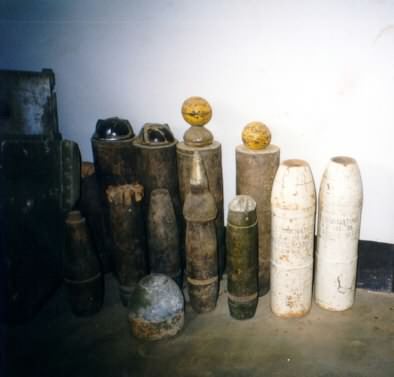
Various types of bombsMore bombs

All the eastern parts of Laos was heavily bombed during the Vietnam War. More bombs were dropped in this area than the number of bombs dropped during the entire Second World War (approximately 10,000 bombs for every citizen of Laos). Laos has the sad reputation of being the most heavily bombed country in the world ...

Ever.

The Ho Chi Min trail went through Laos, and the Americans tried to destroy it with every means. They tried everything from carpet bombing, dropping cases of Budweiser Beer (hoping that the Vietnamese soldiers would get drunk) to dropping washing detergent during the wet season (hoping the trail would get slippery). It is estimated that the Americans only succeeded in stopping 10 percent of the traffic on the trail.


In Vietnam, the Americans were not allowed to bomb within 500 meters from temples and hospitals. Their rules of engagement furthermore said that they were not allowed to return to their home base with a bomb load. The result was that they flew across the border to Laos and dropped all their bombs there. In Laos, there were no rules of engagement. They could bomb whereever they wanted to bomb.
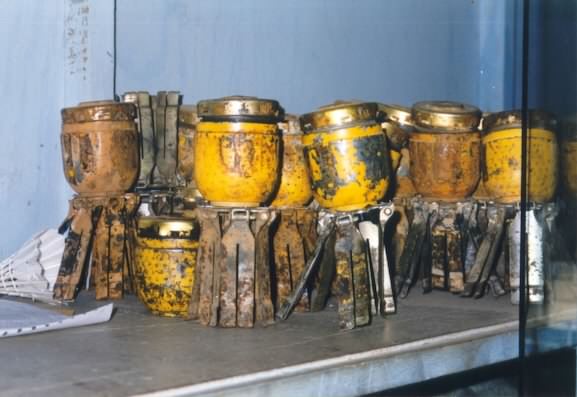
Cluster bombs


This also means that there is quite a large amount of UXO (Unexploded ordnance) in the country. Land mines and unexploded cluster bombs (shown on left) are some of the biggest problems.

In Laos, there are still approximately 4 accidents per day resulting from UXO.

Bombs outside a house


Sad as this may seem, people have been pretty creative about using some of the leftover bombs. In this case they have used a couple of 2000-pound bombs as decoration outside the house.
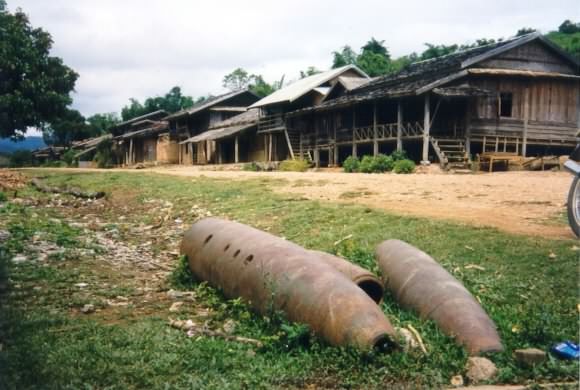
Bombs everywhere


No matter where you go you are reminded of the war.

In all the local villages there are unexploded bombs and shells from the cluster bombs.

Bombs used as scrap metal


A lot of the remains from the war are sold as scrap metal. In this pile there are shells from cluster bombs, wheels from tanks etc. >>>

Bridge made from bombs


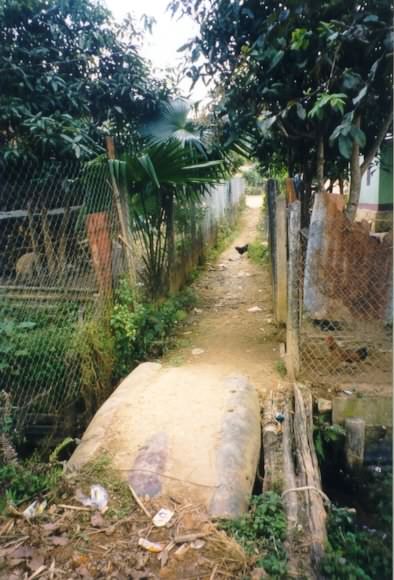
<<< Shells from the cluster bombs have been used to make this bridge.


Fences made from bombs


Here as fence posts outside a house. >>>
School with bombs


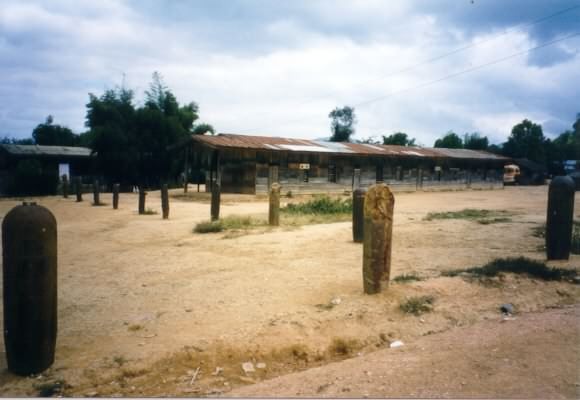
Outside a school, the schoolyard was surrounded by the shells from the American cluster bombs.


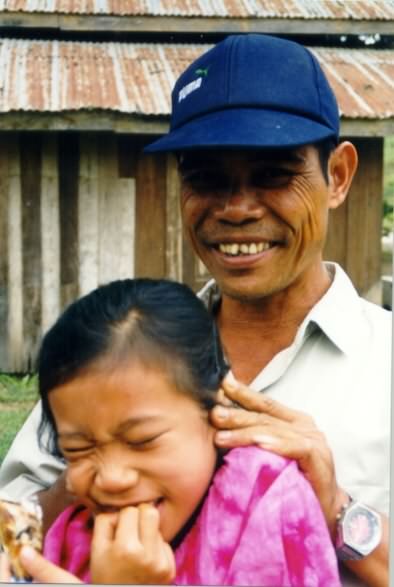
Grandfather  his orphan granddaughterSorrow . . .


This girl's parents were both killed by Hmong guerillas in 1997.

There are still areas where there are lots of problems with guerilla warfare. This is especially the case on Route 7, along the eastern border towards Vietnam and in the western part of Laos west of Vientiane, in the area between the Mekong River and Thailand.

The government is trying to control these problems, but it is difficult with such wast areas of jungle.

Unfortunately such incidents have affected a lot of people. This girl is not the only person in Laos who has lost her family.

Remember that the area has virtually been a permanent warzone since the Vietnam war, until the mid 90’s.

The person behind the girl is her grandfather.
He is now looking after her to make sure that she gets an education

He is after all, her only family left.


Beautiful SunsetHope . . .


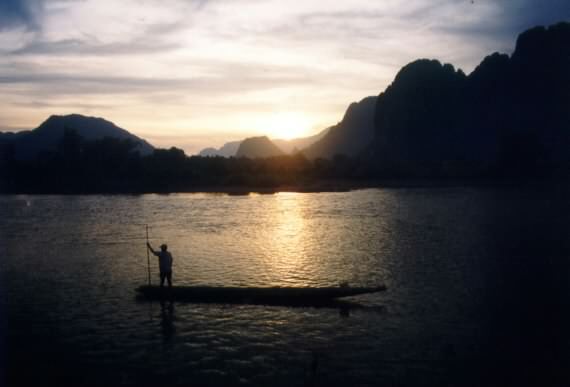
Looking at this beautiful photo, it seems really serene and calm.

You couldn't really tell that things are pretty bad in some parts of the country.

The northern part of Laos is especially poor. The mountainous terrain limits what can be grown. Outdated farming methods using “slash-and-burn” of whole mountainsides are not very appropriate for feeding a growing population. A lot of the western countries are represented in Laos with health care workers. What Laos really needs at the moment is help using more environmentally-friendly farming methods, which at the same time improve the growing of crops. The slash-and-burn method basically means they burn a whole mountainside to grow rice. There is nothing left to hold back the nutrients in the soil, and fertiliser is not added. After a few years there are no more nutrients on this mountainside and they move on to the next mountainside. They need to learn how to grow crops in terraces and add fertiliser from their animals to the soil.

Vinchu - a Red Cross worker

One of the problems with growing rice is that the men are unempleyed most of the year while they are waiting for the rice to grow.

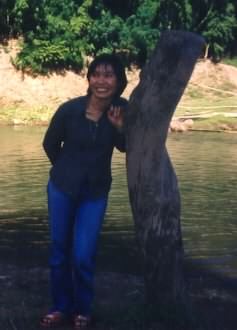
Vinchu is working for the Swiss Red Cross. She intends to buy a piece of land in the 32-kilometre village of Muang Xai, and convert it into a fish farm. This would keep some of the men occupied for most of the year. The profit from the fish farm could be used to take care of the village’s basic needs such as education of the children and buying medicine.

Vinchu is one of the few catholics in the country. She is fluent in English and has had a primary healthcare education. This has enabled her to get a job for one of the foreign representatives in the country, which means she is getting a salary that is considerably higher than what her peers get. Also she gets paid in US dollars instead of kip, the local currency.

On average, the government employed in Laos receives 100.000 kip a month (approx US$30). This is not enough to survive on, so most people have either two jobs or let the wife work as well. Lots of people have small vegetable gardens. This allows them to grow a few things to sell at the markets.
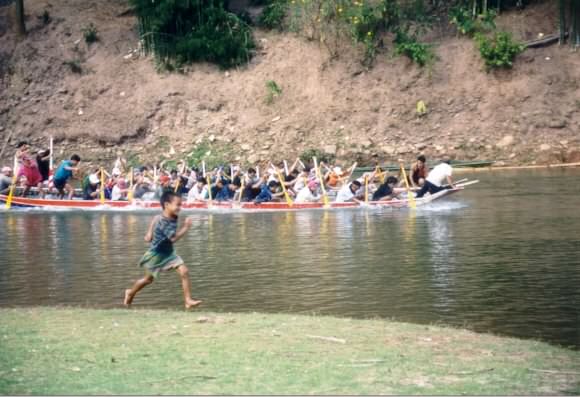

Dragon Boat Race


The employees from the hospital in Muang Xai have not received any money from the government for more than 6 months. The government declared that they should participate in the annual dragon boat race.

Vinchu paid for transportation of the employees to the local river, and other expenses, from her own paycheque.

Most of the people in the boat are doctors and people from the hospital.
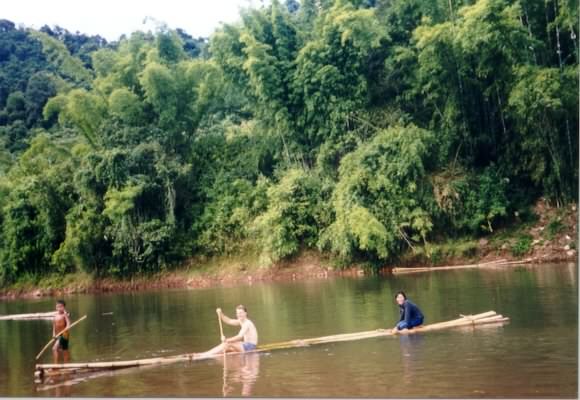


Me in a sailing raft


Vinchu and I in a sailing raft!


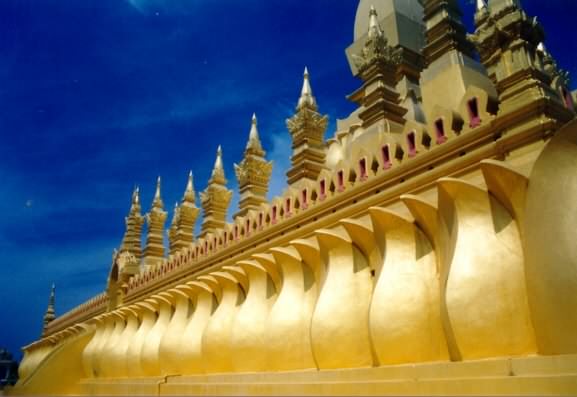
Great Stupa at Vientiene
Religion . . .


Buddhism is a big part of Laos.

The holiest place in Laos is the stupa in Vientiane. There are practically no temples in the eastern part of Laos due to heavy bombardment during the Vietnam War. The only great temples around is the one in Vientiane and Luang Prabang.
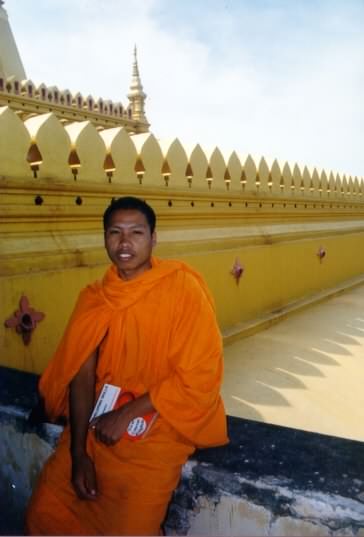

Monk at Great Stupa


The Buddhists in Laos are a bit less extremist than in Thailand. People do not have small alters in their homes, and it is not compulsory for the males to become monks.

In Laos, becoming a monk is voluntary. It is mainly people from the poorer parts of the country that become monks, because it is a good and cheap way to get an education. Some of them are studying English and are therefore very eager to practice their English on the tourists.
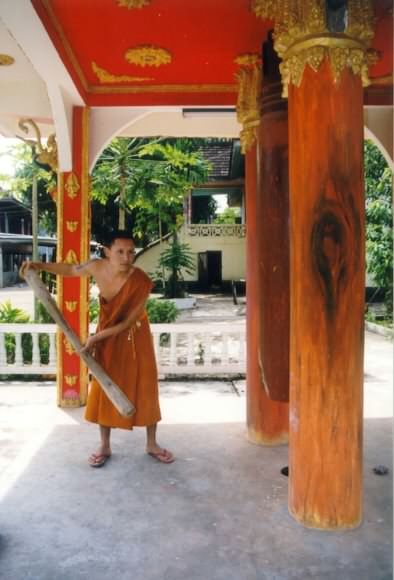
Monk calling for prayer


When they call the monks in for prayer, they either beat a big drum or the use a wooden ram to chime the bell.


Tribes . . .

3 Hmong girls in traditional garb

There are three main tribes in Laos. One of these tribes is called Lao Tsung (or HMong).

They live mainly in the northern part of the country.
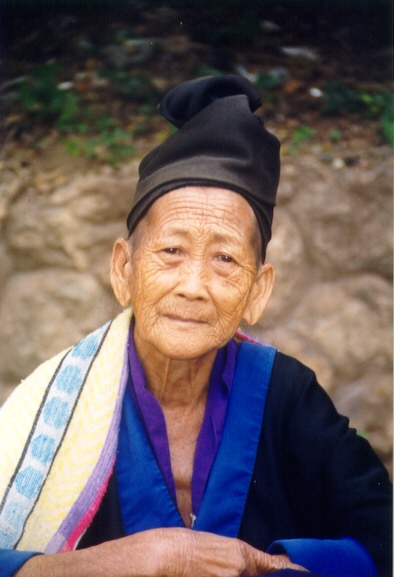
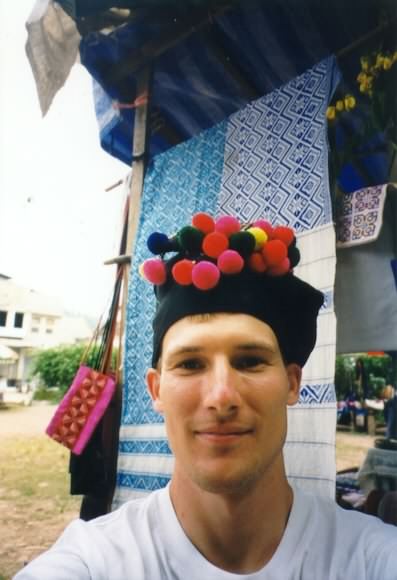
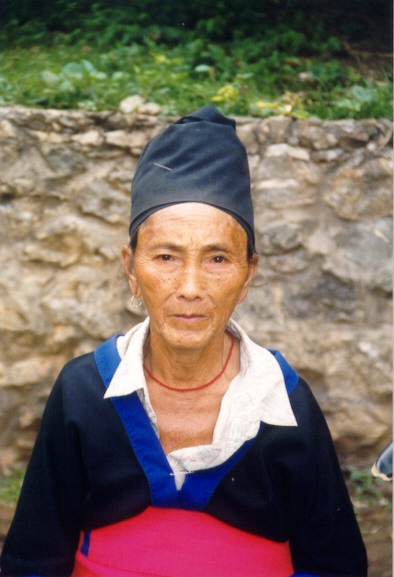
Old Hmong WomanMe wearing a Hmong hatOld Hmong Woman 2

The women still wear traditional clothing. I am wearing a traditional Hmong hat.

A Hmong Woman and I

The Hmong have a dialect that is different from the other tribes. They keep to themselves and are very isolated from the rest of the society.
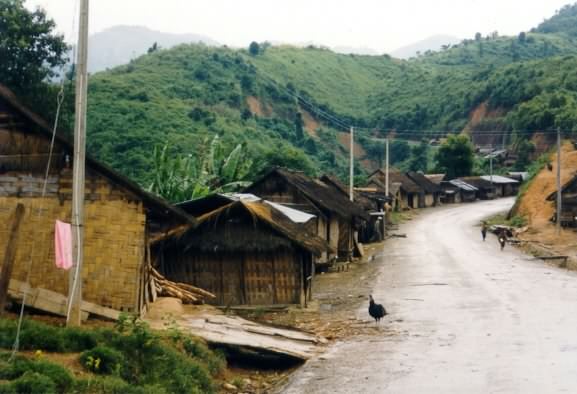
Hmong Village

The difference between the Hmong village and the other villages is that the Hmong build their houses on the ground instead of on stilts.

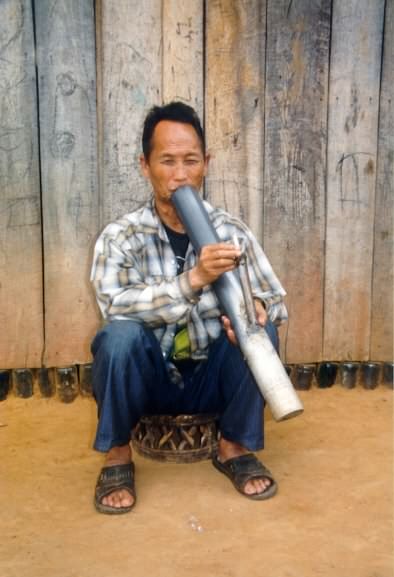
An Opium PortraitMan smoking opium

The Hmong is responsible for most of the opium growing and trading in Laos. The government is trying to stop this trade, but it is difficult as the Hmong live in areas that are not easily accessible.

The Hmong are also responsible for most of the problems in the area around Route 7.


The Children of Laos . . .

The kids in Laos are wonderful. There are always kids around you no matter where you go and they are always very joyful and curious to find out who you are.
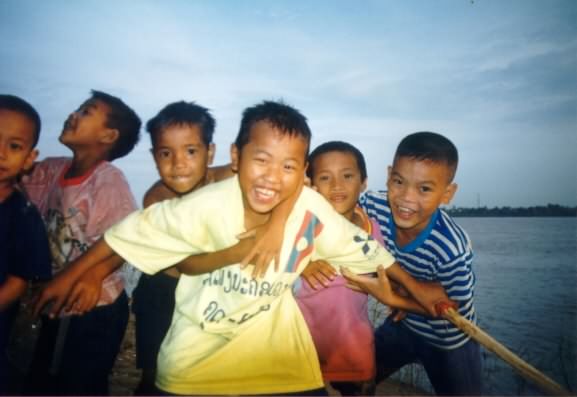
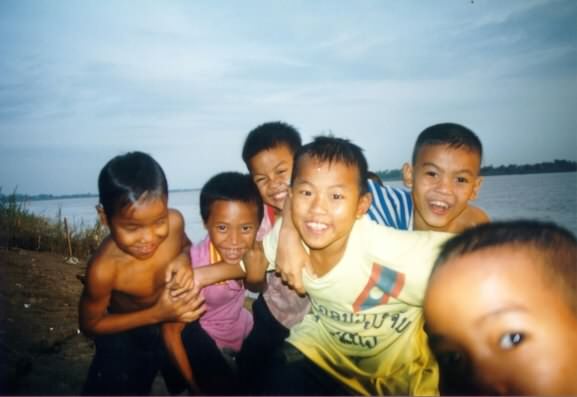
Kids playing by a riverKids playing by a river

You see a lot more kids playing with each other in Laos than in the western world. I guess it also somehow encourages them to grow up being socially responsible. This could be the simple reason why people are so friendly and welcoming in this country.

Lots of people say that it is because of the religion but I believe that it is something more fundamental than that. People in the western world have just forgotten how to be responsible towards each other. Why? Maybe they do not spend enough time in one another's company.
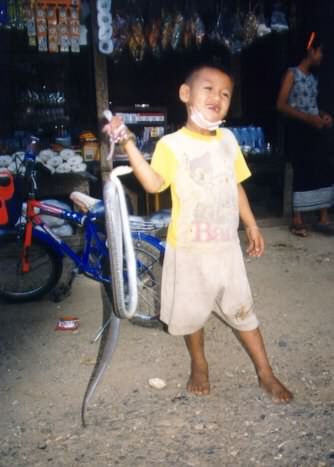
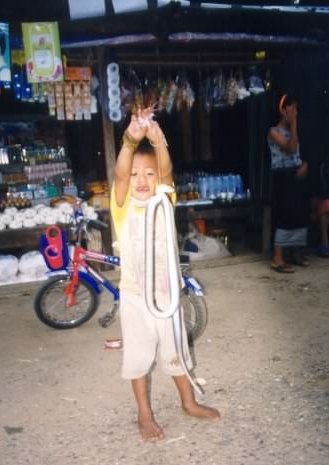
Kid playing snakeKid playing snake

In Vang Vieng, I saw a kid playing around with a snake. It did not seem to bother him or his parents that it might be poisonous.
I don't know if the pad on his chin was caused by the snake. I doubt it though since he had been very sick.

He was pretty proud of his snake.
I am not sure what kind of snake it was. I did see a few other snakes around, especially at the temples.
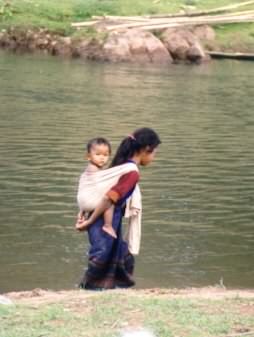
Girl carrying child


It tends to be the elder children’s task to look after their younger brothers and sisters while the parents are busy. The system seems to work fairly well since the whole group of children play together, no matter what their age group. It is therefore not such a big burden as some might think.

The photo was taken approx 40 kilometres north of Muang Xai (where Vinchu was).
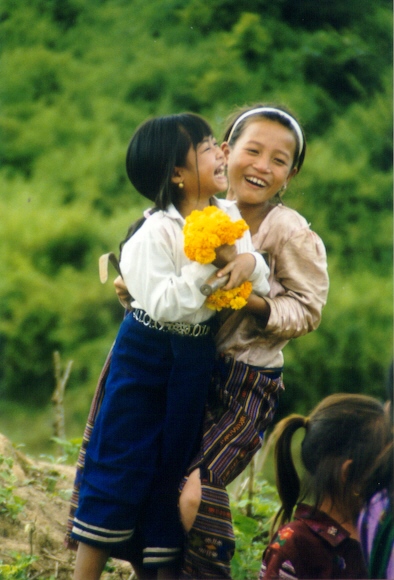
Beautiful flower girls


This photo on the right is one of my favourites.

It was taken in the northern part of Laos, at the 32-kilometer village outside Muang Xai.

The girls were collecting flowers outside one of the local schools.
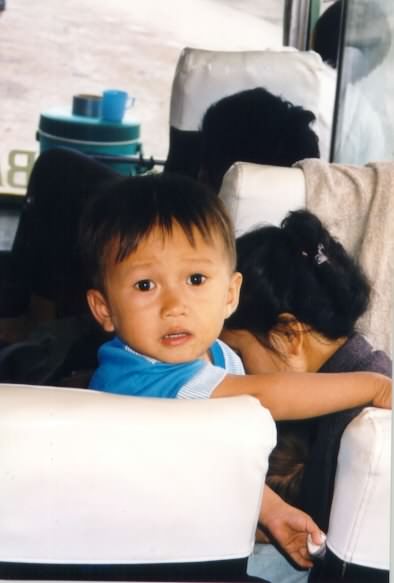
Beautiful flower girls


The younger kids tend to be afraid of Europeans. Most of them have never seen a white face before.

This little fellow here was a bit worried about my presence...
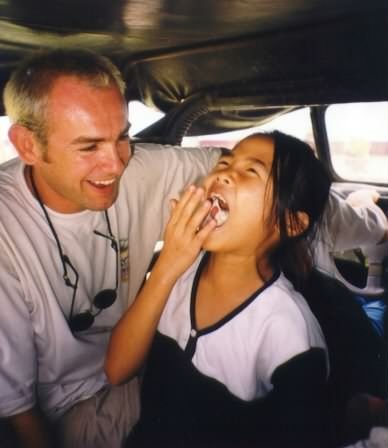
Girl eating chewing gum


This is the girl’s first piece of chewing gum... Pretty interesting to watch! *smile*


In the cities kids love to have their picture taken.
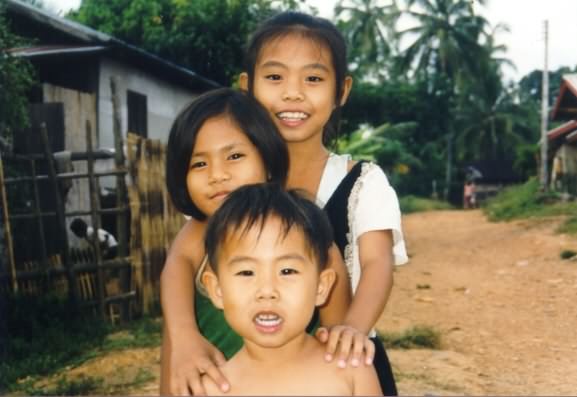
3 kids


Tanoy's mother and friend


The Tanoy Family . . .

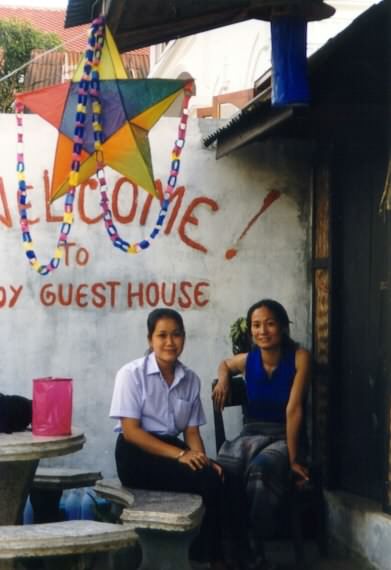
I stayed a few days with a family running the Tanoy Guest house.

The eldest daughter of the place was called Tanoy.

The girl on the left of this photo is one of Tanoy’s friends from school.
The woman on the right is Tanoy's mum. Tanoy’s mum is 40 years old and has had 6 kids. She does not look that old and still looks absolutely stunning.


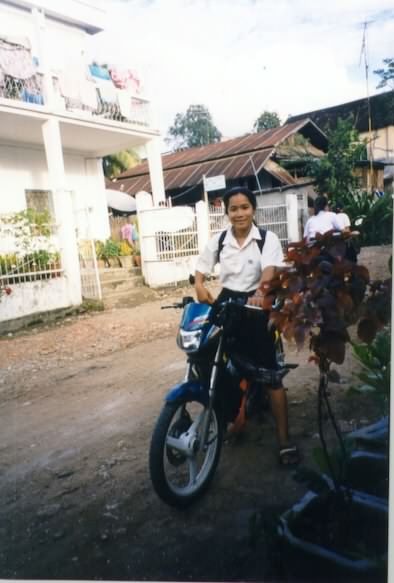
Below are a series of shots of Tanoy herself.

I guess she will one day take over the guest house.


Tanoy herselfTanoyTanoy on scooter

Whilst I was staying at the Tanoy Guest House, I saw the preparations for the annual Water Festival.

Every year when the monsoon ends and Water Festival coincides with the full moon, The festival included Dragon Boat racing.
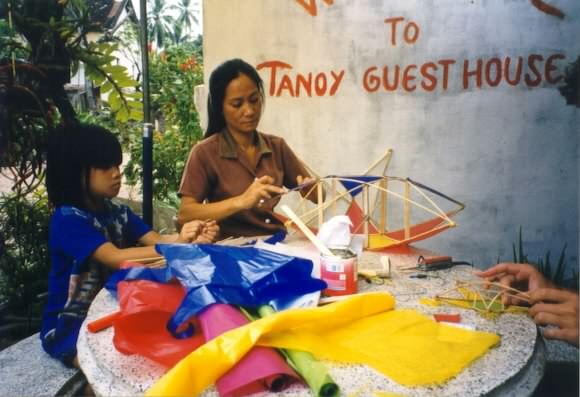
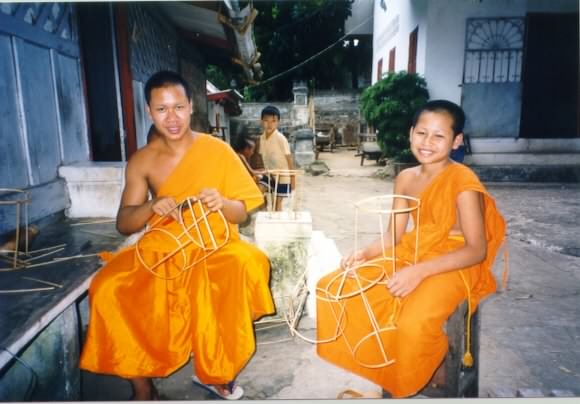
Tanoy's mother making lanterns for the Water FestivalMonks making lanterns for the Water Festival

Everyone was taking part by making lanterns for this festival, including the monks!

All the monks were making lanterns to decorate the temples.

Man drinking already!Party starts!Girl on my shoulders

The festival lasts for three days.

During the festival, they celebrate with all their friends and families. They also drink a lot of “Lao Lao” (or Laos Whisky), which is a kind of rice wine.

Everyone walks down to the river during the day to watch the boat races.

Later in the evening, everyone parties some more and drinks more beer. It does not matter that it is pouring down. The whole village is at the party and everyone is happy.
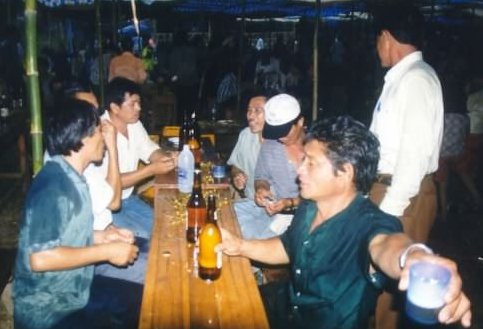
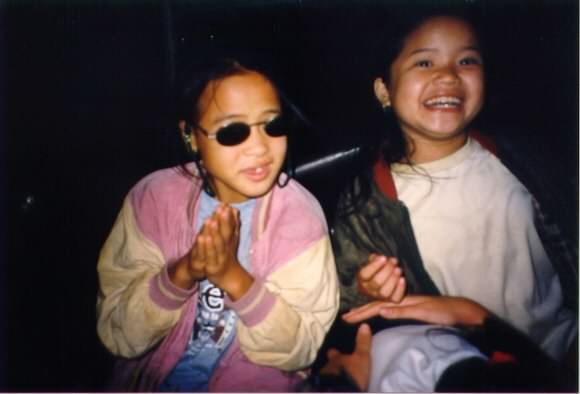
Drinks galore!The kids are also having a good time!

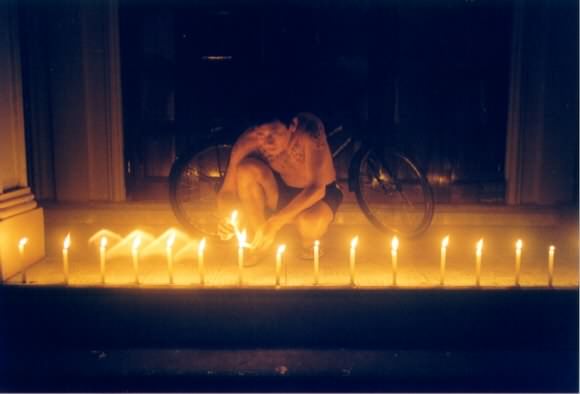
On the night of the festival, people light candles. They also float the candles in the rivers. House lit with candlesMan lighting candles

Unfortunately it was raining a lot that night, so people had difficulties keeping the candles lit.
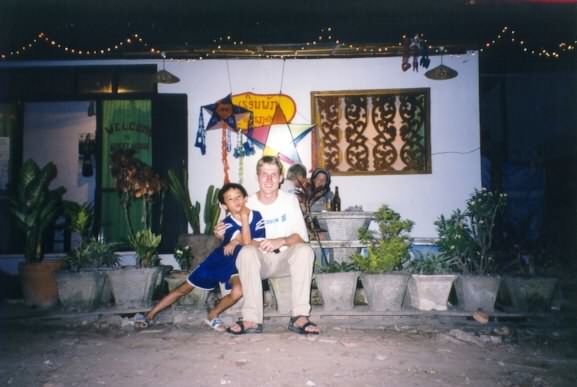
Outside the Tanoy House

At the end of the day, I managed to get a photo of me sitting outside the Tanoy Guest House!


Food . . .
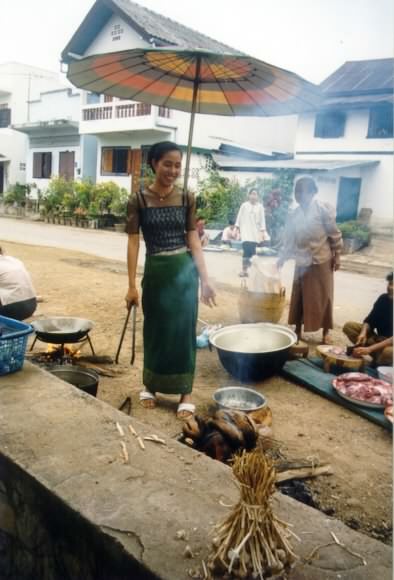
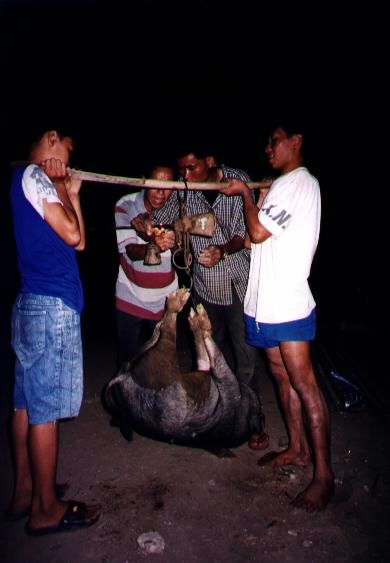
Young woman cookingPig being weighedWater buffalo

The food is excellent in Laos.
It takes some time to get used to eating noodle soup for breakfast, but once you get used to it, it is excellent.

There are pigs and turkeys all over the place. Above is a pig being weighed.

An essential part of farming is the water buffalo - it is important for pulling the heavy plough and there feet are designed to walk in water-logged gxround.

Old woman carrying heavy basketsGirl throwing rice

All ingredients used are very fresh. People are walking around selling vegetables on the streets.

It is hard work getting the rice ready for eating. First the rice is to be pounded to break the husks. Then thrown up in the air to remove the husks from the rice itself.


Created: Jan 2000 Last Updated: 16 Sept 2001

15. March 1999 10:32
by Rene Pallesen
0 Comments

Thailand

15. March 1999 10:32 by Rene Pallesen | 0 Comments

thailand
Statue at Grand Palace
Thailand ( 1999 ) . . .

On my way back from Laos, I stayed in Bangkok for a few days, visiting a friend whom I have known for a long time.

On the right, I am standing in front of a huge statue at the Grand Palace in Bangkok. There are many statues like this, very ornate and detailed. They are brightly coloured and some of them can look scary! As you can see in the background, the architecture and design of the roof is also very detailed and many of these were built a very long time ago by very gifted artists.

Nui


Here is Nui on the left.

She was the girlfriend of one of my friends at University in Denmark. She used to be a lecturer at the University of Bangkok and specialised in software design.

I stayed at her family's house for a few days in the outskirts of Bangkok. It was very nice to get away from all the pollution, noise and chaos of inner city.

You will now be happy to know that Nui has finally married Søren after all these years!

Me on a canal cruise


I am on a canal cruise!

Much of the water near the cities are very polluted, but it is very interesting to see the floating markets in Bangkok - yes, you will see people selling vegetables and meat from little boats...


Created: Jan 2000 Last Updated: 16 Sept 2001

15. March 1999 10:31
by Rene Pallesen
0 Comments

Working in Australia . . .

15. March 1999 10:31 by Rene Pallesen | 0 Comments

work


Dilbert

I can apply a lot of Dilbert's Principles to my work, that is why I always go to the Dilbert website to see what else Dilbert has come up with. More importantly, I thought Dilbert an accurate description of what I do, hence the first think you see on this page is... Dilbert!

The group I worked with at Cochlear

I had the privilege of working as a contractor in the world's leading company in bionic implants, Cochlear. I worked there for 1½ years as the head designer/developer of the software programming the bionic implants. I worked with some of the best developers, and had a lot of fun whilst I was at it.

On the Bridge ClimbOn the Bridge Climb

I had the chance to go on the Harbour Bridge climb, organised by the company. It is quite an expensive trip up over thte top of the bridge and normally would not pay to do it, but had the opportunity to do this with my colleagues. It is very windy up there and the view spectacular. There is quite a lot of people on the bridge climb - average about 10-15 per group, with about 3-5 groups on the bridge at a time. The whole walk from the bottom, to the top and back the other side takes about 2 hours. Many tourists take the opportunity to try out the climb, and I am told that the trip at sunset is spectacular.

Staff at PMP

I took this trip on a Douglas DC-3 (from the 1930-40's) with PMP Software. PMP Software was the company I worked for during the years I was waiting to get my permanent residency in Australia. I had the chance to see this state from an aerial view. There were quite a few Danes working for PMP, and at present, Kenneth is also working for them.


15. June 1998 10:33
by Rene Pallesen
0 Comments

New Zealand South Island 1998

15. June 1998 10:33 by Rene Pallesen | 0 Comments

new zealand south island 1998
Map of New Zealand
New Zealand ( June 1998 ) . . .


My first trip to New Zealand took place in June 1998. I travelled with the Lenehans - friends I have known since my arrival in Australia. This was one of many trips I took with Lance and Anne. We rented a campervan and decided to explore the south island of NZ.

I have since been to New Zealand again - NZ has some of the most beautiful mountains and I had the chance to go there again in January 2001 to do a technical ice-climbing course.

I took so many photos and would have loved to place all of them on this webpage.

Instead, I have selected a few to show some of the places I managed to go to, such as Milford Sound, Nelson, Arthurs Pass and Mt Cook.

There were many glaciers in NZ and lots of seals to go with them!

NZ is a beautiful country with many unusual natural formations. It is a photographer's haven. We ended our trip with a farewell dinner in Christchurch.


Seals . . .

The Lenehans and I decided to spend 2 weeks in New Zealand in the winter of 1998. We flew to Christchurch from Sydney, and drove north to Nelson.

On the way to Nelson, on the east coast of the southern island, there are hundreds of seals. It was a spectacular sight and I managed to get quite close to them to take photos.

SealTired sealWet seal

They did not seem to mind me taking a few photos. Some of the seals look tired - I guess even seals, like humans become tired. Who wouldn't like to pet a seal? They look different when they are wet though.

Anne sitting on stone

This was taken near where the seals were. I like the blend of colours and the harmony of the picture.

A lot of friends have commented on this photo! Most of them really like the photo, and feel there is something calm about it.


Nelson . . .

Nelson is located at the northern most part of the southern island.

We explored the area around Lake Rotoiti.


On the ridgeOn the ridge

These were taken from the ridge itself.

There is a lake at the end of the mountain ridge. From here, it is all downhill. We camped just below the lake at 1,500 metres altitude.

It was snowing the next morning and all water was frozen. We estimated the temperature to be around -7 degrees celcius.


Side of ridgeLenehans  I

The side of the ridge was one big stonefall.

It was very cold and the wind was strong that day so it was necessary to wear gloves hat.

We managed to get a group shot from the top of the ridge. The mountains in the background are knows as the McAngus ridge at Lake Rotoiti. Mountains at Lake Rotoiti

Here are the mountains at Lake Rotoiti.


Morning MistMorning Frost

The mornings are incredibly beautiful at Lake Rotoiti. Here you can see the morning mist floating gently on the water.

It is also very cold here - that is why there is ice on the bridge in the foreground.
Lance  Anne crossing bridge

The photo on the right shows the Lenehans crossing one of the suspension bridges at Lake Rotoiti.

At this point we had walked 15 kilometres, with a 1,000 metre descent. We had yet another 7 to 8 kilometres to go that day!

The Renet

This is what happens when you do not use a tripod. The effect is quiet interesting and makes the photo look like a painting by Monet.

This photo has has been dubbed "The Renet" among my friends.


Ladder at Goat Pass trackArthurs Pass . . .


We drove to Arthurs Pass, on the way from Nelson to Queenstown further south.

There is a place called Goat Pass, and there is only one way in - on foot.

Here, you can see Anne climbing up ladders on the Goat Pass track.

Inside our 'hut'

It was raining so much that we were not able to get down through the canyon on the other side of the Pass. We therefore decided to go back the way we came.

Further down the track, we had passed a bivouak and decided to stay ther during the night. It was very dirty and Anne would rather sleep outside in the rain.

Everything was wet so she changed her mind and came back in. *laugh*

Anne trying to cross a river

She wore plastic bags on her feet, in her boots are so that she could wear her boots without getting cold feet! Aussies will never get used to the cold.

Here is Anne crossing one of the rivers.

Every time she crossed a river, she would sit and massage her feet for 10 minutes until they warm again.

I guess Aussies will never get used to the cold. Neither will Danes for that matter! An Australian winter is like a Danish summer - so you can imagine how cold Denmark is! Still, Danes cannot get used to it - just ask Kenneth or Soeren!

Who's this?

Sleeping ???

Aussies will never learn to live with the cold!

I must admit I hate the cold. I loved it when I lived in Kenya - so hot and humid!

Even living in Denmark for all those year did not make me like cold weather any more than I used to. That is why I love Australia - warm summers and mild winters. Sometimes winter in Australia is a bit too cold for me! But I do not usually wear more than a T-shirt or a thin jumper in winter. My girlfriend was complaining about me having the heater on full-blast in the car during spring!

Okay, so I love the heat!

Lance  Anne in the campervan


Inside the campervan.

Temperature was down to -10 degrees Celcius during the night and there was no heating in the van.


This explains why Anne was wearing a thick blanket. There was only enough water for a two minute shower. That is why Anne is wearing a hat indoors.


See the expression on her face? She knows I will write a stupid description for this photo.

Black  white photo of me


In the campervan I had the top bunk.

This is one of my girlfriend's favourite photos!


On the way to Milford Sound, we saw some unusual formations - The Pancake Rocks. The Pancake Rocks are located near Hokitika, between Kumara and Ross.

Pancake RockPancake Rock

They do not taste as good as real pancakes - you get sand in your teeth...

The Remarkables near QueenstownThe Remarkables at sunset

At Queenstown, we had the most glorious view of "The Remarkables". The Remarkables are the mountains in the background - don't ask me why they call The Remarkables, I don't know. But the photo on the left shows Queenstown with these mountains in the background.

The photo on the right shows the a sunset at The Remarkables (with snow on top!) Pretty 'remarkable', huh?


Putting chains on campervanMilford Sound . . .


Milford Sound is located near the southern-most tip of the south island of NZ. It is the series of 'islands' that you can see on the western tip of NZ on the map.

To get to Milford Sound, we had to take a huge detour from Queenstown. To come back from Milford Sound, we had to take the same detour before heading east from Queenstown.

Driving down to Milford Sound, we had to put chains on the tyres of the campervan.

In the pass, there was at least 10 centimetres of snow on the road, and it was illegal to continue on without chains. Chains help create friction on the roads and makes it easier for the vehicle to drive on in icy conditions.

We managed to rent a set of chains in Te Anau because we had heard rumours about chains being mandatory.

If you go to New Zealand during the winter, then make sure you have a set of chains for the car.

Milford


How many postcards have you seen from Milford Sound, where there was snow on top of the mountains?

It is beautiful, but nothing compared to the Mount Cook area.

Milford


The sun rising in the Milford Sound area.


Glaciers . . .

The Tasman Glacier

Most of the glaciers we went to were located on the main range.

We had to drive inland when we were heading south on the west coast because the Westland was too rough and wild to drive through.

Here on the right is the Tasman glacier near Mt Cook village. It is 35 km long - a hundred years ago it was 85km long. The ice is 600m thick and used to be 1,300m thick.

Where the glacier ends at the water on the photo, the ice is more than 200m thick.

The Fox Glacier


Both the Fox and Franz Josef glaciers are located on the west coast.

On the left is The Fox Glacier.

It is so huge that if you built a house at the end where the ice begins (or ends since it is a glacier), you would not be able to see it on this picture.

Me at the Franz Josef glacier


The pile of ice behind me are 3 to 4 times bigger than the size of a house.

I am standing about half a kilometre from the glacier.


Keas on the campervanA Kea

At the Franz Josef glacier, people have been feeding the keas. The kea is the only alpine parrot in the world.

This means the keas associate every man-made thing with something edible.

They are therefore making the attempt to eat the cars. You can see the keas on the roof of our campervan.

It is a very weird bird. They can survive in extreme conditions with freezing temperatures and snow.


Mt CookMount Cook . . .


On the way back to Christchurch, we went to Mt Cook.

Here is Mt Cook as seen from the west coast.

I achieved my goal to climb it in January 2001! You can see the photos from this trip.


View of Mt Cook from Linde PassAnother view of Mt Cook from Linde Pass

Take a look at the colours. The photos were taken at Lindes Pass, just north of Mount Cook.

There was no sound up there. You could not hear the wind or any birds. The only sound you could hear was yourself breathing.

Lance taking a photo


Lance praying towards Mecca???

No just Lance in a weird posture taking a video of Mt Cook.

My favourite photo of Mt Cook


One of my favorite photos.
"The man and his mountain". Kerenyaga.

Here is Mt Cook in the background (almost 4,000 meters). I am so glad that I had the opportunity to go back to NZ and actually climb on Mt Cook!


Sunrise on the East Coast of New Zealand!Farewell Dinner . . .


From Milford Sound, back to Queenstown, we then drove back to Christchurch via the east coast. We saw some pretty spectacular sunrises along the way.

During our last night in New Zealand, we went to a restaurant called "The Sign of the Takahe". We had our farewell dinner at Christchurch before returning to Sydney.

It is an old castle/house built in the same style as the old English castles. The atmosphere and food is excellent.

This is the place to bring a date.

Someone was playing quiet piano music in the hall.

The photo is taken with a long exposure because I wanted to capture the atmosphere with the woman playing the piano in these old surroundings.

Atmosphere in the restaurantGroup shot at the restaurant


Created: Jan 2000 Last Updated: 19 Sept 2001

15. March 1998 11:09
by Rene Pallesen
0 Comments

Cockatoos . . .

15. March 1998 11:09 by Rene Pallesen | 0 Comments

cockatoos
Cockatoos on my balconyCockatoo up close

I have the most spectacular view from my home in Narrabeen.

It is an apartment on the beach, only 10 metres away from the sand. As you can see from the picture on the left, this was taken from my balcony, with the beach in the background.

Almost every morning, these beautiful white birds, come in abundance to visit me. I usually hand-feed them sunflower seeds, but you have to be extremely careful because sometimes they mistake your fingers for food!

Cockatoos are approximately the same size as a duck. They are very intelligent and not afraid of humans. However, along with the cockatoos, I also get the pesky pigeons - I wish I could get rid of them!!!

Cockatoos on my balconyCockatoos on my balconyCockatoos on my balcony


Created: 12 Aug 2001 Last Updated: 25 Oct 2002

15. March 1998 10:54
by Rene Pallesen
0 Comments

Port Macquarie ( 1998 ) . . .

15. March 1998 10:54 by Rene Pallesen | 0 Comments

port macquarie 1998
Graham -


During my first year in Australia, after coming from Denmark, I was contracted out to work at Port Macquarie - a quiet, but beautiful and peaceful seaside town a few hours north of Sydney. The first pictures were taken in Port Macquarie during Easter 1998.

Lance, Anne and Graham, some good friends of mine, decided to do some exploring around the area...

Graham here, on the right, The Admiral himself... (also called "Wobber") "Is that a chicky-babe in the water ?"

The photo is taken on "Kermit" (Note, the green seats...) in the river at Port Macquarie.

Lance - sleeping


Lance seasick ???? No, just a little tired !

This is one of many photos I have of Lance sleeping - he has a knack for taking a nap just about anywhere - just ask Anne! *smile*

It's a great day to sail on "Kermit".

Rene up front onboard!


Whereas, who do we have here?


Me! I love sailing, and as usual, like to be a'head' of things...

"Clear water ahead Navigator?"

"Aye-Aye Admiral!"
Graham picking on Anne!


"The Admiral" is giving Anne a good whacking.

Poor Anne...


Lighthouse at Port Macquarie


Lance and The Admiral in front of the lighthouse at Port Macquarie


Hundreds of crabs!

In the mangrove at Port Macquarie, there are millions of these small blue crabs (Taste like shit). It's pretty amazing though - crabs do not exist only on a beach. They live wherever there is enough water and they can burrow quickly and easily away from danger.

The photo above is taken on a sandbar in the river at Port Macquarie.

There are also a lot of pelicans in Port Macquarie. I managed to get a picture of one flying. And one yawning!

Flying pelican

More pelicans

There are quite a few pelicans here in Narrabeen, on Pittwater Rd - a main street near where I live. Narrabeen lakes draws its salt water from the sea, and at one point on Pittwater Rd, there is a bridge. This is where I see most of the pelicans - perched on top of the flat heads of street lights! It's quite funny to see them there, and have never managed to get a photo of this yet, as I usually see them when I am driving over the bridge.

Rockpool

We went bushwalking in the mountains and forests at Port Macquarie and found this beautiful rockpool. We used the opportunity to go for a swim.

Me!


Off the beaten track in the forests around Port Macquarie!


Me!


Moi!

One of the few pictures of me (as you will notice in this whole website). I tend to prefer taking pictures of other people and places - but my girlfriend is trying to remedy that! (she's still trying not get blurry pictures...)


Me 
eating lunch


As you can see, this place is really good for getting comfortable, enjoying my lunch, no worries, good place to get a bit of sleep...


Me under the bushes...

Like my new haircut?

I wanted to do something radical. I needed a change, I wanted people to look at me when I was walking down the street. So decided to change my hairstyle. By the way, you like it green? I can't be a dumb blond forever...

Lance & I


A picture of Lance and I with the beaches at Port Macquarie and one of the Brothers in the background !


The hugest waves!

There was a storm in Newcastle. These were the biggest waves I had ever seen - some were 7-8 meters high. The waves were washing all the way up to where I am standing taking the picture.

The kids in the photo were waiting for a big wave to hit them and wash them into the rock pool. You know the big wave coming towards them? They were still a couple of hundred meters away from it...


Dinner with the Lenehans, Henrik & wife


Henrik, Lance and I made a bet with Anne about whether or not we would be able not to use a computer in our sparetime for two weeks while we were up in Newcastle. We accepted the bet and won it simply because it was impossible for us to lose since we didn't have access to any computers!

That meant that Anne had to cook us a dinner... Australian Style!


Who looks Aussie now?


Aussie?

We had to dress "Australian style" for the dinner (at least to start with). Reckon it is Aussie with a billabong hat? (Need some flies for the corks to chase away). But it is DEFINITELY Aussie with that holey surfie t-shirt and a Fosters (disgusting) in hand!


Henrik


Can't see, can't hear and can't talk, who am I?


No actually he was trying to wear his wife's earrings but didn't want it on a photo!

I have often said that Port Macquarie was a beautiful place, but it is much too quiet for me in the long run. Working there during 1998 was good, but I was also glad to be back in Sydney!


15. February 1998 10:54
by Rene Pallesen
0 Comments

Anne's Birthday ( 15th Feb 1998 ) . . .

15. February 1998 10:54 by Rene Pallesen | 0 Comments

anne s birthday 15th feb 1998


Anne


We celebrated Anne's birthday at a restaurant called Pete's Bite. The only access to the restaurant is by seaplane or boat. It is located 2 hours north of where I live.

The food is marvelous and bloody expensive. It is definetely worth trying (once)!

Me feeling hot


It was 40-45 degrees that day and no wind so everybody moved out on the lawn in the shade of palms!

Me definitely feeling hot


So this is what a heat stroke looks like !
Perfect Moments Photography | A Rene Pallesen Journal

Home

22. December 2007 12:28
by Rene Pallesen
0 Comments

Climbing at Mt Keira - Wetting my pants

22. December 2007 12:28 by Rene Pallesen | 0 Comments

climbing at mt keira wetting my pants


Last weekend Andy, May and myself went climbing at Mt keira near woolongong south of Sydney.

May had never really done any outdoor climbing before and Keira is a good place to go and try your first lead climb.

The weather forecast didn't look promising but we decided to go there anyway as in our experience the forecasts are never very accurate here. Besides it said that there was a chance of one or two showers in the afternoon.

As soon as we arrived to the cliffs in the morning we started feeling the first few drops. The rocks were still dry so we decided to put up an easy route anyway.

Click here to see bigger photo

Once we finished it was raining more steadily and the rocks started getting slippery. There was a climb in the corner that was still dry so we decided to quickly also do this. And afterwards we put up a top rope on a climb that also still was dry.

Before we got onto it it was raining heavily and there was a storm with lots of lightening approaching.

>Click here to see bigger photo

Click here to download video

After a couple of not very motivated (and wet) attempts on the climb I volunteered to clean up the climb. As I approached the top the water was coming down like from a waterfall and by the time I had cleaned up the anchors I was drenched (and yes...my pants were very wet).

Climbing wise a really disappointing day...but we still had fun.

6. December 2007 06:01
by Rene Pallesen
0 Comments

Tokyo - Having a whale of a time

6. December 2007 06:01 by Rene Pallesen | 0 Comments

tokyo having a whale of a time


This week I am in Tokyo for work visiting a couple of partners and also giving them some training on some of our internal solutions that they would like to sell.

I love visiting Tokyo...it is like Disney land and everything is just so slightly different. Like for instance the toilets have all the buttons on the side. Yesterday I saw one with a volume control and a "flush noise" button. I couldn't help pressing it...and yes the toilet did make very realistic sounding flushing sounds. I am unsure under what circumstances the sounds can be useful...another mystery that I may be able to solve one day.
In the hotel I also tried all the other buttons and it is kind of cool with all the sprinkling water (heated to body temperature), but I still haven't found the button for the 'but' dryer.

Click here for more photos Click here to see video of Tokyo Square in Shibuya

We visited one of our partners customer service centre and that was like watching a movie. They had big wall-to-wall screen showing that status of all the various sites, latest news tv, weather forecasts...or anything else that could be relevant to them running their operations. The walls were liquid crystal walls and by the flick of a button they could make the whole wall transparent and the next minute they would have the latest status projected onto the walls instead...unfortunately they wouldn't allow me to take a photo.

Click here for more photos

Masaru and I also went to a whale restaurant in Shibuya...we tried Whale Sashimi, Whale Tempura, Whale Skin, Whale Bacon, Whale tongue, Whale Beef and Whale soup (I only ate it for Scientific Purposes). It was all very delicious and the Whale Sashimi (raw whale meat) was definitely my favourite.

Click here for more photos

Click here for more photos


For lunch today I had a really nice baby clam soup...very unusual and very nice.

In general food is really nice and there are some unusual places that specialise in their small niche markets...for instance the lunch place that specialises in 'Lemon Detox lunches'. Compared to the food in Sydney this is a magnitude better.


The hotel I stay at is in Shibuya which is the area in Tokyo that is very famous with all the lights and screens...it is a very hip area where all the teenagers are wearing the latest fashion and have funny hair. My room is a lot bigger than the one I stayed in last time I was in Tokyo...in this one you can actually walk around the bed and it has got all the features you would normally expect from a western hotel room. And they serve a really nice bacon for breakfast...I bet it is Danish bacon.

Click here for more photos

We also took the peak hour train in the morning...man those trains are fast and they are packed so tight that it is impossible to move let alone raise your arms.

Being in Tokyo also means very long working hours. People here start working around 9am in the morning and seldom leave work until after 9pm. It is still the musical chairs with meeting rooms, the deadly silence in the offices, hot working environments etc.

One evening we went out with our partners...which was a big introduction to japanese customs. We went out for a late dinner after work a big group of us and when they have dinner then a lot of drinks were served. This was a chinese restaurant so we were drinking some chinese type of wine that tasted like bitter Kahlua. After dinner we went to this drinking place which was really weird (and slightly uncomfortable but interesting). They pay an entry fee of around 3000 Yen ($30 AUD) and you then get to sit down with a girl that serves you drinks and who you can have conversation with (and conversation only).
You cannot choose the girl and I guess this is the modern form of the Geisha...and a cheaper way of talking about your problems at work or with your wife than visiting a psychologist.

I really like visiting Tokyo...but I don't think I could live there (too controlled). It is really interesting to visit especially in a working capacity as you see all the funny differences in lifestyle, work, objects and opinions. Most of the time it is a really good laugh...like when one of the guys asked if he could take a picture of me because he told his wife that he was working with a foreigner that looks like Tom Cruise (I told him that Tom is a full head shorter then I am).

We had an earthquake while I was there. The whole building started swaying from side to side...I was looking at the Japanese guys are they were calm so I thought that there was no reason to panic. Apparently it happens all the time there.

Click here to see more photos from Tokyo

Here is some more photos from the trip.


1. December 2007 01:23
by Rene Pallesen
0 Comments

Hunter Valley December

1. December 2007 01:23 by Rene Pallesen | 0 Comments

hunter valley december


Before my trip to Tokyo and before Christmas we decided to go to the Hunter Valley to stock up on good wines (We buy them now cheap and drink them in 5-10 years time when they would be really expensive).

Hunter Valley is about 2 hours drive North of Sydney and it had got about 200 Vinyards you can visit for wine tasting and then buy the wines straight from the cellar.

We went there with a couple of Kims friends and Kim and I bought a couple of cases of wine together.

Click here for more photos

Everything in the Valley was nice ang green due to a lot of rain in the area lately.

Click here for more photos
Click here to see more photos from Hunter Valley

21. November 2007 01:50
by Rene Pallesen
0 Comments

Kayaking at Woy Woy

21. November 2007 01:50 by Rene Pallesen | 0 Comments

kayaking at voy voy


When Kim left Epicor she got a gift certificate to go Kayaking at Woy Woy, so this weekend we headed up there together with Mike and his wife Helen.

Click here to see bigger picture

Both Kim and I have done some kayaking before but it was a new experience for Helen. We paddled up through some of the inland waters in Brisbane Waters near Woy Woy and afterwards we stopped at the fisherman's wharf for some really nice seafood.

Click here to see bigger picture

29. October 2007 02:57
by Rene Pallesen
0 Comments

Berowra, Narrabeen Slabs & Australian Wildlife

29. October 2007 02:57 by Rene Pallesen | 0 Comments

berowra narrabeen slabs australian wildlife

One of the things about living in Australia is that you are exposed to a lot of creepy crawly stuff. In the urban jungle you don't really notice, but once you come a bit closer to nature then you cannot avoid seeing some of the insects etc. This is especially true when we go climbing. The last couple of weeks Andy and I have been exposed to a couple more creeps than we usually see.

The last couple of weeks Andy and I have been climbing in the Sydney area. Last weekend we went up to Berowra again and had a generally pleasant day had it not been for the brown snake.

On the last climb of the day we decided to try this climb that none of us had done before, but because of the protection we decided to top rope it. In the guide book the description reads:

Savage Cabbage 8m 19
Up thin crack then tricky moves left to main crack. Follow this (take care with pro) to new lower off. Often dirty and sometimes inhabited by a (friendly) brown snake.


This was warning enough and as a safety precaution we checked the holes at the bottom of the climb and didn't see anything suspicious. He started climbing and about 2 metres up he stuck his had into one of the pockets. He then decided to take a peek to see if there was anything in there and very quickly pulled his stand out shouting "Fu...a snake". Fortunately he hadn't been bitten or I would have had to call him a helicopter....again.

Eastern Brown Snake

Wikipedia says the following about the snake:
Brown snakes are easily alarmed and may bite if approached closely, handled or threatened. The Eastern brown snake is the most toxic member of the genus and is the second most toxic land snake in the world.

I don't think we'll be jumping onto that climb anytime soon.

This weekend we decided instead to go to Narrabeen slaps as we hadn't been there for a while and it is easily accessible (15 minutes drive from home). It is a nice selection of semi difficult slabs along the Wakehurst parkway (almost rain forest).

Andy on a blank slab

Generally when climbing in Sydney you see many webs from the funnel webs and I also saw at least one at Narrabeen. And, when we go to other climbing areas then there are always multiple holes in the rocks where you can see the funnel shaped webs. I happen to hate spiders and always fear that I will poke my fingers into a funnel web. I have only seen a live (I think) funnel web once and that was in Nowra on the bottom of a pond of water (people generally check their swimming pools for funnel webs before swimming as they can stay below the surface for ages), I saw a tiny scorpion on the floor of the cooking area in Nowra on the same trip.

Sydney Funnel Web

Wikipedia says:
Although they are rather small, they should not be handled without taking substantial precautions, because their fangs have been known to penetrate fingernails and soft shoes, resulting in dangerous bites. Funnel-webs are probably one of the three most dangerous spiders in the world and are regarded by some to be the most dangerous.

While Andy was belaying me he saw a redback spider crawl across the rope back and squashed it under his feet. He told me he had to stomp on it several times before it died.

redback spider

Wikipedia says:
The redback spider is a potentially dangerous spider native to Australia. It resembles a Black widow spider. Redbacks, along with funnel-web spiders, are the most dangerous spiders in Australia. Most Australians dislike the redback spider, thanks in part to the frequency with which it is encountered in the environs of human habitations.

Also, the crag is generally infested with mosquitoes, ticks and on this day we also had the pleasure of a big fat Tiger Leech which had had a feast on Andy's big toe so it started bleeding heavily as we left the crag (but the leech lived to see another day). We saw it earlier on Andy's sandals but flicked it off...only later did we discover that it had been sucking blood from him.

Hungry Tiger Leech

16. October 2007 10:21
by Rene Pallesen
0 Comments

Brampton Island 2007

16. October 2007 10:21 by Rene Pallesen | 0 Comments

brampton island 2007


Kim finished her job at Epicor this Monday and we therefore decided to go somewhere for an extended weekend before she starts any new adventures.

Our first choice was to to go Samoa, but because of school holidays the hotels and flights were booked the days we wanted to go. Instead we settled on going to Brampton Island in the Whitsundays about 2000km North of Sydney.

It was a long flight up there, first to Brisbane, then on to Mackay and from there continue with a small light aircraft to Brampton Island itself.


Here is a photo of the island from the aircraft.

Click here to see more photos

Click here to see a video of Brampton Island from the aircraft.

The island is beautiful and there is only one resort on the island accomodating a maximum of 200 guests. Because of all the flights to get there it means that it is a perfect couples destination as there were no kids making noise there (according to Kenneth kids families won't go unless it is a direct flight).

The Island has got a number of really nice remote beaches that are empty and where one can get up to all sorts of mischief. There is also a small 6 hole par 3 golf course as well as archery range, spa and a couple of different pools etc.

Our intention for the weekend wasn't really to be very active, but really to just relax and have a nice time together.

On the first day we walked around the whole island (8km) and went for a swim along the way at a beach on the other side of the island that we had all to ourselves. We managed to get a bit of a sunburn both of us so the next day we stayed in the shade.


Click heer to see more photos

On one of the other days we got a picnic pamper and found another beach where we could relax, swim and enjoy ourselves without anyone else around. The water was crystal clear and we could see fish and stingrays swimming around in it and although we had bought our snorkeling gear we never got around to using it.

Here is a photo of Kim on the beach.


Click here to see more photos

And...click here to see a video of Kim in the water.

Both of us had a very memorable time on the beaches.

Most of the other guests were just spending their time in the resort itself and when it was too hot to go anywhere we also spent the time in the resort relaxing in the shade sipping cocktails.

Click here to see more photos

The only thing that was a bit disappointing was that the resort had all these nice catamarans and sailboards that were free to use, but because of lack of experience of the people working on the resort they wouldn't let anyone sail them if there was any wind whatsoever (really...what's the point!?!?).

Click here to see more photos

In the evening there was various forms of entertainment. Especially this one man band was really good, but most of the other entertainment was pretty average as the staff to be honest had little to no clue whatsoever.


Click here to see more photos from Brampton Island

17. September 2007 10:17
by Rene Pallesen
0 Comments

Fish Market & The Coast Colf Club

17. September 2007 10:17 by Rene Pallesen | 0 Comments

fish market the coast colf club


This Sunday we went to the fish market in Sydney with one of Kims colleagues from Singapore (who also happens to be Danish) and his Singaporean girlfriend for Lunch.

The Seafood at the fish market is very fresh and nice. You can go to all these small seafood stalls and buy various seafood such as various types of Sashimi, Sushi, Lobster, Abalone, Scallops, Calamari and Balmain bugs. Kim and I shared a large seafood basket with different types of seafood as well as a small box of Sashimi.


Michael and Caroline

Afterwards we took Michael to The Coast Golf Club while Caroline went to do some retail therapy in Paddington.

Kim and I at The Coast Golf Club


We only played 8 holes as we had to leave at 5pm to be at Kims sister at 6pm for her youngest sisters birthday.

I took a really cool and funny video of Kim almost making par on one of the holes.

Click here to download the video of Kim


10. September 2007 05:48
by Rene Pallesen
0 Comments

Holland September 2007

10. September 2007 05:48 by Rene Pallesen | 0 Comments

holland september 2007


In early September I again went a week to Holland. The purpose of the trip this time was a combination of team building, create common processes and training. The company is working on getting everyone ECM (Electronic Content Management) certified.


Click here to see more photos

Since I just got back from Holland a couple of months ago I decided to just quickly fly in Sunday afternoon and then return Saturday morning.

I really don't like flying through London Heathrow airport. They always loose my luggage there and every time it takes 1-3 days before it eventually arrives.
My flight was delayed so as I expected I missed my flight to Amsterdam. I asked them to book me onto the next available flight where my luggage also would have a chance to make it.
When the flight boarded I checked with the staff to make sure that my luggage had made it...it hadn't :-(
As I had plenty of time I decided it would be better for me to de-board the flight and then try and catch the next flight hoping that my luggage then would make it...which I then confirmed it did when I boarded.

Heathrow is the only airport in the world where I consistently have this problem. They need at least 3 hours between the flight to have a chance of transferring the luggage. Next time I'll check what options I have to fly through Frankfurt instead.

Click here to see more photos from: Holland


10. September 2007 05:39
by Rene Pallesen
0 Comments

Birthday Party

10. September 2007 05:39 by Rene Pallesen | 0 Comments

birthday party


Because Kim and I was busy travelling we never really managed to hold a birthday party where friends were invited along.

So, in mid august we held a small party celebrating Kim's, Luke's and My birthday.

Click here to see more photos

Kim and Luke has got birthday on the same day and I was out travelling at that time, and on my birthday we went skiing in the Snowy Mountains.

It was a fun evening at a nice Thai restaurant in North Sydney. Click here to see more pictures from: Birthday party

11. August 2007 10:03
by Rene Pallesen
0 Comments

The Gold Coast - Microsoft TechEd

11. August 2007 10:03 by Rene Pallesen | 0 Comments

the golf coast microsoft teched


This week I went to The Gold Coast (Surfers Paradise) to work on our stand at TechEd. This is our biggest marketing push of the year and gives us a chance to talk to more than 2000 people over the 4 days of the conference.

To attract people to our stand we had hired to girls to hand out brochures regarding our price draw. This turned out to be really effective. They managed to hand out 1500 brochures in just one hour so we had to get more printed for the second day. And a lot of people came to visit our stand to see what we were all about.

Click here to see more photos from The Cold Coast

It is pretty hard work. Most days start at around eight in the morning and generally didn't finish until around nine at night..and during this time there is a constant flow of people through the stand and constantly people to talk to.

Click here to see more photos from the Cold Coast

On the last evening Microsoft hosted the TechEd party at MovieWorld...free rides, free drinks and lots of actors dressed up at star wars and star trek characters. None of my colleagues wanted to go, so I went by myself and did some of the rides and alng the way I bumped into various people I knew at the conference.

Click here to see more photos from The Cold Coast

And it was a pretty good fun evening and I took a lot of cool photos, so I recommend you see the rest of the photos in the gallery...just click on one of the photos or on the link provided below.


Click here to see more photos from The Cold Coast

But tell you what...it is really nice being back in Sydney where Kim is.

Click here to see more photos from: The Gold Coast


Perfect Moments Photography | A Rene Pallesen Journal

Home

8. January 2018 18:01
by Rene Pallesen
0 Comments

Vang Vieng - Caves

8. January 2018 18:01 by Rene Pallesen | 0 Comments

In Vang Vieng we also went to some caves. Again we were the only ones there - I don&#39;t know if this w
In Vang Vieng we also went to some caves. Again we were the only ones there - I don't know if this was just because no one else were interested or because we went there at a time when everyone else were doing other activities.

The caves are in fairly pristine condition, they are dark, moist and other than descending a makeshift ladder walking through them gives a feeling of exploring the caves for the very first time.


Some passages were really narrow


And other parts of the caves were massive.


Overall the caves are beautiful and again it was amazing having them to ourselves.


7. January 2018 21:01
by Rene Pallesen
0 Comments

Tribes - Laos

7. January 2018 21:01 by Rene Pallesen | 0 Comments

The tribes of Laos still exist although it is no longer as noticeable. They no longer wear their tra
The tribes of Laos still exist although it is no longer as noticeable.

They no longer wear their traditional costumes but it is possible to glimpse the occasional traditional head wear or dress in one of the shops.


It is especially sad to see the Hmong tribal wear gone as worn below by Mavis and Kim. The Hmong traditionally lived in the mountains. The government has forced them down into the lowlands where they can be controlled and 'integrated' into the the rest of Laos.


6. January 2018 20:01
by Rene Pallesen
0 Comments

Vang Vieng Countryside - Laos

6. January 2018 20:01 by Rene Pallesen | 0 Comments

On the first day in Vang Vieng we hired a local guide to take us through the country side and some o
On the first day in Vang Vieng we hired a local guide to take us through the country side and some of the villages around Vang Vieng.


Hiking through the countryside in Laos is partly magical and at the same time an eye opener. It is not until you get into the country side that you get a glimse of the real Laos and its people, the way of living and their beliefs.

Walking into the first village a group of boys came walking towards us. One of the kids was holding his head with blood dripping down his face. The other boys were taking him home to his parents. I couldn't help but notice that there was a green substance smeared across the wound and asked our guide is he knew what it was. He went over to some bushes and plucked a couple of leaves and said that if you crush them then they will help stop the bleeding. This is when you realise that a lot of the plants in the villages serve a purpose as natural herbal medicine or for eating.

The village was a HMong village and at one of the houses we spotted the little girl above standing in a door opening with her grand mother. There are very few of the traditional bamboo shacks still standing and instead being replaced with brick buildings.


A bit further up the road we heard a sound. Someone was hitting a gong and chanting. Thinking it might be a monk we went to investigate. The sound was coming from one of the local houses. At the back of the house the family was in the process of preparing food, but we couldn't see where the sound was coming from. Our guide asked them and was told that they had a newborn (possibly sick) child and that the Shaman was in the house talking to the 'other world to' attract the good spirits and chase the evil spirits away.


As we walked on we could see him through the opening of the door and I snapped the above photo which is one of my favourite photos of the trip.

In the village people go about their normal life such as this woman removing lice from her daughters hair.


As we walked on we had to walk through the local school. It happened to be recess and the kids in the smaller classes were outside playing.


There was a small stand selling them lunches who also sold lollies, so Kim got the idea to spoil the kids with lollies - but also turned out to be a great opportunity for our kids to interact and see what a classroom in Laos looks like.


The area is still very un-developed. Although there seems to be electricity, this is mainly used for lighting. Cooking is still done by collecting wood and done on wood fired stoves and people still wash their clothes in the rivers and streams.


Although there are still a number of water buffaloes these are mainly used for eating along with any other non-human living animal - such as pigs, dogs, birds etc.


It was very healthy for the boys to see where their food 'potentially' comes from and understand that this is part of life.

The area is full of rice paddies, but these are now worked with mechanical tools rather than buffaloes.


The government has built bridges across the large river to allow access to the villages.


But the smaller streams have bamboo bridges - in this case wide enough to drive a motorbike across, others just a single bamboo to allow a person walk across.


At the far village (Lao and not Hmong) there was a limestone cliff with a small cave in it. This was called elephant cave and inside there was a small shrine along with some bizarre images.


The whole area is spectacular - I can only imagine what it would be like during rice planting season - yes it would be muddy but also stunningly beautiful.


During this whole hike we saw no other travelers. Other than at the cave we didn't get a sense that there frequently came any groups through and I think the feedback from all of us was that this was one of the highlights of the trip - no adrenaline required.

5. January 2018 16:01
by Rene Pallesen
0 Comments

Vang Vieng - Laos

5. January 2018 16:01 by Rene Pallesen | 0 Comments

Vang Vieng is an interesting tourism destination in Laos that has undergone several iterations of re
Vang Vieng is an interesting tourism destination in Laos that has undergone several iterations of re-inventing itself.


When I first visited for an overnight stopover it was a sleepy little town with maybe a handful of backpackers going tubing (more on that later).
I also remember the deserted airport runway from the 'secret war' going through the sleepy little village (Lima site 6) and the stunning mountain scenery in the background. Other than that there wasn't much there.


Ten years later my mum and dad visited the place and told me stories how the place had transformed. It had grown and was full of drunk backpackers with loud rave music and parties throughout the night. During the day they were floating down the river in car tubes again with beers and drinks in their hands.


Then again about 5 years ago, Laos appeared in the Australian news media with stories of young backpackers breaking their necks doing somersaults off the tree branches on the river and lagoons and hitting the rocks. Stories of high highly available drugs were also emerged.

The Lao government stepped in and closed the majority of the bars along the river, stopped the parties and the drugs and implemented a number of other safety restrictions.
It worked, the parties stopped and the young party seeking backpackers fled.

A new crowd has now moved in - this is bus loads of adrenaline seeking Koreans. They go there to go kayaking, zip lining, tubing, buggy riding etc. They eat at the Korean restaurants and stay at the same hotels, but otherwise mostly keep to themselves. This also means that some of the same old sleepy feeling has returned to this town. It also meant that is was easy (or just plain luck from our side) to avoid the tourists.

The airstrip is still there, but I recon most visitors would walk across it and not notice and definitely wouldn't know the history behind the secret war in Laos, let alone the American involvement and the little airstrips around the place. It is a fascinating story and has very much shaped Laos into what it is today.


The area is just absolutely stunning with steep limestone cliffs and rice paddies. I could easily have spent more time there taking photos in the surrounding area.


3. January 2018 21:01
by Rene Pallesen
0 Comments

Pha That Luang - Laos

3. January 2018 21:01 by Rene Pallesen | 0 Comments

A must see in Vientiane is Pha That Luang - It is on every bank note in Laos and they are very proud
A must see in Vientiane is Pha That Luang - It is on every bank note in Laos and they are very proud of it.


Unlike Buddha Park it is surprisingly quiet when it comes to tourists. The majority of people visiting seems to be either Laos or Thai people offering a prayer. The correct way here is to get the insense and flowers and then walk clockwise around the Stuba on the inside of the covered corridor (mostly to keep out of the sun I assume).


Although it is not particularly old (The original 1st century structure was mostly destroyed and has undergone a number of more recent restorations), it is stunningly beautiful and impressive in size.


For me to get some of the panorama photos here with the selection of lenses I'd brought along I had to take multiple photos that I then had to stitch together.

Outside there is a temple that is equally interesting, although nothing compared to further north in Luang Prabang.


There are also street vendors selling cage birds that are supposed to bring good luck and prayers to anyone releasing them.


2. January 2018 10:01
by Rene Pallesen
0 Comments

Buddha Park - Laos

2. January 2018 10:01 by Rene Pallesen | 0 Comments

One of the sights we wanted to visit was Buddha Park outside Vientiane (close to the border crossing
One of the sights we wanted to visit was Buddha Park outside Vientiane (close to the border crossing back into Thailand).


Trying to figure out the most comfortable way to get there we settled on taking the local bus. There aren't any taxis as such in Vientiane and we weren't keen taking a tuk-tuk for 30 kilometers. Most of the tuk-tuks are in an extremely poor shape with failing brakes, wobbling wheels and thick smoke coming out of the exhaust pipes.
They are perfectly fine for shorter trips inside the city (such as hotel to bus station), but not recommended for longer trips.

The bus turned out to be easy to find and we were early enough to all get a seat. The bus was later packed with passengers going to Thailand and it would have been tough to stand up for the one hour bus ride.

The bus is also really convenient in that it stops right outside Buddha Park which is the last stop before the bus turns around and heads back to Vientiane.


Buddha Park itself was apparently established by a Monk building the statues for religious purposes as education of his religious beliefs.


It is actually a nice little area and quite interesting with lots of (to us) weird statues showing bizarre things.


The most obvious is the massive 'pumpkin' at the entrance that you can climb. Each level inside the the sculpture itself represents hell, earth and sky.


The entrance is a head with a clock above it - meaning swallowed up by time?


There is also a massive reclining buddha.


And my favourite was the large centre sculpture carrying the body of a woman...no idea what this is supposed to represent.

2. January 2018 09:01
by Rene Pallesen
0 Comments

Vientiane - Laos

2. January 2018 09:01 by Rene Pallesen | 0 Comments

Vientiane is no longer the sleepy capital city it used to be. It is hustling and bustling with peopl
Vientiane is no longer the sleepy capital city it used to be. It is hustling and bustling with people, cars, motorbikes and shops everywhere.


The once neglected colonial buildings have all been renovated and the red dust flying everywhere is long gone as the roads have been paved. In the outskirts of the city high-rise office towers have started shooting up and I think that given another decade this city will look like any other East Asian capital.


The most striking difference was the banks of the Mekong River. Last time I was there it was really just a dirty path and following it north long enough there would be a string of wooden shacks with local restaurants that would serve some beautiful local dishes, fish and other seafood.
The water then would come right up to the bank and the boats could pull up and during the day the local kids would jump from the trees and swim in the river.
The old path has been replaced by a modern walk way (which actually is really nice) and the shacks have been replaced by some bars closer to the centre catering more for a western clientel - still with some nice seafood on the menu. The water of the Mekon has receeded and there is now a massive sand bank moving the river 2-300 meter back from the city.

Although Vientiane doesn't have a massive amount of things to see, it is definitely worth a visit. The Wats are beautiful and the vertical runway (local Arc de Triumpe - called so because they used cement intended for building an airport) is worth the climb to get a view of the city (and the main road which used to be the only paved road). There is certainly plenty to do for a couple of days.


About 100 meters from the Arc down a side street we had what was probably the best noodle soup of the whole trip. It was just a local mum, dad and grandma run place and it met the critia of being busy having locals eating there which means that it is likely that the food is good and relative fresh.


Even with it being in the middle of the city there was no access to gas or running water, so everything was cooked over wood fired stoves with the broth for the soups likely cooking overnight and the rest cooked fresh on the spot.


On the first afternoon we were sitting in a local coffee place and I started speaking to the girl working there. I asked her for local places to eat great authentic Lao food - not touristy. She recommended a place up neat That Dam (the black stuba) called Soukvinam and she showed me some photos. It looked more like a fine dining place, but the food looked delicious so we decided to give it a go.


It was a quiet place with a nice ambience. We were sitting outside in the courtyard which was ideal with the kids. We ordered a lot of food sticking to specialties we had never tried before such as stuffed frogs, fermented fish eggs etc. and it was all really nice.


By Lao standards it probably wasn't cheap, but for the whole group of us the entire meal ended up costing approximately $100 AUD. On that 'note' it is easy to be an instant millionaire as a foreigner in Laos - change $150 Australian dollars you are there.


We also celebrated New Years Even in Vientiane which was fairly low key with a couple of late night drinks.


1. January 2018 21:01
by Rene Pallesen
0 Comments

Returning to Laos

1. January 2018 21:01 by Rene Pallesen | 0 Comments

Returning to Laos
This year our holiday was going to a country in South East Asia called to the Laos with the boys and some close friends. I went there almost 20 years ago. I had just migrated to Australia and was going on my first holiday. Laos which had only just been opened up by the communist regime, was very much undeveloped after two decades of isolation and happened to be one of the first places I visited in Asia and it was a country that I immediately fell in love with.

It wasn’t the things to see and do in the country that I fell in love with - but the people. I loved the smiles, how welcoming everyone was, and I especially loved the joy of the dirty kids playing in the streets. Everyone was living at very simple lifestyle and yet everyone had what they needed and were happy.


Back then I had no firm plans, but made them up as I went along. I traveled light, caught local transport, I met locals and other travelers along the way on a budget of less than $10/day, and still remember the sticky rice sold to passengers when passing through towns.


I had some incredible experiences in an amazing country. I managed to have a full busload full of locals break down laughing from me trying to read up sentences from my little pocket Lao phrase book. Through this I was invited to visit families and join their local celebrations through festive events. The only local I met up in Northern Laos who could English was a girl working for an NGO. She invited me to join her visits to remote local villages where we had to cross the rivers on bamboo rafts to get to them and experienced the local dragon boat racing.

Since this distant time I had heard and lots about the country from other travelers including my Mum and Dad who visited the country ten years ago. I heard how the country had changed and how mass tourism had ruined the experience. I had heard about the young backpacker rave parties, the drugs and adrenaline junkies in Vang Vieng. I heard about the modernization, cars and traffic in Vientiane.

Going back with family and friends I was worried that they wouldn’t see the country that I saw so many years ago. There isn’t a lot of historical sites to see in Laos other than in Luang Prabang where there are lots of Temples due to many wars destroying major parts of the country. More worried was I that I would be disappointed by the country and the people I saw back then being no more.


When we got there it turned out that, yes, the country has changed a lot. Lots of roads have been paved, there are lots of cars everywhere, the old colonial buildings have been renovated and all the houses are now built in brick and mortar instead of being wooden bamboo shacks. People are on mobile phones, the kids are watching youtube videos, every hotel has wifi, you can buy everything, and major investments are flowing in from neighboring Thailand, China and Vietnam.

There are a lot more tourists in the country, especially in Vang Vieng and Luang Prabang, but they are a different type of tourists than the ones I was dreading.The backpackers have been replaced with mainly adrenalin loving Korean tourists or wealthier middle-aged Europeans and the era of party fueled backpacker tourism is largely gone.


And most importantly getting outside the towns, the Laos I loved back then still very much exists if you go look for it. The modern tourists are surprisingly easy to avoid. They all stay in the same places and visit the same top ten sites or visit the same restaurants that Tripadvisor recommended they go to. They go back home and tell everyone that they have experienced Laos, not knowing that their comfort has eluded them of the real magic of Laos.


The Lao people everywhere are still very loving, smiling and friendly, there are dirty kids, chickens, cows, dogs and cats roaming the streets everywhere and the remnants of the old tribes that I saw back then still exists through their ancient traditions although the traditional costumes and houses are largely gone now due to government policies.


Had we gone even further afield that we did on this trip, I’m convinced that little has changed in those villages I once visited two decades ago. Prior to going I was scared what I would find there, but now I feel blessed that my family and friends have experienced some of the glimpses of ‘my’ Laos together with me…Laos still has a big place in my heart.


9. October 2017 12:10
by Rene Pallesen
0 Comments

Kims old photos

9. October 2017 12:10 by Rene Pallesen | 0 Comments

Kims dad has some old photos hanging of Kim when she was little.This is Kims mum when she was young.
Kims dad has some old photos hanging of Kim when she was little.


This is Kims mum when she was young.


This is Kims dad when he was young


Perfect Moments Photography | A Rene Pallesen Journal

Home

14. November 2004 11:04
by Rene Pallesen
0 Comments

Bedstemor's 85 års fødselsdag ( 13 - 20 Nov 2004 )b

14. November 2004 11:04 by Rene Pallesen | 0 Comments

bedstemor s 85 rs f dselsdag 13 20 nov 2004 b
Bedstemor's 85 års fødselsdag ( 13 - 20 Nov 2004 )
Oversættelse Freddy Pallesen © 2004


Det gamle Ægyptens historier og legender har længe markeret sig gennem film som "Kleopatra", "Mumien" og begejstret os kvinder med Omar Sharifs optræden i "Lawrence of Arabia" og "Doctor Zhivago og senere i tegnefilm som "The Prince of Egypt". Der er en vis mystik omkring mellemøsten skildret for os i en meget ung alder, når vi hørte godnathistorier som "Ali Baba og de 40 røvere" eller "Sinbad Søfareren" - de fleste af os har en drøm om at se pyramiderne.

Jeg var meget heldig at få muligheden for 20 år siden sammen med mine forældre at komme til Ægypten, men som 10 årig er der ikke så meget et barn kan huske. Men dette år samles Familien Pallesen igen engang for "Matriarkens" 85 års fødselsdag. Det er tradition for familien at samles og rejse til et eksotisk land - tidligere har det været Tunesien, Marokko, Tyrkiet og Gambia - og nu for Bedstemors ønske om at se Ægyptens pyramider, som hendes mand så for 50 år siden.

Bedstemors tre børn, seks børnebørn (Nikolai kunne ikke komme med), fire oldebørn og respektive ægtefæller, alle tog sammen til det magiske Ægypten. Det er efterår med varme dage og kølige nætter - en kontrast til den kommende vinter i Danmark.


Lørdag 13. November 2004
Afrejse til Ægypten

Vores familie måtte af sted kl. 3.30 for at nå flyet kl. 6.55; 4½ time senere ankom vi til Cairo lufthavn. Jeg har en svag hukommelse om en meget varm lufthavn med komplet kaos, med mennesker, der skubber for at få deres kufferter igennem, råbende gennem en masse larm. Nu fandt vi en næsten ren og ikke tætpakket lufthavn.Vi mødte AP-Travels repræsentant, som tog os til Hotel Pyramissa, hvor vi tilsyneladende blev glemt i Pianobaren, til en af os fik den lyse ide, at bede om vores værelsesnøgler.Pallesen familie venter på værelser

Vores familie deltes om en toværelses suite med et stort fællesrum. Vores første eftermiddag blev brugt til en spadseretur rundt i kvarteret for evt. at finde et sted for familien at spise. Vores hotel lå på den anden side af floden i forhold til centrum, så der var ikke meget at se på sammen med, at mange butikker var lukket p.g.a. Ramadanen, den Islamiske fasteperiode fra daggry til solnedgang. Søndag var sidste dag i Ramadanen, så mange var i gang med at forberede den sidste faste.

Sluttelig spiste familien til aften i hotellets "Orientel" restaurant i Ægyptisk stil. Vi regnede med at få ordentlig Ægyptisk mad, men blev skuffede over at få lunkent mad. Risen var meget tør, lammekødet var meget småt og maden var en blandet fornøjelse. Til vores overraskelse, efter vores kommentarer, fik vi serveret ekstra tallerkner med lokal Ægyptisk frugt så som friske dadler og duava. Til vores morskab smagte alle Ægyptiske vine ens, uanset mærke. Der var masser af Ægyptisk øl og selvfølgelig levede danskerne op til deres drikkeevner og Bedstemor gav maden til alle.


Søndag 14. november 2004

Første nat sov vi ikke så godt - at sove i en fremmed seng kombineret med koranbøn fra en nærliggende moske gav os ikke ligefrem en fredfyldt søvn. Imidlertid var vi alle tidlig oppe for at mødes i Bedstemors værelse for at overraske hende med danske fødselsdagssange til flimmer med danske flag og små gaver. Denne familie overrasker fødselaren og alle synger unisont denne meget søde fødselsdagssang.

Citadellet Muhammad Ali Moskeen

Udsigten fra CitadelletVores første besøg gjaldt Citadellet. Det er byens fort og husede engang den kongelige familie og skønt det meste af komplekset er åben for besøgende, besidder militæret stadig en del, som er lukket område. Det tager en halv dag at komme gennem hele Citadellet, hvilket vi ikke havde mulighed for. I stedet tilbragte vi vores tid i Muhammed Ali moskeen.

<== Der er en fantastisk panorama over byen fra den Vestlige terrasse - fantastisk at Cairo ikke et bygget af ens mudderfarvede stenbygninger. Det mest bemærkelsesværdige ved Cairo er imidlertid mangelen på farver og farverne stemmer overens med ørkenens farver.

Mohammed Ali MosqueVores guide Adam/Mohammed gav os en ringe indsigt i funktionen eller historien af Citadellet, og i stedet pladserede gruppen i hjørnet i hjørnet af Muhammed Ali moskeen som en gruppe skolebørn, og gav en lektion om Islamisk lov og sædvane.

Da René vovede sig til at spørge om mere om Citadellet, blev han skældt ud for at afbryde og fik besked på at lytte. Vi fik aldrig muligheden for at finde 7-tallet Napoleons tropper hade malet over port for at undgå de uvante arabiske navne, eller det halvrunde tårn, da vores guide simpelthen ikke vidste, hvor de var.

Ind i Mohammed Ali Mosque


I den tid havde jeg muligheden for at spadsere lidt for mig selv og gå i moskeens skønne alabaster arkader. Den himmelhvælvede centrale bederum var et glimmer af hundrede af lys, der hang i koncentriske cirkler. På loftet var der arabiske inskriptioner i guld. Kvinder skulle være anstændig klædt og kunne ikke bære ærmeløse trøjer eller korte shorts eller skørter. I et hjørne af rummet lå sarkofaget med Muhhamed Ali - grundlægger af moskeen og Albanisk handelsmand, grundlægger af dynastiet, som herskede til revolutionen i 1952.

Cairo Ægyptisk Museet

Jeg huske turen rundt i dette museum, hvor jeg kiggede ind i smudsige glas montre og stirrede på de rynkede ansigter af nogle engang kendte faroer som Ramses II og undrede mig over, om disse gamle Ægyptere var giganter i deres store kister.
20 år senere var det næsten umuligt at skubbe sig gennem mængderne af turister - kun nyttigt fordi deres guider gav flere informationer end vores. Med kun to timer var det umulig at se hele museet og slet ikke de kongelige mumier.
Museet fejrede sit hundred år med en speciel udstilling omkring TutAnkhAmun - det mest berømte fund. Med rejseguiden i hånden "aaaede" og "åååede" vi over guldskattene fundet i hans grav - en guldtrone med den berømte scene med TutAnkhAmons dronning, der tilbeder ham, kister af ibenholt og elfenben, jagtskjolde beklædt med gepardskin, buer og pile, alabaster krukker med kong Tuts mummificerede organer, guld sarkofager - da Howard Carter havde fundet sådanne skatte for en lille kendt drenge-konge, forestil jer, hvad Ramses II´s grav har indeholdt. Kong Tuts inderste kiste af rent guld og og den berømte maske af guld, som alle gerne vil se, er trykt i mange Ægyptiske billedmaterialer.
Museet er blevet en ny pengemaskine for Ægypterne med yderligere en entre for at se de kongelige mumier. Vi måtte være tilfreds med at se dyremumierne - katte, hunde, fugle, geder, Nile Perch (ja, også fisk!) og mest fantastisk var en 7 meter krokodillemumie.
Udstillingerne var på øverste etage opsat efter emne og på underste etage i kronologisk orden uret rundt fra det Gamle Kongerige, til det midterste og sluttende med de Nye og Sidste Kongedømmer. Der var værelser fyldt med kæmpe sarkofager (kister), som hver ville veje en tons, et værelse fyldt med miniaturer, der viste daglig liv i Ægypten, et værelse fuld af falmede gamle papyrusskrifter og værelser fulde af brokker og stykker fra ruiner, statuer, palads gulve - et sted, man kan tilbringe dage med en ordentlig rejse guide.


Khan Al-Khalili

På gaderne af Ægypts største bazar, Khan Al KhaliliEfter et stop på en Ægyptisk parfumefabrik og en frokostpause, kom vi til Khan Al-Khalili, det ældste basar i Ægypten, som går tilbage til 1300-tallet. Gamle tiders købere besøgte Khanen for at kigge på varerne bragt dertil af handelskaravanerne. Vi finder ikke længere slaver, silke, juveler eller diamanter, men træ guitarer, skønne klude tæpper, klæder, t-shirts, papyrustryk, vandpiber, bunker af tøj, aromaen af krydderier breder sig og boder med stakke af rødt, guld og blå pulver og sække med frø og bønner. Kobbersmede udhamrer fade, terriner, kaffekander og enorme halvmåneformede toppe til minareter. Det er et ritual i basarer at tinge om priserne, lokale såvel som gæster - almindeligvis til en tiendedel af den budte pris - har du betalt en tredjedel, har du betalt for meget. Vi havde kun en time til vores rådighed, men mange af boderne var lukkede for siesta og for ramadanen. Ulla og jeg pegede på nogle sække af mangefarvede krydderier. Han ville have 50£ (50 kr.), men efter jeg sagde "da ketir awi" (det koster for meget) og gik, fulgte sælgeren efter os en kilometer mens han reducerede prisen fra 40£ til 30£, 25£, 20£, og efter vi i spøg råbte 10£, tilbød han 15£, 10£ og endelig 5£ før han opgav os. Efter megen tingen lykkedes det os få to udsmykkede parfumeglas flasker for 20£ (20 kr.).


Bedstemor's fødselsdagfest

Bedstemors festIrene og Ole havde sørget for et privat værelse til Bedstemors fødselsdagsfest. Et enkelt langt bord i et værelse i Ægyptisk stil. Sølv fade i to rækker midt på bordet med ild under holdt maden varm.

Vi fik kommen-panneret stegt fisk, kyllinge filleter på Ægyptisk stil, kanel-krydret ravioli, ris, kartoffelmos og steg i pebbersauce, "sang" og brød med Ægyptisk vin og øl til Bedstemor.

Mens børnene legede i et hjørne, var der meget snak bordet rundt, og aftenen sluttede med chokolade og frugt kage pyntet med "Happy Pirthday" (det er ikke en fejl) og vi morede os over os over overfloden af Ægyptiske kager - bagværk, semulje tærte, rosenvands krydrede tærter og tærter, der smagte af flydende honning… Ulla ville gerne have resten af desserten med sig (undtagen den rosenvands krydrede - det var morsomt at se hendes udtryk - rosenvand dufter næsten som parfume). Tjenerne var hele tiden meget opmærksomme, passerede hver andet minut for at opvarte os.

Det bedste var, at Bedstemor blev som to årig, da hun skulle puste lysene på kagerne ud. Som danskerne ville sige, "det var meget hyggeligt!"


Mandag 15. november 2004 (start 7:30)

Fra de grå bygninger og gader I Cairo kørte vi 24 km mod sydøst til Saqqara, skiftende fra ensartet brun til frodige grøne marker med grøntsager og hundrede af dadelpalmer. Det var som en oase, hvor et fint slør gav en uvirkelig følelse af de frodige områder i det gamle Ægypten. Kvinder i hellange sorte "abeeyas" fordelt i markerne, den gamle mand, der vandrede omkring - en stor kontrast til mylderet i Cairos centrum.

Saqqara's Trin Pyramide

Grundlagt som et nekropolis (begravelses by) for det gamle Kongedømme og et af de rigeste arkæologiske områder i Ægypten.

Trin pyramiden er mindre end halv så høj, som den største pyramide ved Giza, men dette monument var en forløber for de glatte pyramider. Tidligere var gravene bygget af soltørrede muddersten, rektangulære byggesten, der dækkede gravstedet. Men arkitekten Imhotep havde Zosers trinpyramide i Sakkaraden lyse ide at bygge med sten og bygge den trinagtige struktur fen gange ovenpå hinanden, og skabte den første pyramide.

Vi kom ind gennem den store sydlige gård - på størelse med en fodboldbane - gennem en koridor af 40 søjler inspireret af bundter af bundne rør. Mens Adam holdt endnu en af sine taler, blev jeg antastet af en klæde og turbanklædt Ægypter, som førte mig op til toppen, hvor jeg fik et godt skud af de fantastiske søjlers top, før jeg blev skældt ud af Adam og tigget for "baksheesh". Jeg var taknemmelig for at blive reddet fra Ægypteren, som ikke ville lade mig gå uden baksheesh, af et par Italienere. Da jeg kom ud fra koridoren blev jeg imidlertid blændet af det hvide sand og den enorme pyramide alene omgivet af sten fra andre ruiner og en meget mindre trekantet høj af sten i baggrunden. Selv om morgenen var køkig, så varmede solen os, mens vi vandrede nord omkring pyramiden.


Memphis

Ramses II ligger på Memphis' lille museetEngang hovedstaden i det gamle Ægypten, uudgravet på grund af landsbyen, bygget over den gamle by, og det hævede grundvandsspejl på grund at Asuan-dæmningen. Der er en lille park med nogle få fund, brokker og stykker, men den mest spændende ting at se er en kolos af Ramses II, der ligger på ryggen og mangler den nederste del af benene. Kolossen ville have været 5 etager høj, hvis den havde været hel. Midt i parken ligger den største alabaststatue, der er fundet - en sphinx på 80 tons - tænk hvilke skatte, der kunne have været fundet, hvis Memphis kunne udgraves, især da denne gamle by lå på halvvejen mellem Øvre og Nedre Ægypten.


Vores sidste stop før frokost var ved en papyrus butik - endnu et sted med kommission til Adam. Bedstemor købte en papyrus med det Ægyptiske alfabet i heroglypher. Nogle af papyrusbillederne kostede 3500£ (3500 kr). Til frokost fik vi et udmærket Ægyptisk måltid ude midt i ingenting. Vi fik glimrende mezza (ægyptiske tapas) af baba ghanoush (ristet aubergine dip), tzatziki (agurke dip), hummus (kikærte dip), fuul (bønner) serveret med friskbagte pitabrød, varme vinblade ruller, lamme kofta og ny grillet kylling med timian. Det var et måltid for konger og det bedste Ægyptiske måltid, vi fik på hele turen.


Pyramider af Giza

De store fantastiske pyramider i Giza. Her ses vi den største pyramid - Cheops/Khufus pyramidFra luften ligger ørkenen og pyramiderne lige op til byen, 16 km fra Cairo.

Jeg husker svagt at blive puklet op ad en overraskende varm skakt, oplyst af en enkelt lyspære, og komme ind i et meget køligt, mørk rum, hvor der stod en enkel stensarkofag; rummet var tomt, men med tilfældige firkantede huller i væggen til mad til livet hinsides.

Jeg var inde i Dronningerummet i den største pyramide og nu 20 år senere kan kun de første 300 gæster daglig komme ind i disse pyramider - for en anseelig entre.


René står næste pyramiden
Den største af de tre, Kheops pyramide, er 146 meter høj, 920 meter i omkreds og består af 2,3 millioner stenblokke! Hver blok var mindst en meter høj, så man kan forestille sig hvor massive disse pyramider var.


Den anden største pyramid - Chephrens pyramid


Den næststørste Khefrens (Kheops søn) pyramide har stadig noget af de glatte skinnende kalkstens dækning, som engang dækkede alle pyramiderne.==>

Den massive solbåd, som engang bragte faraos krop fra Memphis til Giza og de tre mindre Dronninge pyramider står ved foden af den massive Kheops pyramide. Vi havde ikke mulighed for at komme ind i gravkammeret denne gang, men jeg føler mig privilegeret over at jeg var derinde, og stadig har nogle minder fra begivenheden.


Sphinxen

SfinxenPyramiderne rejser sig i baggrunden, mens den sider stille på det varme sand under den bagende sol i 4000 år. Napoleons tropper brugte den som målskive, så næsen og faraos skæg er for længst faldet af og findes i British museum. Grækerne kaldte den "Sphinx", som var basseret på en mærkelig skikkelse med hovedet af et menneske og kroppen af en løve, som ville stoppe enhver rejsende langs vejen med en gåde - hvis gåden ikke blev gættet, blev man måltid for Sphinxen. Trængslen af skarerne omringede Sphinxen og vi kunne kun bevæge os i gåsegang. Gennem tiden ser det ud til, at turisterne må se Sphinxen på længere og længere afstand. For 50 år siden kunne Bedstefar røre ved Sphinxen og også klatre op på toppen af pyramiden; for 20 år siden var Sphinxen hegnet inde med et lille trådhegn, men jeg kunne stå tæt ved den; nu ligger den i et stort hul, hvor besøgende kun kan se den tæt på gennem zoomen på deres kameraer. 4 tusind år senere bjergtager den stadig os alle.


Tirsdag 16. november 2004 (start 2:30)

Ja, du læste rigtig - vi ventede alle I receptionen kl. 2.30. I aftes diskede Bedstemors børnebørn op med Spansk-Ægyptisk-Italiensk middag til hele familien. Dette fulgtes op af en Familien i en larm fra tamboriner, obo og trommer, der spillede til forlovelsesfest for et Ægyptisk par I receptionen.

Denne morgen fløj vi til Asuan for at gå ombord til et Nilkryds på 4 dage op til Luxor. Da vi ankom, tog vi på en "felucca" (nilbåd) tur på Nilen med en fantastisk panorama til "Tomb of Nobles" (de overordnedes grave). Da vi kom tilbage fik vi vores værelser på en fire etages krydstogt skib, der havde motionsrum, svømmebassin og soldæk øverst oppe. Selv fra vores værelser i bunden, havde vi en fantastisk udsigt til de små moskelignende bygninger på toppen af de store sandbjerge med små huler.

Om aftenen havde vi mulighed for at besøge byens lille souq (locale bazaar), hvor de solgte t-shirts, papyrusbilleder, dynger af safran og tørret vellugtende lotusblomster, brun, rød, gul og indigo bjerge af duftende krydderier - alt noget som nogle af os tingede om - det dyreste køb var 25£ for papyrus billede og billigst 15£ for en broderet t-shirt med hieroglyffer. Sidst brugte vi 5£ til en hestevogn tilbage til skibet.

Den anden papyrus har jeg købt fra bazaren


Onsdag 17. november 2004 (start 7:30)

Det ser ud til, at nogle I familien har pådraget sig en maveonde. Vi andre undgik uvasket frugt, frisk salat, rå grøntsager og drinks med vand fra vandhane. Dette forhindrede os imidlertid ikke i at tage på sightseing.

Den ufærdige Obelisk

Hvis denne obelisk var blevet færdig, ville det have været den højeste og tungeste nogensinde fremstillet på 142 meter. Den ligger i et granitstenbrud, færdighugget på tre sider, men opgivet da en revne viste sig i stenen. Det er næsten umulig at forestille sig, hvordan de gamle ægyptere kunne flytte selv en enkelt sten fra dette stenbrud, da dette sted er ganske mange mile fra alle monumenterne, som er færdigfremstillet. Uheldigt for Ægypten er de fleste obelisker blevet spredt til andre lande - til Italien, England, Frankrig og selv Argentina - af fremmede arkæologer gennem de sidste århundreder. Mange af os havde ikke tid til at se hele obelisken før Adam ringede med sin klokke, som han medbragte (for at genere os, tror jeg).

Den ufuldendte ObeliskDe meste familier kom ikke så langt til her


Den Høje Dæmning

I århundreder har Nilen styret Ægypternes liv - hvad enten der var oversvømmelse eller for lidt vand, var det skæbnesvangert for folket, hvis liv afhang af denne store vandkilde. Da Asuandæmningen blev bygget mistede nogle af landsbyerne i det sydlige deres vandforsyninger.

For 30 år siden blev den nye Høje Dæmning bygget, hvilket resulterede i den menneskeskabte Nasser sø mod syd. ==>

Det betød, at mange mennesker måtte flyttes, da landsbyerne og bopladserne blev oversvømmet, ligesom også nogle af de gamle Ægyptiske monumenter som Philae templet.


Aswan dæmningPå sit højeste er den Høje Dæmning 111 m, 3,8 km lang og 980 m bred ved foden.

Der er blevet brugt tre gange så mange sten, som der var i Kheops pyramiden til bygningen af dæmningen.

Da dæmningen er militært område, må man ikke bruge videokamera - hvis der blev rettet et angreb på dæmningen kunne meget af Ægypten blive oversvømmet, hvilket ville være en katastrofe for landet.


Efter kun 10 minutter "ringede" Adam os tilbage til bussen igen.


Philae templet

Vi sejler til Philae templetEfter den første Asuan dæmning blev bygget, var Philae templet oversvømmet 6 måneder om året, og turisterne måtte se templet gennem Philae søens mudrede vand. Da den Høje Dæmning blev bygget, truede det med at oversvømme templet for evigt. Templet blev da flyttet sten for sten til en ø med et lignende landskab. Philae er speciel i, at den kun kan nås med båd og at solnedgangen giver et spektakulært bagtæppe. Templet, som er bygget til Isis (gudinden for kvinder, sexualitet og renhed), var en af de sidste hedenske udsteder og på grund af Isis popularitet, blev det også brugt af de tidlige Kristne. Templets vægge og mange af søjlerne var fra top til fod fyldt med hieroglyffer og billeder af Isis - mange af billedernes ansigter var ødelagt af de tidlige Kristne, som anså de gamle Ægyptiske guder for hedenske. Jeg havde en fantastisk eftermiddag med at vandre ind og ud af gennem alle krogene og sprækkerne - besøge Fødselshuset, Nilometeret, Faraos sengested og meget mere og til stor morskab for familien, var jeg den sidste til at møde op.


Kom Ombo templet i aftenKom Ombo

Skibet sejlede fra Asuan kl. 15.45 efter en eftermiddag tilbragt med solbadning og øldrikning (typisk dansk med solbadning og øl). Vi sejlede 48 km. nord for Asuan til Kom Ombo - den gamle by med tilbedelsen af krokodilleguden Sobek. Den gamle by er for længst forsvunden og krokodillernes eksistens på de nærliggende sandbanker er blevet jagtet til udryddelse.

I solnedgangen besøgte vi Kom Ombo templet, opført til både krokodilleguden Sobek og Horus, den falkehovede himmelgud og Isis søn. Selvom vi ikke havde tiden til at fordybe os i 2 crocodil mumie på Kom Ombo templedette tempen, var det både imponerende og sælsomt med store projektører, der belyste templet. Der var en brønd med vand og en afsats halvvejs nede, hvor krokodiller gennem en gang blev lokket ind fra Nilen med menneskekød, og den største krokodille blev fanget og mumificeret som et offer til Sobek. Ved kapellet for Hathor (Horus hustru) var der en Amerikaner, der udbrød "Gud, jeg troede jeg skulle se krokodillestatuer!" - latter - Kapellet indeholdt to krokodillemumier fundet i templet.

Vi returnerede til et lille cocktail party før middagen, givet af skibet for at introducere de ansvarlige for personalet og for at gøre vores tur behagelig.


Tirsdag 18. november 2004 (start 7.00)

Gennem natten sejlede vi fra Kom Ombo til Edfu, et lille regionalt center for sukkerrørshandlen, besøgte Horus templet og sejlede videre til broen over Nilen og slusesystemet ved Esna.

Horus templet

Den smukke Horus temple i EdfuDette er det mest komplette tempel i Ægypten, et Græsk-Romansk tempel, helt bygget efter gamle Ægyptiske arkitektoniske principper. Vi besøger Edfu for at se, hvordan alle andre templer kunne have set ud i deres originale form. Vi var benovet over indgangspartiet med pylonernes massive mure med tydelige spejlvendte relieffer af Horus og af Farao, der holder sine fjender i håret for at henrette disse. Templet er bygget af Kleopatras far omkring 50 år før Kristus. Omkring pladsen foran dette velbevarede tempel, kan vi se huse bygget af muddersten (mudder fra Nilen blandet med strå og soltørrede) på toppen af bakkerne omkring templet. Templet var tidligere begravet helt op til taget med en landsby opført ovenpå. Mange af templets relieffer viser den voldsomme kamp mellem Horus og hans bror Seth.Vi gik ned i et lille Nilometer - en mørk, snæver tunnel, der stank af urin, som engang blev brugt til at måle Nilens vandstand. Igen var jeg den sidste (kun et par minutter for sent) til store klapsalver fra alle (og et stikkende blik fra Adam).


Fra vort skib på NilenTilbage på skibet til afgang kl. 9.00, hvor vi afsejler mod Esna, 48 km syd for Luxor. Mens familien trængte sig sammen på soldækket, sad jeg i solen på skibets fordæk i fred og ro. Det var rigtig skønt at sidde på et skib - ikke for lille eller for stor - og skue det skiftende sceneri på begge bredder, store palmelunde og frodige grønne marker passerede forbi, et rygende flimmer, skibet, der bevæger sig med fredfyldte 16 km/t og passerer utrolige bjerge af sand og sten. Ole gør mig selskab for en snak - han og Irene flytter til Grønland på tirsdag. Senere på formiddagen sluttede jeg mig til René og Ulla ved poolen, der sludrede om Bedstefar og familie sammenligningerne, mens de betragtede Vinnies børn og Sebastian plaske rundt i pølen, og Lonnie, Sarah og Berit afklædt til et minimum for at få lidt farve.


En ægyptisk mand ryger vand pibeVi ankom til Esna og brugte et par timer til at strække benene efter en formiddag at have dovnet omkring pølen. Jeg kløede efter at spadsere i Esna, væk fra turister og se, hvordan de lokale boede. René og jeg gik efter de stille gader og undgik de travle gader omkring souqen. Vi blev fulgt af en flok børn i lange grå eller hvide klæder, der førte og irriterede os. De fleste af de snævre gader var ubelagte, nogle var mudrede og lugtede af gødning. Magre, skelletagtige æsler stod forspændt arbejdsvogne, mange sky piger vinkede fra deres mørke døråbninger eller fra 1.sals vinduer, mens små drenge kom ud for at sige hello og kredse omkring os. De fleste huse var simple af lermursten og med små tilskoddede vinduer for at holde varmen ude.Nogle havde fantastiske udskårne trædøre, efterladenskaber fra kolonitiden. Tilfældige blikke ind gennem døråbningerne afslørede tomme mudderklinede rum, da de fleste mennesker boede på første sal. Ind imellem råbte René "imshee!" (forsvind), når børnene blev for støjende og nærgående, trak os i armene og smed småsten efter os. Da jeg snublede over en pibende sort og hvid sygelig hvalp svøbt i brun papir, som var sparket til side - rakte jeg næsten ud efter den, hvis ikke René havde stoppet mig. Det var klogt endog ikke at komme i kontakt med børnene, som var støvede og klædt i de lange Ægyptiske dragter. Det var en befrielse, da de til sidst forlod os, selv om vi vidste de gemte sig i smøgene og iagttog os skride gennem gaderne. Der var guldsmedier glimrende af smykke ringe, øreringe og halskæder; skræddere, der stadig syede i hånden sidende på trappetrinene til deres butikker; kaffehuse fyldt kun med mænd, der røg på deres vandpiber - deres øjne fulgte os ned ad gaden. Vi havde siddet forskellige steder så lang tid, at det var godt at komme væk.

Gennem slusen

Vi sejlede kl. 15.00 og samledes med andre skibe som vores ved en bro lige nord for Esna. Hver fjerde time åbner broen i en time for skibene og bilerne kunne i stedet tage en lille færge over Nilen. Til aften har skibet dækket op til en speciel Ægyptisk "Orientalsk" middag, hvor gæsterne kunne klæde sig i ægyptiske dragter. Det var et festmåltid med fladbrød, baba ghanoush, varme fyldte zucchini og peberfrugt, varme pølseruller, kikærter, linser, fisk, traditionel ret af okra (ligner grøn chili, men er ikke stærk), pyntet og risfyldt hel lam med foliedækket hoved med små magre oberginer som ører sat op på et sølvfad. Som afslutning på det hele var der et bord med ægyptiske desserter - semulje tærte, mandel-mælk agar (gelé) og små tærter med honningsmag. Mellem 22 0g 23 samledes vi alle for at se slusningen.

Ved slusning føres skibet fra et niveau til et andet niveau, som regel ved en dæmning. To krydstogtskibe sejlede ind i slusen, hvorefter portene lukkedes efter os. Vandet ledtes ud af slusen og skibene blev sænket næsten 10 meter ned, hvorefter portene foran skibene åbnedes, og vi sejlede videre. Slusningen tog ca. en time, selv om ventetiden varede nogle timer for at komme til. Det var værd at se, selv om vi skulle starte tidlig næste morgen. Det mest fantastiske var at se den ekspertise skibet førtes gennem den snævre sluse med næsten ingen plads til begge sider.


Fredag 19 November 2004 (start 7.00)

Gennem natten sejlede vi fra Esna til Luxor, vores sidste havn, hvortil vi kom ca. kl. 2. Vi blev effektivt vækket og kunne høre telefonvækningen omkring på de værelser, som skulle ud på en tidlig tur. Vi havde en lang dag for os, hvor vi skulle besøge fire steder.

Kongernes dal

Bygmestrene af de store pyramider opdagede, at skjulte indgange og falske skakter ikke beskyttede deres døde faraoer eller rigdommene, der var med i gravene, for gravrøvere, så fra det 18. dynasti startede de gamle ægyptere med at grave i undergrunden. Rullende bakker og dale af sand, grus og solid sandsten - det er forbavsende at tænke sig, at de gamle Ægyptere var i stand til at begrave over 300 faraoer hvoraf kun 62 er fundet (den sidste var TutAnkhAmun).


Kongernes Dal

Bjerget, under hvilket mange af gravene er fundet, har en pyramidelignende fason.


Ramses V/VI grave


Vores billetter gav os ret til kun at besøge tre grave og kun en håndfuld var åbne på dagen med lange køer ved alle.

Vi besøgte gravene for Ramsesene III, IX og V/VI - alle relative små grave, nogle delvis udgravede, andre meget skadede af fugtighed fra de mange turister og fra svedige fingre.


Det smukke loft af Ramses V/VI graveDer var en mængde af hieroglyffer og billeder af faroerne, hvordan de behandlede deres undersåtter, selv lofterne var smukt udsmykket med blå himmel, tusinder af stjerner og himmel gudindens hoved. Ramses III´s grav var som en billedbog over "Bedre Huse og Haver" med billeder af hundrede af krukker, møbler og madkunst. I Ramses V/VI's grav var der en kæmpe revnet Faraoformet sarkofag uhyggelig illumineret med sølvagtig lys - Ramses VI delte usædvanligt graven med sin forgænger og broder. Det er rugtig forbavsende, at sådanne billeder har overlevet tusinder af år, gemt bort i mørke tørre grave, som hurtig nedbrydes, efter at de er blevet udgravet.


Memnon kolosserne

Colossi af MemnonLige efter Kongernes Dal stoppede vi for at se Memnon kolosserne - to 18 meter høje figurer af Amenhotep III, som stod foran hvad men mener var Ægyptens største tempel, endnu større end det eksisterende Karnak tempel. Hver af statuerne er hugget ud af en hel sten, engang berømte for klokkelignende toner, der opstod fra statuerne ved solopgang. Grækerne troede disse lyde blev lavet af den udødelige Memnon, der hilste på sin moder. Efter at en Romersk hersker foretog restaurationer på kolosserne i 170 efter kristus, forsvandt lydene.

Til vores morskab gjorde Adam endnu et "kommisions stop" ved en alabaster butik. Han kunne ikke forstå, hvorfor vi brød ud i latter. I stedet for at boycotte turen, skyndte vi os alle ind for at få en kop gratis myntete (som ikke havde noget med myntete at gøre). René førte an i et race med Sebastian og Vinnies drenge med det glatte alabastergulv som glidebane. I den anden ende blev Ulla præsenteret for en lille 10000£ alabaster flodhest, som hun i sjov sagde ja til, hvorefter butiksassistenten gik for at sætte den til side.


Hatshepsut templet

Dronning Hatshepsuts terrassetempelI nærheden af Kongernes Dal ligger dette tempel for den eneste kvindelige Farao, der har regeret Ægypten. På grund af et forkvaklet arbejde af et rent Ægyptisk arkæologisk hold, blev templets ruiner genrejst til at indeholde et busdepot, resulterende i at meget af de originale kunstværker blev overmalet eller ødelagt. Efterfølgeren til Hatshepsuts bror/mand var stedsønnen Tuthmose III, som måtte vente 20 år på sin trone, hvorfor Hatshepsut ikke blev balsameret, da hun døde, og hendes tempel blev ødelagt som straf. Templet stod på stedet for et Koptisk kloster og fantastiske sandstensklipper. Der er måske ikke meget af templet at se, men synet tæt på, fra stor afstand og endog fra himlen gør absolut turen værd.

Så fik vi frokost og et lille hvil. Jeg blev overrasket over, at et humoristisk medlem af rengøringspersonalet havde sat håndklæder, tæppe og pude op i min seng, så det lignede en mand og hans slange. Jeg troede René havde lavet grin med mig, til jeg fandt ud af, at noget lignende var lavet i andre familiemedlemmers værelser!


134 kæmpe-søjler af Karnak temple - verdens største tempelkompleksKarnak Luxor templer

Karnak var kendt som "Ipet-Isyt" - det mest perfekte af stederne.

Meget af det ligger I ruiner, men er muligvis det største tempelkompleks bygget nogensinde og skabt over 1500 år af efterfølgende generationer af Faraoer.

Det var boplads for Faroer, stedet for gudedyrkelse, rigt skattekammer og administrationscenter med tusinder ansat.

Karnak er berømt for dets gigantiske søjler - 134 på 15 meters højde, 12 i midten på 21 meter. Der skal seks voksne til at favne omkring en søjle.

Engang stod der statuer af Faraoer mellem søjlerne og hele stemningen ville have været skræmmende, som at passere gennem en hal af kæmpe guder.


Underskrift af Ramses II


<== Ramses II var ansvarlig for meget af restaureringen af templet, og hans signatur er hugget dybt ind i flere områder, så ingen anden Farao kunne tage æren.


Den højste obelisk i Ægypt - Hatshepsuts Oberlisk i Karnak tempel


Forbi de kæmpe søjler stod den højeste eksisterende obelisk I Ægypten, næsten 30 meter høj. Selvom den er lavet af et stykke granit, ser Hatsheosuts obelisk ud, som om den er lavet af to forskellige sten, da den nederste del i mange år var dækket til af Tuthmosis III i hans vrede over stedmoderens tilranelse af tronen. Der var engang 17 obeliske, men disse er nu spredt over hele verden.

Jo længere vi kommer ind i tempelområdet, jo ældre er templet og ligger i ruiner, så da vi når den anden ende, ligger alt i ruiner.


Smukke vægge i Karnak tempel

Det mest skønne syn for mig I templet var billedet af dronningen, der omfavner sin Farao.

Det blev betragtet som tabu at vise billeder med en sådan affekt, så billedet var i mange år dækket af en guldplade.


Tæt ved den hellige sø - et bassin beregnet til præsternes renselse - stor en kæmpe skarabel. Adam fortalte, at vi skulle gå syv gange rundt om den, mod uret, og vi ville få vort ønske opfyldt. Det ville have været ret komisk at se en stor skare af folk vandre omkring skarabellen.

Efter 1½ time måtte vi videre… til endnu en kommisionsbutik - en bomuldsbutik med t-shirts med fabrikstryk, der kostede fem så meget, som jeg havde købt broderede t-shirts for.


Luxor tempel


Til sidst på vores tur: Luxor templet==>

Der var en avenue af Sphinxer, som engang forbandt Karnak templet med Luxor templet med 2½ km.

Engang i Faraoernes tid lå Luxor templet i hjertet af den gamle hovedstad Thebes og var velbevaret fordi den engang var begravet under landsbyen Luxor og endog i det 13. årh. havde en moske opført indenfor dens mure - hvilket indbyggerne kræver bevaret under restaureringen af templet.

Templet synes ikke oversvømmet med turister og i det forsvindende lys fra solnedgangen lægger templet et spøgelsesagtigt men flot skygge over byen.


En Efter turen tog resten af familien på hestevognstur tilbage til skibet, mens vores lille familie besluttede at gå gennem byen - en kort tur langs Nilen. Som i Esra var vi interesserede i at gå gennem gaderne, tage video og fotos og se, hvordan folk levede - gamle mænd ryger vandpibe, skrædere syer dragter, en mand vasker kopper i en kaffeshop, en åben slagter med kroppe hængende ved fortovet, små børn hviner for at blive fotograferet, kvinder klædt fra top til tå i sort, børn glad vinkende fra alle hjørner - disse mennesker smilede mere og syntes venligere - og ingen spurgte efter bakshees (drikkepenge), og en skarp kontrast til Esna. Vi stoppede for at få en sodavand på tagterrassen af en hotel og betragtede endnu en fantastisk solnedgang over Luxor.


En kobbersmedEn tømmer
En ægyptisk kvinde bærer noget på hendes hovedEn skrædderEn sky dreng
En mand laver maden ægyptisk caféAnden mand ryger vand
Venter på gadenAnden ægyptiske café / restaurant

en Sko magerTømmerEn slagter


en Hvivlende danserEfter vores sidste middag blev vi underholdt af en ung kedelig mavedanserinde og, hvad jeg har ventet på at se, en "Hvirvlende Dervish" - en fremvisning af Sufi dans.

Sufism, en halv-mystisk gren af Islam, med en uortodoks vej til bøn, det vil sige at danse og opnå en trancelignende forening med Gud.

Tilskyndet af takten fra trommer, strenge og fløjter, spinner danseren rundt i et slør of flerfarvet skørt - rød, gul og blå - indtil han lignede en snurretop.


Photo Courtesy of Tour Egypt Photos


Lørdag 20 November 2004 (start 4:45)

De fleste af familien nød krydstogtet og stederne de så. De var ikke særlig glade ved planlægningen af turen med latterlige tidlige morgenstarter, nogle dage sammenpressede og andre med næsten intet. Men mest af alt var mange af familien utilfredse med Adam - vi klagede på vore spørgeskemaer og Ulla gav AB-Travel repræsentanten en opsang om, hvor ubehagelig Adam havde været, hvor intetsigende hans høj-accenterede sprog havde været, han kørte på nogle af os, stirrede på børnene for at sludre bag i bussen, han undgik spørgsmål og skældte på alle, der afbrød ham med et spørgsmål. Værst var alle de unødvendige "kommissions baserede" stop, som tog tid fra vores seværdigheds besøg. Han var en typisk Ægypter, som kunne have gjort vores tur meget mere lykkelig.

Fra en tidelig flyvetur til Cairo, en galehus med vores bagage, en tretimers ventetid I en kaffeshop på et hotel tæt ved, til en 4½ timers flyvetur tilbage til København, var klokken 17, da vi fik vores bagage og tog en sidste afsked med alle medlemmer af familien. På trods af en start kl. 4.45 tog det os en hel dag at komme hjem.

Der er en vis portion tristhed at det måske er sidste gang familien er samlet, da Bedstemor jo bliver ældre. René har været med på måske ti samlinger, planlagt af Bedstemors børn, men betalt af Bedsteforældrene - som en arv til familien. Jeg har været heldig og privilegeret at blive inviteret med på en af disse familiesamlinger - fire generationer i alt. Det gav mig lov til at besøge en anden eksotisk del af verden og at lære at kende denne meget specielle Matriark.

BEDSTEMOR på Karnak tempel

§ Fin §


Tilbage til indholdsfortegnelse

Estimated loading time for current page: 4min 30s (based on 56K modem)

Fotografier Oversættelse ©Copyright Freddy Pallesen 2000 ~ 2005
Design dagbog ©Copyright 2001 ~ 2005
Created: 13Dec 2004Sidst update: 13-Dec-2004

14. November 2004 11:03
by Rene Pallesen
0 Comments

Egypt - Pallesen Family Holiday 2004

14. November 2004 11:03 by Rene Pallesen | 0 Comments

egypt pallesen family holiday 2004
Egypt - Pallesen Family Holiday 2004

~ Travel Journal ~

Read about our journey with links to an amazing photo gallery


~ Photo Gallery ~

What We are All in Egypt for

The Sphinx
~ Half Man Half Lion
~
Saqqara's Step Pyramid
Valley of the Kings
Pyramids of Giza
Kheop's Pyramid
~ the Largest Pyramid ~
Khefren's Pyramid
Aswan Dam
Memphis
~ Capital of Ancient Egypt ~
The Unfinished Obelisk


Temples

Karnak
~ 120-metre Columns ~

Hatshepsut in a Cliff
Horus
~ Greek "Egyptian" Temple ~
Philae - the Island Temple
Kom Ombo
Crocodile Mummies
Luxor


The People Way of Life

Streets of Luxor
Khan Al-Khalili
~ an Egyptian Bazaar ~
Horses


The Pallesen Family

Bedstemor's Fest
Egyptian "Italian" Dinner
Coffee-shop

On the Roof-top

In Cairo


The Nile

On the Boat
Felucca on the Nile
Tomb of Nobles


Egyptian Sunset


Things to Buy

Papyrus
Perfumery
Alabaster


Other Places We Saw


The Citadel in Cairo

Lunch on the Nile


Created: 8 Jan 2005Last Updated: 24-Jan-2005

14. November 2004 11:02
by Rene Pallesen
0 Comments

Bedstemor's 85th Birthday ( 13 - 20 Nov 2004 )

14. November 2004 11:02 by Rene Pallesen | 0 Comments

bedstemor s 85th birthday 13 20 nov 2004
Bedstemor's 85th Birthday ( 13 - 20 Nov 2004 )


Ancient Egyptian stories and legends have long made their mark through movies such as "Cleopatra", "The Mummy" and wowed us women with Omar Sharif's performance in "Lawrence of Arabia" and "Doctor Zhivago" and more recently in cartoons such as "The Prince of Egypt". There is a certain mystic about middle east portrayed to us from a very young age when we hear bedtime tales like "Ali Baba the 40 Thieves" or "Sinbad the Sailor" - most of us have a dream of seeing the pyramids.

I was very lucky to have the opportunity 20 years ago to come to Egypt with my parents and at 10 years old, there's only so much a child can remember. But this year, the Pallesen Family once again get together for the Matriach's 85th birthday. It is tradition for the family to come together and travel to an exotic country - in the past Tunisia, Morocco, Gambia and for Grandmother's last wish, to see the pyramids of Egypt, that her husband saw 45 years earlier.

The Matriach's three children, six grandchildren (Nikolai could not make it), four greatgrandchildren and respective spouses all came together for a week in magical Egypt. It is autumn with warm days and cool nights - a contrast to the approaching winter in Denmark.


Saturday 13 November 2004
Departure for Egypt

Our family had to leave Falster at 2:30am to catch a 6:30 flight, 4½hr later we arrived at Cairo Airport. I have dim memories of a very warm airport in complete chaos, with people pushing to get their luggage through, shouting over a mad din. Instead we found a rather clean and uncrowded airport. We were met by the AB Travel Agency representative, taken to a Hotel Pyramisa, left in a closed piano barPallesen familie venter på værelser and promptly forgotten until one of us had the bright idea to ask for our keys.

Our family shared a two-bedroom hotel room with a large living area. Our first afternoon was spent walking around the streets of Cairo trying to find a place for the family to have dinner. Our hotel was located across the river from downtown Cairo, so there was not a lot to see, combined with the fact that many shops were closed during the day over Ramadan, the Islamic period of fasting from dawn to dusk. Sunday heralded the last day of Ramadan, so many were preparing for the final feast.

In the end, the whole family had dinner in the hotel's "Oriental" restaurant of Egyptian style. We figured we would get some decent Egyptian food but were disappointed to find most of our food luke-warm. The rice was very dry, little meat on the lamb and rather bland food. To our surprise, after our comment about this, we were presented with a complimentary platter of fruits native to Egypt such as fresh dates and guava. To our amusement, no matter what kind of Egyptian wine we ordered, they all tasted the same. There was plenty of Egyptian beer and of course the danes lived up to their drinking prowess and Bedstemor ("grandmother") treated us all dinner.


Sunday 14. november 2004

On the first night we didn't sleep very well - sleeping in a different bed combined with quranic prayers coming from a nearby mosque didn't exactly leave us with a peaceful sleep. However we were all up early to get together in Bedstemor's room for a "surprise" get-together - to sing the danish birthday song amongst a flutter of red white flags, and present her with a small gift. This family "surprises" the birthdayee and all sing in unison this rather cute birthday song.

The Citadel Muhammad Ali Mosque

Udsigten fra CitadelletOur first destination was the Citadel. It is the city's fortress that once housed the royal family and although most of the complex is open to visitors, the military still have a foothold and some areas are out of bounds. It takes a half day to explore all areas of the Citadel but we didn't have the opportunity to do so, and instead spent most of our time in the Muhammad Ali Mosque.

<== There is a magnificent view of the city from the Western Terraces - magnificent had most of Cairo not been filled with the same shade of mud-bricked buildings. What was most notable about Cairo was its lack of colour or rather its ability to blend into the desert.

Mohammed Ali MosqueOur guide Adam/Mohammed provided little insight to the function or history of the Citadel, and instead sat the group in one corner of the Muhammad Ali Mosque like a bunch of school children, and gave a lecture on Islamic laws and behaviour.

When René ventured to ask more about the Citadel, he was scolded for interrupting and told to listen. We never got the opportunity to find the number 7 Napoleon's troops had painted above one doorway to avoid using the unfamiliar Arabic names or the twin half-round towers because our guide simply didn't know where they were.

Ind i Mohammed Ali Mosque


During this time, I had the opportunity to wander off and walk the beautiful alabaster-lined arcades of the mosque. the soaring central prayer hall was a glimmer of hundreds of lights hanging in concentric circles. Arabic inscriptions in gold were painted on the ceiling. Women had to be suitably attired and could not wear sleeveless tops or short skirts or shorts. In one corner lay the sarcophagus of Muhammad Ali - the builder of the mosque and an albanian mercenary who was the founder of the dynasty that ruled till the revolution in 1952.

Cairo Egyptian Museum

I have memories of wandering around this museum, peering into smudged glass cases, staring into the shrivelled faces of some once well-known pharaoh like Ramses II and wondering if the ancient Egyptians were giants in their large coffins.
20 years later, it was almost impossible to push through the crowds of tourists - only useful because their guides provided more information than ours. With only two hours, there was no way that we could view the whole museum or see the royal mummies.
The museum was celebrating its centenary and there was a special exhibition dedicated to TutAnkhAmun - the most famous archaeological find. With travel guide in hand, we oohed and ahhed over the gold treasures found in his tomb - a gold throne featuring the famous scene of TutAnkhAmun's queen anointing him, chests made out of ebony ivory, cheetah-skinned hunting shields, bows, arrows, alabaster canopic jars holding King Tut's mummified organs, gold sarcophagus - if Howard Carter had found such treasures for a little known boy-king, imagine what the tomb of a pharaoh like Ramses II would have been like? King Tut's inner coffin of solid gold and the famous mask of gold that everyone wants to see and is portrayed in many egyptian images.
The museum has become another money-making expedition for the Egyptians with an exhorbitant price to view the royal mummies. We had to content ourselves with the animal mummies - cats, dogs, birds, goats, Nile perch (yes, fish as well!) and most amazing was a 7-metre crocodile mummy.
The exhibitions were arranged by themes on the upper floor and chronological on the lower floor, going clockwise from the Old Kingdom, to the Middle and finally to the New and later kingdoms. There were rooms full of giant sarcophagi that would've weighed a tonne each, a room full of miniatures showing the egyptians' daily lives, a room full of ancient papyrus long faded and rooms full of bits and pieces from ruins, statues, palace floors - a place where one needs a days to spend with a decent travel guide.


Khan Al-Khalili

På gaderne af Ægypts største bazar, Khan Al KhaliliAfter a stop at an egyptian perfumery and some lunch, we headed to Khan Al-Khalili - the oldest bazaar in Egypt that has lasted since the 1300s. Ancient buyers visited the khan for goods brought in on merchant caravans. No longer do we find slaves, silk, jewels or diamonds, but wooden guitars, brightly patched pouffe covers, clothes, t-shirts, crappy papyrus paintings, bongs/water pipes, bright bolts of cloth, the aroma of spices is very much present and stalls are heaped with bright red, gold and blue powders and sacks of seeds pods. Coppersmiths hammer out platters, tureens, coffeepots and enormous crescent-shaped tops for minarets. It is a ritual of the bazaar to expect to bargain - locals or foreign visitors - usually a 10th of the offer price - if you have paid a third, you have paid too much. We had only an hour to spare but many of the shops were closed for a siesta after lunch. Ulla I pointed to bags of multicoloured spices. He wanted £50 (AUD$10, 50DK.Kr) and after I said "da ketir awi" (it costs too much) and walked away, the shopkeeper doggedly followed us for a kilometre reducing the price from £40 to £30, £25, £20 and after we shouted £10 in jest, he offered £15, £10 and finally £5 before finally giving up on us. After much haggling, we managed to bargain for two ornate glass perfume bottles for £20 (AUD$2.50; 20DK.Kr)


Bedstemor's Birthday Feast

Bedstemors festIrene Ole had organised a private room for Bedstemor's birthday party. A single long table in a room of egyptian style. Small silver pots lined in two rows in the middle of the table kept the food warm.

We feasted on cumin-flavoured fried fish, chicken fillets egyptian-style, cinammon-flavoured ravioli, rice, mashed potatoes and beef steaks in pepper sauce, sang and toasted with bottles of egyptian wine and beer to Bedstemor.

Whilst the children played in one corner, there was much chatter througout the table and the evening finished off with chocolate and fruit cakes topped with "Happy Pirthday" (note, it's not an error) and we laughed in amusement in a plethora of egyptian sweets - baklawa, semolina tarts, rose-water flavoured tarts, and tarts that tasted like liquid honey... Ulla almost wanted to take the rest of the desserts with her (except for the rose-water flavoured ones - it was funny to watch her expression - rosewater almost smells like cosmetics). The waiters were extremely attentive, coming by every two minutes to serve us.

Best of all, Bedstemor turned 2 years old, as she blew out each candle on the cakes. As the danes would say, "det var meget hyggeligt!" (it was cozy)


Monday 15. november 2004 (7:30am start)

From the brown buildings and streets of Cairo, we travelled 24km southeast of the city to Saqqara, changing from a uniform brown to lush green fields of large cabbages and hundreds of date palms. It was like an oasis, a gentle mist gave a surreal sense of the fertile plains of ancient Egypt. Women in full-length black abeeyas squatted in the fields, the odd man walking around - such a contrast to the intense crowds of central Cairo.

Saqqara's Step Pyramid

Founded as a necropolis (burial city) for the Old Kingdom and is one of the richest archaeological sites in Egypt.

The Step Pyramid is less that ½ the height of the largest pyramids at Giza, but this monument served as a predecessor of the smooth pyramids. Previously tombs were made of mud brick, rectangular slablike structure covering a burial pit. But the architect Imhotep had the bright idea to construct in stone and Zosers trinpyramide i Sakkarabuild the slablike structure 5 times one on top of the other, creating the first pyramid.

We entered through the Great South Court - the size of a soccer field, down a corridor of 40 pillars inspired by bundles of tied reeds. Whilst Adam was making another one of his speeches, I was tempted by a turbaned egyptian in a dress who took me to the top where I managed to get one shot of the magnificent pillars up top, before being scolded by Adam and being asked for baksheesh (tip). I was gratefully rescued by a couple of Italians when the egyptian would not let me go without a baksheesh. However, once I surfaced from the building, I was blinded by white sands and the immense pyramid sitting solitary amongst a few ruined stones, with a much smaller triangular heap of stones in the background. Although the morning had been cool, the sun soon warmed us up as we wandered round to the north.


Memphis

Ramses II ligger på Memphis' lille museetOnce the capital of ancient Egypt, it remains unexcavated due to villages built on top of it and a high water table as a result of the Aswan Dam. There is a small garden with small finds - bits and pieces but the most exciting thing to see is a colossus of Ramses II lying on his back as the lower legs are missing. The colossus would've been 5 stories high had it been standing. Nearby lies the largest alabaster statue ever found - 80 tons of sphinx - imagine what treasures that could've been found if Memphis could've been excavated, especially as this ancient city lay halfway between Upper and Lower Egypt.


Our final stop before lunch was a papyrus museum - another place of commission for Adam. Bedstemor purchased a papyrus of egyptian alphabets. Some of the paintings cost a massive £3,500 (AUD$900, 3,500DK.Kr). For lunch, we had a splendid egyptian meal in the middle of nowhere that served excellent mezza (egyptian tapas) of baba ghanoush (roasted eggplant dip), tzatziki (cucumber dip), hummus (chickpea dip), fuul (beans) served with freshly made pita bread, warm vine-leaf rolls, lamb kofta and freshly roasted chicken in thyme. It was feast fit for a king and the most egyptian meal we had on the whole trip.


De store fantastiske pyramider i Giza. Her ses vi den største pyramid - Cheops/Khufus pyramidPyramids of Giza

From air the desert pyramids were right on the edge of the city, 16km from Cairo.

I remember vaguely, as a child, hunched over, walking up a surprisingly warm shaft lit by a single light bulbs and emerging into a very chilly dark room that held a single stone sarcophagus, the room empty except for occasional square holes in the wall where food was left for the afterlife.

I had entered the Queen's chamber in the largest pyramid and 20 years later, only the first 300 can enter these pyramids - for an exhorbitant fee.


René står næste pyramiden
The largest of the three, Cheops' pyramid was the largest, standing at 146metres at one point, took 920 metres to walk around it and contained 2.3 million blocks! Each block was at least one metre high, so you can imagine how massive these pyramids were.


Den anden største pyramid - Chephrens pyramid


The 2nd largest, Khefren's (Cheop's son) pyramid still had some of the smooth shiny limestone casing that once used to cover all these pyramids.==>

The massive solar boat that once carried the pharaoh's body from Memphis to Giza and the three smaller Queens' pyramids stood at one corner of the massive Cheop pyramid. We didn't have the opportunity this time to enter the tombs, but I feel priveleged that I did and that I still have some memories of the event.


The Sphinx

SfinxenThe pyramids loomed in the background as it sat silently on the hot sand under the glaring sunlight for 4,000 years. Napoleon's troops once used it for target practice, so its nose and pharaohs beard and long fallen off and lies in a British museum. The Greeks called it "the Sphinx" as it was based on a mystical creature with the head of a man and body of a lion, which would stop any traveller along the way with a riddle - if the riddle wasn't answered, it became the sphinx's dinner. Throngs of crowds surrounded the sphinx and we could only enter in single file. Over time, it seemed that tourists could view it from further and further away. 45 years ago, Bedstefar's (grandfather) could touch the Sphinx and even climb to the top of the pyramid; 20 years ago, it was simply surrounded by a small wire fence but I could stand close up to it; now it lay in a very large pit where visitors could only view it up close if they zoomed in on their cameras. 4 millenia later, it still manages to awe all of us.


Tuesday 16. november 2004 (2:30am start)

Yes, you did read that right - we were all waiting in the lobby at 2:30AM. Last night, Bedstemor's grandchildren treated the family to a Spanish-Egyptian Italian dinner, which was followed by a Familien i en cacophany of tambourines, oboes and drums played for an Egyptian engagement couple in the lobby.

This morning we were flying to Aswan, to board a 3-day cruise up the Nile, sailing up to Luxor. When we arrived, we were taken for a short felucca ride along the Nile with a fantastic view of the Tomb of Nobles. When we returned we were given our rooms onboard a four-storey cruise ship that had an indoor games room, a pool and sundeck at the top. Even from our rooms right at the bottom, we had a magnificent view of a small white mosque-like structure on top of huge sandy mountains dotted with small caves.

In the evening we had the opportunity to visit a small souq (local bazaar) selling t-shirts, papyrus paintings, mounds of saffron and dry scented lotus flowers, brown, red, yellow indigo mounds of fragrant spices - all of which some of us bargained for - the most expensive £25 papyrus painting (AUD$5, 25DK.Kr) to cheapest £15 embroidered t-shirts with hieroglyphics (AUD$3, 15DK.Kr). To top the evening off, we took a £5 horse carriage ride back to the ship.

Den anden papyrus har jeg købt fra bazaren


Wednesday 17. november 2004 (7:30am start)

It seemed some of the family had succumbed to a tummy bug. The rest of us steered clear of unwashed fruit, fresh salads, raw vegetables and drinks made with local water. However, this didn't stop us from going out to see a few sights.

The Unfinished Obelisk


Had this obelisk been completed, it would've been the largest and heaviest ever made standing at 142 metres. It sat in a granite quarry, perfectly complete on three sides but abandoned when a flaw was found in the stone. It is almost impossible to imagine how the ancient egyptians could've moved even a single rock made from this quarry as it stood a great many miles from any of the monuments ever made. Unfortunately for Egypt, most of its obelisks have been spirited to other countries - to Italy, Britain, France and even Argentina by foreign archaeologists in the last centuries. Most of us didn't have the chance to view the complete obelisk before Adam rang a bell that he carried (to annoy us I suppose)

Den ufuldendte ObeliskDe meste familier kom ikke så langt til her


High Dam

For centuries the Nile controlled the Egyptians' lives - either flooding or insufficient water levels were disastrous for the people who relied on this huge water source for their livelihood. When the Aswan Dam was built, some of the villages in the south lost their water supply.

30 years ago, a new High Dam was built which resulted in the man-made Lake Nasser to the south being created ==>

This meant many people had to be moved as villages were buried, as well as some of the ancient egyptian monuments such as the Temple of Philae.


Aswan dæmningAt its highest point, the High Dam stands at 111m high, 3.8km long and 980m wide at the base.

Three times the number of stones used for Cheops' Pyramid was used.

Videoing isn't allowed as it is a high-security military area - should there be an attack on this Dam, then much of Egypt would be submerged under water and would be a disaster for the country.


Given only 10min, Adam "rang" us back to the bus.


Temple of Philae

Vi sejler til Philae templetAfter Aswan Dam, the Temple of Philae was submerged for six months a year and tourists had to view it through the murky waters of Lake Philae. When the High Dam was built, it threatened to submerge the Temple permanently, so was moved stone by stone to a new island similarly landscaped. Philae is special in that it's only accessible by boat and the sunset forms a spectactular backdrop. A temple dedicated to Isis (goddess of women, sex purity), it was one of the last outposes for paganism and due to the popularity of Isis, was also used by the early Christians. The Temple walls and many pillars were filled from top to bottom with hieroglyphs and images of Isis - many defaced by the early Christians who considered ancient Egypt's gods to be "pagan". I had a fantastic afternoon walking in and out of all the nook and crannies - visiting the Birth House, Nilometer, the "Pharaoh's Bedstead" and much to the amusement of the family, I was the last to emerge.


Kom Ombo templet i aftenKom Ombo

The ship set sail from Aswan at 3:45pm after an afternoon spent sunbaking and drinking beer (typically danish to make the most of sunshine and beer). We were sailing 48km north of Aswan to Kom Ombo - the site of an ancient city devoted to the worship of a crocodile god, Sobek. The ancient city is long gone and crocodiles existing on nearby sandbanks have been hunted to extinction.

At sunset, we visited the Temple of Kom Ombo, dedicated to both Sobek the Crocodile god and Horus, the falcon-headed sky god Isis' son. Although we didn't have the opportunity to explore this 2 crocodil mumie på Kom Ombo templetemple, it was both spectacular and eerie at sunset, with large light illuminating it. There existed a pit filled with water, with a platform halfway down, where crocodiles were lured in from the Nile with human flesh, and the largest crocodile was caught and mummified as a tribute to Sobek. At the Chapel of Hathor (Horus' wife), an American shouted "Geez, I thought I was supposed to see crocodile statues!" *laugh* It contained two of the mummified crocodiles found at the Temple.

We returned to a small cocktail party before dinner, provided by the ship to introduce all the staff responsible for making our trip enjoyable.


Thursday 18. november 2004 (7am start)

We sailed overnight past Kom Ombo to Edfu, a small regional center for the sugarcane trade, visited the Temple of Horus and sailed on to the Lock-crossing at Esna.

Temple of Horus

Den smukke Horus temple i EdfuThis is the most complete of its kind, a Greco-Roman temple that conforms exactly to ancient egyptian principles of architecture ie visit Edfu to see what almost every other temple in Egypt would've looked like in its original form. We were awed by the massive walls of the pylons at the entrance, distince reliefs showing mirror images of Horus and the pharaoh grasping the hair of his enemies. It was built by Cleopatra's father around 50yr BC. Standing in the forecourt of this well-preserved temple we can see mud-brick houses lined up at the top of the compound walls because this temple was once buried right up to the ceiling with a village built on top of it. Many of the temple relifes capture the cataclysmic battle of Horus with his brother Seth. We entered a small Nilometer - a dark, dank tunnel that smelled of pee and was once used to measure the level of the Nile. Again I was the last to emerge (a couple of minutes late only) to the loud applause of everyone (and a huge glare from Adam).


Fra vort skib på NilenReturning to the ship in time for the 9am sail, we set off for Esna, 48km south of Luxor. Whilst the family tanned on the sundeck, I sat in the sun at the front of the boat, enjoying sense of peace and tranquility. It was truly beautiful to sit on a boat not too big or small, to watch the changing scenery on both sides, passed fields of giant palms and lush green fields, a smoking metal, the ship moving at a leisurely 16km/hr and passing some incredibe mountains of sand and cliffs. Ole joined me for a chat - he Irene are moving to Greenland on Tuesday. Later in the morning, I joined René and Ulla by the pool, gossiping about Bedstefar and family resemblances, watching Vinnie's kids and Sebastian splash about the pool, Lonnie, Sarah Birit stripped down to the minimum to get a bit of colour.


En ægyptisk mand ryger vand pibeWe reached Esna and used the few hours to get off the ship and stretch our legs after a morning of lazing around the pool. I was itching to walk around Esna, away from tourists and see how the locals lived. René and I headed for the quieter streets avoiding the busy streets around a souq. We were followed by a few children clad in long grey or white robes, who guided and annoyed us. Most of the narrow streets were unpaved, some very muddy and smelling of manure. Skinny, skeletal donkeys balanced again flat wagons, many shy girls waving from the darkness of their doorways or 2nd-level windows, whilst little boys came out to say hello and mill around us. Most houses were simple of mud bricks, with tiny wooden shuttered windows to keep the intense summer heat out. Some had extremely ornate wooden doors, reminiscent of colonial days. Occasional peek in doorways revealed empty mud-lined rooms as most people lived in the upper floors. Eventually René shouted imshee! (go away) as the kids got noisier, more aggressive, pulling on our arms and throwing pebbles at us. When I stumbled over a whimpering black and white disease-ridden puppy in brown paper, it was kicked aside - making me almost reach out for it if René hadn't stopped me.it was wise not to even make contact witht the children, who were dust-covered and clad in the long egyptian grey robes. It was such a relief when they finally left us even though we knew they were hiding in in alleyways watching us wind through the streets. There were goldsmiths glittering with ornate rings, earrings and necklaces; tailors still sewing by hand on the steps of their shop; coffee houses filled with solitary men smoking their water-pipes - their eyes following us down the street. We had spent so much time just sitting around that it was good to get away.

Crossing of the Lock

We set sail at 3pm and many ships like ours got together near two bridges just north of Esna. For one hour of the day, a bridge opened up for the ships and cars were ferried across the Nile instead. In the meanwhile, the ship had organised a special Egyptian "Oriental" dinner where guests could dress up in egyptian attire. It was a traditional egyptian feast of flat bread, baba ghanoush, warm stuffed zucchini and capsicum, warm cabbage rolls, chickpeas, lentils, fish, and traditional dish of okra, and a dressed up rice-stuffed whole lamb with a foil-covered head, small skinny eggplants for ears sitting upright on a silver platter. To finish it off was a plethora of egyptian dessert - semolina tarts, almond-milk agar (jelly) and the tartlets that tasted of liquid honey. Between 10-11pm we all gathered together for the lock-crossing.
Canal lock-crossing involves ships moving from a one water-level to another, usually where a dam is involved. Two cruise ships moved into a channel that is closed off and the water in the channel gradually reduced - in our case approx 10 metres. Once we reached the new water-level on the other side of the lock, the door in front of the ship opened and we sailed out. The lock-crossing took approx one hour, although all the waiting took a few hours. It was well-worth staying up even though we had an early start the next day. What was most amazing was the way the ship travelled with such expertise through such a narrow channel with barely enough space on each side.


Friday 19 November 2004 (7am start)

Overnight we had sailed from Esna to Luxor arriving at approx 2am - the last port for us. We were awoken by efficient wake-up calls and we could hear phones ringing in all the rooms going on early tours. We had a long day ahead, cramming four different sights.

Valley of the Kings

Builders of the great pyramids realised that hidden entrances and false shafts were not going to protect their dead pharaohs or the riches buried with them from tomb-robbers, so from the 18th dynasty, the ancient egyptians started digging underground. Rolling hills and valleys of sand, rubble and solid limestone - it is amazing to think that the ancient egyptians managed to bury something like possibly over 300 pharaohs of which only 62 have been found (last was TutAnkhAmun).


Kongernes Dal

The mountain under which many of the tombs were found has a pyramid-shaped peak.


Ramses V/VI grave


Our tickets allowed us to visit three tombs only and only a handful were opened on the day with long queues at each.

We visited the tombs of Ramseses III, IX and V/VI - all of them relatively small tombs, some partly excavated, others quite madly damaged by humidity from all the tourists and from oily fingers.


Det smukke loft af Ramses V/VI graveThere was a variety of hieroglyphs and images, of the pharaohs, how they treated their subjects, even the ceilings were beautifully adorned with dark blue skies, thousands of stars and the sky goddess Nut, stretched above. Tomb of Ramses III was like a picture book of "Better Homes Gardens" with images of hundreds of pots, furniture and food preparation. In the tomb of Ramses V/VI was a large shattered giant pharaoh-shaped sarcophagus eerily illuminated by silver light - Ramses VI unusually sharing a tomb with his predecessor brother. It is truly amazing that such images have lasted thousands of years, hidden away in dark low-humidity tombs that are quickly disintegrating since they have been excavated.


Colossi of Memnon

Colossi af MemnonJust past the Valley of the Kings, we stopped to view the Colossi of Memnon - twin 18-metre figures of Amenhotep III that once stood in front of what was believed to be Egypt's greatest temples, even larger than the existing Temple of Karnak. Each carved from single pieces of stone, once famous for bell-like tone emitted each sunrise. The Greeks believed these sounds were made by the immortal Memnon greeting his mother. After an Roman emperor made restorations in 170AD, the sounds ceased.

To our amusement, Adam made another one of his commission-based stops at an alabaster factory. He couldn't understand why we broke into laughter. Instead of boycotting the trip, we all went rushing in for free cups of coffee. René led a race with Sebastian and Vinnie's boys sliding across the smooth alabaster marble floor. At the other end was Ulla being approached with a small £10,000 alabaster hippo, to which she jokingly said yes and the shop-assistant went away to put it aside.


Temple of Hatshepsut

Dronning Hatshepsuts terrassetempelLying next to the Valley of the Kings is this temple of the only female pharaoh who ever ruled in Egypt. Due to a botched job by an Egyptian-Polish archaeological team, the ruined temple was recreated to resemble a bus depot, with much of the original artwork covered over or destroyed. The sucessor to Hatshepsut's brother/husband was stepson Tuthmose III who had to wait 20 year to get his throne, hence when she died, she was not mummified and her temple destroyed as punishment. The temple was at the site of a Coptic monastery and fantastic limestone cliffs. There may not be much of the temple to look at but the view, from up close, far away or even from the sky is definitely worth the trip.

Then we had lunch and a brief rest. I was surprised to find that a humorous member of housekeeping had set up towels, blanket lettuce leaves to resember a man and his snake. I thought René had played a joke on me until I found out something similar other family members' rooms!


134 kæmpe-søjler af Karnak temple - verdens største tempelkompleksTemples of Karnak Luxor

Karnak was known as "Ipet-Isut" - The Most Perfect of Places.

Much of it is in ruins but is possibly the largest temple complex ever built anywhere and created over 1,500 years by successive generations of pharaohs.

It was the residence of pharaohs, place of worship, wealthy treasury, centre of administration and employed thousands.

Karnak is most famous for its giant columns - 134, each 15m high, centre 12 columns were 21 metres tall. It takes six adults to stretch their arms out around a column's girth.

Between the columns there once stood statues of pharaohs and the whole effect would've been intimidating, as though passing through a hall of giant gods.


Underskrift af Ramses II


<== Ramses II was responsible for a lot of the restoration of the temple and his signature is etched deeply in certain area so no other pharaoh could take credit.


Den højste obelisk i Ægypt - Hatshepsuts Oberlisk i Karnak tempel


Past the giant columns stood the tallest obelisk existing in Egypt at almost 30m high. Although made out of one piece of granite, the Obelisk of Hatshepsut looks like it's made of two different stones as the lower half was covered up for many years by Tuthmosis III in his resentment towards his stepmother's usurpment of the throne. There once existed 17 obelisks but these now lie in various parts of the world.

The further we walked into the temple, the older the temple and the more ruined it became so when we reached the other side, it was a mass of ruins.


Smukke vægge i Karnak tempel

The most beautiful aspect of the temple to me were the images of a queen embracing her pharaoh.

It was considered taboo for such displays of close affection that for many years it was covered up with a gold plate.


Near the Sacred Lake - a body of water used for priests' ablutions - stood a giant scarab beetle. Adam told us to walk around it seven time and our wishes would be granted. It would've been very comical to see a large group of people all walking around this large beetle.

After 1½hr, it was time to move on... to another commission-based stop - a cotton t-shirt shop with template-printed t-shirts costing five times more than what I bought them for.


Luxor tempel


Finally our last tour - the Temple of Luxor==>

There was once an Avenue of Sphinxes that joined the Temple of Karnak to the Temple of Luxor for 2.5km.

In pharaonic times, Luxor Temple sat at the heart of the ancient capital of Thebes and was well-preserved because it was once buried under the village of Luxor and even had a 13th-century mosque built amongst its walls - which the villagers demanded it remain during excavations of the site.

It is a temple that doesn't seem to be flooded with tourists and at the diminishing lights of sunset, the temple casts an eerie but beautiful shadow through the city.


En After the tour, the rest of the family returned to the ship whilst our little family decided to walk through the city - a short walk along the Nile. Like the walk around Esna, we were interested in walking through the streets, taking photos and seeing how people lived - old men smoking bongs, tailors mending clothes, a man cleaning cups in small coffeeshop, an open butcher with carcasses hanging by the roadside, little kids all vying for a shot on a photo, women clad from head to toe in black, children happily waving from all corners - these people were smiled more and seemed friendlier - and none asking for baksheesh (tip), and a sharp contrast to the streets of Esna. We stopped for a drink on the rooftop of a hotel and watched another fantastic sunset over Luxor.


En kobbersmedEn tømmer
En ægyptisk kvinde bærer noget på hendes hovedEn skrædderEn sky dreng
En mand laver maden ægyptisk caféAnden mand ryger vand
Venter på gadenAnden ægyptiske café / restaurant

en Sko magerTømmerEn slagter


en Hvivlende danserAfter our last dinner, we were entertained by a young boring bellydancer and what I've been waiting to see... a Whirling Dervish - a display of Sufi dancing.

Sufism a semi-mystical branch of Islam with an unorthodox approach to prayer ie dancing to attain a trancelike union with God.

Urged on by the pulse of drums, strings and pipes, the dancer spun in a blur of multicoloured skirts - reds, yellows blue until he looked like a spinning top.


Photo Courtesy of Tour Egypt Photos


Saturday 20 November 2004 (4:45am start)

Most of the family enjoyed the cruise and the sights they saw. They were not very happy with the organisation of the tour, with ridiculous early-morning starts, packed days on some and almost nothing on others. Most of all, many of the family were unhappy with Adam - we vented on our questionnaires and Ulla gave the AB Travel Agent representative an earful, about how rude Adam had been, how unintelligible his heavily-accented danish had been, he picked on some of us, glared at the children for chattering at the back of the bus, he avoided questions and scolded anyone who interrupted him with a question. Worst of all were all these unneccesary "commission-based" trips that cut into our sightseeing time. He was the typical Egyptian that could've made our trip much more enjoyable.

From an early flight to Cairo, a mad-scramble for our baggage, a three-hour wait in the coffeeshop of a nearby hotel to a 4½hr flight back to København, it was 5pm by the time we all retrieved our luggage and bade our final farewells to each member of the family. Despite a 4:45am start, it took us a whole day to return home.

There is a certain amount of sadness that it may be last time the family is united as Bedstemor is getting on in her years. René has been on approx ten reunions, organised by Bedstemor's children but paid for the grandparents - as a legacy to the family. I have been lucky and privileged to be invited to one of these family gatherings - four generations in all. It allowed me to visit another exotic part of the world and to get to know this very special Matriach.

BEDSTEMOR på Karnak tempel

§ The End §


Created: 8 Dec 2004Last Updated: 16-Jan-2005

14. November 2004 11:02
by Rene Pallesen
0 Comments

Bedstemor's 85 års fødselsdag ( 13 - 20 Nov 2004 )

14. November 2004 11:02 by Rene Pallesen | 0 Comments

bedstemor s 85 rs f dselsdag 13 20 nov 2004
Bedstemor's 85 års fødselsdag ( 13 - 20 Nov 2004 )
Oversættelse Freddy Pallesen © 2004


Det gamle Ægyptens historier og legender har længe markeret sig gennem film som "Kleopatra", "Mumien" og begejstret os kvinder med Omar Sharifs optræden i "Lawrence of Arabia" og "Doctor Zhivago og senere i tegnefilm som "The Prince of Egypt". Der er en vis mystik omkring mellemøsten skildret for os i en meget ung alder, når vi hørte godnathistorier som "Ali Baba og de 40 røvere" eller "Sinbad Søfareren" - de fleste af os har en drøm om at se pyramiderne.

Jeg var meget heldig at få muligheden for 20 år siden sammen med mine forældre at komme til Ægypten, men som 10 årig er der ikke så meget et barn kan huske. Men dette år samles Familien Pallesen igen engang for "Matriarkens" 85 års fødselsdag. Det er tradition for familien at samles og rejse til et eksotisk land - tidligere har det været Tunesien, Marokko, Tyrkiet og Gambia - og nu for Bedstemors ønske om at se Ægyptens pyramider, som hendes mand så for 50 år siden.

Bedstemors tre børn, seks børnebørn (Nikolai kunne ikke komme med), fire oldebørn og respektive ægtefæller, alle tog sammen til det magiske Ægypten. Det er efterår med varme dage og kølige nætter - en kontrast til den kommende vinter i Danmark.


Lørdag 13. November 2004
Afrejse til Ægypten

Vores familie måtte af sted kl. 3.30 for at nå flyet kl. 6.55; 4½ time senere ankom vi til Cairo lufthavn. Jeg har en svag hukommelse om en meget varm lufthavn med komplet kaos, med mennesker, der skubber for at få deres kufferter igennem, råbende gennem en masse larm. Nu fandt vi en næsten ren og ikke tætpakket lufthavn.Vi mødte AP-Travels repræsentant, som tog os til Hotel Pyramissa, hvor vi tilsyneladende blev glemt i Pianobaren, til en af os fik den lyse ide, at bede om vores værelsesnøgler.Pallesen familie venter på værelser

Vores familie deltes om en toværelses suite med et stort fællesrum. Vores første eftermiddag blev brugt til en spadseretur rundt i kvarteret for evt. at finde et sted for familien at spise. Vores hotel lå på den anden side af floden i forhold til centrum, så der var ikke meget at se på sammen med, at mange butikker var lukket p.g.a. Ramadanen, den Islamiske fasteperiode fra daggry til solnedgang. Søndag var sidste dag i Ramadanen, så mange var i gang med at forberede den sidste faste.

Sluttelig spiste familien til aften i hotellets "Orientel" restaurant i Ægyptisk stil. Vi regnede med at få ordentlig Ægyptisk mad, men blev skuffede over at få lunkent mad. Risen var meget tør, lammekødet var meget småt og maden var en blandet fornøjelse. Til vores overraskelse, efter vores kommentarer, fik vi serveret ekstra tallerkner med lokal Ægyptisk frugt så som friske dadler og duava. Til vores morskab smagte alle Ægyptiske vine ens, uanset mærke. Der var masser af Ægyptisk øl og selvfølgelig levede danskerne op til deres drikkeevner og Bedstemor gav maden til alle.


Søndag 14. november 2004

Første nat sov vi ikke så godt - at sove i en fremmed seng kombineret med koranbøn fra en nærliggende moske gav os ikke ligefrem en fredfyldt søvn. Imidlertid var vi alle tidlig oppe for at mødes i Bedstemors værelse for at overraske hende med danske fødselsdagssange til flimmer med danske flag og små gaver. Denne familie overrasker fødselaren og alle synger unisont denne meget søde fødselsdagssang.

Citadellet Muhammad Ali Moskeen

Udsigten fra CitadelletVores første besøg gjaldt Citadellet. Det er byens fort og husede engang den kongelige familie og skønt det meste af komplekset er åben for besøgende, besidder militæret stadig en del, som er lukket område. Det tager en halv dag at komme gennem hele Citadellet, hvilket vi ikke havde mulighed for. I stedet tilbragte vi vores tid i Muhammed Ali moskeen.

<== Der er en fantastisk panorama over byen fra den Vestlige terrasse - fantastisk at Cairo ikke et bygget af ens mudderfarvede stenbygninger. Det mest bemærkelsesværdige ved Cairo er imidlertid mangelen på farver og farverne stemmer overens med ørkenens farver.

Mohammed Ali MosqueVores guide Adam/Mohammed gav os en ringe indsigt i funktionen eller historien af Citadellet, og i stedet pladserede gruppen i hjørnet i hjørnet af Muhammed Ali moskeen som en gruppe skolebørn, og gav en lektion om Islamisk lov og sædvane.

Da René vovede sig til at spørge om mere om Citadellet, blev han skældt ud for at afbryde og fik besked på at lytte. Vi fik aldrig muligheden for at finde 7-tallet Napoleons tropper hade malet over port for at undgå de uvante arabiske navne, eller det halvrunde tårn, da vores guide simpelthen ikke vidste, hvor de var.

Ind i Mohammed Ali Mosque


I den tid havde jeg muligheden for at spadsere lidt for mig selv og gå i moskeens skønne alabaster arkader. Den himmelhvælvede centrale bederum var et glimmer af hundrede af lys, der hang i koncentriske cirkler. På loftet var der arabiske inskriptioner i guld. Kvinder skulle være anstændig klædt og kunne ikke bære ærmeløse trøjer eller korte shorts eller skørter. I et hjørne af rummet lå sarkofaget med Muhhamed Ali - grundlægger af moskeen og Albanisk handelsmand, grundlægger af dynastiet, som herskede til revolutionen i 1952.

Cairo Ægyptisk Museet

Jeg huske turen rundt i dette museum, hvor jeg kiggede ind i smudsige glas montre og stirrede på de rynkede ansigter af nogle engang kendte faroer som Ramses II og undrede mig over, om disse gamle Ægyptere var giganter i deres store kister.
20 år senere var det næsten umuligt at skubbe sig gennem mængderne af turister - kun nyttigt fordi deres guider gav flere informationer end vores. Med kun to timer var det umulig at se hele museet og slet ikke de kongelige mumier.
Museet fejrede sit hundred år med en speciel udstilling omkring TutAnkhAmun - det mest berømte fund. Med rejseguiden i hånden "aaaede" og "åååede" vi over guldskattene fundet i hans grav - en guldtrone med den berømte scene med TutAnkhAmons dronning, der tilbeder ham, kister af ibenholt og elfenben, jagtskjolde beklædt med gepardskin, buer og pile, alabaster krukker med kong Tuts mummificerede organer, guld sarkofager - da Howard Carter havde fundet sådanne skatte for en lille kendt drenge-konge, forestil jer, hvad Ramses II´s grav har indeholdt. Kong Tuts inderste kiste af rent guld og og den berømte maske af guld, som alle gerne vil se, er trykt i mange Ægyptiske billedmaterialer.
Museet er blevet en ny pengemaskine for Ægypterne med yderligere en entre for at se de kongelige mumier. Vi måtte være tilfreds med at se dyremumierne - katte, hunde, fugle, geder, Nile Perch (ja, også fisk!) og mest fantastisk var en 7 meter krokodillemumie.
Udstillingerne var på øverste etage opsat efter emne og på underste etage i kronologisk orden uret rundt fra det Gamle Kongerige, til det midterste og sluttende med de Nye og Sidste Kongedømmer. Der var værelser fyldt med kæmpe sarkofager (kister), som hver ville veje en tons, et værelse fyldt med miniaturer, der viste daglig liv i Ægypten, et værelse fuld af falmede gamle papyrusskrifter og værelser fulde af brokker og stykker fra ruiner, statuer, palads gulve - et sted, man kan tilbringe dage med en ordentlig rejse guide.


Khan Al-Khalili

På gaderne af Ægypts største bazar, Khan Al KhaliliEfter et stop på en Ægyptisk parfumefabrik og en frokostpause, kom vi til Khan Al-Khalili, det ældste basar i Ægypten, som går tilbage til 1300-tallet. Gamle tiders købere besøgte Khanen for at kigge på varerne bragt dertil af handelskaravanerne. Vi finder ikke længere slaver, silke, juveler eller diamanter, men træ guitarer, skønne klude tæpper, klæder, t-shirts, papyrustryk, vandpiber, bunker af tøj, aromaen af krydderier breder sig og boder med stakke af rødt, guld og blå pulver og sække med frø og bønner. Kobbersmede udhamrer fade, terriner, kaffekander og enorme halvmåneformede toppe til minareter. Det er et ritual i basarer at tinge om priserne, lokale såvel som gæster - almindeligvis til en tiendedel af den budte pris - har du betalt en tredjedel, har du betalt for meget. Vi havde kun en time til vores rådighed, men mange af boderne var lukkede for siesta og for ramadanen. Ulla og jeg pegede på nogle sække af mangefarvede krydderier. Han ville have 50£ (50 kr.), men efter jeg sagde "da ketir awi" (det koster for meget) og gik, fulgte sælgeren efter os en kilometer mens han reducerede prisen fra 40£ til 30£, 25£, 20£, og efter vi i spøg råbte 10£, tilbød han 15£, 10£ og endelig 5£ før han opgav os. Efter megen tingen lykkedes det os få to udsmykkede parfumeglas flasker for 20£ (20 kr.).


Bedstemor's fødselsdagfest

Bedstemors festIrene og Ole havde sørget for et privat værelse til Bedstemors fødselsdagsfest. Et enkelt langt bord i et værelse i Ægyptisk stil. Sølv fade i to rækker midt på bordet med ild under holdt maden varm.

Vi fik kommen-panneret stegt fisk, kyllinge filleter på Ægyptisk stil, kanel-krydret ravioli, ris, kartoffelmos og steg i pebbersauce, "sang" og brød med Ægyptisk vin og øl til Bedstemor.

Mens børnene legede i et hjørne, var der meget snak bordet rundt, og aftenen sluttede med chokolade og frugt kage pyntet med "Happy Pirthday" (det er ikke en fejl) og vi morede os over os over overfloden af Ægyptiske kager - bagværk, semulje tærte, rosenvands krydrede tærter og tærter, der smagte af flydende honning… Ulla ville gerne have resten af desserten med sig (undtagen den rosenvands krydrede - det var morsomt at se hendes udtryk - rosenvand dufter næsten som parfume). Tjenerne var hele tiden meget opmærksomme, passerede hver andet minut for at opvarte os.

Det bedste var, at Bedstemor blev som to årig, da hun skulle puste lysene på kagerne ud. Som danskerne ville sige, "det var meget hyggeligt!"


Mandag 15. november 2004 (start 7:30)

Fra de grå bygninger og gader I Cairo kørte vi 24 km mod sydøst til Saqqara, skiftende fra ensartet brun til frodige grøne marker med grøntsager og hundrede af dadelpalmer. Det var som en oase, hvor et fint slør gav en uvirkelig følelse af de frodige områder i det gamle Ægypten. Kvinder i hellange sorte "abeeyas" fordelt i markerne, den gamle mand, der vandrede omkring - en stor kontrast til mylderet i Cairos centrum.

Saqqara's Trin Pyramide

Grundlagt som et nekropolis (begravelses by) for det gamle Kongedømme og et af de rigeste arkæologiske områder i Ægypten.

Trin pyramiden er mindre end halv så høj, som den største pyramide ved Giza, men dette monument var en forløber for de glatte pyramider. Tidligere var gravene bygget af soltørrede muddersten, rektangulære byggesten, der dækkede gravstedet. Men arkitekten Imhotep havde Zosers trinpyramide i Sakkaraden lyse ide at bygge med sten og bygge den trinagtige struktur fen gange ovenpå hinanden, og skabte den første pyramide.

Vi kom ind gennem den store sydlige gård - på størelse med en fodboldbane - gennem en koridor af 40 søjler inspireret af bundter af bundne rør. Mens Adam holdt endnu en af sine taler, blev jeg antastet af en klæde og turbanklædt Ægypter, som førte mig op til toppen, hvor jeg fik et godt skud af de fantastiske søjlers top, før jeg blev skældt ud af Adam og tigget for "baksheesh". Jeg var taknemmelig for at blive reddet fra Ægypteren, som ikke ville lade mig gå uden baksheesh, af et par Italienere. Da jeg kom ud fra koridoren blev jeg imidlertid blændet af det hvide sand og den enorme pyramide alene omgivet af sten fra andre ruiner og en meget mindre trekantet høj af sten i baggrunden. Selv om morgenen var køkig, så varmede solen os, mens vi vandrede nord omkring pyramiden.


Memphis

Ramses II ligger på Memphis' lille museetEngang hovedstaden i det gamle Ægypten, uudgravet på grund af landsbyen, bygget over den gamle by, og det hævede grundvandsspejl på grund at Asuan-dæmningen. Der er en lille park med nogle få fund, brokker og stykker, men den mest spændende ting at se er en kolos af Ramses II, der ligger på ryggen og mangler den nederste del af benene. Kolossen ville have været 5 etager høj, hvis den havde været hel. Midt i parken ligger den største alabaststatue, der er fundet - en sphinx på 80 tons - tænk hvilke skatte, der kunne have været fundet, hvis Memphis kunne udgraves, især da denne gamle by lå på halvvejen mellem Øvre og Nedre Ægypten.


Vores sidste stop før frokost var ved en papyrus butik - endnu et sted med kommission til Adam. Bedstemor købte en papyrus med det Ægyptiske alfabet i heroglypher. Nogle af papyrusbillederne kostede 3500£ (3500 kr). Til frokost fik vi et udmærket Ægyptisk måltid ude midt i ingenting. Vi fik glimrende mezza (ægyptiske tapas) af baba ghanoush (ristet aubergine dip), tzatziki (agurke dip), hummus (kikærte dip), fuul (bønner) serveret med friskbagte pitabrød, varme vinblade ruller, lamme kofta og ny grillet kylling med timian. Det var et måltid for konger og det bedste Ægyptiske måltid, vi fik på hele turen.


Pyramider af Giza

De store fantastiske pyramider i Giza. Her ses vi den største pyramid - Cheops/Khufus pyramidFra luften ligger ørkenen og pyramiderne lige op til byen, 16 km fra Cairo.

Jeg husker svagt at blive puklet op ad en overraskende varm skakt, oplyst af en enkelt lyspære, og komme ind i et meget køligt, mørk rum, hvor der stod en enkel stensarkofag; rummet var tomt, men med tilfældige firkantede huller i væggen til mad til livet hinsides.

Jeg var inde i Dronningerummet i den største pyramide og nu 20 år senere kan kun de første 300 gæster daglig komme ind i disse pyramider - for en anseelig entre.


René står næste pyramiden
Den største af de tre, Kheops pyramide, er 146 meter høj, 920 meter i omkreds og består af 2,3 millioner stenblokke! Hver blok var mindst en meter høj, så man kan forestille sig hvor massive disse pyramider var.


Den anden største pyramid - Chephrens pyramid


Den næststørste Khefrens (Kheops søn) pyramide har stadig noget af de glatte skinnende kalkstens dækning, som engang dækkede alle pyramiderne.==>

Den massive solbåd, som engang bragte faraos krop fra Memphis til Giza og de tre mindre Dronninge pyramider står ved foden af den massive Kheops pyramide. Vi havde ikke mulighed for at komme ind i gravkammeret denne gang, men jeg føler mig privilegeret over at jeg var derinde, og stadig har nogle minder fra begivenheden.


Sphinxen

SfinxenPyramiderne rejser sig i baggrunden, mens den sider stille på det varme sand under den bagende sol i 4000 år. Napoleons tropper brugte den som målskive, så næsen og faraos skæg er for længst faldet af og findes i British museum. Grækerne kaldte den "Sphinx", som var basseret på en mærkelig skikkelse med hovedet af et menneske og kroppen af en løve, som ville stoppe enhver rejsende langs vejen med en gåde - hvis gåden ikke blev gættet, blev man måltid for Sphinxen. Trængslen af skarerne omringede Sphinxen og vi kunne kun bevæge os i gåsegang. Gennem tiden ser det ud til, at turisterne må se Sphinxen på længere og længere afstand. For 50 år siden kunne Bedstefar røre ved Sphinxen og også klatre op på toppen af pyramiden; for 20 år siden var Sphinxen hegnet inde med et lille trådhegn, men jeg kunne stå tæt ved den; nu ligger den i et stort hul, hvor besøgende kun kan se den tæt på gennem zoomen på deres kameraer. 4 tusind år senere bjergtager den stadig os alle.


Tirsdag 16. november 2004 (start 2:30)

Ja, du læste rigtig - vi ventede alle I receptionen kl. 2.30. I aftes diskede Bedstemors børnebørn op med Spansk-Ægyptisk-Italiensk middag til hele familien. Dette fulgtes op af en Familien i en larm fra tamboriner, obo og trommer, der spillede til forlovelsesfest for et Ægyptisk par I receptionen.

Denne morgen fløj vi til Asuan for at gå ombord til et Nilkryds på 4 dage op til Luxor. Da vi ankom, tog vi på en "felucca" (nilbåd) tur på Nilen med en fantastisk panorama til "Tomb of Nobles" (de overordnedes grave). Da vi kom tilbage fik vi vores værelser på en fire etages krydstogt skib, der havde motionsrum, svømmebassin og soldæk øverst oppe. Selv fra vores værelser i bunden, havde vi en fantastisk udsigt til de små moskelignende bygninger på toppen af de store sandbjerge med små huler.

Om aftenen havde vi mulighed for at besøge byens lille souq (locale bazaar), hvor de solgte t-shirts, papyrusbilleder, dynger af safran og tørret vellugtende lotusblomster, brun, rød, gul og indigo bjerge af duftende krydderier - alt noget som nogle af os tingede om - det dyreste køb var 25£ for papyrus billede og billigst 15£ for en broderet t-shirt med hieroglyffer. Sidst brugte vi 5£ til en hestevogn tilbage til skibet.

Den anden papyrus har jeg købt fra bazaren


Onsdag 17. november 2004 (start 7:30)

Det ser ud til, at nogle I familien har pådraget sig en maveonde. Vi andre undgik uvasket frugt, frisk salat, rå grøntsager og drinks med vand fra vandhane. Dette forhindrede os imidlertid ikke i at tage på sightseing.

Den ufærdige Obelisk

Hvis denne obelisk var blevet færdig, ville det have været den højeste og tungeste nogensinde fremstillet på 142 meter. Den ligger i et granitstenbrud, færdighugget på tre sider, men opgivet da en revne viste sig i stenen. Det er næsten umulig at forestille sig, hvordan de gamle ægyptere kunne flytte selv en enkelt sten fra dette stenbrud, da dette sted er ganske mange mile fra alle monumenterne, som er færdigfremstillet. Uheldigt for Ægypten er de fleste obelisker blevet spredt til andre lande - til Italien, England, Frankrig og selv Argentina - af fremmede arkæologer gennem de sidste århundreder. Mange af os havde ikke tid til at se hele obelisken før Adam ringede med sin klokke, som han medbragte (for at genere os, tror jeg).

Den ufuldendte ObeliskDe meste familier kom ikke så langt til her


Den Høje Dæmning

I århundreder har Nilen styret Ægypternes liv - hvad enten der var oversvømmelse eller for lidt vand, var det skæbnesvangert for folket, hvis liv afhang af denne store vandkilde. Da Asuandæmningen blev bygget mistede nogle af landsbyerne i det sydlige deres vandforsyninger.

For 30 år siden blev den nye Høje Dæmning bygget, hvilket resulterede i den menneskeskabte Nasser sø mod syd. ==>

Det betød, at mange mennesker måtte flyttes, da landsbyerne og bopladserne blev oversvømmet, ligesom også nogle af de gamle Ægyptiske monumenter som Philae templet.


Aswan dæmningPå sit højeste er den Høje Dæmning 111 m, 3,8 km lang og 980 m bred ved foden.

Der er blevet brugt tre gange så mange sten, som der var i Kheops pyramiden til bygningen af dæmningen.

Da dæmningen er militært område, må man ikke bruge videokamera - hvis der blev rettet et angreb på dæmningen kunne meget af Ægypten blive oversvømmet, hvilket ville være en katastrofe for landet.


Efter kun 10 minutter "ringede" Adam os tilbage til bussen igen.


Philae templet

Vi sejler til Philae templetEfter den første Asuan dæmning blev bygget, var Philae templet oversvømmet 6 måneder om året, og turisterne måtte se templet gennem Philae søens mudrede vand. Da den Høje Dæmning blev bygget, truede det med at oversvømme templet for evigt. Templet blev da flyttet sten for sten til en ø med et lignende landskab. Philae er speciel i, at den kun kan nås med båd og at solnedgangen giver et spektakulært bagtæppe. Templet, som er bygget til Isis (gudinden for kvinder, sexualitet og renhed), var en af de sidste hedenske udsteder og på grund af Isis popularitet, blev det også brugt af de tidlige Kristne. Templets vægge og mange af søjlerne var fra top til fod fyldt med hieroglyffer og billeder af Isis - mange af billedernes ansigter var ødelagt af de tidlige Kristne, som anså de gamle Ægyptiske guder for hedenske. Jeg havde en fantastisk eftermiddag med at vandre ind og ud af gennem alle krogene og sprækkerne - besøge Fødselshuset, Nilometeret, Faraos sengested og meget mere og til stor morskab for familien, var jeg den sidste til at møde op.


Kom Ombo templet i aftenKom Ombo

Skibet sejlede fra Asuan kl. 15.45 efter en eftermiddag tilbragt med solbadning og øldrikning (typisk dansk med solbadning og øl). Vi sejlede 48 km. nord for Asuan til Kom Ombo - den gamle by med tilbedelsen af krokodilleguden Sobek. Den gamle by er for længst forsvunden og krokodillernes eksistens på de nærliggende sandbanker er blevet jagtet til udryddelse.

I solnedgangen besøgte vi Kom Ombo templet, opført til både krokodilleguden Sobek og Horus, den falkehovede himmelgud og Isis søn. Selvom vi ikke havde tiden til at fordybe os i 2 crocodil mumie på Kom Ombo templedette tempen, var det både imponerende og sælsomt med store projektører, der belyste templet. Der var en brønd med vand og en afsats halvvejs nede, hvor krokodiller gennem en gang blev lokket ind fra Nilen med menneskekød, og den største krokodille blev fanget og mumificeret som et offer til Sobek. Ved kapellet for Hathor (Horus hustru) var der en Amerikaner, der udbrød "Gud, jeg troede jeg skulle se krokodillestatuer!" - latter - Kapellet indeholdt to krokodillemumier fundet i templet.

Vi returnerede til et lille cocktail party før middagen, givet af skibet for at introducere de ansvarlige for personalet og for at gøre vores tur behagelig.


Tirsdag 18. november 2004 (start 7.00)

Gennem natten sejlede vi fra Kom Ombo til Edfu, et lille regionalt center for sukkerrørshandlen, besøgte Horus templet og sejlede videre til broen over Nilen og slusesystemet ved Esna.

Horus templet

Den smukke Horus temple i EdfuDette er det mest komplette tempel i Ægypten, et Græsk-Romansk tempel, helt bygget efter gamle Ægyptiske arkitektoniske principper. Vi besøger Edfu for at se, hvordan alle andre templer kunne have set ud i deres originale form. Vi var benovet over indgangspartiet med pylonernes massive mure med tydelige spejlvendte relieffer af Horus og af Farao, der holder sine fjender i håret for at henrette disse. Templet er bygget af Kleopatras far omkring 50 år før Kristus. Omkring pladsen foran dette velbevarede tempel, kan vi se huse bygget af muddersten (mudder fra Nilen blandet med strå og soltørrede) på toppen af bakkerne omkring templet. Templet var tidligere begravet helt op til taget med en landsby opført ovenpå. Mange af templets relieffer viser den voldsomme kamp mellem Horus og hans bror Seth.Vi gik ned i et lille Nilometer - en mørk, snæver tunnel, der stank af urin, som engang blev brugt til at måle Nilens vandstand. Igen var jeg den sidste (kun et par minutter for sent) til store klapsalver fra alle (og et stikkende blik fra Adam).


Fra vort skib på NilenTilbage på skibet til afgang kl. 9.00, hvor vi afsejler mod Esna, 48 km syd for Luxor. Mens familien trængte sig sammen på soldækket, sad jeg i solen på skibets fordæk i fred og ro. Det var rigtig skønt at sidde på et skib - ikke for lille eller for stor - og skue det skiftende sceneri på begge bredder, store palmelunde og frodige grønne marker passerede forbi, et rygende flimmer, skibet, der bevæger sig med fredfyldte 16 km/t og passerer utrolige bjerge af sand og sten. Ole gør mig selskab for en snak - han og Irene flytter til Grønland på tirsdag. Senere på formiddagen sluttede jeg mig til René og Ulla ved poolen, der sludrede om Bedstefar og familie sammenligningerne, mens de betragtede Vinnies børn og Sebastian plaske rundt i pølen, og Lonnie, Sarah og Berit afklædt til et minimum for at få lidt farve.


En ægyptisk mand ryger vand pibeVi ankom til Esna og brugte et par timer til at strække benene efter en formiddag at have dovnet omkring pølen. Jeg kløede efter at spadsere i Esna, væk fra turister og se, hvordan de lokale boede. René og jeg gik efter de stille gader og undgik de travle gader omkring souqen. Vi blev fulgt af en flok børn i lange grå eller hvide klæder, der førte og irriterede os. De fleste af de snævre gader var ubelagte, nogle var mudrede og lugtede af gødning. Magre, skelletagtige æsler stod forspændt arbejdsvogne, mange sky piger vinkede fra deres mørke døråbninger eller fra 1.sals vinduer, mens små drenge kom ud for at sige hello og kredse omkring os. De fleste huse var simple af lermursten og med små tilskoddede vinduer for at holde varmen ude.Nogle havde fantastiske udskårne trædøre, efterladenskaber fra kolonitiden. Tilfældige blikke ind gennem døråbningerne afslørede tomme mudderklinede rum, da de fleste mennesker boede på første sal. Ind imellem råbte René "imshee!" (forsvind), når børnene blev for støjende og nærgående, trak os i armene og smed småsten efter os. Da jeg snublede over en pibende sort og hvid sygelig hvalp svøbt i brun papir, som var sparket til side - rakte jeg næsten ud efter den, hvis ikke René havde stoppet mig. Det var klogt endog ikke at komme i kontakt med børnene, som var støvede og klædt i de lange Ægyptiske dragter. Det var en befrielse, da de til sidst forlod os, selv om vi vidste de gemte sig i smøgene og iagttog os skride gennem gaderne. Der var guldsmedier glimrende af smykke ringe, øreringe og halskæder; skræddere, der stadig syede i hånden sidende på trappetrinene til deres butikker; kaffehuse fyldt kun med mænd, der røg på deres vandpiber - deres øjne fulgte os ned ad gaden. Vi havde siddet forskellige steder så lang tid, at det var godt at komme væk.

Gennem slusen

Vi sejlede kl. 15.00 og samledes med andre skibe som vores ved en bro lige nord for Esna. Hver fjerde time åbner broen i en time for skibene og bilerne kunne i stedet tage en lille færge over Nilen. Til aften har skibet dækket op til en speciel Ægyptisk "Orientalsk" middag, hvor gæsterne kunne klæde sig i ægyptiske dragter. Det var et festmåltid med fladbrød, baba ghanoush, varme fyldte zucchini og peberfrugt, varme pølseruller, kikærter, linser, fisk, traditionel ret af okra (ligner grøn chili, men er ikke stærk), pyntet og risfyldt hel lam med foliedækket hoved med små magre oberginer som ører sat op på et sølvfad. Som afslutning på det hele var der et bord med ægyptiske desserter - semulje tærte, mandel-mælk agar (gelé) og små tærter med honningsmag. Mellem 22 0g 23 samledes vi alle for at se slusningen.

Ved slusning føres skibet fra et niveau til et andet niveau, som regel ved en dæmning. To krydstogtskibe sejlede ind i slusen, hvorefter portene lukkedes efter os. Vandet ledtes ud af slusen og skibene blev sænket næsten 10 meter ned, hvorefter portene foran skibene åbnedes, og vi sejlede videre. Slusningen tog ca. en time, selv om ventetiden varede nogle timer for at komme til. Det var værd at se, selv om vi skulle starte tidlig næste morgen. Det mest fantastiske var at se den ekspertise skibet førtes gennem den snævre sluse med næsten ingen plads til begge sider.


Fredag 19 November 2004 (start 7.00)

Gennem natten sejlede vi fra Esna til Luxor, vores sidste havn, hvortil vi kom ca. kl. 2. Vi blev effektivt vækket og kunne høre telefonvækningen omkring på de værelser, som skulle ud på en tidlig tur. Vi havde en lang dag for os, hvor vi skulle besøge fire steder.

Kongernes dal

Bygmestrene af de store pyramider opdagede, at skjulte indgange og falske skakter ikke beskyttede deres døde faraoer eller rigdommene, der var med i gravene, for gravrøvere, så fra det 18. dynasti startede de gamle ægyptere med at grave i undergrunden. Rullende bakker og dale af sand, grus og solid sandsten - det er forbavsende at tænke sig, at de gamle Ægyptere var i stand til at begrave over 300 faraoer hvoraf kun 62 er fundet (den sidste var TutAnkhAmun).


Kongernes Dal

Bjerget, under hvilket mange af gravene er fundet, har en pyramidelignende fason.


Ramses V/VI grave


Vores billetter gav os ret til kun at besøge tre grave og kun en håndfuld var åbne på dagen med lange køer ved alle.

Vi besøgte gravene for Ramsesene III, IX og V/VI - alle relative små grave, nogle delvis udgravede, andre meget skadede af fugtighed fra de mange turister og fra svedige fingre.


Det smukke loft af Ramses V/VI graveDer var en mængde af hieroglyffer og billeder af faroerne, hvordan de behandlede deres undersåtter, selv lofterne var smukt udsmykket med blå himmel, tusinder af stjerner og himmel gudindens hoved. Ramses III´s grav var som en billedbog over "Bedre Huse og Haver" med billeder af hundrede af krukker, møbler og madkunst. I Ramses V/VI's grav var der en kæmpe revnet Faraoformet sarkofag uhyggelig illumineret med sølvagtig lys - Ramses VI delte usædvanligt graven med sin forgænger og broder. Det er rugtig forbavsende, at sådanne billeder har overlevet tusinder af år, gemt bort i mørke tørre grave, som hurtig nedbrydes, efter at de er blevet udgravet.


Memnon kolosserne

Colossi af MemnonLige efter Kongernes Dal stoppede vi for at se Memnon kolosserne - to 18 meter høje figurer af Amenhotep III, som stod foran hvad men mener var Ægyptens største tempel, endnu større end det eksisterende Karnak tempel. Hver af statuerne er hugget ud af en hel sten, engang berømte for klokkelignende toner, der opstod fra statuerne ved solopgang. Grækerne troede disse lyde blev lavet af den udødelige Memnon, der hilste på sin moder. Efter at en Romersk hersker foretog restaurationer på kolosserne i 170 efter kristus, forsvandt lydene.

Til vores morskab gjorde Adam endnu et "kommisions stop" ved en alabaster butik. Han kunne ikke forstå, hvorfor vi brød ud i latter. I stedet for at boycotte turen, skyndte vi os alle ind for at få en kop gratis myntete (som ikke havde noget med myntete at gøre). René førte an i et race med Sebastian og Vinnies drenge med det glatte alabastergulv som glidebane. I den anden ende blev Ulla præsenteret for en lille 10000£ alabaster flodhest, som hun i sjov sagde ja til, hvorefter butiksassistenten gik for at sætte den til side.


Hatshepsut templet

Dronning Hatshepsuts terrassetempelI nærheden af Kongernes Dal ligger dette tempel for den eneste kvindelige Farao, der har regeret Ægypten. På grund af et forkvaklet arbejde af et rent Ægyptisk arkæologisk hold, blev templets ruiner genrejst til at indeholde et busdepot, resulterende i at meget af de originale kunstværker blev overmalet eller ødelagt. Efterfølgeren til Hatshepsuts bror/mand var stedsønnen Tuthmose III, som måtte vente 20 år på sin trone, hvorfor Hatshepsut ikke blev balsameret, da hun døde, og hendes tempel blev ødelagt som straf. Templet stod på stedet for et Koptisk kloster og fantastiske sandstensklipper. Der er måske ikke meget af templet at se, men synet tæt på, fra stor afstand og endog fra himlen gør absolut turen værd.

Så fik vi frokost og et lille hvil. Jeg blev overrasket over, at et humoristisk medlem af rengøringspersonalet havde sat håndklæder, tæppe og pude op i min seng, så det lignede en mand og hans slange. Jeg troede René havde lavet grin med mig, til jeg fandt ud af, at noget lignende var lavet i andre familiemedlemmers værelser!


134 kæmpe-søjler af Karnak temple - verdens største tempelkompleksKarnak Luxor templer

Karnak var kendt som "Ipet-Isyt" - det mest perfekte af stederne.

Meget af det ligger I ruiner, men er muligvis det største tempelkompleks bygget nogensinde og skabt over 1500 år af efterfølgende generationer af Faraoer.

Det var boplads for Faroer, stedet for gudedyrkelse, rigt skattekammer og administrationscenter med tusinder ansat.

Karnak er berømt for dets gigantiske søjler - 134 på 15 meters højde, 12 i midten på 21 meter. Der skal seks voksne til at favne omkring en søjle.

Engang stod der statuer af Faraoer mellem søjlerne og hele stemningen ville have været skræmmende, som at passere gennem en hal af kæmpe guder.


Underskrift af Ramses II


<== Ramses II var ansvarlig for meget af restaureringen af templet, og hans signatur er hugget dybt ind i flere områder, så ingen anden Farao kunne tage æren.


Den højste obelisk i Ægypt - Hatshepsuts Oberlisk i Karnak tempel


Forbi de kæmpe søjler stod den højeste eksisterende obelisk I Ægypten, næsten 30 meter høj. Selvom den er lavet af et stykke granit, ser Hatsheosuts obelisk ud, som om den er lavet af to forskellige sten, da den nederste del i mange år var dækket til af Tuthmosis III i hans vrede over stedmoderens tilranelse af tronen. Der var engang 17 obeliske, men disse er nu spredt over hele verden.

Jo længere vi kommer ind i tempelområdet, jo ældre er templet og ligger i ruiner, så da vi når den anden ende, ligger alt i ruiner.


Smukke vægge i Karnak tempel

Det mest skønne syn for mig I templet var billedet af dronningen, der omfavner sin Farao.

Det blev betragtet som tabu at vise billeder med en sådan affekt, så billedet var i mange år dækket af en guldplade.


Tæt ved den hellige sø - et bassin beregnet til præsternes renselse - stor en kæmpe skarabel. Adam fortalte, at vi skulle gå syv gange rundt om den, mod uret, og vi ville få vort ønske opfyldt. Det ville have været ret komisk at se en stor skare af folk vandre omkring skarabellen.

Efter 1½ time måtte vi videre… til endnu en kommisionsbutik - en bomuldsbutik med t-shirts med fabrikstryk, der kostede fem så meget, som jeg havde købt broderede t-shirts for.


Luxor tempel


Til sidst på vores tur: Luxor templet==>

Der var en avenue af Sphinxer, som engang forbandt Karnak templet med Luxor templet med 2½ km.

Engang i Faraoernes tid lå Luxor templet i hjertet af den gamle hovedstad Thebes og var velbevaret fordi den engang var begravet under landsbyen Luxor og endog i det 13. årh. havde en moske opført indenfor dens mure - hvilket indbyggerne kræver bevaret under restaureringen af templet.

Templet synes ikke oversvømmet med turister og i det forsvindende lys fra solnedgangen lægger templet et spøgelsesagtigt men flot skygge over byen.


En Efter turen tog resten af familien på hestevognstur tilbage til skibet, mens vores lille familie besluttede at gå gennem byen - en kort tur langs Nilen. Som i Esra var vi interesserede i at gå gennem gaderne, tage video og fotos og se, hvordan folk levede - gamle mænd ryger vandpibe, skrædere syer dragter, en mand vasker kopper i en kaffeshop, en åben slagter med kroppe hængende ved fortovet, små børn hviner for at blive fotograferet, kvinder klædt fra top til tå i sort, børn glad vinkende fra alle hjørner - disse mennesker smilede mere og syntes venligere - og ingen spurgte efter bakshees (drikkepenge), og en skarp kontrast til Esna. Vi stoppede for at få en sodavand på tagterrassen af en hotel og betragtede endnu en fantastisk solnedgang over Luxor.


En kobbersmedEn tømmer
En ægyptisk kvinde bærer noget på hendes hovedEn skrædderEn sky dreng
En mand laver maden ægyptisk caféAnden mand ryger vand
Venter på gadenAnden ægyptiske café / restaurant

en Sko magerTømmerEn slagter


en Hvivlende danserEfter vores sidste middag blev vi underholdt af en ung kedelig mavedanserinde og, hvad jeg har ventet på at se, en "Hvirvlende Dervish" - en fremvisning af Sufi dans.

Sufism, en halv-mystisk gren af Islam, med en uortodoks vej til bøn, det vil sige at danse og opnå en trancelignende forening med Gud.

Tilskyndet af takten fra trommer, strenge og fløjter, spinner danseren rundt i et slør of flerfarvet skørt - rød, gul og blå - indtil han lignede en snurretop.


Photo Courtesy of Tour Egypt Photos


Lørdag 20 November 2004 (start 4:45)

De fleste af familien nød krydstogtet og stederne de så. De var ikke særlig glade ved planlægningen af turen med latterlige tidlige morgenstarter, nogle dage sammenpressede og andre med næsten intet. Men mest af alt var mange af familien utilfredse med Adam - vi klagede på vore spørgeskemaer og Ulla gav AB-Travel repræsentanten en opsang om, hvor ubehagelig Adam havde været, hvor intetsigende hans høj-accenterede sprog havde været, han kørte på nogle af os, stirrede på børnene for at sludre bag i bussen, han undgik spørgsmål og skældte på alle, der afbrød ham med et spørgsmål. Værst var alle de unødvendige "kommissions baserede" stop, som tog tid fra vores seværdigheds besøg. Han var en typisk Ægypter, som kunne have gjort vores tur meget mere lykkelig.

Fra en tidelig flyvetur til Cairo, en galehus med vores bagage, en tretimers ventetid I en kaffeshop på et hotel tæt ved, til en 4½ timers flyvetur tilbage til København, var klokken 17, da vi fik vores bagage og tog en sidste afsked med alle medlemmer af familien. På trods af en start kl. 4.45 tog det os en hel dag at komme hjem.

Der er en vis portion tristhed at det måske er sidste gang familien er samlet, da Bedstemor jo bliver ældre. René har været med på måske ti samlinger, planlagt af Bedstemors børn, men betalt af Bedsteforældrene - som en arv til familien. Jeg har været heldig og privilegeret at blive inviteret med på en af disse familiesamlinger - fire generationer i alt. Det gav mig lov til at besøge en anden eksotisk del af verden og at lære at kende denne meget specielle Matriark.

BEDSTEMOR på Karnak tempel

§ Slut §


Tilbage til Ægypter indholdsfortegnelse

Tilbage til indholdsfortegnelse

Estimated loading time for current page: 4min 30s (based on 56K modem)

Fotografier Oversættelse ©Copyright Freddy Pallesen 2000 ~ 2005
Design dagbog ©Copyright 2001 ~ 2005
Created: 13Dec 2004Sidst update: 21-Jan-2005

14. November 2004 10:57
by Rene Pallesen
0 Comments

Papyrus Paintings We Bought

14. November 2004 10:57 by Rene Pallesen | 0 Comments

papyrus paintings we bought


Created: Dec 2004Last Updated: 21-Jan-2005

14. November 2004 10:53
by Rene Pallesen
0 Comments

Saqqara's Step Pyramid & Great South Court

14. November 2004 10:53 by Rene Pallesen | 0 Comments

saqqara s step pyramid great south court


Created: Dec 2004Last Updated: 21-Jan-2005

14. November 2004 10:52
by Rene Pallesen
0 Comments

The Sphinx at Giza

14. November 2004 10:52 by Rene Pallesen | 0 Comments

the sphinx at giza


Created: Dec 2004Last Updated: 21-Jan-2005

14. November 2004 10:38
by Rene Pallesen
0 Comments

Khan Al-Khalili - Egypt's Oldest Bazaar

14. November 2004 10:38 by Rene Pallesen | 0 Comments

khan al khalili


Al-Khalili's Bazaar / Markets, is the oldest market in Egypt, established some time in the 12th century. The surviving towers of the original markets go back to the 1500s and miles of shops adorn the streets.
I was looking forward to purchasing some papyrus paintings and some t-shirts, but it was rather quiet with half the shops closed.
However, we did see plenty selling wooden guitars, brightly tattered pouffe covers, egyptian clothes, spices, t-shirts, crappy papyrus paintings, plenty of bong-like pipes.


Wherever we went, we would see a couple of individuals smoking "water-pipes" (or what I would've called "bongs"). These bongs were brightly coloured, some intricately ornate and were inexpensive - AUD$40 for the ignorant tourist, less than AUD$10 for the savvy bargain-hunter.


Afterward only an hour, we all met up at a typical Egyptian coffee-house. We met up here because it seems, Adam wanted to smoke his water-pipe...


Created: Dec 2004Last Updated: 24-Jan-2005

14. November 2004 10:37
by Rene Pallesen
0 Comments

Aswan Dam

14. November 2004 10:37 by Rene Pallesen | 0 Comments

aswan dam


The High Dam was built in the 1970s. It was higher and wider than the old Aswan Dam.


At its highest point, the High Dam was 111m high, 3.8km long and 980m wide at the base. It was built with 3 times as many stones that was used to build Cheops' Pyramid.


The High Dam is a high-security military area so no video cameras were allowed. Should the High Dam be destroyed, than most of Egypt will be under water and it would be a disaster for the country.


Lake Nasser is a man-made lake to the south, created as a result of the building of the High Dam. Because of this lake, some great monuments, villages and many of the Nubian tribes had to be moved or they would have been submerged under water. I think much history has been lost to these waters.


This temple had to moved onto higher ground after the High Dam was built.


Created: Dec 2004Last Updated: 24-Jan-2005

14. November 2004 10:37
by Rene Pallesen
0 Comments

The Alabaster Factory

14. November 2004 10:37 by Rene Pallesen | 0 Comments

the alabaster factory


This alabaster factory was one of Adam's commission-based stops.
Alabaster is a cheaper type of marble - the corridors of the Mohammed Ali Mosque was made of this marble, as was the small sphinx statue in Memphis. It was also used for King TutAnkhAmun's canopic jars


Created: Dec 2004Last Updated: 24-Jan-2005
Perfect Moments Photography | A Rene Pallesen Journal

Home

17. August 2009 10:30
by Rene Pallesen
0 Comments

Switzerland - Going home

17. August 2009 10:30 by Rene Pallesen | 0 Comments

switserland


After Lake Como it was our last day and Italy and was time to go home. We had to return to Milan that evening to fly back to Sydney next morning.

We decided to detour around the lake and possibly stop at some of the villages along the way. At the top end of the lake we came to a T intersection. I told kim that Switzerland was one hour if we turned left and Milan was 2 hours to the right. I asked her if she felt like a quick dash across the border before returning.

Most of the borders to Switzerland (and Austria) are located on the top of the mountain passes since the Mountains was what defined the borders the old days. The road up to this mountain pass was very narrow and full of blind corners. Kim developed stomach cramps on a number of occations on the trip and we eventually came to the conclusion that it was the tension when driving on these roads.

The scenery on the way up there was stunning. It was nice and cool climate and we were soon above the tree line and could see patches of snow on the mountains surrounding up.

Click here for more photos

Click here for more photos

Click here for more photos

Click here for more photos

Click here for more photos


The style of houses changed from being traditional italian to be more swiss looking.

Click here for more photos

Eventually we got to the border. Unfortunately the officer at the post didn't have a stamp to stamp Kims passport.

Click here for more photos

We had lunch at the border and then returned toward Milan. We had dinner at the southern end of Lake Como and arrived at our airport hotel at 10pm.

Click here for more photos

I had to return the car to the rental company at the Airport. Fortunately the hotel had an efficient shuttle bus service that made it easy to come back to the hotel. Unfortunately I forgot the cover for my phone in the car so I had to make the trip twice and was pretty knackered (and grumpy) when I eventually got back.

At 6am next morning we were back at the airport returning to Sydney.


17. August 2009 10:29
by Rene Pallesen
0 Comments

Lago di Como

17. August 2009 10:29 by Rene Pallesen | 0 Comments

lago di como


After the Riviera we drove up to Lago di Como (Lake Como). This was the only place on the trip where we hadn't organised accomodation prior to us arriving.

When we arrived we initially used the TomTom to find us a B&B, but it kept taking us up into the hills on all these narrow streets with blind corners. We therefore instead decided to drive up along the shore of the lake and just check out whatever hotels we came past.

We ended up finding a place for a reasonable price in Argegno. It was right on the lake next to the passenger ferry and our room was facing the lake....perfect!

Click here for more photos

Click here to see more photos

For dinner we drove to Menaggio a bit further up the lake. Parking was impossible because there was another festival happening so I ended up doing another illegal parking (If you are in Italy you do like the Italians).

Click here for more photos

Click here for more photos

Click here for more photos

Click here to see more images


Next morning we went down to the ferry and bought a day ticket for the central part of the ticket. This enabled us to take the ferry and hop on and off whenever we felt like it.

This meant that we we easily could get to other places on the lake such as Bellagio and Varenna. It also meant that we were able to look at the expensive villas from the lakeside.

Click here to see more photos

Click here to see more photos

Click here to see more photos

Click here to see more photos

Click here to see more photos

Click here for more photos

On the way back in the afternoon we stopped at Tremezzo at one of the large villas that was open to the public. The villa was surrounded by a beautiful garden.

Click here for more photos

Click here for more photos

Click here for more photos

Click here for more photos

Click here for more photos


In the evening we were tired (and I was finally developing some sort of a sun tan evident from the sandal stripes on my feet).

Click here for more photos


17. August 2009 10:28
by Rene Pallesen
0 Comments

Italian Riviera & Cinque Terre

17. August 2009 10:28 by Rene Pallesen | 0 Comments

italian riviera


After Pisa we headed to the Italian Riviera, also called the Flower Riviera. I asked Kim to find us a nice spot along the coast for lunch and she picked Lido di Camaiore.

When I was a kid I went to the italian riviera quite a lot with my parents. My mum and dad met eachother here in a town called Diano Marina, both working for the same travel company as travel companies. We used to stay in caravan parks along the coast and I don't remember the place being very busy (but I may remember wrong).

When we arrived to Camaiore we were met by beaches full of hotels (whom had each closed of an area of the beach for themselves), umbrellas and people boiling in the sun and tanning oil.

Click here for more photos

After lunch I decided to drive along the coast to our hotel in Sestri Levante...this turned out to be a mistake. After 30 kilometers full endless beaches covered in umbrellas, of dodging pedestrians and cyclists, traffic lights and people parking to go for a swim I decided I'd had enough and headed for the motorway. This part of the riviera is really not very nice and I was looking forward to go somewhere with a bit more charm.

Sestri Levante was the only place we could find accomodation. The hotel was up in the hills far away from the coast line, it was expensive and absolutely nothing special compared to all the other places we were staying during our trip.

In the evening we drove to a town called Rapallo for dinner. The city had closed off the roads around the water because of a festival, so it was really nice to sit at the water eating seafood and watch people.

Click here for more photos


After dinner we went for a walk along the water down to the area where the festival was taking place. We were sitting there for a while listening to the music and enjoying a perfect evening.

When we came back to the car to drive home it turned out that we'd received a parking ticket (20 Euros). We were parking in a valid parking space and I thought we were outside the hours wheer we had to pay....but obviously not. I'd done lots of illigal parking elsewhere on the trip so didn't feel too bad about it.


Next day it was time to explore Cinque Terre. This is a national park along the costline with 5 small villages accessible only from the ocean (There is a trainline now). We drove to the only one of the villages that can be accessed by car Monterosso and parking right next to the village area.

Click here for more photos

Click here for more photos


From here we walked down to the water. It turned out that the trains weren't running between the villages so the only access was by boat or walk. We didn't have time to walk so bought a day ticket for the boat.

Click here for more photos

While on the boat we did a bit of planning and decided to go to the furtherst village Riomaggiore first and from here walk to the next village Manarola. From here we would take the boat to Vernazza and then back to Monterosso.

Click here for more photos

Click here for more photos

Click here for more photos

Click here for more photos

Click here for more photos

Click here for more photos


Cinque Terre is a beautiful part of the Italian riviera, and although there is a lot of tourists there it doesn't feel overcrowded such as many other places. When we vere having lunch along the beached the previous day I was dreading that Cinque Terre would be as crowded as that.

In the evening we decided to drive to Portofino for dinner. We arrived there (along all these small narrow streets) around 7pm. Although Portofine if a nice place it doesn't beat the villages at Cinque Terre in beauty. The place is expensive in all respects and there isn't a lot of shops and restaurants, it is mainly fashion and expensive jewellery being sold there. Obviously catering for the Euripean rich who dock here in their expensive million dollar boats.

Click here for more photos

Click here for more photos

We therefore decided to go back to the centre of Sestri Levante and have dinner here.

Click here for more photos

Click here for more photos


17. August 2009 10:27
by Rene Pallesen
0 Comments

Pisa - A revisit three decades later

17. August 2009 10:27 by Rene Pallesen | 0 Comments

pisa


When I was a child I spend a lot of summers with my parents in Italy. They used to work in the Northern part of Italy as travel guides and as a result we generally headed that way during the summer time with our caravan or with a tent.

When I was a baby my parent took me to Pisa (I have to trust them I an don't remember) and also up into the leaning tower.

Kim and I was planning to drive from Tuscany to the Italien Riviera and I asked Kim if it was ok to make a short stop at Pisa for me to have a look at the tower some 3X years later.

Our Tom-Tom navigated us by the backway into the city and within a short timefra we were at the tower. We had a look for a parking spot and literally found a spot less than 100 metres from the tower (so far pretty fortunate with the parking).

It was really cool to have a look at the tower. They have started allowing people to enter the tower again, but when we got there they next timeslot was 6pm in the evening (8 hours later) so we instead took some photos and bought some T shirts for Kims family.

Of cause we had to take the classic photos of trying to straighten the tower.

Click here for more photos

Click here for more photos


And a couple of nice ones

Click here for more photos

Click here for more photos


And then there was the silly ones

Click here for more photos

Click here for more photos Click here for more photos


Click here for more photos


And then some photos from the beautiful architecture of the tower and the church next to it.

Click here for more photos

Click here for more photos

Click here for more photos

17. August 2009 10:26
by Rene Pallesen
0 Comments

Tuscany

17. August 2009 10:26 by Rene Pallesen | 0 Comments

tuscany


While Kim and I was in San Gemignano in Tuscany we spent a day just driving around in the beautiful landscape. Even though we just missed the harvest it was still really beautiful. It is full of all these rolling hills, Vineyards, Sunflower fields and old Italian houses.

Click here for more photos

Click here for more photos

Click here for more photos

Click here for more photos

Click here for more photos

Click here for more photos

Click here for more photos

Click here for more photos

Click here for more photos

Click here for more photos

Click here for more photos


Driving was fun and I could easily have spent longer time just driving around there exploring small villages etc. I would love to go back there during spring when all the flowers are out and the fields have been planted.


17. August 2009 10:25
by Rene Pallesen
0 Comments

Siena and one expensive dinner

17. August 2009 10:25 by Rene Pallesen | 0 Comments

siena and one expensive dinner


On the first day in Tuscany we decided to drive into Siena and have a look around.

Our first impression was that parking was going to be a problem. There was some large tourist carparks on the outside of the city walls changing an exorbant amount of money per hour. We were planning to have dinner in the city and was planning to be there for most of the day and eventually we found a spot in a parking area that didn't have any meters. There was some italian scribling underneath the sign and we hoped that it didn't say "Reserved for residents and permit holders".

Anyway, eventually we made it inside the city walls and was met by 8 storeys of escalators from the walls to the innner city (You wouldn't want those fat Americans loosing any weight while on holiday).

We went around to some of the tourist attractions and there was unbeliveable queues everywhere. We started queuing up to get into the large tower at the main square and for 30 minuted the queue didn't move. Eventually we gave up and couldn't be bothered.

Click here for more photos

Click here to see more photos

Instead we decided to wander around the city looking at the old buildings and at shops which is really nice.

Click here for more photos

Siena is known for the annual horse race in the center of the city. It was amazing to look at the area and suddenly realise why the horses often go flying into the barriers when they get around the corners of the race course.

The details of the houses is incredible. Everything is decorated. A metal spike is not just a skike any longer, but a instead formed into a dragon, a snake or a swan.

Click here for more photos

Click here for more photos

Click here for more photos


In the evening we were going for dinner at an italian restaurant called 'Cane e Gato' (Kat and Dog). It was recommended to Kim by one of her colleagues who had also warned us that it was a bit on the pricey side.

At the place we were staying I found a book about Tuscany where it said that the degustation was 50 Euros (Appx $95 AUD). When we arrived we were given no menu's or any price list. The girl (Who turned out to be the daughter of the owner, who himself was in the kitchen with his wife) showed us our table.

We were told what was the degustation menu consisted of and got started. The food was quite nice...all ingredients that were in season from the surrounding country side. The pastas were home made and everything was very delicious.

At the end Kim and I was discussing what the damage was...a bit of a surprise when we were presented with a bill of 175 Euros ($320 AUD). This was a bit more than we expected.

Fortunately we didn't have a parking ticket when we got back to the car (This would have been the icing on the cake).

Another late night finishing dinner after midnight and then 45 minutes drive back to San Gimignano.

17. August 2009 10:21
by Rene Pallesen
0 Comments

Manhatten of the Medievil - San Gemignano

17. August 2009 10:21 by Rene Pallesen | 0 Comments

san gemignano


After Verona we drove to Tuscany to a small medievil town called San Gimignano. It is a very small town where in the medievil days they were competing who could build the most 'high-rises'. This means that today the town is full of all these tall towers (There used to be a lot more back in those days).

Click here for more photos

Click here for more photos


The town is full of tourists during the daytime and at night the town is again taken over by the locals including the werewolves from the surrounding area.

We were staying inside the old city walls, so for the most part we were safe except for the odd werewolf.


Click here for more photos


Click here to see more photos

Click here for more photos

They also have the world champion in Gelato...normally I don't belive marketing gimmick like this, but I must admit that the gelato was very nice.

Click here for more photos

At night time once the tourists were gone it was an amazing place. The towers are rising into the night sky and I had a lot of fun taking photos of the towers just using the ambient light.

Click here for more photos

Click here for more photos

Click here for more photos

17. August 2009 10:18
by Rene Pallesen
0 Comments

Verona and the Opera - Italy

17. August 2009 10:18 by Rene Pallesen | 0 Comments

verona and the opera


We arrived to Milan in Italy from Copenhagen in the evening. The first thing we did after landing was to pick up our rental car which was a small Fiat Panda (Never, ever rent a large car in Italy...some streets only accomodate snall cars) and then drive to our Hotel. The Tom-Tom nagigator software on my mobile phone turned out to be exceptionally useful on our trip to find our way around.

Click here for more photos

The next morning we drove towards Verona and at lunchtime we had a look at our map and noticed that we'd drive right past Lago di Gardia (Lake Garda). I asked Kim to plan a diversion somewhere for a lakeside lunch.

She chose Sirmione which is a long peninsula on the southern side of the lake.

Click here for more photos

I used to stay at Lake Garda with my parents when I was a kid. The water is bright blue and it is a beautiful place.

We then continued to Verona early afternoon and found our bed and breakfast which is about a kilometer from the city centre. The road up there was very narrow and anything wider than the Panda would not have been able to get through.

As soon as we had gotten settled we walked down into the city centre.

Click here for more photos

We had opera tickets for Aida in the old coloseum in Verona in the evening, but had to first pick up the tickets. The tickets were quite pricey so we had chosen to get ticket on the upper stairs with almost everyone else.

Click here for more photos Click here for more photos


It meant that it was a bit less confortable and that we would have to enter early to get a good seat. But it also meant that we were sitting up higher which is better for taking photos.

Click here for more photos

The performance was amazing. There was approximately 500 actors on stage (and 4 horses) and ther used about a quarter of the coloseum as the stage.

Click here for more photos

Click here for more photos

It was a beautiful and warm night with a brightly lit full moon.

Click here for more photos


The performance finished around 1am at night and from there we walked to one of the squares of Verona and had some coffee (Places were still open).

The next morning we did a bit more exploration around Verona. Kim wanted to see the romantic balcony of Romeo and Juliet (Or Donald and Daffy Duck as I called them as they are just as real as the imaginary Romeo and Juliet)

Click here for more photos

Since we were there we also had to rub the right breast of the Juliet statue there for good luck.

Click here for more photos Click here for more photos


In Daffy's house they also has a lot of interesting art work.

Click here for more photos Click here for more photos

Click here for more photos Click here for more photos


Verona is an interesting city. They have a whale bone suspended from one of the gates...apparently the legend says that it will fall down upon the first 'Just' man who passes under it (and kills him??). Unfortunately (or fortunately) it didn't fall on neither Kim or I.

Click here for more photos

The city is full of old buildings with interesting architecture


Click here for more photos

Click here for more photos

Click here for more photos

Click here for more photos

Click here for more photos

17. August 2009 10:13
by Rene Pallesen
0 Comments

Rosenborg - Denmark

17. August 2009 10:13 by Rene Pallesen | 0 Comments

copenhagen denmark


On the last day in Denmark our flight wasn't leaving from Copenhagen to Milan until early evening, we therefore decided to head into the capital a bit earlier in the day and spend a couple of hours sightseeing with my parents.

We went to a place called Rosenborg (Rose Castle) which is where the Danish royals keep their crown jewels.

Click here for more photos

It is also the place where they train the soldiers that protect the royals.

Click here to see more photos

Some of the jewels are absolutely stunning. There is lots of ivory, old weapons, saddles, gold etc. everything coverved with diamonds, perls, emeralds, rubys and other jewels.


Click here to see more photos

Click here to see more photos


Click here to see more photos

Click here for more photos

Click here for more photos

Click here for more photos

My mum and dad was waiting outside (half asleep) while we were inside looking at all the awsomeness.

Click here for more photos

17. August 2009 10:12
by Rene Pallesen
0 Comments

Knuthenborg Zoo - Denmark

17. August 2009 10:12 by Rene Pallesen | 0 Comments

knuthenborg zoo


While we were in Denmark we went to the local zoo called Knuthenborg. It was created by the owner of one of the big farms who had a vision to create one of Europes larges open air zoos. What is so special about this particular zoo is that you drive around amongst the animals and in certain areas are allowed to leave the car and interact with the animals.

The first place we went was the monkey area. Here we were able to walk around some of the Lemurs (Half monkeys) from Madagascar.

Click here for more photos

Click here to see more photos

Driving around we also saw a number of other animals such as the asian water buffalo (which loves mud), zebras, Zobel Antelopes, Goats


Click here for more photos

Click here for more photos


Click here for more photos

Kim even found a horse her own size

Click here for more photos

We had a bit of fun with the camels. I don't know what they were thinking but they kept eating my hair and I think one of them was in love with me.

Click here for more photos

click here for more photos

Click here for more photos

They also have some more exotic animals there such as tigers and rhinos (The wouldn't allow us to get out of our car to pet these).

Click here for more photos

Click here for more photos
Perfect Moments Photography | A Rene Pallesen Journal

Home

11. January 2010 01:14
by Rene Pallesen
0 Comments

Restaurants with my dad

11. January 2010 01:14 by Rene Pallesen | 0 Comments

restaurants with my dad


While my dad was in Sydney we went to a number of different restaurants. We tried to find venues of the sort he hadn't tried before or that is unusual for his side of the hemisphere.

There was the Yum-Cha (For those that are not familiar with this...it is a sort of chinese dumpling place where you just point at the items you want from trolleys). And my dad was brave enough to try the chicken feet this time.


We also did Japanese a couple of times (once at Liverpool St which was terrible) and then later at Wagaya at the entertainment centre (which was excellent).


We also did brasilian (no, we did not all get a close shave). This was a lot of meat and we were all very full afterwards.


We also did French food at Tabou in Surrey Hills.


And one evening we did hot-pot at home with friends.


And Kims dad cooked his famous crabs.

1. January 2010 09:27
by Rene Pallesen
0 Comments

New Years Eve 2009

1. January 2010 09:27 by Rene Pallesen | 0 Comments

new years eve 2009


New years eve we celebrated first with Kims family in Coogee. Here they had a firework at 9.30pm which was rather small.

Since my dad is in Sydney we though that he should have a look at the proper midnight firework, so after Coogee my dad and I drove into the city to watch the firework at Sydney Harbour.

Kim stayed back with her family because we expected to walk a fair bit to get into the city and especially to get back afterwards (and it would be hard to walk with her being pregnant).

I brought my camera gear and this is some of the shots I took (I haven't had time to photoshop anything).


Click here for more photos

Click here for more photos

Click here for more photos

Click here for more photos

31. December 2009 01:12
by Rene Pallesen
0 Comments

Christmas Lights

31. December 2009 01:12 by Rene Pallesen | 0 Comments

christmas lights


Every year the local area puts on some amazing christmas decoration lightshows outside their houses.

One evening we went for a drive to take some photos...and here they are:


Click here for more photos

Click here for more photos

Click here for more photos

Click here for more photos

Click here for more photos

28. December 2009 09:05
by Rene Pallesen
0 Comments

Blue Mountains

28. December 2009 09:05 by Rene Pallesen | 0 Comments

blue mountains


One day when it was raining and we were unable to do any work outside, we took my dad to the Blue Mountains.

It was nice and warm up there considering that the weather was sort of drizzling. My dad wanted to go and have another look at the Three Sisters, but they were covered in clouds, so instead we came up with taking the scenic railway as an alternative into the Jamison Valley.

As soon as Kim saw the drop into the valley she immediately bailed out and said that she didn't want to go....too steep.

My dad and I continued into the valley and went for a walk along one of the tracks there. While there I did some close-up photos of some of the local fauna.

Click here for more photos Click here for more photos


After the walk we headed back up to the top with the cable car and then to Katooma for some lunch.

Click here for more photos

After lunch it was clearing up a bit, but the sisters were still covered. Instead we went for a walk at Wentworth Falls. My dad had never been there so that was something new for him.

Click her for more photos Click here for more photos

Click here for more photos

After the walk it was getting late and we headed back to Sydney.

26. December 2009 12:54
by Rene Pallesen
0 Comments

Sydney to Hobart Race 2009

26. December 2009 12:54 by Rene Pallesen | 0 Comments

sydney to hobart race 2009


Every year on Boxing day (26th December) the Sydney to Hobart Yacht race kicks off.

It is a great event for anyone interested in sailing to see the large boats exit out through the heads of Sydney Harbour.


My dad was interested in seeing the race start and I wanted to get some great photos with the ships and the north head in the background.

We arrived at Watsons bay about 30 minutes before the race start and only just made it up to the viewpoint as the boats went through the heads. We were running the last 500 meters so as not to miss it (it has been a while since I've seen my dad run that sort of distance).


It was spectacular to watch all the ships and the follow boats head out through the harbour and head south towards the Tasman sea.


On the way back to the car we walked past the nude beach full of perverts (I don't mind nudists...but when it is old men with hard-on's standing facing the public swinging their willy's back and forth or pouring beer on it then they are exhibitionist perverts....click here...and....here...so see what I mean).

The winner of the race this year finished after 2 days and 9 hours.

26. December 2009 12:35
by Rene Pallesen
0 Comments

Christmas Day 2009

26. December 2009 12:35 by Rene Pallesen | 0 Comments

christmas day 2009


In the morning of Christmas Day we were so stuffed that we weren’t ready to start eating again already.

Click here for more photos

Kim’s family always puts on a big feats on Christmas Day with turkey, ham, seafood and a lot of other Asian and non Asian dishes.

Click here for more photos

The food was great and amazingly Santa Claus appeared again (He must have been hovering around in the area).

Click here for more photos

26. December 2009 12:34
by Rene Pallesen
0 Comments

Christmas Eve 2009

26. December 2009 12:34 by Rene Pallesen | 0 Comments

christmas eve 2009
This may also come as a surprise to you....but Santa Clause does exist and he visited our house on Christmas Eve.

Click here for more photos

We did the traditional Christmas dinner with friends coming over along with some of our nieces and nephews. Soeren and Nui joined us with their daughter and Andy joined us with his daughter so it was an almost equal representation of adults and kids (if you count me as a kid).

lick here for more photos

Later on in the evening Santa Clause appeared (Ethan asked where the reindeer were and apparently they were parked on the roof).

Ethan had been asking all evening whether Santa would be coming. Eventually we told him that Santa is a very busy man and that he visits all the good kids first and leaves all the naughty ones until later...that kept him quiet for a while.

Click here for more photos

He gave the children lots of presents and soon afterwards he headed off again...he is a very busy person this time of the year (I think he borrowed a couple of beer from the fridge).

Click here for more photos

By the end of the evening we were so stuffed with food that we had to be rolled into bed.

25. December 2009 11:59
by Rene Pallesen
0 Comments

Dad - The Handyman

25. December 2009 11:59 by Rene Pallesen | 0 Comments

dad the handyman


My dad arrived early January to spend Christmas and New Years Eve here with us.

Before he arrived i asked him if he'd mind helping with a couple of jobs arround the house. I told him that the biggest job was the tiles in the outdoor area in the back yard.

When they built the house they only tiled a part of the area. Later they extended the area but didn't level the area properly so where the joint between the old and the new area was the tiles weren't the same level and were either loose or broken. My dad thought it was best if we removed all the tiles on the upper deck and then poured a new concrete slab on top of the old one. He said that this would guarantee that the area would have the correct run-off from the house and at the same time avoid any spots where water would collect (There is two small areas where the water collects with the result that dirt and leaves collect and makes a mess).


So far we have removed all the old tiles (360 tiles in total equalling more than 1 ton worth) and carried these to the front of the house. We also carried 1.3 ton of cement to the back to pour the slab (65 bags of cement). My dad was poiring most of this and leveling it while I was at work before Christmas. On top of this is all the new tiles, adhesive and grout (all heavy lifting).


I notices after a days rain that water was collecting in a couple of areas and my dad told me that I shouldn't worry about it as he would be able to compensate for this when laying the tiles to ensure that the water would run off.


The slab is now complete and we are ready to start laying new tiles. We bought a jackhammer which has been a life saver in terms of removing the old tiles and mixing the new cement and adhesive.

The area won't look too much different from before though. We are laying the exact same type of tiles (otherwise it wouldn't match the rest of the area at the back of the house and at the front).

I just really hope my dad does a good job making sure everything is level, because otherwise this would be a waste of the $3000 it is costing in materials and tools (I can also see that I will have a cleanup job to do afterwards...there is cement on the walls and the fence of the house how...my dads comment was that he couldn't take that much care and that I'd just have to re-paint the house). If water is still collecting then we could have accomplished the same for a fraction of the price (and work) by just replacing and leveling a couple of rows of tiles at the area where they were broken (admittedly this would have been uneven, but the savings would probably have justified it).


Problem is that I won't know how dodgy the job is until after we've finished the grouting which wouldn't happen until end of this week (with a lot of effort).

Anyway...will provide an update when we finish.

25. December 2009 10:24
by Rene Pallesen
0 Comments

Expecting

25. December 2009 10:24 by Rene Pallesen | 0 Comments

expecting


Good news everyone...we are expecting a baby and the stork should be delivering around mid June next year.

I guess most of you guys already know by now....for the rest of you...Surprise!!

It is not unexpected as we were trying.


Now there is a busy time ahead preparing for the baby. Kims wants the baby room painted (Even though in my opinion the baby doesn't care what colour it is).

We will also need to get hold of stuff like prams etc. If there are any baby items that you can spare (especielly items such as car baby seats, pram and changing table) then we would be very grateful.

We don't know if it is a boy or a girl yet (We should know by the end of January).

17. November 2009 08:46
by Rene Pallesen
0 Comments

One year Anniversary

17. November 2009 08:46 by Rene Pallesen | 0 Comments

one year anniversary


yesterday it was Kim and I's one year anniversary.

We actually celebrated it on Saturday with a visit to one of Sydney top restaurants called Bilson's.

Yesterday we instead planned to have a nice evening out watching a movie in the evening. Kim was apparently waiting for me to deliver something to her office (or so her colleague said) but after work I was waiting at the car with a bunch of flowers. Kim was so excited to go out in the evening that she forgot to get off the train at our station with the result that she by accident ended up in Parramatta (western Sydney)...it took her one and a half hours to make it to the car...but fortunately the flower still looked fresh.

When we got home I spend some time experimenting with some photos and some lighting of the flowers before we went out, and here are the results. The Macro photos are taking using a 35/50mm lens reversed. The light comes from a single strobe reflected of a mirror.

Click here for more photos


Click here for more photos


Click here for more photos Click here for more photos


Click here for more photos

The movie was really good and entertaining. We saw 2012...and it doesn't pretend to be anything other than what it is.
Perfect Moments Photography | A Rene Pallesen Journal

Home

19. March 2006 03:56
by Rene Pallesen
0 Comments

Thailand 2006

19. March 2006 03:56 by Rene Pallesen | 0 Comments

thailand


In Mid 2006 I went to a work meeting in Krabi in Thailand.

This happens to be a few kilometers away from one of the best rock climbing destinations in the world. So, after the meeting I took a few days off to go rock climbing.

Kim happened to be travelling in the Northern part of Thailand with some friends who had to leave on the same day my meeting ended. Kim flew down to Krabi where I picked her up at the airport.

Unfortunately it was rainy season, so most of the time in Railay it was raining, but we did manage to get one day of climbing done and the rest of the time we spend in the restaurants and playing cards.

Romantic sunset photo
Click here to see more photos from: Thailand/Slideshow

19. March 2006 03:54
by Rene Pallesen
0 Comments

Holland

19. March 2006 03:54 by Rene Pallesen | 0 Comments

Holland


In 2006 I went to Holland a couple of time for work. We have an office in Vianen 50 milometers outside Amsterdam.

I normally don't take a lot of photos when I go there, but if you click on the link below then you can see some of the ones I did take.

Amsterdam
Click here to see more photos from:Holland/Slideshow

19. March 2006 03:53
by Rene Pallesen
0 Comments

Skiing Thredbo Australia

19. March 2006 03:53 by Rene Pallesen | 0 Comments

skiing thredbo australia


Mid 2006 I went with Soeren and his family (visiting from Thailand) to Thredbo to do some skiing. We drove down there Friday night and returned Sunday night. Thredbo is located in the Australian Alps 5 hours drive south of Sydney.

Generally the skiing conditions are pretty good, but last year was pretty bad, but we did get some skiing done.

Soeren on skiis
Click here to see more photos from:Skiing in Australia 2006/Slideshow

19. March 2006 03:53
by Rene Pallesen
0 Comments

Skiing USA

19. March 2006 03:53 by Rene Pallesen | 0 Comments

skiing usa


In early 2006 I went a trip to Seattle for our annual kick-off event.

Some of us flew over there a few days early to go skiing in Wanatchee east of Seattle. If was a weekend of perfect skiing. It was my first time skiing so I took some lessons after which I was doing fine (blue slopes).

During the week we had lots of meetings and dinners. There were award nights as well as just social nights where we could meet up with the rest of the company.

The following all of us in International went down to Crystal Mountain at Mount Raineer to do some more skiing. It was a lot of fun and we all had a great time.

Me with Mount Raineer in the background
Click here to see more photos from: USA/Slideshow

19. March 2006 03:51
by Rene Pallesen
0 Comments

Various

19. March 2006 03:51 by Rene Pallesen | 0 Comments

various


I have a number of photos that don't really justify being in individual albums. I have now added all these photos from 2006 into one album.

Who's the clown? Click here to see more photos from: Miscellaneous/Slideshow

19. March 2006 03:51
by Rene Pallesen
0 Comments

Denmark 2006

19. March 2006 03:51 by Rene Pallesen | 0 Comments

denmark


In early 2006 my Mum had a stroke while my parents were on holiday in Thailand.

A few months later in April when I was in Europe for work I used the opportunity to go and visit and check up on how my mum is doing.

She is now in a wheelchair and still getting used to finding new ways of doing things.

I didn't do much while I was there, because it was mainly a social visit to help my mum and dad.

My mum
Click here to see more photos from: Denmark/Slideshow

19. March 2006 03:48
by Rene Pallesen
0 Comments

Rock Climbing & Blue Mountains 2006

19. March 2006 03:48 by Rene Pallesen | 0 Comments

rock climbing blue mountains 2006


I quite regularly head up to the Blue Mountains to go Rock Climbing.

We normally camp overnight and then depending on the weather and temperature decide on the day what walls we are going climbing on. The photos in the gallery are a selection of some of the photos I've taken in 2006, but there will be more to come in 2007.

Unfortunately I don't have a lot of photos of me climbing as I tend to forget to pass my camera to someone else.

Most of the time I go with my friend Sarah, but she has now moved to Canberra so she doesn't come up there as often as she used to.

Climbing
Click here to see more photos from: Climbing in the Blue Mountains/Slideshow

19. March 2006 03:46
by Rene Pallesen
0 Comments

Portugal 2006

19. March 2006 03:46 by Rene Pallesen | 0 Comments

portugal 2006


In Mid 2006 I was in Portugal for our International Partner Conference with the company.

It was a week of being busy setting up for the conference, socialising but also a lot of fun and partying.

The bridge across the river in Lisbon
Click here to see more photos from:Portugal/Slideshow

13. March 2005 09:04
by Rene Pallesen
0 Comments

Photos from Sydney

13. March 2005 09:04 by Rene Pallesen | 0 Comments

photos from sydney


During the year I took a number of photos in Sydney. If you would like to know what the inner city of Sydney looks like then have a look at this photo collection.

Click here to see more photos

Click here to see more photos from: Sydney/Slideshow

13. March 2005 08:57
by Rene Pallesen
0 Comments

Climbing 2005

13. March 2005 08:57 by Rene Pallesen | 0 Comments

climbing 2005


In 2005 I managed to do a fair bit of climbing. Sarah and her boyfriend at that time were climbing almost every weekend and climbing with them definitely boosted my confidence and allowed me to increase the difficulty of the climbs I was able to tackle.

The photo below is a photo of me climbing at Centenial Glen.

Click here to see more photosClick here to see more photos from: Climbing 2005/Slideshow